
Mexico Blue Agave Market
 |
Author:
Sayali T
|
Pages:
195
|
Author:
Sayali T
|
Pages:
195
Mexico Blue Agave Market Size, Share, By Type (Premium, Standard), By Application (Beverages, Sweeteners, Pharmaceuticals, Cosmetics), and By Distribution channel (Supermarket and Hypermarkets, Speciality Retail, Online), Analysis and Forecast 2025-2035.
CAGR
9.01%
REVENUE 2025
USD Million 414.3
FORECAST 2035
USD Million 981.32
REPORT COVERAGE
Country
Market Snapshot
- Mexico Blue Agave Market Size (2026): USD 414.3 Million
- Projected Mexico Blue Agave Market Size (2035): USD 981.32 Million
- Mexico Blue Agave Market Compound Annual Growth Rate (CAGR): 9.01%
- Base Year: 2025
- Historical Period: 2021–2024
- Forecast Period: 2026–2035.
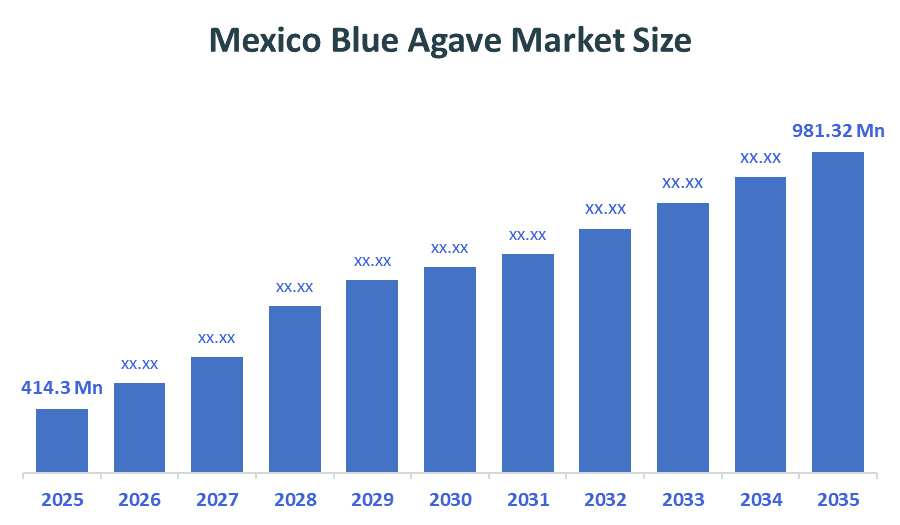
According to Decision Advisors, the Mexico Blue Agave Market Size is expected to grow from USD 414.3 million in 2024 to USD 981.32 million by 2035, at a CAGR of 9.01% during the forecast period 2025-2035. The Mexican blue agave market experiences growth because of the more people wants high-quality tequila and they choose natural sweeteners that have low glycemic index. The food industry and consumers have started to adopt clean-label products which use plant-based ingredients that come from sustainable sources because they want organic agave as their preferred ingredient for both food and beverage production.
Market Overview/Introduction
The blue agave market in Mexico serves as the main foundation for premium tequila production because its generates the high-value export revenues that support rural development and international trade. The company has expanded its product range by introducing agave syrup which serves as a low-glycemic sweetener and enables it to reach customers in international markets. The plant has become a vital component of functional foods and nutraceuticals and cosmetics which demonstrates the growing value of this product throughout its entire distribution process. The market faces three major structural challenges which will determine its ability to maintain stability over time. The Mexico’s blue agave market experiences innovation through the use of functional ingredients which include inulin and the introduction of non-alcoholic agave spirits and the increasing demand for organic-certified products. The company will discover new possibilities through developing health-focused food products and expanding into international markets and creating high-value premium products. The implementation of AI-based product development and blockchain-based tracking systems together with sustainable farming practices and environmentally friendly packaging solutions will improve operational efficiency and transparency while establishing competitive advantages throughout the entire agave supply chain.
- In Mexico, as of March 2025, blue agave underpins a diversified agro-industrial ecosystem spanning tequila, mezcal, fibers, bioenergy, and sweeteners; with over 300 million plants recorded by Tequila Regulatory Council, it remains economically and culturally strategic.
- In Mexico, as of January 2024, blue agave pricing dynamics reflect macroeconomic sensitivity, with second-order models highlighting inflation and MXN/USD exchange rate as key drivers, according to Tequila Regulatory Council, reinforcing volatility in the agave market.
Notable Insights: -
- By type, the premium segment held a dominant position with 59.8% in terms of market share in 2025.
- By application, beverages segment is the dominating accounting for over 72.55% of the Mexico blue agave market share in 2025.
- The compound annual growth rate of the Mexico Blue Agave Market is 9.01%.
- The market is likely to achieve a valuation of USD 981.32 million by 2035.
What is role of technology in grooming the market?
Technology is creating a transformative effect which helps the Mexico blue agave industry to develop into a structured data-based agricultural business system by converting its existing disorganized and traditional operations into a unified system. The combination of precision agriculture systems with satellite mapping technology and Internet of Things soil monitoring devices enables researchers to improve crop production and control environmental climate threats. The digital marketplaces enable better price discovery for products while they decrease the need for intermediaries, which allows smallholders to access markets directly. The application of artificial intelligence for demand forecasting helps businesses match their production output to worldwide consumption patterns, which results in decreased market fluctuations and increased institutional funding for the agave industry.
Market Drivers
The Mexico blue agave market experiences growth because of its combination of demand patterns and improvements in supply operations. The global demand for high-quality tequila continues to drive agave exports which establishes agave as a valuable agricultural product. The current consumer trend that favors natural sweeteners with low glycemic index has developed new uses for agave which now extends beyond its traditional use in alcoholic drinks. The geographical indication protection and cultivation zoning receive government backing which helps maintain product authenticity while creating stable supply networks. The beverage companies increase their financial investments which results in better operational efficiency through vertical business expansion and business partnerships that create new job opportunities in rural areas which helps develop the economic strength of local communities. The agave value chain benefits from better mechanized harvesting and processing technologies which result in more stable product yields and reduced operational costs and increased production capacity.
Restrain
The Mexico blue agave market experiences supply limitations because of the agave plant requires a lengthy maturation period which makes it difficult for producers to respond to market demands and results in unstable price movements. The combination of unpredictable weather patterns and the rising outbreak of agricultural diseases creates higher production risks for farmers. The use of intensive monoculture methods is causing soil degradation and biodiversity loss which leads to sustainability problems and increases regulatory oversight. The processing waste which creates environmental externalities forces companies to spend money on compliance requirements that reduce their profit margins and drive them towards sustainable farming practices which will help them build resilient operations.
Strategies to Implement for Growth of the Market
The sustainable development of the Mexico blue agave market depends on matching agricultural productivity with changes in global market requirements. The stakeholders should use predictive analytics to establish permanent planting cycles which will help them manage supply variations. The company should expand its product range to include bio-based sweeteners nutraceuticals and specialty spirits which will help reduce its dependence on tequila exports. The organization will achieve better infrastructure operations by combining its backward integration strategy with the development of public-private partnerships. The adoption of climate-resilient farming practices together with circular waste management solutions will help the company meet environmental standards while achieving its ESG targets.
Market Segmentation
The Mexico Blue Agave Market share is classified into product type, application, and distribution channel
- The premium segment dominated the market in 2024, and is projected to grow at a substantial CAGR of approximately 7.3% during the forecast period.
Based on the product type, the Mexico blue agave market is divided into premium, standard. Among these, the premium segment dominated the market in 2024, and is projected to grow at a substantial CAGR of approximately 7.3% during the forecast period. It is because of its prices of products become unaffordable for consumers who are sensitive to price changes. The high dependence on premium segments increases vulnerability to economic slowdowns. The growing demand for 100% agave products leads to increased raw material costs which result in supply difficulties and variable profit margins that prevent balanced market growth across all business segments.
- The beverages segment accounted for the largest share in 2024, and is anticipated to grow at a significant CAGR of approximately 6.7% during the forecast period.
Based on the application, the Mexico blue agave market is divided into beverages, sweeteners, pharmaceuticals, cosmetics. Among these, the beverages segment accounted for the largest share in 2024, and is anticipated to grow at a significant CAGR of approximately 6.7% during the forecast period. It is dominating because the price control system used by denomination of origin regulations provides stabilized demand for products. The premium spirit export market controls revenue generation because it delivers better financial results than other uses while it maintains agave's status as a valuable industrial material in worldwide beverage production.
- The supermarket and hypermarkets segment dominated the market in 2024, and is projected to grow at a substantial CAGR during the forecast period.
Based on the distribution channel, the Mexico blue agave market is divided into supermarket and hypermarkets, speciality retail, online. Among these, the supermarket and hypermarkets segment dominated the market in 2024, and is projected to grow at a substantial CAGR during the forecast period. The diversified pricing strategies, enabling wider consumer access across income segments. Integrated supply chains and promotional intensity are driving off-trade consumption growth, as at-home drinking trends reshape demand patterns, supporting volume stability and strengthening market resilience beyond traditional on-premise channels.
Competitive Analysis
The report offers the appropriate analysis of the key organisations/companies involved within the Mexico blue agave market, along with a comparative evaluation primarily based on their product offering, business overviews, geographic presence, enterprise strategies, segment market share, and SWOT analysis. The report also provides an elaborative analysis focusing on the current news and developments of the companies, which includes product development, innovations, joint ventures, partnerships, mergers & acquisitions, strategic alliances, and others. This allows for the evaluation of the overall competition within the market.
Top Key Companies in Mexico blue agave market
- Jose Cuervo
- Casa Herradura
- Patrón Spirits
- Don Julio
- Casa Sauza
- Dialce
- Grupo Solave
- Casa Don Ramón
- Others
Key Target Audience
- Market Players
- Investors
- End-users
- Government Authorities
- Consulting and Research Firm
- Venture capitalists
- Value-Added Resellers (VARs)
Market Segment
This study forecasts revenue at the Mexico, regional, and country levels from 2026 to 2035. Decision Advisors has segmented the Mexico blue agave market based on the below-mentioned segments
Mexico blue agave market, By Type
- Premium
- Standard
Mexico blue agave market, By Application
- Beverages
- Sweeteners
- Pharmaceuticals
- Cosmetics
Mexico blue agave market, By Distribution channel
- Supermarket and Hypermarkets
- Speciality Retail
- Online
Frequently Asked Questions (FAQ)
Q. Why is blue agave considered a high-value agricultural commodity?
A. The economic worth of blue agave arises from its exclusive application in tequila production which follows denomination of origin regulations. The plant's extended growth period together with its restricted ability to grow in specific areas creates limitations on its availability which allows farmers to charge higher prices for this crop that serves as an essential cash crop in Mexico's agricultural export industry.
Q. How does the supply cycle impact market stability?
A. The 6–10 year maturation cycle of blue agave introduces structural supply rigidity which prevents the system from responding to changes in market demand. This leads to cyclical price volatility which creates periodic shortages or surpluses and makes inventory planning difficult, which results in profit losses for both upstream cultivators and downstream beverage producers.
Q. What role does premiumization play in market growth?
A. The premiumization increases revenue generation because customers develop a preference for high-quality 100% agave tequila products. The trend improves profitability while increasing export value, yet it restricts market development to high-income buyers, which leads to reduced market expansion and greater vulnerability to economic changes in consumer spending.
Q. What is the significance of export markets for blue agave?
A. The Tequila serves as the main product for international markets while exports function as the main source of revenue for the business. The market benefits from North American and European demand because it increases foreign exchange earnings yet creates risks through trade policies and currency shifts and changes in global consumption patterns.
Check Licence
Choose the plan that fits you best: Single User, Multi-User, or Enterprise solutions tailored for your needs.
We Have You Covered
- 24/7 Analyst Support
- Clients Across the Globe
- Tailored Insights
- Technology Tracking
- Competitive Intelligence
- Custom Research
- Syndicated Market Studies
- Market Overview
- Market Segmentation
- Growth Drivers
- Market Opportunities
- Regulatory Insights
- Innovation & Sustainability
Report Details
| Scope | Country |
| Pages | 195 |
| Delivery | PDF & Excel via Email |
| Language | English |
| Release | Apr 2026 |
| Access | Download from this page |