
Global Micro Hospital Market
 |
Pages:
240
|
Pages:
240
Global Micro Hospital Market Size, Share, By Facilities (Physical Therapy, Primary Care, Rotating Specialists, Surgery Centres, On Site X-Ray, Ultrasound), By Location (Tier-1 Cities, Tier-2 Cities, Tier-3 Cities), By End-User (International Tourists, Corporates, Individuals), and By Region (North America, Europe, Asia-Pacific, Latin America, Middle East & Africa), Analysis and Forecast 2025?2035
REPORT COVERAGE
Global
Market Snapshot
- Market Size (2025): USD 321.9 Billion
- Projected Market Size (2035): USD 694.9 Billion
- Compound Annual Growth Rate (CAGR): 8.31%
- Largest Regional Market: North America
- Fastest Growing Region: Asia-Pacific
- 3rd Largest Region: Europe
- Base Year: 2025
- Historical Period: 2021–2024
- Forecast Period: 2026–2035
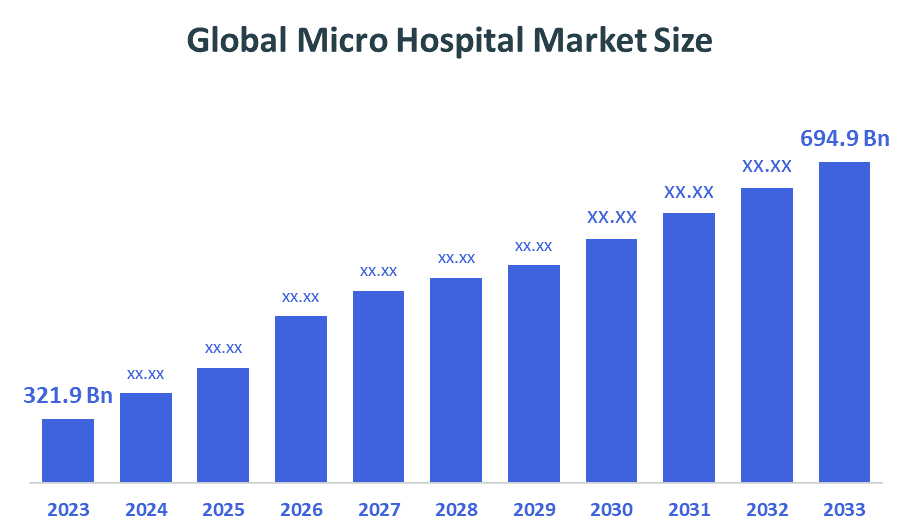
According to Decision Advisors, the Global Micro Hospital Market Size is expected to grow from USD 321.9 billion in 2024 to USD 694.9 billion by 2035, at a CAGR of 8.31% during the forecast period 2025-2035. The global micro hospital market is projected to grow significantly over the next decade due to rising demand for accessible healthcare, cost-effective healthcare delivery, increasing chronic diseases, technological advancements, growing urbanization & population expansion, reduced patient waiting time, shift toward outpatient & ambulatory care, and government & private investments.
Market Overview/ Introduction
The micro hospital market refers to all small healthcare facilities that operate between 10 and 50 beds to deliver emergency services, primary care, and restricted inpatient treatment and diagnostic services to local communities. These hospitals function as intermediate medical facilities between outpatient clinics and major tertiary hospitals by delivering medical services that are both affordable and easy to access. The market is experiencing rapid growth because of two main factors, namely the increasing prevalence of chronic diseases and the rising need for decentralized healthcare, and the existing issues of traditional hospital capacity. The implementation of supportive government policies and the financial backing that the Centers for Medicare & Medicaid Services provide, and companies such as Adani Group make, are driving the process of adoption forward. The healthcare system is expanding because of three factors, which include telemedicine progress and digital health technology development, and the increasing demand for healthcare services from rural areas and underserved populations. The micro-hospital model provides a healthcare solution that achieves three objectives by delivering quicker medical treatments and reducing operational expenses. The micro-hospital model provides a medical treatment approach that healthcare systems can implement as an economically viable and environmentally friendly method.
- Under the SPI scheme, India allocates 500 crores to support pharma MSMEs through PTUAS and APICF, targeting approx. 400 units and multiple clusters. This strengthens affordable drug supply chains, indirectly enabling the growth of the global micro hospital market through cost-efficient healthcare inputs.
- Micro-hospitals operate with 30–60% lower infrastructure costs than traditional hospitals, enabling rapid deployment and scalability. This cost advantage supports expansion in underserved regions, making micro-hospitals a key growth driver in the global micro hospital market and improving access to affordable healthcare services.
- The UK government, through Innovate UK, supports health innovators via grants and loans up to £1 million, fostering new care delivery models. This promotes technology-driven healthcare solutions, indirectly supporting the global micro hospital market by enabling scalable and efficient healthcare innovations.
Notable Insights: -
- North America holds the largest regional market share in the global micro hospital market.
- Asia-Pacific is the fastest-growing region in the global micro hospital market.
- The primary care services segment dominated the market in 2025 and is projected to grow at a substantial CAGR during the forecast period.
- The tier-1 cities offices segment accounted for the largest share in 2025, and is anticipated to grow at a significant CAGR of during the forecast period.
- The individuals segment dominated the market in 2025 and is projected to grow at a substantial CAGR during the forecast period.
- The compound annual growth rate of the Global Micro Hospital Market is 8.31%.
- The market is likely to achieve a valuation of USD 694.9 billion by 2035.
What is role of technology in grooming the market?
Technology plays a vital role in grooming the micro hospital market by enabling efficient, high-quality care in smaller facilities. Telemedicine allows remote consultations and specialist access, reducing the need for large hospital infrastructure. Electronic health records improve data management and continuity of care. Advanced diagnostic tools and AI-driven systems support quick and accurate decision-making. Automation streamlines administrative tasks, enhancing operational efficiency. Remote patient monitoring and wearable devices help manage chronic conditions effectively. Additionally, digital platforms improve appointment scheduling and patient engagement. Overall, technology enhances accessibility, reduces costs, and enables micro hospitals to deliver comprehensive and patient-centric healthcare services.
Market Drivers
The global micro hospital market is propelled by the fact that, compared to typical hospitals, micro hospitals have reduced building and operating costs, which makes them more affordable for both patients and clinicians while guaranteeing effective use of scarce healthcare resources and enhancing accessibility to healthcare overall. Micro hospitals are more accessible and sustainable in the delivery of healthcare because they are less expensive to build and run than standard hospitals, offer patients and providers affordable care, and make effective use of the limited resources available. As the prevalence of diabetes, heart disease, and hypertension rises, patients require more frequent visits and ongoing monitoring, and micro hospitals provide patients with easy, accessible care near their homes. Micro hospitals can provide high-quality care without the need for extensive infrastructure by integrating telemedicine, digital tools, and modern diagnostics in smaller facilities.
Restrain
The micro hospital market faces restraints due to high initial investment in medical equipment and technology, limited capacity to handle complex or critical cases, and dependence on referrals to larger hospitals. Regulatory challenges, staffing shortages, and reimbursement uncertainties also hinder growth. Additionally, lack of awareness in rural areas may restrict adoption and utilization of micro hospital services.
Competitive Analysis:
The report offers the appropriate analysis of the key organizations/companies involved within the Global Micro Hospital Market, along with a comparative evaluation primarily based on their product of offering, business overviews, geographic presence, enterprise strategies, segment market share, and SWOT analysis. The report also provides an elaborative analysis focusing on the current news and developments of the companies, which includes product development, innovations, joint ventures, partnerships, mergers & acquisitions, strategic alliances, and others. This allows for the evaluation of the overall competition within the market.
Top Companies in Global Micro Hospital Market
- Emerus Holdings Inc.
- SCL Health
- Baylor Scott & White Health
- Ascension Health
- Mercy Health
- Dignity Health
- Saint Luke’s Health System
- Tenet Healthcare Corporation
- HCA Healthcare
- Universal Health Services
- Community Health Systems
- LifePoint Health
Government Initiatives
|
Country |
Key Government Initiatives |
|
UK |
The Centers for Medicare & Medicaid Services finalized a reimbursement pathway for Rural Emergency Hospitals, alongside a $50 billion fund to convert struggling rural hospitals into micro-hospitals, boosting financial viability, modernization, and growth prospects for the micro-hospital market. |
|
US |
The National Health Service expanded its CDC program into a micro-hospital model, allocating £2.3 billion to build 40 surgical hubs, decentralizing diagnostics and minor surgeries, reducing hospital burden, and supporting growth of the micro-hospital market. |
|
China |
China’s 15th Five-Year Plan promotes decentralized, research-oriented healthcare units to optimize spending and support aging populations, indirectly boosting micro-hospital models by encouraging smaller, efficient facilities and creating positive long-term growth opportunities in the micro-hospital market. |
Market Segmentation
The micro hospital market share is classified into facilities, location, and end-user
- The primary care services segment dominated the market in 2025 and is projected to grow at a substantial CAGR during the forecast period.
Based on the service type, the Micro Hospital Market is divided into primary care services, diagnostic services, minor surgical procedures, and rehabilitation services. Among these, the primary care services segment dominated the market in 2025 and is projected to grow at a substantial CAGR during the forecast period. Primary care services act as the first point of contact for most patients, managing common illnesses and routine health concerns. They involve repeat visits for chronic disease management and follow-ups, experience higher patient volumes, and are accessible and affordable, promoting frequent and continued use.
The tier-1 cities offices segment accounted for the largest share in 2025, and is anticipated to grow at a significant CAGR of during the forecast period.
Based on the location, the micro hospital market is divided into tier-1 cities, tier-2 cities, and tier-3 cities. Among these, the tier-1 cities segment accounted for the largest share in 2025, and it's anticipated to grow at a significant CAGR during the forecast period. Due to high population density, better awareness, and overcrowded tertiary hospitals, driving demand for accessible micro-hospitals. Individuals form the largest end-user segment as they rely on these facilities for routine care, chronic disease management, and quick, convenient healthcare services across urban settings.

- The individuals segment dominated the market in 2025 and is projected to grow at a substantial CAGR during the forecast period.
Based on the end user, the micro hospital market is divided into international tourists, corporates, and individuals. Among these, the individual segment dominated the market in 2025 and is projected to grow at a substantial CAGR during the forecast period. Individuals dominate the end-user segment because micro-hospitals primarily cater to everyday healthcare needs such as routine check-ups, chronic disease management, and emergency care. Their accessibility and community-based approach attract a high volume of walk-in patients, ensuring consistent utilization compared to corporates and international tourists.
Strategies to Implement for Growth of the Market in Non-Leading Regions
To drive growth of the micro-hospital market in non-leading regions, providers should focus on decentralized, cost-efficient facilities offering essential and specialist services. Leveraging public schemes like Ayushman Bharat can improve affordability and patient access. Integrating telemedicine platforms such as eSanjeevani helps address doctor shortages and expand reach. Adopting a hub-and-spoke model with larger hospitals ensures continuity of care and referrals. Partnerships with local governments and communities build trust and awareness. Additionally, flexible pricing models, preventive care programs, and focusing on high-demand services like chronic disease management and emergency care can enhance utilization and ensure sustainable expansion in underserved markets.
Regional Segment Analysis of the Micro Hospital Market
- North America (U.S., Canada, Mexico)
- Europe (Germany, France, U.K., Italy, Spain, Rest of Europe)
- Asia-Pacific (China, Japan, India, Rest of APAC)
- South America (Brazil and the Rest of South America)
- The Middle East and Africa (UAE, South Africa, Rest of MEA)
North America is anticipated to hold the largest share of the micro hospital market over the predicted timeframe.
North America is anticipated to hold the largest share of the micro hospital market over the predicted timeframe. The dominance of this region is primarily driven by the early adoption of decentralized healthcare models, strong presence of leading providers like HCA Healthcare and Tenet Healthcare, and supportive policies from the Centers for Medicare & Medicaid Services. High healthcare spending, advanced infrastructure, and increasing demand for cost-effective, accessible care further drive growth. Additionally, rising chronic disease prevalence and a focus on reducing hospital overcrowding contribute to sustained market expansion across the region.
Asia Pacific is expected to grow at a rapid CAGR in the micro hospital market during the forecast period.
Asia Pacific is expected to grow at a rapid CAGR in the micro hospital market during the forecast period. This growth is driven by increasing healthcare demand driven by increasing healthcare demand, rising population, and growing prevalence of chronic diseases. Expanding healthcare infrastructure, government initiatives, and investments by players like Adani Group further support growth. Additionally, improving access in Tier-2 and Tier-3 cities and a shift toward decentralized, cost-effective care models are accelerating market expansion across the region.
Europe is the 3rd largest region to grow in the micro hospital market during the region. Europe ranks as the third-largest region in the micro hospital market due to its well-established healthcare systems and gradual shift toward decentralized care. Initiatives by the National Health Service and similar European bodies promote community-based diagnostic and surgical hubs. Aging populations, rising chronic diseases, and pressure to reduce hospital congestion further drive demand. However, slower adoption compared to North America and Asia Pacific, along with regulatory complexities, keeps growth relatively moderate.
Future Market Trends in Global Micro Hospital Market: -
1. Shift Toward Decentralized & Community-Based Healthcare
The shift toward decentralized and community-based healthcare, including micro hospitals, is driven by the need for accessible, cost-effective, and convenient care. These smaller, localized facilities reduce patient travel, manage minor procedures, and provide preventive services, while easing pressure on large hospitals and improving healthcare reach in urban and semi-urban areas.
2. Integration of Digital Health & Telemedicine
The integration of digital health and telemedicine is driven by the demand for convenient, accessible, and efficient outpatient care. It enables remote consultations, continuous patient monitoring, and timely follow-ups, reducing travel and costs. Growing technology adoption, internet penetration, and patient acceptance further accelerate the shift toward virtual healthcare delivery.
3. Expansion of Hybrid Care Models
The expansion of hybrid care models is driven by the need to combine in-person and virtual healthcare services for greater flexibility and efficiency. Patients benefit from convenient teleconsultations alongside necessary on-site treatments, improving access, reducing wait times, and enhancing continuity of care, while providers optimize resource utilization and patient engagement.
Recent Development
In March 2026, Pacific OneHealth, backed by Pacific Malls Group, announced a 300?crore investment to build North India’s largest community micro-hospital chain, starting with five Delhi NCR facilities and expanding to over 20 nationwide, enhancing decentralized outpatient and short-stay care.
In March 2026, Adani Group announced a 60,000 crore plan to build 30 hospitals, with many community-centric hubs. This decentralized approach supports micro-hospital models, signaling strong investment, improved regional access, and positive growth momentum for the micro-hospital market in India.
In January 2026, The Centers for Medicare & Medicaid Services has begun deploying a 50 billion rural healthcare fund, with states like Texas and North Carolina investing in micro-hospitals, signaling strong growth, adoption, and positive momentum for the micro-hospital market.
In December 2025, India’s health experts have proposed micro-hospitals to bridge the gap between clinics and large hospitals, aiming to combat rising chronic diseases. By bringing specialist care closer to communities, this model reduces overcrowding and signals strong growth potential for the micro-hospital market
How is Recent Developments Helping the Market?
Recent developments across India and the US are significantly boosting the micro-hospital market by validating decentralized healthcare models. In India, expert recommendations and investments by Adani Group highlight the need for community-based, mid-sized facilities to address infrastructure gaps and rising chronic diseases. Globally, funding initiatives led by Centers for Medicare & Medicaid Services support micro-hospitals as cost-effective replacements for large, inefficient rural hospitals. These trends drive strong capital inflows, policy backing, and scalable opportunities. As healthcare systems shift toward localized, accessible care, micro-hospitals are emerging as a sustainable solution, improving patient outcomes while reducing burden on traditional hospitals.
Market Segment
This study forecasts revenue at global, regional, and country levels from 2020 to 2035. Decision Advisors has segmented the micro hospital market based on the below-mentioned segments:
Global Micro Hospital Market, By Facilities
- Physical Therapy
- Primary Care
- Rotating Specialists
- Surgery Centres
- On Site X-Ray
- Ultrasound
Global Micro Hospital Market, By Location
- Tier-1 Cities
- Tier-2 Cities
- Tier-3 Cities
Global Micro Hospital Market, By End-User
- International Tourists
- Corporates
- Individuals
Global Micro Hospital Market, By Regional Analysis
- North America
- US
- Canada
- Mexico
- Europe
- Germany
- UK
- France
- Italy
- Spain
- Russia
- Rest of Europe
- Asia Pacific
- China
- Japan
- India
- South Korea
- Australia
- Rest of Asia Pacific
- South America
- Brazil
- Argentina
- Rest of South America
- Middle East & Africa
- UAE
- Saudi Arabia
- Qatar
- South Africa
- Rest of the Middle East & Africa
Frequently Asked Questions (FAQ)
Q How do micro-hospitals improve patient experience compared to traditional hospitals?
A. Micro-hospitals enhance patient experience by offering shorter wait times, faster diagnostics, and personalized care in smaller settings. Their proximity to residential areas reduces travel time, while streamlined operations ensure quicker admissions, treatments, and discharges, improving overall patient satisfaction and convenience.
Q. What role do partnerships play in the expansion of micro-hospitals?
A. Partnerships between healthcare providers, real estate developers, and technology firms accelerate micro-hospital expansion. Collaborations enable shared infrastructure, reduced capital costs, and faster deployment. Joint ventures also help integrate advanced technologies and improve service offerings, making micro-hospitals more scalable and financially viable.
Q. How are micro-hospitals contributing to rural healthcare development?
A. Micro-hospitals are improving rural healthcare by providing essential medical services closer to underserved populations. They reduce dependency on distant tertiary hospitals, offer emergency and diagnostic care locally, and support early disease detection, thereby improving health outcomes and reducing mortality rates in rural regions.
Q. What challenges do micro-hospitals face in scaling globally?
A. Key challenges include high initial setup costs, regulatory differences across countries, and shortages of skilled healthcare professionals. Additionally, limited capacity to handle complex cases and reliance on referrals to larger hospitals can restrict scalability and operational efficiency in certain markets.
Check Licence
Choose the plan that fits you best: Single User, Multi-User, or Enterprise solutions tailored for your needs.
We Have You Covered
- 24/7 Analyst Support
- Clients Across the Globe
- Tailored Insights
- Technology Tracking
- Competitive Intelligence
- Custom Research
- Syndicated Market Studies
- Market Overview
- Market Segmentation
- Growth Drivers
- Market Opportunities
- Regulatory Insights
- Innovation & Sustainability
Report Details
| Scope | Global |
| Pages | 240 |
| Delivery | PDF & Excel via Email |
| Language | English |
| Release | Mar 2026 |
| Access | Download from this page |