
Global Microwave Oven Market
 |
Author:
Achal E
|
Pages:
190
|
Author:
Achal E
|
Pages:
190
Global Microwave Oven Market Size, Share, By Product (Solo Microwave Ovens, Grill Microwave Ovens, Convection Microwave Ovens), By Structure (Countertop Microwaves, Built-in Microwaves, Over-the-Range Microwaves), By Application (Residential, Commercial), and By Region (North America, Europe, Asia-Pacific, Latin America, Middle East, and Africa), Analysis and Forecast 2026-2035.
CAGR
3.45%
REVENUE 2025
USD Billion 11.98
FORECAST 2035
USD Billion 16.82
REPORT COVERAGE
Global
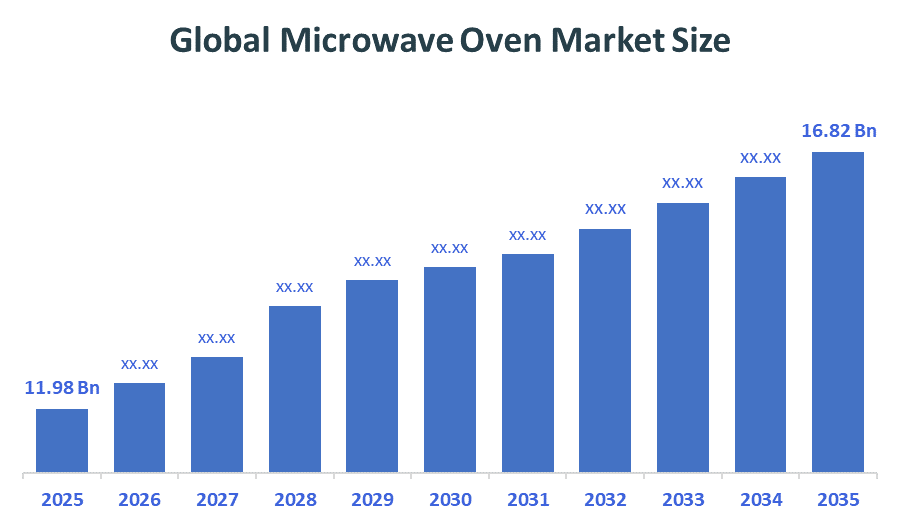
The Global Microwave Oven Market Size is Predicted to grow from USD 11.98 billion in 2025 and is expected to reach around USD 16.82 billion by 2035. According to Decision Advisors, a detailed research report on microwave oven market signifies that the convenience trend dominates the global microwave oven market, accounting for nearly 63-69% across international markets. Midea Group holds a leading position with nearly USD 53-55 Billion in annual revenue and a 14-21% global market share, defining the growth path and strategic direction of the global microwave oven market.
Market Snapshot
- Global Microwave Oven Market Size (2025): USD 11.98 billion
- Projected Global Microwave Oven Market Size (2035): USD 16.82 billion
- Global Microwave Oven Market Compound Annual Growth Rate (CAGR): 3.45%
- Largest Regional Market: Asia-Pacific
- Fastest Growing Region: North America
- 3rd Largest Region: Europe
- Base Year: 2025
- Historical Period: 2021-2024
- Forecast Period: 2026-2035
Market Overview/ Introduction
The microwave oven functions as a sophisticated cooking device which generates the electromagnetic waves through its magnetron system to provide users with quick heating and cooking and defrosting capabilities that save time during contemporary cooking processes. The system operates through cooking methods such as convection models, grill systems that produce better cooking results, and budget-friendly single-function devices. The residential market drives industrial operations because of the changing consumer habits need residential products while restaurants and hospitality businesses use the system to deliver fast food service with reliable results and effective operations at large scale dining facilities.
The microwave oven market is experiencing rapid innovation through the adoption of smart connectivity, inverter technology, and multifunctional designs which combine baking and grilling and air frying functions. The future opportunities such as AI-driven kitchen ecosystems which operate through energy-efficient appliances and quick commercial ovens that serve cloud kitchens and foodservice expansion. The manufacturers are developing intelligent automation and compact designs and eco-friendly solutions for microwaves which they aim to establish as essential elements of future smart kitchens.
- India’s Budget 2026-27 BCD exemption on microwave components is set to attract fresh investments, reduce import reliance, and integrate India into the USD 12-billion global microwave ovens market, strengthening its position as a competitive electronics manufacturing hub.
- China’s trade-in scheme, launched in March 2024, generated 240 billion yuan in appliance sales, boosting investments and scaling production, thereby reinforcing its dominance and cost competitiveness in the global microwave ovens market through strengthened supply chains and exports.
Notable Insights: -
- Asia-Pacific holds the largest regional market share, approximately 42.3% in the global microwave oven market.
- North America is the fastest growing region in the microwave oven market is supported by the rising demand for smart appliances together with their replacement cycles and the introduction of premium products, which enhances the company's market position according to current consumer spending patterns and ongoing technological progress.
- By product, the convection microwave ovens segment held a dominant position with 43.2% in terms of market share in 2025.
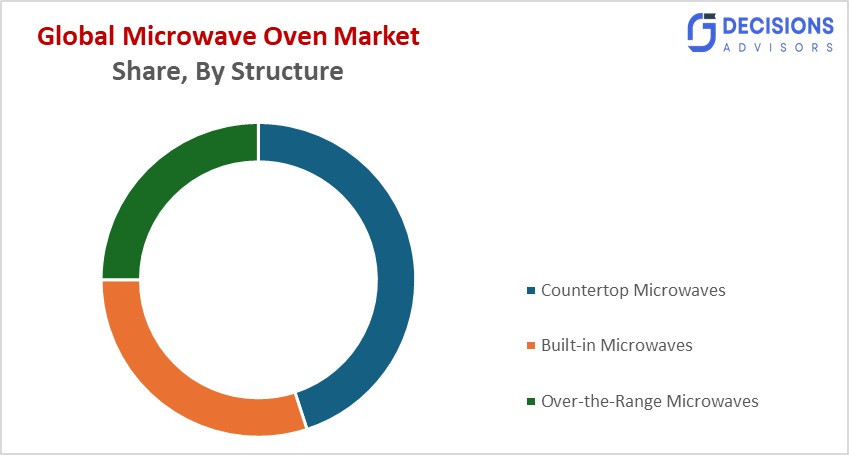
- By structure, countertop microwaves segment is the dominating accounting for over 57.1% of the global market share in 2025.
- The compound annual growth rate of the global microwave oven market is 3.45%.
- The market is likely to achieve a valuation of USD 16.82 billion by 2035.
What is role of technology in grooming the market?
The global microwave ovens market is changing because of the people prefer to buy smart microwaves which use less energy and have multiple functions. The combination of IoT technology and sensor-based cooking systems and AI-powered cooking presets provides users with better convenience while achieving better energy efficiency. The use of advanced inverter technology provides consistent heating which results in better food quality and more efficient operations. The companies are developing smart connectivity features which allow users to control their devices remotely through smartphone applications and voice-activated assistants. The combination of new compact design technologies and better material efficiency helps manufacturers reduce production expenses while creating high-end products.
How is Recent Developments Helping the Market?
The recent developments of the global microwave ovens market have gained strong momentum through their combination of policy support and consumer incentives and manufacturing expansion. The demand for products is increasing because of the government initiatives have implemented both tariff rationalization and trade-in schemes which also promote local production. The China’s microwave ovens market reflects global trends, with countertop units dominating volumes, while rising investments in premium built-in and convection models, driven by kitchen upgrades, are accelerating value growth and enhancing competitiveness across the global appliance landscape. The leading appliance manufacturers are making strategic investments in both smart technologies and energy-efficient solutions to increase their product value and profit margins. E-commerce and omnichannel retail expansion create better market access which leads to faster sales processes. The manufacturing of components through localized supply chains enables companies to reduce their need for imports while maintaining stable operating costs. The present developments create better industry protection which increases product consumption while enabling the market to achieve continuous investment-based growth throughout the global market.
Market Drivers
The global microwave oven market is influenced by evolving lifestyle patterns which lead urban consumers with time limitations and dual-income households to choose cooking solutions that provide maximum convenience. The growing reliance on ready-to-eat and packaged food further reinforces demand for efficient reheating appliances. The rapid urbanisation together with the trend towards compact living spaces now drives people to adopt space-saving microwave designs which include built-in microwave systems. The product performance and energy-saving capabilities of the system improve through technological progress which includes IoT device connections and sensor automation and inverter technology. These elements represent a transition toward modern kitchen systems which deliver time-saving benefits and smart features, while microwave ovens have become essential to modern homes and bring market growth in developed and emerging regions.
Restrain
The global market for microwave ovens experiences limitations which result from how people view product costs and their evolving buying patterns. The adoption rate of the product remains affected by electricity usage issues which particularly impact areas that charge high electricity rates. The demand for products currently available in the market faces disruption because of the consumers now prefer alternative cooking devices which include air fryers and induction cooktops. The ongoing health and safety misconceptions together with existing health and safety misunderstandings create barriers which prevent customers from trusting products.
Competitive Analysis:
The report offers the appropriate analysis of the key organizations/companies involved within the global microwave oven market, along with a comparative evaluation primarily based on their product of offering, business overviews, geographic presence, enterprise strategies, segment market share, and SWOT analysis. The report also provides an elaborative analysis focusing on the current news and developments of the companies, which includes product development, innovations, joint ventures, partnerships, mergers & acquisitions, strategic alliances, and others. This allows for the evaluation of the overall competition within the market.
Top Companies in Global Microwave Oven Market
- Samsung Electronics
- LG Electronics
- Whirlpool Corporation
- Panasonic Corporation
- Midea Group
- Sharp Corporation
- Electrolux AB
- Bosch Home Appliances
- Haier Group
- Toshiba Corporation
Government Initiatives
|
Country |
Key Government Initiatives |
|
US |
U.S. regulations under the Energy Conservation Program (10 CFR Part 430) are driving investments in energy-efficient microwave technologies, accelerating innovation and compliance, and shaping competitive dynamics within the global microwave ovens market through stricter efficiency standards and product upgrades. |
|
Japan |
Japan’s Energy Conservation Law, implemented via the Top Runner Program, is driving investments exceeding USD 500 million in high-efficiency microwave technologies, fostering innovation, reducing energy consumption, and strengthening competitiveness in the global microwave ovens market. |
|
|
Market Segmentation
The Microwave Oven Market share is classified into product, application, and component
- The convection microwave ovens segment dominated the market in 2024 and is projected to grow at a substantial CAGR of approximately 5.1% during the forecast period.
Based on the product, the microwave oven market is divided into solo microwave ovens, grill microwave ovens, convection microwave ovens. Among these, the convection microwave ovens segment dominated the market in 2024 and is projected to grow at a substantial CAGR of approximately 5.1% during the forecast period. It is because of the demand for multifunctional appliances together with premiumization trends and consumer preference for efficient, yet versatile cooking solutions continues to grow in developed and emerging markets.
- The countertop microwaves segment accounted for the largest share in 2024 and is anticipated to grow at a significant CAGR of approximately 4.9% during the forecast period.
Based on the structure, the microwave oven market is divided into countertop microwaves, built-in microwaves, over-the-range microwaves. Among these, the countertop microwaves segment accounted for the largest share in 2024 and is anticipated to grow at a significant CAGR of approximately 4.9% during the forecast period. It is dominating because of two factors which include affordable products and straightforward installation processes and the widespread use of products among consumers in developing markets.
- The Residential segment dominated the market in 2024, and is projected to grow at a substantial CAGR during the forecast period.
Based on the application, the microwave oven market is divided into residential, commercial. Among these, the residential segment dominated the market in 2024, and is projected to grow at a substantial CAGR during the forecast period. It is because of consumers continue to spend more on products. The demand for easy cooking solutions increases because more households adopt modern cooking technologies and urban areas expand.
Strategies to Implement for Growth of the Market in Non-Leading Regions
The global microwave ovens market requires specific affordable solutions which must be combined with localized products and distribution improvements to support development in non-primary market areas. The product development should focus on cost-effective designs which meet the needs of budget-conscious buyers whereas manufacturers should establish local production facilities to decrease their reliance on imported goods and associated tariffs. The regional retailers and e-commerce platforms should establish strategic partnerships which will enable them to reach more customers. The first-time users will adopt products after marketing campaigns show them both convenience and energy-saving benefits. The consumer confidence depends on two essential elements which include financing options and after-sales service networks. The company’s plans to enhance market strength through targeted supply chain investments. The company can achieve sustainable growth through its supply chain development efforts in markets that have not yet achieved full market penetration.
Regional Segment Analysis of the Global Microwave Oven Market
- North America (U.S., Canada, Mexico)
- Europe (Germany, France, U.K., Italy, Spain, Rest of Europe)
- Asia-Pacific (China, Japan, India, Rest of APAC)
- South America (Brazil and the Rest of South America)
- The Middle East and Africa (UAE, South Africa, Rest of MEA)
Asia-Pacific is anticipated to hold the largest share of the microwave oven market over the predicted timeframe. The Asia-Pacific is anticipated to hold the largest share of the microwave oven market, accounting for approximately 42.4% of total revenue over the forecast period. It is because of the industrial supremacy through vital manufacturing capabilities which enable costs to remain competitive while consumer demand from China and India continues to increase. The rise of urban areas together with higher income levels and government backing of initiatives is driving growth in appliance market penetration. The region's export-oriented supply chain system enables Asia-Pacific to operate as both a manufacturing centre and a rapidly expanding market.
North America is expected to grow at a rapid CAGR in the microwave oven market during the forecast period. The North America market will experience fast growth because it accounts for approximately 5.6% of it is due to the United States hardware market experiences growth because of strong replacement demand, increasing demand for smart kitchen appliances, and continuous investment in high-end energy-saving products.
Europe is the 3rd largest region to grow in the microwave oven market during the region. The Europe region stands as the third biggest area global for the microwave oven market since it holds approximately 27.1% the combination of steady demand and rapid urbanization and increasing demand for premium appliances, which developed European economies, will experience permanent growth during the upcoming future.
Future Market Trends in Microwave Oven Market: -
- Smart Kitchen Integration Gains Traction
The global microwave oven market is experiencing a transition toward smart connected appliances. The combination of IoT systems with voice recognition technologies has created new user convenience solutions. The manufacturers are now using AI cooking presets to transform microwaves into intelligent kitchen devices that modern homes can use.
- Energy Efficiency Becomes a Core Differentiator
The sustainability has emerged as a significant factor which both policy makers and consumers now recognize. The energy-efficient microwave ovens have become as essential for customers because they now determine their purchasing decisions. The manufacturers have dedicated resources to develop environmentally friendly technologies together with advanced insulation systems which will help them achieve lower energy usage. The existing regulatory frameworks in different regions of the world are creating stronger support for the adoption of environmentally friendly appliance products
- Health-Conscious Cooking Influences Product Innovation
The increasing awareness about healthy eating practices drives the development of new microwave oven technologies. The market for kitchen appliances currently shows increasing interest in features that provide low-oil cooking and steam heating and nutrient preservation capabilities. The brands position microwave ovens as equipment that helps people prepare nutritious meals while developing products that match the wider trend of wellness-focused consumer behavior.
Recent Development
- In March 2025, China reinforced its position in the global microwave oven market by rolling out trade-in subsidies offering up to 20% incentives, backed by multi-billion-dollar investments aimed at boosting consumption, accelerating appliance upgrades, and strengthening domestic manufacturing momentum.
- In January 2026, South Korea Samsung Electronics strengthen the global microwave oven market through multifunctional smart models, backed by over USD 25 billion in 2025 R&D investments, reflecting rising demand for faster, versatile, and technology-driven cooking solutions.
Market Segment
This study forecasts revenue at global, regional, and country levels from 2020 to 2035. Decision Advisors has segmented the microwave oven market based on the above-mentioned segments:
Global Microwave Oven Market, By Product
- Solo Microwave Ovens
- Grill Microwave Ovens
- Convection Microwave Ovens
Global Microwave Oven Market, By Structure
- Countertop Microwaves
- Built-in Microwaves
- Over-the-Range Microwaves
Global Microwave Oven Market, By Application
- Residential
- Commercial
Global Microwave Oven Market, By Regional Analysis
- North America
- US
- Canada
- Mexico
- Europe
- Germany
- UK
- France
- Italy
- Spain
- Russia
- Rest of Europe
- Asia Pacific
- China
- Japan
- India
- South Korea
- Australia
- Rest of Asia Pacific
- South America
- Brazil
- Argentina
- Rest of South America
- Middle East & Africa
- UAE
- Saudi Arabia
- Qatar
- South Africa
- Rest of the Middle East & Africa
Frequently Asked Questions (FAQ)
Q. How is technology reshaping microwave oven demand globally?
A. The demand for microwave ovens is being changed by technological innovations which include smart connectivity and AI-powered cooking presets and sensor-based heating systems. The growing trend of smart home integration has transformed microwaves into intelligent devices which provide users with better functionality and streamlined operations while driving urban households to purchase high-end products.
Q. What role does e-commerce play in market expansion?
A. The e-commerce platforms create essential market expansion through their competitive pricing and extensive product selection and efficient purchasing processes. The digital channels now play a crucial role in shaping consumer purchasing choices, which forces manufacturers to enhance their online presence while implementing omnichannel approaches for reaching more customers worldwide.
Q. Which regions are emerging as key growth markets?
A. The Asia-Pacific region maintains its position as the leading market for microwave ovens because of its robust manufacturing systems and increasing consumer demand. North America and Europe experience steady market growth because of premiumization trends, whereas The Latin American, African emerging markets offer new business potential through their increased access to electricity and growing urban areas.
Q. What is the future outlook for the global microwave oven market?
A. The global microwave oven market will experience consistent growth because of the technological progress and increasing consumer spending and greater use of smart kitchen products. The industry will achieve its future expansion goals through ongoing development of energy-efficient products that offer multiple functions and target new customer bases.
Check Licence
Choose the plan that fits you best: Single User, Multi-User, or Enterprise solutions tailored for your needs.
We Have You Covered
- 24/7 Analyst Support
- Clients Across the Globe
- Tailored Insights
- Technology Tracking
- Competitive Intelligence
- Custom Research
- Syndicated Market Studies
- Market Overview
- Market Segmentation
- Growth Drivers
- Market Opportunities
- Regulatory Insights
- Innovation & Sustainability
Report Details
| Scope | Global |
| Pages | 190 |
| Delivery | PDF & Excel via Email |
| Language | English |
| Release | Apr 2026 |
| Access | Download from this page |