
Global Military Fibre Optic Cables Market
 |
Author:
Atul K
|
Pages:
200
|
Author:
Atul K
|
Pages:
200
Global Military Fibre Optic Cables Market Size, Share By Application (Communication Systems, Data Transmission, Surveillance Systems, Missile Guidance, Network Infrastructure), By Cable Type (Single-Mode, Multi-Mode, Armored, Disaster Resistant), By End Use (Army, Navy, Air Force), and By Region (North America, Europe, Asia-Pacific, Latin America, Middle East & Africa), Analysis and Forecast 2026-2035
CAGR
7.69%
REVENUE 2025
USD Billion 5.09
FORECAST 2035
USD Billion 10.68
REPORT COVERAGE
Global
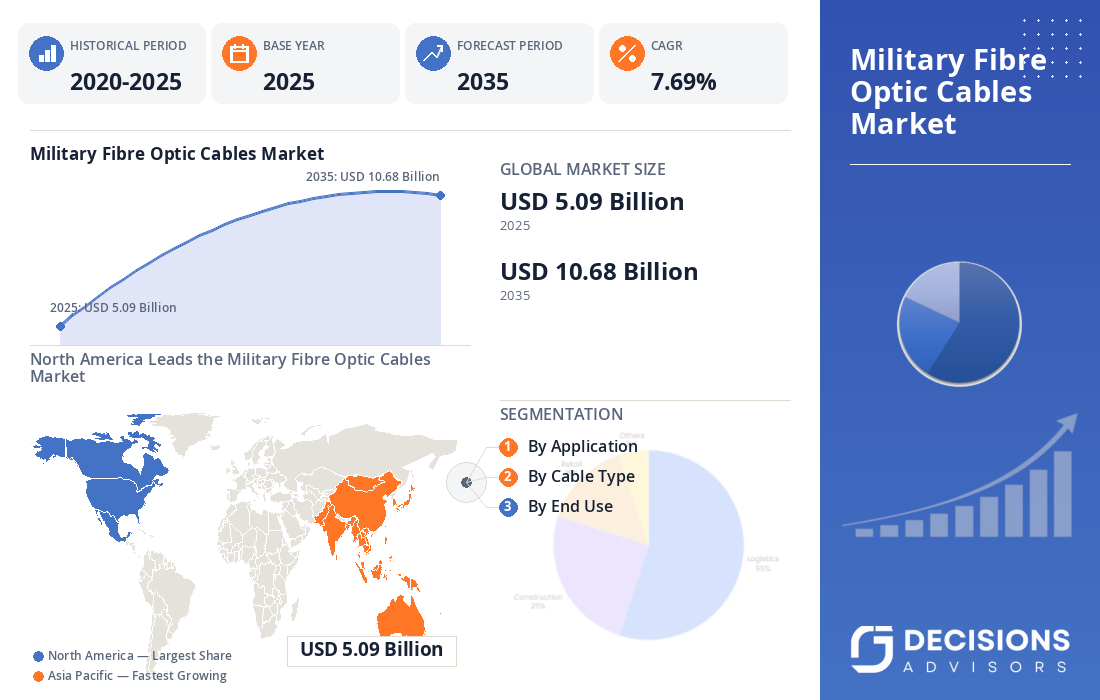
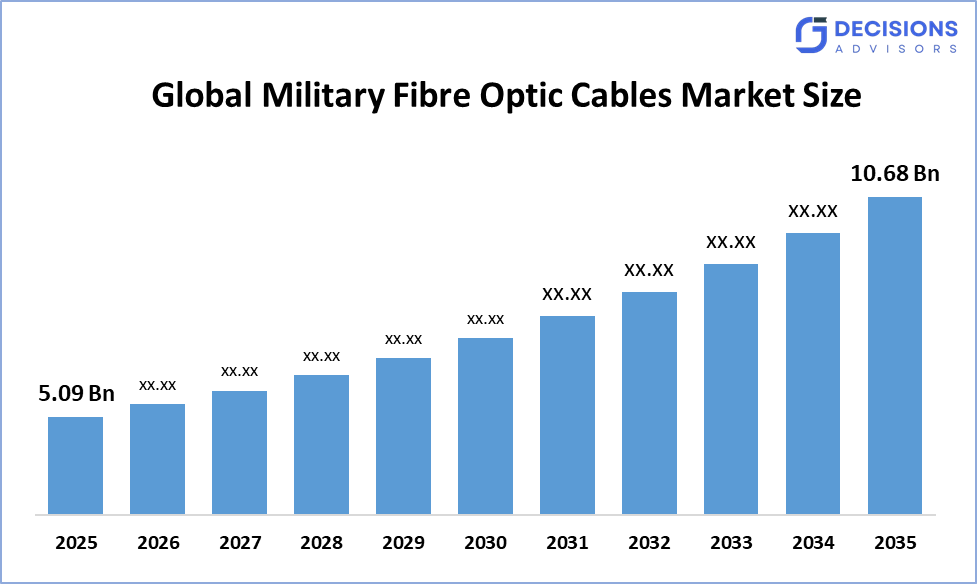
The Global Military Fibre Optic Cables Market Size is predicted to grow from USD 5.09 Billion in 2025 and is likely to reach around USD 10.68 Billion by 2035 with a CAGR of 7.69%. According to Decision Advisors, a detailed research report on the market reflects that the touchless sensing adoption trend dominates the Global Military Fibre Optic Cables Market by application, holding approximately 38.5% share in 2025. L3Harris Technologies leads the market with a strong C4ISR and fibre optic cable portfolio, making it a key contributor to global market development and growth dynamics.
Market Snapshot
- Global Military Fibre Optic Cables Market Size (2025): USD 5.09 Billion
- Projected Global Military Fibre Optic Cables Market Size (2035): USD 10.68 Billion
- Global Military Fibre Optic Cables Market Compound Annual Growth Rate (CAGR): 7.69%
- Largest Regional Market: North America
- 2nd Largest Region: Europe
- Fastest Growing Region: Asia Pacific
- Base Year: 2025
- Historical Period: 2020-2025
- Market Forecast Period: 2026-2035
Market Overview/ Introduction
The Global Military Fibre Optic Cables Market refers to the industry that designs, manufactures, and deploys specialized fibre optic cables engineered for harsh operational environments, employing glass or plastic strands to transmit data as light pulses with high bandwidth and immunity to electromagnetic interference. The market is experiencing strong growth because of rising defense spending and military modernization programs, increased demand for high-bandwidth secure communication, and the proliferation of advanced weapon systems and network-centric warfare. Growing emphasis on real-time intelligence, surveillance, and reconnaissance (ISR) operations is creating favorable conditions for cable manufacturers. Key companies, including L3Harris Technologies, ADVA Optical Networking, Nexans, Leonardo, and TE Connectivity are developing advanced ruggedized, EMP-hardened, and quantum-safe fibre optic solutions that support secure battlefield connectivity while achieving high durability. The market provides defense customers with solutions that combine low-latency data transmission with scalable C4ISR deployment models that provide continuous situational awareness and reduced signal interception risk. The global market will experience future expansion through the development of hypersonic communications infrastructure, AI-driven network hardening, and quantum-resistant fibre architectures.
- India's 'Make in India' initiative is fuelling indigenous production and R&D for military fibre optic cables, supporting India's growing defense sector and reducing dependency on foreign suppliers for critical military infrastructure.
Notable Insights: -
- North America dominated the market and is anticipated to hold approximately 38.2% share of the Global Military Fibre Optic Cables Market over the predicted timeframe.
- Asia Pacific is expected to grow at the fastest CAGR in the Global Military Fibre Optic Cables Market, approximately 9.2% of the share during the forecast period.
- By application, the communication systems segment dominated the market and holds approximately 38.5% share in 2025 and is projected to grow steadily during the forecast period.
- By cable type, the single-mode fibre optic cable segment dominated the market and holds approximately 44% share in 2025 and is projected to grow at a substantial CAGR during the forecast period.
- The compound annual growth rate of the Global Military Fibre Optic Cables Market is 7.69%
- The market is likely to achieve a valuation of USD 10.68 Billion by 2035.
Market Drivers
The Global Military Fibre Optic Cables Market experiences growth because nations worldwide are increasing defense budgets to address evolving geopolitical landscapes, directly fuelling military modernization initiatives. Increased demand for high-bandwidth secure communication, driven by intelligence gathering, real-time situational awareness, and complex command and control needs, is accelerating adoption. The proliferation of advanced weapon systems and network-centric warfare, along with expansion of military bases and battlefield digitization, is further boosting demand. The imperative for low latency and enhanced situational awareness in real-time ISR operations is further fuelling adoption of advanced fibre optic solutions.
Restrain
The Global Military Fibre Optic Cables Market faces challenges such as geopolitical tensions and export controls, including restrictions under the Wassenaar Arrangement, which fragment supply chains and limit international trade of high-specification fibre optic cables. High barriers to entry and vendor lock-in, stemming from substantial upfront R&D investment and lengthy qualification and certification processes required by defense ministries, also restrain market growth for new entrants.
Competitive Analysis:
The report offers the appropriate analysis of the key organizations/companies involved within the Global Military Fibre Optic Cables Market along with a comparative evaluation primarily based on their product offerings, business overviews, geographic presence, enterprise strategies, segment market share, and SWOT analysis. The report also provides an elaborative analysis focusing on the current news and developments of the companies, which includes product development, innovations, joint ventures, partnerships, mergers & acquisitions, strategic alliances, and others. This allows for the evaluation of the overall competition within the market.
Top Companies in the Global Military Fibre Optic Cables Market
- L3Harris Technologies
- ADVA Optical Networking
- Nexans
- Leonardo
- TE Connectivity
- BAE Systems
- General Dynamics
- Northrop Grumman
- Oceaneering International
- Thales Group
Government Initiatives
|
Country |
Key Government Initiatives |
|
India |
India's 'Make in India' initiative is fuelling indigenous production and R&D of military fibre optic cables, supporting the country's growing defense sector and reducing dependency on foreign suppliers. |
|
United States |
The United States heavily invests in domestic production and advanced R&D for high-bandwidth, ruggedized military fibre optic cables, driven by extensive defense spending and a focus on technological leadership. |
|
China |
China's state-backed enterprises drive innovation and mass production of military fibre optic cables, leveraging advanced manufacturing capabilities to strengthen domestic military communication and intelligence infrastructure. |
Market Segmentation
The Global Military Fibre Optic Cables Market share is classified into application, cable type, end use
- The communication systems segment dominated the market and holds approximately 38.5% share in 2025 and is projected to grow steadily during the forecast period.
Based on application, the Global Military Fibre Optic Cables Market is divided into Communication Systems, Data Transmission, Surveillance Systems, Missile Guidance, and Network Infrastructure. Among these, the communication systems segment dominates the market and holds approximately 38.5% share in 2025 due to the critical need for secure, high-bandwidth, and reliable data exchange across all military operations, from tactical field communications to strategic command and control centers. The data transmission segment held the second-largest share at approximately 22% in 2025, driven by growing demand for real-time sensor data from drones and satellites.
- The single-mode fibre optic cable segment accounted for the largest share in 2025 and is anticipated to grow at a significant CAGR during the forecast period.
Based on cable type, the market is divided into Single-Mode Fibre Optic Cable, Multi-Mode Fibre Optic Cable, Armored Fibre Optic Cable, and Disaster Resistant Fibre Optic Cable. Among these, Single-Mode Fibre Optic Cable is preferred for long-distance, high-bandwidth data transmission in network infrastructure and strategic communication links due to its low attenuation. The Armored and Disaster Resistant segments are gaining traction, driven by demand for cables that can withstand extreme temperatures, moisture, vibration, and impact in diverse combat and deployment scenarios.
- The army segment accounted for a significant share in 2025 and is anticipated to grow at a steady CAGR during the forecast period.
Based on end use, the market is divided into Army, Navy, and Air Force. The Army requires rugged, deployable cables for mobile command centers and field operations, often favoring armored or disaster-resistant types. The Navy prioritizes waterproof and corrosion-resistant cables for naval vessels, integrating them into shipboard network infrastructure and surveillance systems, while the Air Force needs lightweight yet durable solutions for aircraft systems and missile guidance, emphasizing high performance and minimal interference for critical airborne applications.
Regional Segment Analysis of the Global Military Fibre Optic Cables Market
- North America (U.S., Canada)?
- Europe (Germany, France, U.K., Italy, Spain, Russia, Rest of Europe)
- Asia-Pacific (China, India, Japan, South Korea, Rest of APAC)
- Latin America (Brazil, Mexico, Rest of Latin America)?
- The Middle East and Africa (South Africa, Saudi Arabia, UAE, Rest of MEA)
North America dominated the Global Military Fibre Optic Cables Market, holding approximately 38.2% share in 2025.
North America dominated the global military fibre optic cables market, accounting for approximately 38.2% share in 2025. The region’s leadership is supported by substantial defense spending in the United States and Canada, alongside continued investments in secure military communication and advanced data-transmission infrastructure. Modernization programs, replacement of legacy systems, and the development of next-generation warfare capabilities are increasing demand for ruggedized, high-performance fibre optic cables. Strong defense research and development activities further support technological innovation. Growing requirements for secure, high-speed battlefield connectivity, surveillance, command-and-control systems, and interoperability across military platforms are expected to sustain regional market growth throughout the forecast period.
Asia Pacific is expected to grow at the fastest share of approximately 9.2% in 2025 CAGR in the Global Military Fibre Optic Cables Market during the forecast period
Asia Pacific is projected to be the fastest-growing region in the global military fibre optic cables market, with a CAGR of approximately 9.2% from 2026 to 2035. Increasing defense expenditure across major economies is driving modernization of military communication infrastructure. China and India are investing substantially in advanced communications, secure data transmission, and battlefield connectivity, creating opportunities for high-performance fibre optic cable solutions. Rising geopolitical tensions, territorial disputes, and evolving security requirements are encouraging regional governments to strengthen defense capabilities. Furthermore, modernization of naval, aerospace, land-based, and command-and-control systems is expected to increase demand for ruggedized fibre optic technologies across the region during the forecast period.
Europe is growing steadily in the Global Military Fibre Optic Cables Market largest share of approximately 46% during the forecast period.
Europe is expected to maintain steady growth in the global military fibre optic cables market, supported by rising defense expenditure, military modernization, and increasing requirements for secure communications. Major defense companies, including Leonardo, Thales, and BAE Systems, contribute to the region’s advanced defense technology ecosystem. NATO interoperability requirements also encourage standardized communication solutions capable of supporting integration across different military platforms and allied forces. Modernization of naval, land, and command-and-control communication networks is creating sustained demand for high-performance fibre optic cables. In addition, growing investments in defense readiness and secure digital infrastructure are expected to strengthen adoption of ruggedized fibre optic solutions across Europe.
Future Market Trends in Global Military Fibre Optic Cables Market: -
-
- Hypersonic Communications Imperative
The escalating development and deployment of hypersonic weapons systems, traveling at Mach 5 and beyond, demands near-instantaneous data transfer to maintain command and control. Military planners are increasingly investing in robust, low-latency fibre optic networks to ensure uninterrupted, high-bandwidth connectivity to hypersonic assets, both pre- and post-launch.
-
- AI-Driven Network Hardening
Global militaries increasingly leverage AI to fortify their fibre optic cable networks, signifying a shift from reactive to proactive cybersecurity. AI algorithms continuously monitor network traffic, detecting anomalous patterns and automatically reconfiguring network defenses to isolate compromised segments without human intervention.
-
- Quantum-Resistant Fibre Architectures
The market is seeing a surge in quantum key distribution (QKD) integration, promising unparalleled data security for critical military transmissions by leveraging the fundamental principles of quantum mechanics to counter future quantum computing threats.
-
- Space-Based Interconnect Evolution
Advancements in autonomous deployment and self-healing cable technologies are emerging alongside hybrid solutions combining power and data, along with modular designs to facilitate easy upgrades and maintain long-term strategic relevance for global defense forces, including space-based platforms.
Recent Development
- In May 2025, General Dynamics showcased a new ultra-lightweight, high-density fibre optic cable designed for airborne and drone platforms at a major defense expo, targeting increasing demand for high-speed data links in unmanned aerial systems.
- In March 2025, L3Harris Technologies announced a strategic partnership with a major European defense contractor to jointly develop next-generation ruggedized fibre optic cable solutions for networked warfare systems across NATO operations.
Market Segment
This study forecasts revenue at global, regional, and country levels from 2020 to 2035. Decision Advisors has segmented the Global Military Fibre Optic Cables Market based on the below-mentioned segments:
Global Military Fibre Optic Cables Market, By Application
- Communication Systems
- Data Transmission
- Surveillance Systems
- Missile Guidance
- Network Infrastructure
Global Military Fibre Optic Cables Market, By Cable Type
- Single-Mode Fibre Optic Cable
- Multi-Mode Fibre Optic Cable
- Armored Fibre Optic Cable
- Disaster Resistant Fibre Optic Cable
Global Military Fibre Optic Cables Market, By End Use
- Army
- Navy
- Air Force
Global Military Fibre Optic Cables Market, By Regional Analysis
- North America
- US
- Canada
- Mexico
- Europe
- Germany
- UK
- France
- Italy
- Spain
- Russia
- Rest of Europe
- Asia Pacific
- China
- Japan
- India
- South Korea
- Australia
- Rest of Asia Pacific
- South America
- Brazil
- Argentina
- Rest of South America
- Middle East & Africa
- UAE
- Saudi Arabia
- Qatar
- South Africa
- Rest of the Middle East & Africa
Frequently Asked Questions (FAQ)
Q. What is the military fibre optic cables market growth rate?
A. The military fibre optic cables market is expected to grow at a compound annual growth rate (CAGR) of around 7.69% from 2026 to 2035.
Q. What are the driving factors of the military fibre optic cables market?
A. The driving factors of the military fibre optic cables market are rising defense spending and military modernization programs, increased demand for high-bandwidth secure communication, and the proliferation of advanced weapon systems and network-centric warfare.
Q. Which region will lead the global military fibre optic cables market?
A. North America is expected to lead the global military fibre optic cables market during the forecast period 2026 to 2035, followed by Europe and a fast-growing Asia Pacific.
Check Licence
Choose the plan that fits you best: Single User, Multi-User, or Enterprise solutions tailored for your needs.
We Have You Covered
- 24/7 Analyst Support
- Clients Across the Globe
- Tailored Insights
- Technology Tracking
- Competitive Intelligence
- Custom Research
- Syndicated Market Studies
- Market Overview
- Market Segmentation
- Growth Drivers
- Market Opportunities
- Regulatory Insights
- Innovation & Sustainability
Report Details
| Scope | Global |
| Pages | 200 |
| Delivery | PDF & Excel via Email |
| Language | English |
| Release | Aug 2026 |
| Access | Download from this page |