
Global Milk Replacers Market
 |
Author:
Anurag B
|
Pages:
220
|
Author:
Anurag B
|
Pages:
220
Global Milk Replacers Market Size, Share By Type (Whey Based, Skim Based), By Application (Calf, Lamb, Piglet, Other), and By Region (North America, Europe, Asia-Pacific, Middle East & Africa), Analysis and Forecast 2026-2035.
CAGR
4.66%
REVENUE 2025
USD Billion 4.95
FORECAST 2035
USD Billion 7.81
REPORT COVERAGE
Global
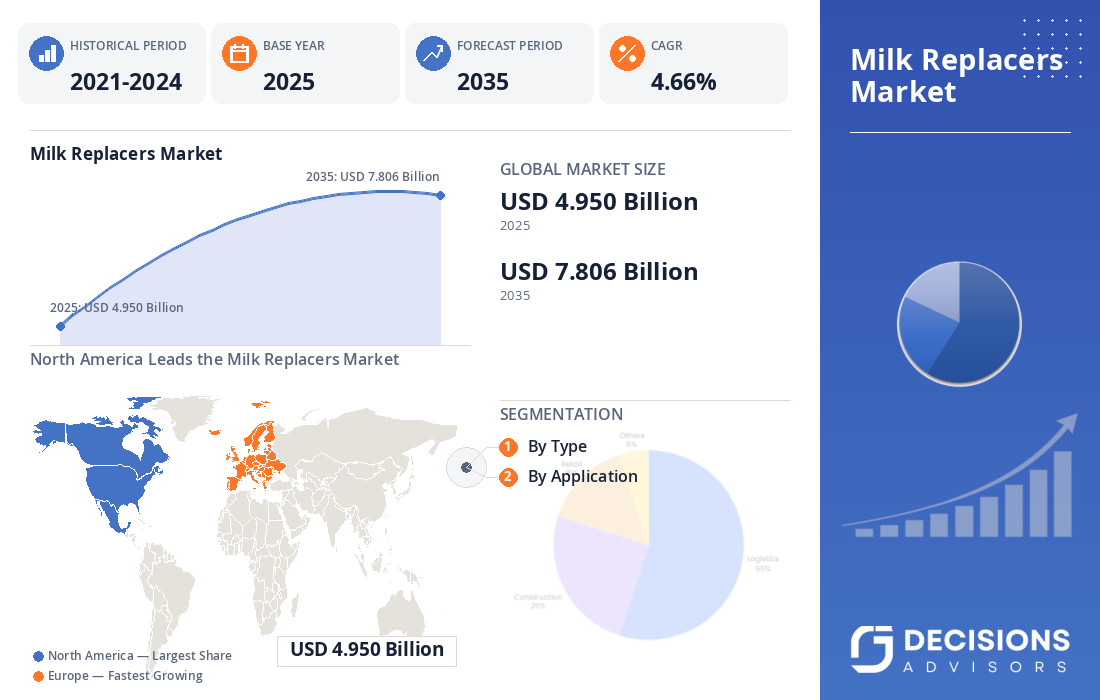
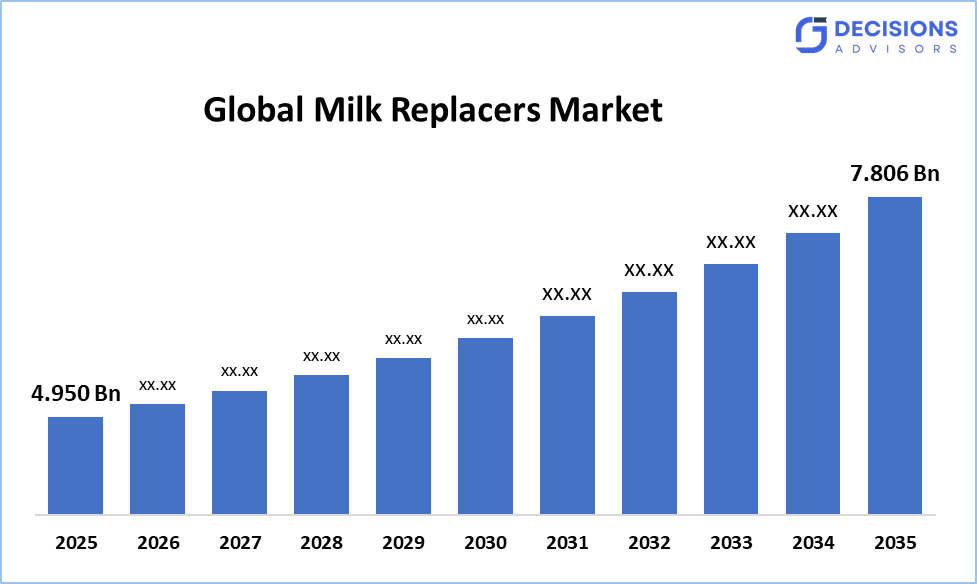
The Global Milk Replacers Market Size is predicted to grow from USD 4.950 Billion in 2026 and is likely to reach around USD 7.806 Billion by 2035 with a CAGR of 4.66%. According to Decision Advisors, a detailed research report on the market reflects that the touchless sensing adoption trend dominates the Global Milk Replacers Market by type, accounting for approximately 64% of the total market share. Cargill leads the market with a strong portfolio of calf and livestock nutrition solutions, holding approximately 18% market share and making it the key contributor to global market development and growth dynamics.
Market Snapshot
- Global Milk Replacers Market Size (2026): USD 4.950 Billion
- Projected Global Milk Replacers Market Size (2035): USD 7.806 Billion
- Global Milk Replacers Market Compound Annual Growth Rate (CAGR): 4.66%
- Largest Regional Market: North America
- 2nd Largest Region: Asia Pacific
- Fastest Growing Region: Europe
- Base Year: 2025
- Historical Period: 2021-2024
- Market Forecast Period: 2026-2035
Market Overview/ Introduction
The Global Milk Replacers Market refers to the industry that manufactures formulated feed products designed to replace animal milk, providing essential nutrition to young animals such as calves, piglets, and lambs when natural milk is unavailable or impractical. The market is experiencing steady growth because over 65% of commercial dairy farms globally have adopted formulated feeding systems, and milk replacers now account for approximately 55% of early-stage calf nutrition in industrial farms. Growth in intensive livestock farming, cost-efficient feeding systems, and improved calf survival rates are creating favorable conditions for manufacturers. Key companies, including Cargill, ADM, CHS, Land O'Lakes, and Glanbia are developing advanced whey-based and skim-based formulations enriched with probiotics and prebiotics that support faster calf growth while achieving high feed conversion efficiency. The market provides livestock producers with solutions that combine optimized protein and fat ratios with scalable automated feeding systems that improve consistency and reduce labor dependency. The global market will experience future expansion through the development of plant-based protein formulations, precision nutrition blends, and antibiotic-free medicated alternatives.
- Government-led dairy productivity programs in Asia-Pacific have expanded by approximately 40%, encouraging structured feeding adoption and supporting the transition of small and medium farms toward commercial livestock operations.
- In the Middle East & Africa region, government initiatives supporting dairy productivity have increased by around 30%, encouraging structured feeding practices despite import dependency accounting for nearly 45% of total product availability.
Notable Insights: -
- North America is anticipated to hold approximately 38% share of the Global Milk Replacers Market in 2025.
- Asia Pacific is expected to grow at a rapid Global Milk Replacers Market, by holding approximately 28% of the share during the forecast period.
- By type, the whey-based segment dominated the market and holds approximately 64% share in 2025 and is projected to grow steadily during the forecast period.
- By application, the calf segment dominated the market and holds approximately 70% share in 2025 and is projected to grow at a substantial CAGR during the forecast period.
- The compound annual growth rate of the Global Milk Replacers Market is 4.66%
- The market is likely to achieve a valuation of USD 7.806 Billionby 2035.
Market Drivers
The Global Milk Replacers Market experiences growth because of rising demand for efficient livestock nutrition, with over 65% of commercial dairy farms adopting replacer-based feeding systems. Calf growth rates have improved by 12% to 18% due to optimized protein and fat ratios, and approximately 70% of large-scale farms report better feed conversion efficiency using milk replacers. The global livestock population exceeds 1.5 billion cattle, creating sustained demand for structured feeding solutions. Early weaning practices have increased by 40%, further boosting replacer usage, while adoption of automated feeding systems is further fuelling adoption of advanced milk replacer solutions.
Restrain
The Global Milk Replacers Market faces challenges such as volatility in raw material costs, with nearly 48% of manufacturers impacted by whey and skim milk powder price fluctuations, and protein ingredient costs increasing by 20% to 30% in recent years. Approximately 45% of producers face challenges in maintaining consistent formulation quality due to supply variability, while regulatory compliance requirements impact 42% of manufacturers, increasing operational complexity and restraining market growth.
Competitive Analysis:
The report offers the appropriate analysis of the key organizations/companies involved within the Global Milk Replacers Market along with a comparative evaluation primarily based on their product offerings, business overviews, geographic presence, enterprise strategies, segment market share, and SWOT analysis. The report also provides an elaborative analysis focusing on the current news and developments of the companies, which includes product development, innovations, joint ventures, partnerships, mergers & acquisitions, strategic alliances, and others. This allows for the evaluation of the overall competition within the market.
Top Companies in the Global Milk Replacers Market
- Cargill
- ADM
- CHS Inc.
- Land O'Lakes
- Glanbia plc
- Lactalis Group
- VanDrie Group
- FrieslandCampina
- Nutreco N.V.
- Alltech Inc.
Government Initiatives
|
Country |
Key Government Initiatives |
|
China |
Government-led dairy productivity programs have expanded by approximately 40%, supporting structured feeding adoption and encouraging small and medium farms to transition toward commercial livestock operations. |
|
United States |
USDA-backed dairy support programs and structured feeding ecosystems support over 70% of large-scale dairy farms utilizing milk replacers, with automated feeding systems installed in nearly 35% of operations. |
|
Germany |
Environmental regulations influence nearly 50% of manufacturing processes, while government-supported sustainable sourcing initiatives for the dairy sector have grown by 35%, promoting structured feeding practices. |
Market Segmentation
The Global Milk Replacers Market share is classified into type and application
- The whey-based segment dominated the market and holds approximately 64% share in 2025 and is projected to grow steadily during the forecast period.
Based on type, the Global Milk Replacers Market is divided into Whey Based and Skim Based. Among these, the whey-based segment dominates the market and holds approximately 64% share in 2025, driven by high digestibility and superior amino acid profiles, with protein content typically ranging between 20% and 24% supporting faster calf growth rates. The skim-based segment holds around 36% share and is primarily used in cost-sensitive and emerging markets, with adoption growing by approximately 10% across developing regions with expanding dairy sectors.
- The calf segment accounted for the largest share of approximately 70% in 2025 and is anticipated to grow at a significant CAGR during the forecast period.
Based on application, the market is divided into Calf, Lamb, Piglet, and Other. Among these, Calf applications dominate the market with nearly 70% share, driven by structured dairy farming practices, with over 60 million calves annually fed milk replacers worldwide. The Piglet segment holds approximately 15% share, driven by intensive swine production systems, while the Lamb segment accounts for around 10% share, with adoption increasing in sheep farming regions.
Regional Segment Analysis of the Global Milk Replacers Market
- North America (U.S., Canada)?
- Europe (Germany, France, Netherlands, Rest of Europe)
- Asia-Pacific (China, India, Rest of APAC)
- South America (Brazil and the Rest of South America)?
- The Middle East and Africa (Saudi Arabia, Rest of MEA)
North America is anticipated Global Milk Replacers Market, holding approximately 38% share in 2025.
North America holds approximately 38% share of the Global Milk Replacers Market, supported by over 70% adoption across commercial dairy farms. The United States contributes nearly 80% of regional demand, with protein-enriched formulations used in 58% of operations and automated feeding systems installed in 35% of farms, improving feeding accuracy by 20% and reducing labor dependency. Canada represents around 20% of the regional market, with adoption rates increasing by 12% annually across medium and large-scale farms.
Asia Pacific is expected to grow at a rapid CAGR in the Global Milk Replacers Market by holding approximately 28% of the share during the forecast period.
Asia Pacific captures around 28% share of the Global Milk Replacers Market, with livestock populations increasing by 25% to 35% over recent years. China and India together account for more than 65% of regional demand, although adoption rates remain below 30% in several developing areas. Government-led dairy productivity programs have expanded by 40%, supporting structured feeding adoption, with small and medium farms transitioning toward commercial operations representing nearly 50% of new demand in the region.
Europe holds a significant share in the Global Milk Replacers Market by holds approximately 32% during the forecast period.
Europe holds approximately 32% share of the Global Milk Replacers Market, with more than 65% of farms utilizing replacer-based feeding systems. Organic milk replacers account for 18% of total consumption, while Germany, France, and the Netherlands together contribute over 60% of regional demand due to highly structured dairy sectors. Environmental regulations influence nearly 50% of manufacturing processes, while sustainable sourcing initiatives have grown by 35% across the region.
Future Market Trends in Global Milk Replacers Market: -
- Shift Toward Plant-Based Protein Formulations
Producers are increasingly shifting toward plant-based protein sources as sustainability concerns rise. Plant-based milk replacers are gaining traction among environmentally conscious livestock operations seeking alternatives with improved sustainability profiles.
- Growing Adoption of Medicated Formulations
The market is witnessing growing adoption of medicated formulations to address calf health and disease-prevention needs. At the same time, antibiotic-free formulations are gaining traction as producers increasingly prioritize responsible livestock management.
- Rise of Customized Nutrition Blends
Manufacturers are increasingly developing customized nutrition blends tailored to specific livestock requirements. Functional additives such as probiotics and prebiotics are also gaining popularity for supporting digestive health, immunity, and overall animal performance.
- Increasing Use of Fortified Micronutrient Additives
Manufacturers are increasingly incorporating fortified micronutrient additives to improve nutritional consistency and support animal development. High-protein formulations are also widely used in intensive farming systems to meet the nutritional requirements of rapidly growing livestock.
Recent Development
- In September 2025, ADM introduced Digest Carb, a feed solution designed to support rumen fermentation, fiber degradability, milk performance and feed efficiency in dairy production.
- In December 2025, Cargill highlighted its Micronutrition & Health Solutions portfolio for supporting animal gut health and performance across dairy and other livestock sectors.
Market Segment
This study forecasts revenue at global, regional, and country levels from 2020 to 2035. Decision Advisors has segmented the Global Milk Replacers Market based on the below-mentioned segments:
Global Milk Replacers Market, By Type
- Whey Based
- Skim Based
Global Milk Replacers Market, By Application
- Calf
- Lamb
- Piglet
- Other
Global Milk Replacers Market, By Regional Analysis
- North America
- US
- Canada
- Mexico
- Europe
- Germany
- UK
- France
- Italy
- Spain
- Russia
- Rest of Europe
- Asia Pacific
- China
- Japan
- India
- South Korea
- Australia
- Rest of Asia Pacific
- South America
- Brazil
- Argentina
- Rest of South America
- Middle East & Africa
- UAE
- Saudi Arabia
- Qatar
- South Africa
- Rest of the Middle East & Africa
Frequently Asked Questions (FAQ)
- What are the driving factors of the milk replacers market?
The driving factors of the milk replacers market are rising demand for efficient livestock nutrition, growing adoption of replacer-based feeding systems, and improved feed conversion efficiency on large-scale farms.
- Which region will lead the global milk replacers market?
North America is expected to lead the global milk replacers market during the forecast period 2026 to 2035, followed by Europe and a fast-growing Asia Pacific.
- What are the major trends in the milk replacers market?
Major trends include increasing demand for customized nutrition, growing adoption of non-medicated formulations, rising use of functional additives, and greater emphasis on sustainable protein sources.
- What product type dominates the milk replacers market?
Whey-based milk replacers are expected to remain a leading product type because of their digestibility, nutritional profile, availability, and suitability for young livestock nutrition. - Which application segment holds the largest share of the milk replacers market?
Calf applications are expected to account for the largest market share, supported by increasing focus on early-life nutrition, calf health, growth performance, and efficient dairy herd management.
Check Licence
Choose the plan that fits you best: Single User, Multi-User, or Enterprise solutions tailored for your needs.
We Have You Covered
- 24/7 Analyst Support
- Clients Across the Globe
- Tailored Insights
- Technology Tracking
- Competitive Intelligence
- Custom Research
- Syndicated Market Studies
- Market Overview
- Market Segmentation
- Growth Drivers
- Market Opportunities
- Regulatory Insights
- Innovation & Sustainability
Report Details
| Scope | Global |
| Pages | 220 |
| Delivery | PDF & Excel via Email |
| Language | English |
| Release | Aug 2026 |
| Access | Download from this page |