
Global Mirrorless Camera Market
 |
Author:
Kunal M
|
Pages:
230
|
Author:
Kunal M
|
Pages:
230
Global mirrorless camera market Size, Share By Camera Type (Compact Mirrorless Cameras, Larger Sensor Mirrorless Cameras, and High-End Mirrorless Cameras), By Application (Photography, Videography, and Live Streaming), By End User (Professional Photographers, Amateur Photographers, and Content Creators), By Sales Channel (Online Retail, Retail Stores, and Direct Sales), and By Region (North America, Europe, Asia-Pacific, Latin America, Middle East & Africa), Analysis and Forecast 2026-2035.
CAGR
6.15%
REVENUE 2025
USD Billion 5.02
FORECAST 2035
USD Billion 9.12
REPORT COVERAGE
Global
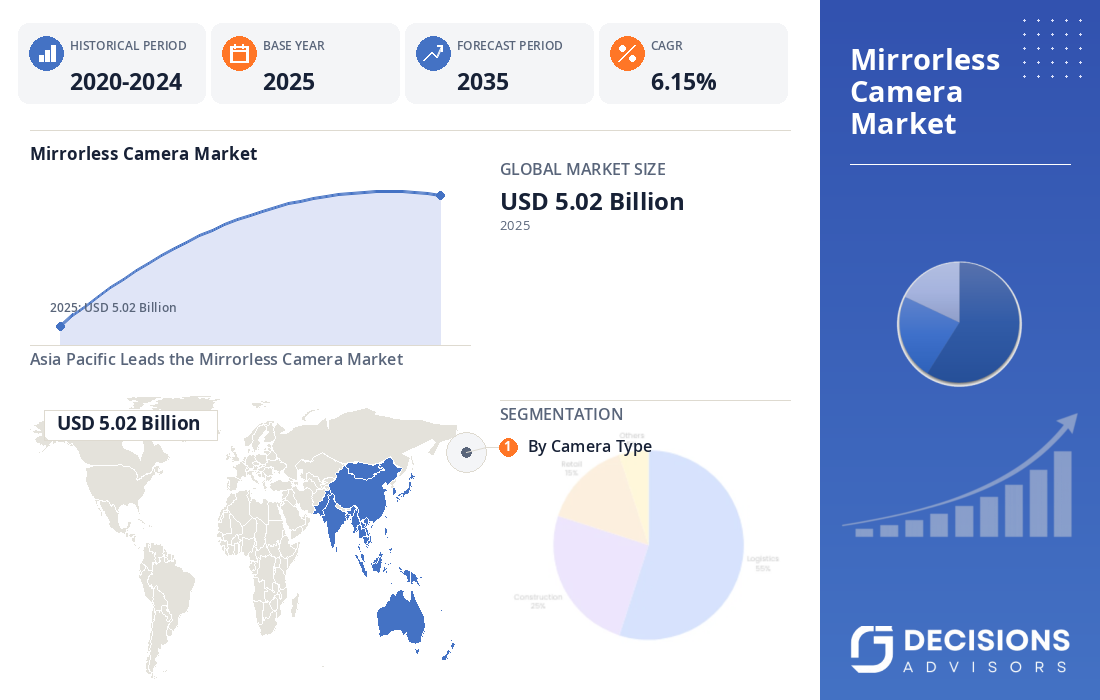
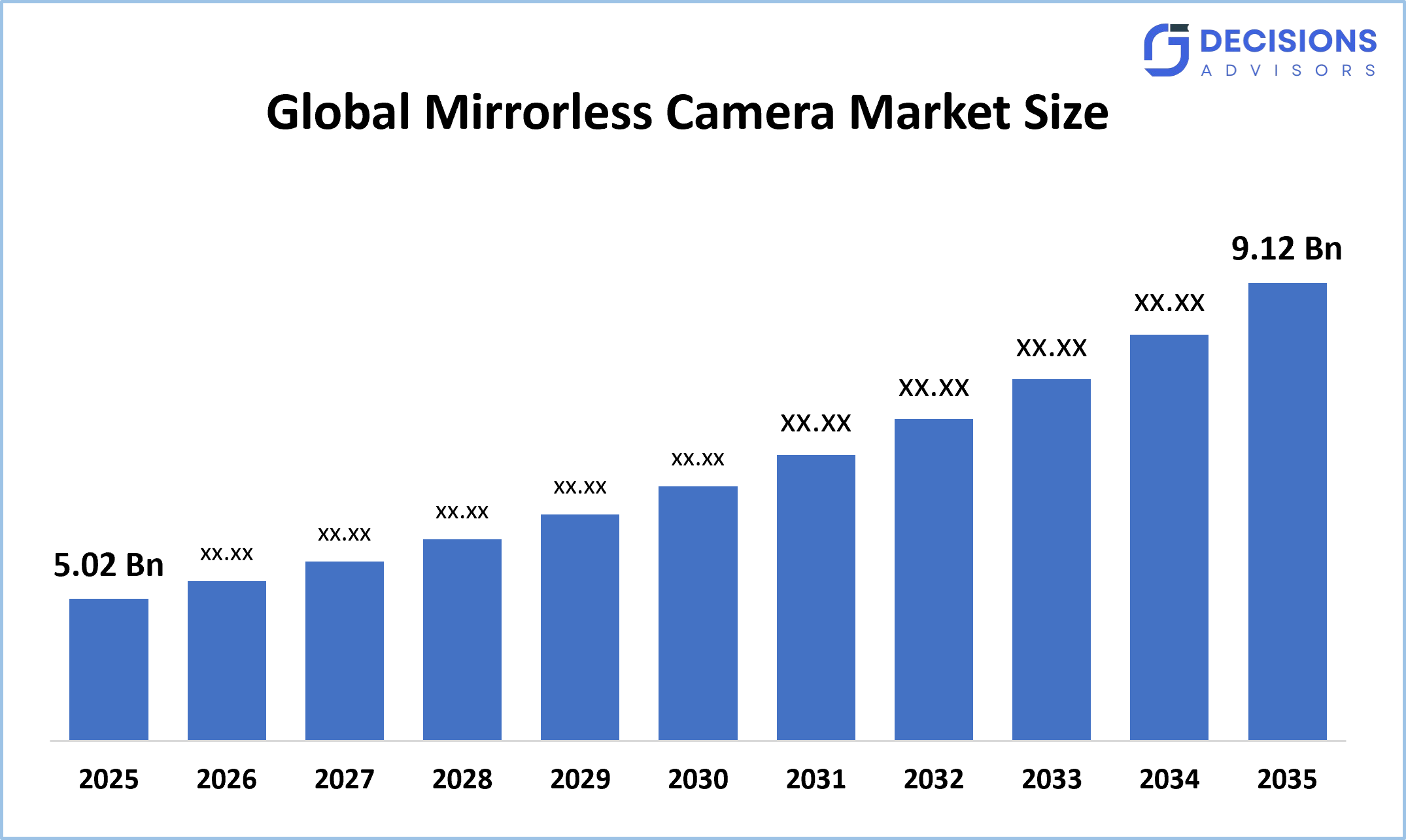
The Global mirrorless camera market Size is predicted to grow from USD 5.02 Billion in 2025 and is likely to reach around USD 9.12 Billion by 2035 with a CAGR of 6.15%. According to Decision Advisors, a detailed research report on the market reflects that the photography application dominates the global mirrorless camera market, accounting for approximately 55% of the total share worldwide. Canon Inc. leads the market with an estimated 40-46% share of the interchangeable-lens mirrorless segment, making it the key contributor to global market development and growth dynamics.
Market Snapshot
- Global mirrorless camera market Size (2025): USD 5.02 Billion
- Projected Global mirrorless camera market Size (2035): USD 9.12 Billion
- Global mirrorless camera market Compound Annual Growth Rate (CAGR): 6.15%
- Largest Regional Market: Asia Pacific
- 2nd Largest Region: North America
- Fastest Growing Region: Europe
- Base Year: 2025
- Historical Period: 2020-2024
- Market Forecast Period: 2026-2035
Market Overview/ Introduction
The global mirrorless camera market refers to the industry that designs and manufactures interchangeable-lens and fixed-lens digital cameras that remove the mirror box and optical viewfinder found in traditional DSLRs, relying instead on electronic viewfinders and on-sensor autofocus. The market is experiencing substantial growth because of increasing demand for high-quality imaging and video content among professionals, enthusiasts, and social media creators. Government programs like Japan's METI-backed image sensor manufacturing subsidies and the US CHIPS and Science Act are creating better conditions for camera-grade sensor manufacturing and supply chain security. Key companies, including Canon, Sony, Nikon, Panasonic, and Fujifilm, are developing compact, high-performance imaging systems that combine large sensors with fast autofocus while achieving superior low-light output. The market provides customers with products that combine high image quality with compact designs, which provide portability and advanced video capability. The global market will experience future expansion through the development of AI-powered computational photography, content-creator ecosystems, live-streaming features, and advanced human-machine interface systems.
- Japan's government, through the Ministry of Economy, Trade and Industry (METI), is subsidizing next-generation image sensor manufacturing, including Sony's new Kumamoto sensor plant, strengthening the domestic supply chain for camera-grade sensors and supporting continued innovation in mirrorless imaging technology.
- Creator-economy and digital-content initiatives in South Korea are driving the adoption of professional-grade mirrorless cameras among content creators and broadcasters, supporting the development of high-quality live-streaming and video production infrastructure.
Notable Insights: -
- Asia Pacific is anticipated to hold approximately 41.8% share of the Global mirrorless camera market over the predicted timeframe.
- North America is expected to hold the second-largest share of the Global mirrorless camera market by holding approximately 23% of the share during the forecast period.
- By camera type, the Larger Sensor Mirrorless Cameras segment dominated the market and holds approximately 45.5% share in 2025 and is projected to grow at a substantial CAGR during the forecast period.
- By application, the photography segment dominated the market and holds approximately 55% share in 2025 and is projected to grow at a substantial CAGR during the forecast period.
- The compound annual growth rate of the Global mirrorless camera market is 6.15%.
- The market is likely to achieve a valuation of USD 9.12 Billion by 2035.
Market Drivers
The Global mirrorless camera market experiences growth because more photographers, videographers, and content creators demand compact, high-performance imaging systems with advanced autofocus and superior low-light output. The expansion of social media, YouTube, and live-streaming platforms drives increased adoption of mirrorless cameras capable of high-resolution 4K and 8K video. The rise of the creator economy and vlogging culture drives the adoption of mirrorless systems among influencers, independent filmmakers, and small businesses. The professional sector shows increasing demand because of rising use of mirrorless cameras in wedding, commercial, and editorial photography that previously relied on DSLRs. The market expands because rising disposable incomes in emerging economies fuel consumer expenditure on premium electronics. The global imaging industry moves towards AI-enabled, computational photography features to implement smarter autofocus and noise reduction systems.
Restrain
The global mirrorless camera market faces challenges such as supply chain disruptions and component shortages affecting image sensors, processors, and specialized optical glass. Intensifying competition from high-end smartphone cameras with advanced computational photography also limits demand among casual and entry-level users.
Competitive Analysis:
The report offers the appropriate analysis of the key organizations/companies involved within the global mirrorless camera market along with a comparative evaluation primarily based on their product offerings, business overviews, geographic presence, enterprise strategies, segment market share, and SWOT analysis. The report also provides an elaborative analysis focusing on the current news and developments of the companies, which includes product development, innovations, joint ventures, partnerships, mergers & acquisitions, strategic alliances, and others. This allows for the evaluation of the overall competition within the market.
Top Companies in the Global mirrorless camera market
- Canon Inc.
- Sony Group Corporation
- Nikon Corporation
- Panasonic Holdings Corporation
- Fujifilm Holdings Corporation
- OM Digital Solutions (Olympus)
- Ricoh Company, Ltd. (Pentax)
- Leica Camera AG
- DJI
- Blackmagic Design
Government Initiatives
|
Country |
Key Government Initiatives |
|
US |
The U.S. Department of Commerce, through the CHIPS and Science Act, supports domestic semiconductor and image-sensor manufacturing investment, strengthening the supply chain for camera-grade sensors and enhancing development of next-generation mirrorless imaging technology. |
|
Japan |
Japan's Ministry of Economy, Trade and Industry (METI) is subsidizing up to ¥60 billion for Sony's new Kumamoto image sensor plant under the Economic Security Promotion Act, strengthening the domestic supply chain for camera image sensors used in mirrorless systems. |
|
China |
Policies focusing on smart manufacturing, electronics export promotion, and “Made in China 2025” are driving innovation and increasing domestic production of camera components and mirrorless imaging technologies across industrial and consumer electronics applications. |
Market Segmentation
The global mirrorless camera market share is classified into camera type, application, and end user
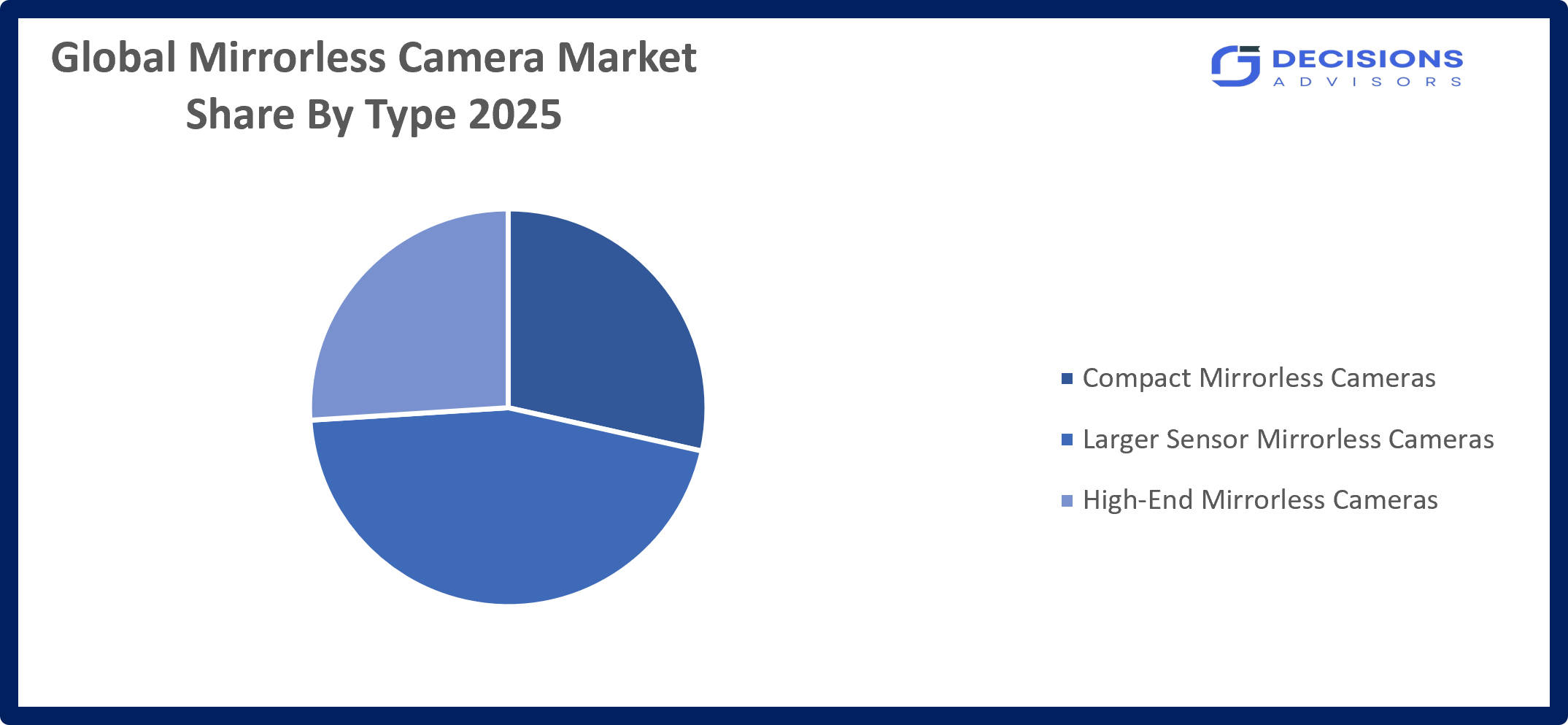
- The larger sensor mirrorless cameras segment dominated the market and holds approximately 45.5% share in 2025 and is projected to grow at a substantial CAGR during the forecast period.
Based on camera type, the global mirrorless camera market is divided into compact mirrorless cameras, larger sensor mirrorless cameras, and high-end mirrorless cameras. Among these, the larger sensor mirrorless cameras segment dominates the market and holds approximately a 45.5% share in 2025. This dominance is due to its balance of image quality, portability, and price, making it the preferred choice among enthusiasts, prosumers, and professional photographers alike. These cameras are widely used in portrait, travel, wedding, and everyday photography, making them the most preferred choice across advanced imaging applications globally.
- The photography segment accounted for the largest share of approximately 55% in 2025 and is anticipated to grow at a significant CAGR during the forecast period.
Based on the application, the market is divided into photography, videography, and live streaming. Among these, photography accounted for the largest share and holds approximately 55% share in 2025. This dominance is due to rising demand from professional photographers, wedding and event photographers, and amateur enthusiasts who prioritize still-image quality. Increasing adoption of AI-enabled autofocus and computational imaging further supports segment growth, making photography the primary revenue contributor in the Global mirrorless camera market.
- The professional photographers segment accounted for the largest share of approximately 41% in 2025 and is anticipated to grow at a significant CAGR during the forecast period.
Based on end user, the market is divided into professional photographers, amateur photographers, and content Creators. Among these, professional photographers dominate the market and hold approximately 41% share in 2025. This dominance is due to their reliance on high-end mirrorless bodies, extensive lens ecosystems, and advanced video capabilities for commercial, editorial, and cinematic work. Their demand for reliability and image quality makes them essential to the premium segment of the market, driving strong global adoption across multiple end-use applications.
Regional Segment Analysis of the Global mirrorless camera market
- North America (United States, Canada, Mexico)
- Europe (Germany, France, U.K., Italy, Spain, Russia, Rest of Europe)
- Asia-Pacific (China, Japan, India, South Korea, Rest of APAC)
- Latin America (Brazil, Mexico, Rest of Latin America)
- The Middle East and Africa (Saudi Arabia, UAE, South Africa, Rest of MEA)
Asia Pacific is anticipated to hold approximately 41.8% share of the global mirrorless camera market over the predicted timeframe.
Asia Pacific holds approximately 41.8% share of the global mirrorless camera market due to a large consumer base with a strong affinity for imaging technology, a thriving content-creation industry, and rapid adoption of new photographic technologies in countries such as Japan, South Korea, and China. The region benefits from the presence of major camera and sensor manufacturers, which support continuous innovation in sensor design and integration. High adoption of vlogging, live streaming, and social-media sharing further strengthens market growth. Additionally, expanding e-commerce and rising disposable incomes across the region contribute to sustained demand. The region's strong manufacturing base also plays a key role, with local players introducing competitively priced mirrorless models tailored to regional preferences.
North America is the second-largest region in the global mirrorless camera market, holding approximately 23% of the share during the forecast period
North America holds approximately 23% share of the Global mirrorless camera market due to strong demand from professional photographers, content creators, and filmmakers who rely on premium imaging equipment. The region benefits from the presence of leading camera and lens technology companies, which drive continuous innovation in high-resolution sensors and AI-powered autofocus. High adoption of livestreaming, social media content creation, and online retail channels further supports market expansion. Additionally, the growing integration of mirrorless cameras in wedding, editorial, and commercial photography contributes to sustained demand across the region, strengthening North America's position in the global market.
Europe is the fastest-growing region in the global mirrorless camera market during the forecast period, holding approximately a 19% share.
Europe is the fastest-growing region in the Global mirrorless camera market during the forecast period, holding approximately 19% share due to strong adoption of mirrorless systems among photography hobbyists, premium camera buyers, and professional videographers. The region benefits from a regulatory push toward energy-efficient product design and reduced electronic waste, encouraging manufacturers to introduce sustainable, low-power mirrorless bodies. Growing demand for wedding photography, documentary filmmaking, and content creation further supports market expansion. Continuous investments in digital infrastructure and camera retail across countries such as Germany, France, and the UK are accelerating the adoption of advanced mirrorless camera solutions across multiple end-use segments.
Future Market Trends in the Global Mirrorless Camera Market: -
-
- AI-Powered Computational Photography
AI-powered computational photography is increasingly used in mirrorless cameras, enhancing image quality and simplifying complex photographic tasks through intelligent autofocus, subject tracking, and noise reduction. It enables continuous improvement in low-light performance, dynamic range, and creative HDR imaging. Growing demand for smart, easy-to-use professional-grade cameras is accelerating adoption globally.
-
- Professional Workflow Integration Driving Premium Growth
Professional photographers and videographers are increasingly adopting mirrorless systems that integrate seamlessly into demanding production workflows, including internal RAW video recording and high-resolution electronic viewfinders. It improves efficiency, expands creative control, and personalizes the shooting experience across studio, cinema, and event photography. This trend is driving more advanced, reliable, and efficient professional imaging tools worldwide.
-
- Sustainability and Eco-Conscious Camera Design
Camera manufacturers are increasingly designing mirrorless bodies with recycled materials, reduced plastic packaging, and repairable components to meet rising consumer demand for environmentally responsible products. These designs offer better longevity, lower energy consumption, and improved brand appeal. Rising consumer awareness of sustainability is significantly boosting this trend globally.
-
- Expansion of Live Streaming and Creator-Economy Features
Mirrorless cameras are increasingly used for live streaming, vlogging, and social media content creation through built-in wireless connectivity and dedicated streaming modes. Their compact design and high responsiveness make them ideal for the growing creator economy. Rising demand for professional-grade content tools is accelerating market expansion globally.
Recent Development
- In March 2025, Canon Inc. launched the EOS R5 Mark II full-frame mirrorless camera, featuring advanced autofocus capabilities, improved video specifications up to 8K RAW, and a redesigned sensor for superior image quality.
- In January 2025, Nikon Corporation announced a strategic partnership with DJI to integrate advanced drone technology with its mirrorless camera systems. In February 2025, Panasonic introduced the LUMIX S9, a new compact full-frame mirrorless camera designed for content creators and vloggers.
- In April 2025, Blackmagic Design acquired Zeiss's cinematic lens division, expanding its ecosystem for professional video production and offering independent filmmakers a more comprehensive mirrorless camera and lens solution.
Market Segment
This study forecasts revenue at global, regional, and country levels from 2020 to 2035. MAK Data Insights has segmented the global mirrorless camera market based on the below-mentioned segments:
Global mirrorless camera market, By Camera Type
- Compact Mirrorless Cameras
- Larger Sensor Mirrorless Cameras
- High-End Mirrorless Cameras
- Full-Frame Mirrorless Cameras
- APS-C Mirrorless Cameras
Global mirrorless camera market, By Application
- Photography
- Videography
- Live Streaming
- Content Creation
- Wildlife & Sports Photography
Global mirrorless camera market, By End User
- Professional Photographers
- Amateur Photographers
- Content Creators
- Institutional & Educational Buyers
Global mirrorless camera market, By Regional Analysis
- North America
- United States
- Canada
- Mexico
- Europe
- Germany
- UK
- France
- Italy
- Spain
- Russia
- Rest of Europe
- Asia Pacific
- China
- Japan
- India
- South Korea
- Singapore
- Rest of Asia Pacific
- Latin America
- Brazil
- Mexico
- Rest of Latin America
- Middle East & Africa
- UAE
- Saudi Arabia
- Qatar
- South Africa
- Rest of the Middle East & Africa
Frequently Asked Questions (FAQ)
Q. How is AI improving the performance of mirrorless cameras?
A. AI enables faster and more accurate subject tracking, smarter noise reduction in low light, and automated scene optimization, allowing photographers to capture professional-quality images and video with less manual adjustment and post-processing effort.
Q. Why are mirrorless cameras increasingly preferred over DSLR cameras?
A. They offer a lighter, more compact body, faster continuous shooting, silent electronic shutters, and superior video capabilities, making them more suitable for travel, content creation, and professional video production.
Q. What role do mirrorless cameras play in the growth of the creator economy?
A. Their compact size, built-in connectivity, and high-quality 4K/8K video make them essential tools for vloggers, live streamers, and independent filmmakers producing content for social media and online platforms.
Q. How is sensor and imaging technology innovation influencing mirrorless camera development?
A. Advances in stacked and backside-illuminated sensor design, along with faster image processors, are enabling higher resolution, better low-light performance, and more compact, energy-efficient camera bodies across professional and consumer segments.
Check Licence
Choose the plan that fits you best: Single User, Multi-User, or Enterprise solutions tailored for your needs.
We Have You Covered
- 24/7 Analyst Support
- Clients Across the Globe
- Tailored Insights
- Technology Tracking
- Competitive Intelligence
- Custom Research
- Syndicated Market Studies
- Market Overview
- Market Segmentation
- Growth Drivers
- Market Opportunities
- Regulatory Insights
- Innovation & Sustainability
Report Details
| Scope | Global |
| Pages | 230 |
| Delivery | PDF & Excel via Email |
| Language | English |
| Release | Aug 2026 |
| Access | Download from this page |