
Global Mobile C-Arm Market
 |
Author:
David J
|
Pages:
200
|
Author:
David J
|
Pages:
200
Global Mobile C-Arm Market Size, Share By Product Type (Full-Size C-arm Systems, Mini C-arm Systems, Hybrid/Advanced Systems, and Others), By Application (Orthopaedic Surgeries, Cardiovascular Surgeries, Neurosurgeries, Gastrointestinal Surgeries, Others), By Technology (Flat Panel Detectors (FPD), Image Intensifiers, 2D Imaging, 3D/4D Imaging, Low-Dose Systems), and By Region (North America, Europe, Asia-Pacific, Latin America, Middle East & Africa), Analysis and Forecast 2026-2035
CAGR
6.36%
REVENUE 2025
USD Billion 2.66
FORECAST 2035
USD Billion 4.93
REPORT COVERAGE
Global
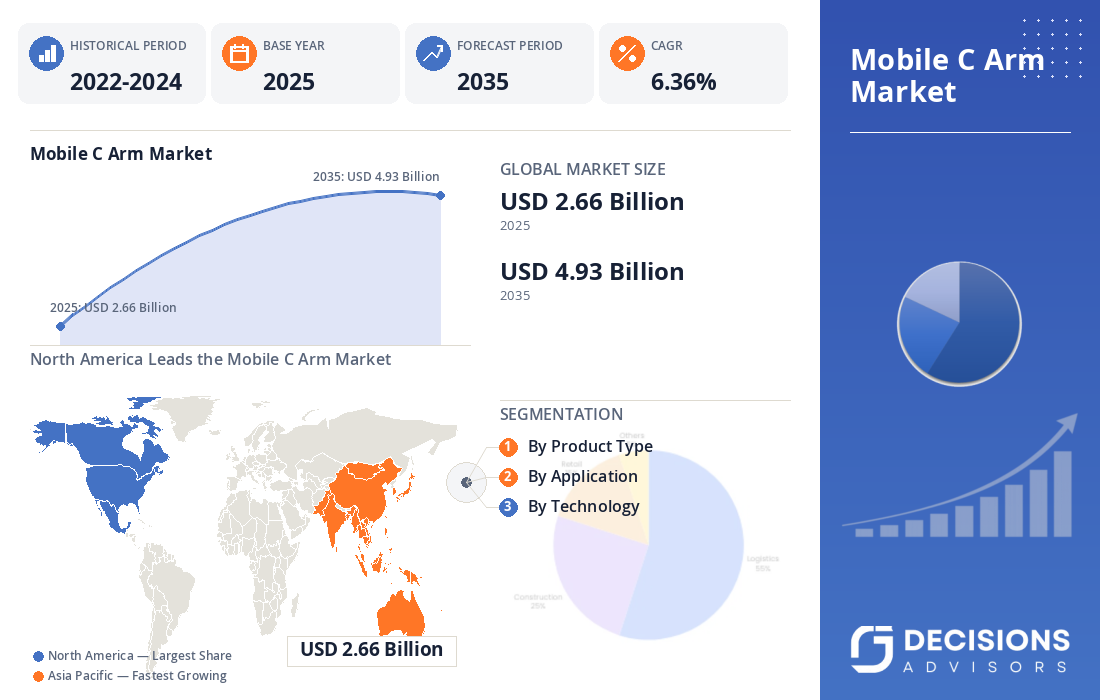
The Global Mobile C-Arm Market Size is predicted to grow from USD 2.66 Billion in 2025 and is likely to reach around USD 4.93 Billion by 2035 with a CAGR of 6.36%. According to Decision Advisors, a detailed research report on the market reflects that the touchless sensing adoption trend dominates the Global Mobile C-Arm Market, accounting for approximately 62.53% of the total share worldwide. Siemens Healthineers leads the market the market with annual revenue of approximately USD 1.85 billion and approx 20% global market share, making it the key contributor to global market development and growth dynamics.
Market Snapshot
- Global Mobile C-Arm Market Size (2025): USD 2.66 Billion
- Projected Global Mobile C-Arm Market Size (2035): USD 4.93 Billion
- Global Mobile C-Arm Market Compound Annual Growth Rate (CAGR): 6.36%
- Largest Regional Market: North America
- 2nd Largest Region: Europe
- Fastest Growing Region: Asia Pacific
- Base Year: 2025
- Historical Period: 2022-2024
- Market Forecast Period: 2026-2035
Market Overview/ Introduction
The Global Mobile C-Arm Market refers to the industry that develops portable, wheel-mounted fluoroscopic imaging systems used to provide real-time X-ray visualization during surgical and interventional procedures. The market is experiencing substantial growth because of the rising volume of orthopaedic, cardiovascular, and neurosurgical procedures, increasing preference for minimally invasive techniques, and continued expansion of hospital and ambulatory surgical infrastructure. Government programs such as the US FDA modernization initiatives, the EU4Health programme, and China’s State Council medical device regulatory reforms are creating better conditions for faster approval and adoption of advanced surgical imaging systems. Key companies, including Siemens Healthineers, GE Healthcare, Philips Healthcare, Ziehm Imaging, and Canon Medical Systems are developing compact, low-dose imaging platforms that combine high image quality with improved workflow efficiency. The market provides customers with products that combine flat-panel detector precision through compact, mobile designs which provide durability and reduced radiation exposure. The global market will experience future expansion through the development of AI-enabled imaging, 3D/4D reconstruction technologies, hybrid operating rooms, and advanced minimally invasive surgical platforms.
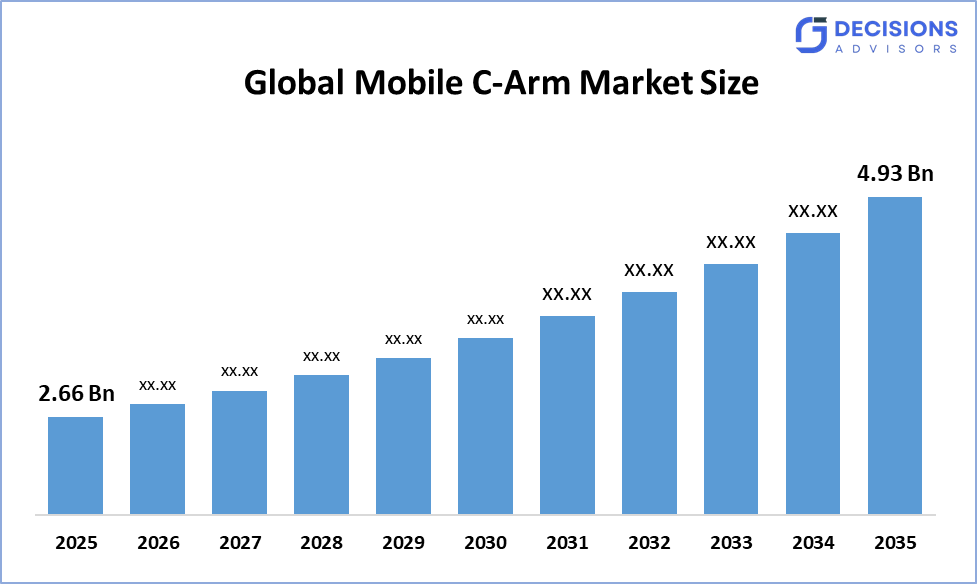
- The U.S. FDA’s streamlined 510(k) clearance pathway and supportive CMS reimbursement policies are encouraging hospitals to adopt next-generation, AI-enabled Mobile C-arm systems for surgical imaging.
- China’s State Council reforms to modernize medical device regulation and expedite review of innovative imaging technologies are driving increased adoption of Mobile C-arm systems across an expanding hospital network.
Notable Insights: -
- North America is anticipated to hold approximately 35.89% share of the Global Mobile C-Arm Market over the predicted timeframe.
- Asia Pacific is expected to grow at the fastest CAGR in the Global Mobile C-Arm Market at approximately 7.47% during the forecast period.
- By product type, the Full-Size C-arm Systems segment dominated the market and holds approximately 70.63% share in 2025 and is projected to grow at a substantial CAGR during the forecast period.
- By application, the orthopaedic surgeries segment dominated the market and holds approximately 38.54% share in 2025 and is projected to grow at a substantial CAGR during the forecast period.
- The compound annual growth rate of the Global Mobile C-Arm Market is 6.36%
- The market is likely to achieve a valuation of USD 4.93 Billion by 2035.
Market Drivers
The Global Mobile C-Arm Market experiences growth because more hospitals and surgical centers perform minimally invasive orthopaedic, cardiovascular, and neurosurgical procedures that require real-time imaging guidance. The expansion of hybrid operating rooms and modular, portable imaging systems drives increased adoption of Mobile C-arms in outpatient and regional facilities. The rising global surgical volume and Industry-wide shift toward flat panel detector technology drives the replacement of legacy image-intensifier systems with modern, low-dose platforms. The growing preference for ambulatory surgical centers shows increasing demand because of the rising use of mini C-arms for extremity and outpatient imaging. The market expands because the healthcare sector increasingly relies on dose-optimization and AI-driven imaging analytics to improve patient safety and surgical precision. The global medical device industry moves towards compact, energy-efficient, and digitally connected products which drives manufacturers to implement high-precision Mobile C-arm imaging systems.
Restrain
The Global Mobile C-Arm Market faces challenges such as high capital costs of advanced flat-panel detector systems, stringent regulatory approval requirements including FDA and CE certification, and a shortage of trained radiology technicians. Ongoing concerns around cumulative radiation exposure, despite dose-optimization technologies, also restrain broader adoption.
Competitive Analysis:
The report offers the appropriate analysis of the key organizations/companies involved within the Global Mobile C-Arm Market along with a comparative evaluation primarily based on their product offerings, business overviews, geographic presence, enterprise strategies, segment market share, and SWOT analysis. The report also provides an elaborative analysis focusing on the current news and developments of the companies, which includes product development, innovations, joint ventures, partnerships, mergers & acquisitions, strategic alliances, and others. This allows for the evaluation of the overall competition within the market.
Top Companies in the Global Mobile C-Arm Market
- Siemens Healthineers
- GE Healthcare
- Philips Healthcare
- Ziehm Imaging
- Canon Medical Systems
- Hologic Inc.
- Shimadzu Corporation
- Medtronic
- Carestream Health
- Fujifilm Holdings Corporation
Government Initiatives
|
Country |
Key Government Initiatives |
|
US |
The U.S. FDA’s streamlined 510(k) clearance pathway and CMS reimbursement policies support faster hospital adoption of AI-enabled, dose-optimized Mobile C-arm systems, encouraging continuous investment in advanced surgical imaging infrastructure. |
|
Germany |
Germany’s participation in the EU4Health programme and national healthcare digitalization strategy is funding the modernization of surgical imaging infrastructure, driving adoption of flat-panel detector Mobile C-arm systems across hospitals and specialty clinics. |
|
China |
China’s State Council reforms modernizing medical device regulation and expediting review of innovative imaging technologies, combined with hospital infrastructure expansion programs, are accelerating adoption of Mobile C-arm systems across tier 2 and tier 3 hospitals. |
Market Segmentation
The Global Mobile C-Arm Market share is classified into product type, application and technology
- The Full-Size C-arm Systems segment dominated the market and holds approximately 70.63% share in 2025 and is projected to grow at a substantial CAGR during the forecast period.
Based on the product type, the Global Mobile C-Arm Market is divided into Full-Size C-arm Systems, Mini C-arm Systems, Hybrid/Advanced Systems, and Others. Among these, the Full-Size C-arm Systems segment dominates the market and holds approximately 70.63% share in 2025. This dominance is due to its reliability, superior imaging quality, and strong compatibility with complex surgical procedures. These systems are widely used in hospitals and specialty surgical centers, making them the most preferred choice across orthopaedic, cardiovascular, and neurosurgical applications globally.
- The Orthopaedic Surgeries segment accounted for the largest share of approximately 38.54% in 2025 and is anticipated to grow at a significant CAGR during the forecast period.
Based on the application, the market is divided into Orthopaedic Surgeries, Cardiovascular Surgeries, Neurosurgeries, Gastrointestinal Surgeries, and Others. Among these, Orthopaedic Surgeries accounted for the largest share and holds approximately 38.54% share in 2025. This dominance is due to rising demand for trauma imaging, joint replacements, and extremity imaging. Increasing adoption of minimally invasive techniques and real-time imaging further supports segment growth, making orthopaedic surgeries the primary revenue contributor in the Global Mobile C-Arm Market.
- The Flat Panel Detectors (FPD) segment accounted for the largest share of approximately 62.53% in 2025 and is anticipated to grow at a significant CAGR during the forecast period.
Based on technology, the market is divided into Flat Panel Detectors (FPD), Image Intensifiers, 2D Imaging, 3D/4D Imaging, and Low-Dose Systems. Among these, Flat Panel Detectors dominate the market and hold approximately 62.53% share in 2025. This dominance is due to superior image quality, faster image acquisition, and reduced radiation exposure compared with image intensifiers. Their high responsiveness, durability, and workflow efficiency make them essential for modern surgical imaging, driving strong global adoption across multiple clinical applications.
Regional Segment Analysis of the Global Mobile C-Arm Market
- North America (U.S., Canada, Mexico)
- Europe (Germany, France, U.K., Italy, Spain, Rest of Europe)
- Asia-Pacific (China, Japan, India, Rest of APAC)
- South America (Brazil and the Rest of South America)
- The Middle East and Africa (UAE, South Africa, Rest of MEA)
North America is anticipated to hold approximately 35.89% share of the Global Mobile C-Arm Market over the predicted timeframe.
North America holds approximately 35.89% share of the Global Mobile C-Arm Market due to established healthcare infrastructure, high surgical volumes, and strong reimbursement frameworks across the United States and Canada. The region benefits from the presence of major medical device manufacturers, which support continuous innovation in flat-panel detector and dose-optimization technologies. High adoption of hybrid operating rooms, AI-driven imaging analytics, and 3D/4D reconstruction further strengthens market growth. Additionally, expanding ambulatory surgical center networks and rising demand for outpatient orthopaedic procedures contribute to sustained demand. The presence of leading Mobile C-arm manufacturers headquartered in the region also plays a key role in reinforcing North America’s leadership position in the global market.
Europe is expected to grow at a rapid CAGR in the Global Mobile C-Arm Market, holding approximately 28% of the share during the forecast period
Europe holds a strong position in the Global Mobile C-Arm Market holding approximately 28% of the share during the forecast period due to widespread adoption of advanced imaging technologies and high levels of regulatory compliance across Germany, France, and the United Kingdom. The region benefits from EU4Health programme funding and national healthcare modernization strategies that support the replacement of aging surgical imaging infrastructure. Growing demand for dose-optimization systems, hybrid operating rooms, and portable devices in outpatient settings is creating further growth opportunities. Government initiatives for patient safety and healthcare digitalization are adding to the positive growth prospects across the region.
Asia Pacific is the fastest-growing region in the Global Mobile C-Arm Market during the period, holding a CAGR of approximately 7.47%.
Asia Pacific is the fastest-growing region in the Global Mobile C-Arm Market during the forecast period, registering a CAGR of approximately 7.47%, driven by expanding healthcare infrastructure, rising surgical volumes, and increasing investment in high-end imaging equipment across China, India, and Japan. The region is witnessing rapid adoption of both full-size and mini C-arm systems in hospitals and regional clinics. Government-backed healthcare modernization programs and rising incidence of trauma, orthopaedic, and cardiovascular conditions are also supporting strong market expansion. Continuous investments in hospital infrastructure and medical device manufacturing across the region are accelerating the adoption of Mobile C-arm imaging solutions across multiple end-use settings.
Future Market Trends in Global Mobile C-Arm Market: -
-
- Rising Adoption of AI-Enabled Imaging and Workflow Optimization
AI integration is enhancing Mobile C-arm imaging by enabling automated positioning, intelligent dose optimization, and workflow-adaptive image processing. It improves diagnostic accuracy, reduces procedure time, and personalizes surgical support across orthopaedic, cardiovascular, and neurosurgical applications. This trend is driving more efficient, precise, and responsive intraoperative imaging worldwide.
-
- Growth of 3D/4D Imaging in Neurosurgery and Orthopaedic Reconstruction
3D/4D Mobile C-arm systems are increasingly used in complex neurosurgical and orthopaedic reconstruction procedures due to their ability to provide real-time, high-resolution volumetric imaging. They enable improved surgical accuracy, reduced repeat imaging, and better patient outcomes. Growing demand for advanced spinal and trauma surgery support is accelerating adoption globally.
-
- Expansion of Mini and Portable C-arms in Ambulatory Surgical Settings
Manufacturers are increasingly launching compact, mini C-arm systems designed for outpatient orthopaedic clinics and ambulatory surgical centers to enhance extremity imaging and reduce procedure costs. These systems offer greater portability, ease of use, and lower capital investment. Rising outpatient procedure volumes and demand for cost-effective imaging are significantly boosting this trend globally.
-
- Increasing Integration of Hybrid Operating Rooms
Mobile C-arm systems are being increasingly integrated into hybrid operating rooms that combine surgical and interventional imaging capabilities for complex cardiovascular and vascular procedures. Their flexibility, connectivity, and compatibility with navigation systems make them ideal for advanced hybrid OR ecosystems. Growing investment in hybrid OR infrastructure is accelerating market expansion globally.
Recent Development
- In May 2025, Siemens Healthineers launched the Cios Flow system, designed to enhance flexibility and efficiency in routine surgical imaging, expanding its portfolio for hospitals and outpatient centers.
- In July 2025, GE Healthcare introduced upgrades to its OEC Elite C-arm platform, integrating enhanced dose management and connectivity features to improve patient safety and surgical workflow efficiency.
- In September 2025, Philips Healthcare expanded its Zenition Mobile C-arm series, introducing AI-powered workflow enhancements and improved imaging quality to support orthopaedic and cardiovascular procedures.
Market Segment
This study forecasts revenue at global, regional, and country levels from 2020 to 2035. Decision Advisors has segmented the Global Mobile C-Arm Market based on the below-mentioned segments:
Global Mobile C-Arm Market, By Product Type
- Full-Size C-arm Systems
- Mini C-arm Systems
- Hybrid / Advanced Systems
- Others
Global Mobile C-Arm Market, By Application
- Orthopaedic Surgeries
- Cardiovascular Surgeries
- Neurosurgeries
- Gastrointestinal Surgeries
- Others
Global Mobile C-Arm Market, By Technology
- Flat Panel Detectors (FPD)
- Image Intensifiers
- 2D Imaging
- 3D/4D Imaging
- Low-Dose Systems
Global Mobile C-Arm Market, By Regional Analysis
- North America
- US
- Canada
- Mexico
- Europe
- Germany
- UK
- France
- Italy
- Spain
- Russia
- Rest of Europe
- Asia Pacific
- China
- Japan
- India
- South Korea
- Australia
- Rest of Asia Pacific
- South America
- Brazil
- Argentina
- Rest of South America
- Middle East & Africa
- UAE
- Saudi Arabia
- Qatar
- South Africa
- Rest of the Middle East & Africa
Frequently Asked Questions (FAQ)
Q. How are flat panel detectors transforming Mobile C-arm imaging performance?
A. Flat panel detectors deliver higher image resolution, faster image acquisition, and reduced radiation exposure compared with image intensifiers, allowing manufacturers to design lighter, more compact systems with improved workflow efficiency for hospitals and surgical centers.
Q. Why are mini C-arm systems gaining popularity in ambulatory surgical settings?
A. Mini C-arm systems offer lower capital costs, greater portability, and imaging optimized for extremity procedures, making them well suited to outpatient orthopaedic clinics and ambulatory surgical centers handling high patient volumes.
Q. What role do Mobile C-arms play in minimally invasive cardiovascular procedures?
A. They provide real-time fluoroscopic guidance that helps interventional cardiologists navigate catheters and devices with precision, reducing procedure time and improving patient safety during angioplasty and related interventions.
Q. How is AI influencing the future of Mobile C-arm imaging systems?
A. AI-powered analytics are enabling automated positioning, intelligent dose optimization, and workflow-adaptive image processing, improving diagnostic accuracy and enabling more efficient, personalized surgical imaging support across clinical settings.
Q. What are the key factors driving the Mobile C-arm market?
A. The key factors include rising surgical procedure volumes, increasing demand for minimally invasive surgeries, technological advancements in flat-panel detectors, growing adoption of mobile imaging systems, and the need for efficient intraoperative imaging.
Check Licence
Choose the plan that fits you best: Single User, Multi-User, or Enterprise solutions tailored for your needs.
We Have You Covered
- 24/7 Analyst Support
- Clients Across the Globe
- Tailored Insights
- Technology Tracking
- Competitive Intelligence
- Custom Research
- Syndicated Market Studies
- Market Overview
- Market Segmentation
- Growth Drivers
- Market Opportunities
- Regulatory Insights
- Innovation & Sustainability
Report Details
| Scope | Global |
| Pages | 200 |
| Delivery | PDF & Excel via Email |
| Language | English |
| Release | Aug 2026 |
| Access | Download from this page |