
Global Mobility Scooters Market
 |
Author:
Atul K
|
Pages:
235
|
Author:
Atul K
|
Pages:
235
Global Mobility Scooters Market Size, Share By Type (Class 2 Scooter and Class 3 Scooter), By Application (Residential and Commercial), By Battery Type (Lithium-Ion and Lead-Acid), and By Region (North America, Europe, Asia-Pacific, Latin America, Middle East & Africa), Analysis and Forecast 2026-2035.
CAGR
1.36%
REVENUE 2025
USD Billion 2.01
FORECAST 2035
USD Billion 2.3
REPORT COVERAGE
Global
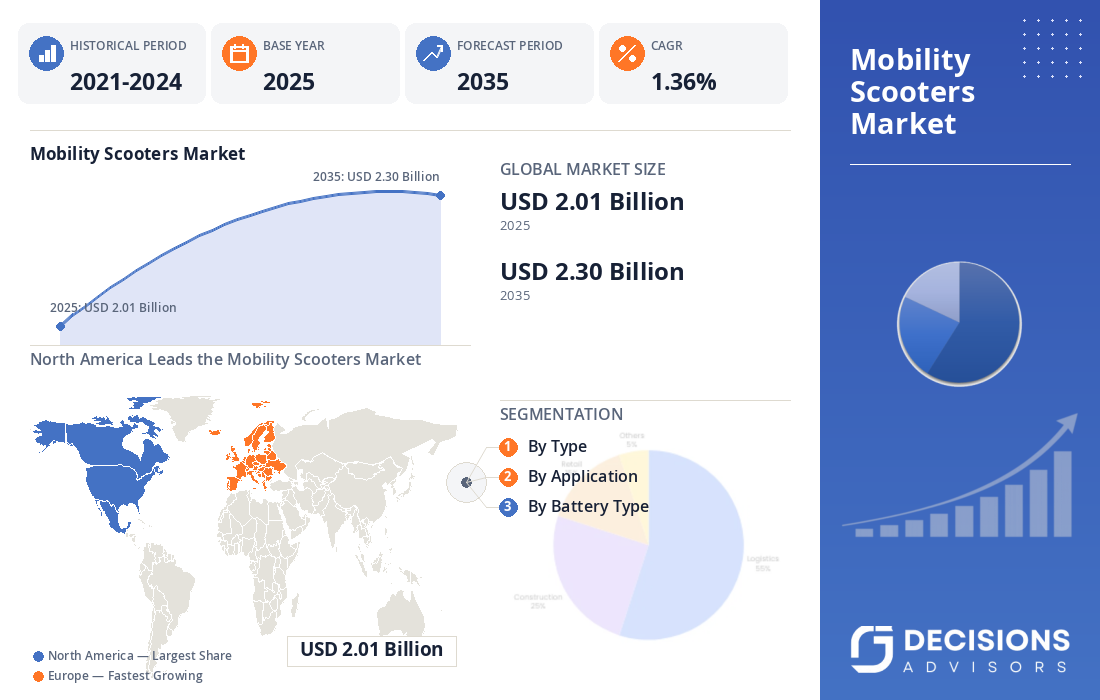
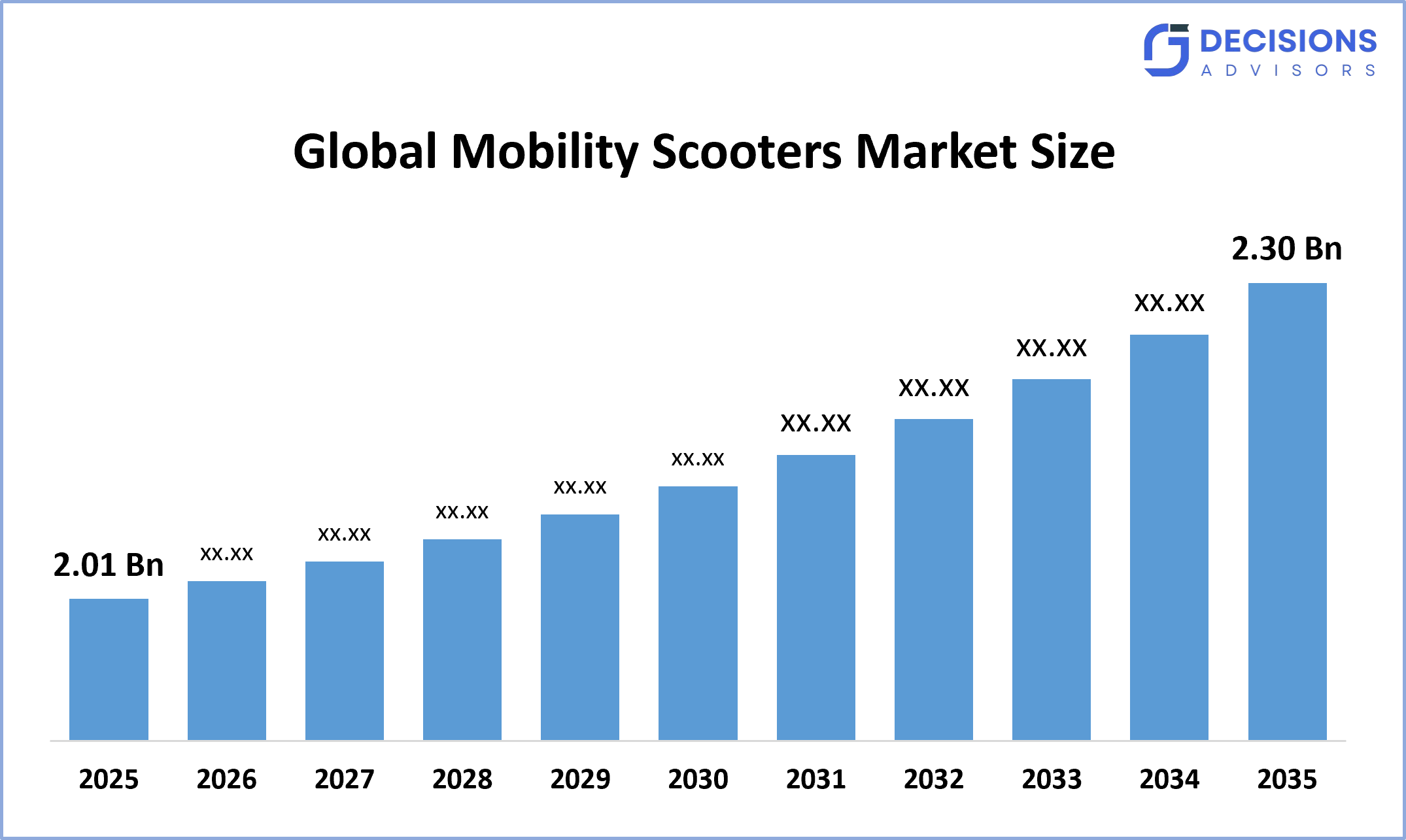
The Global Mobility Scooters Market Size is predicted to grow from USD 2.01 Billion in 2025 and is likely to reach around USD 2.30 Billion by 2035 with a CAGR of 1.36%. According to Decision Advisors, a detailed research report on the market reflects that the aging population and rising demand for independent mobility solutions dominate the Global Mobility Scooters Market, with the Class 2 Scooter segment accounting for approximately 54% of the total type-wise share worldwide. Pride Mobility Products leads the market with approximately 17% market share, making it one of the key contributors to global market development and growth dynamics.
Market Snapshot
- Global Mobility Scooters Market Size (2025): USD 2.01 Billion
- Projected Global Mobility Scooters Market Size (2035): USD 2.30 Billion
- Global Mobility Scooters Market Compound Annual Growth Rate (CAGR): 1.36%
- Largest Regional Market: North America
- 2nd Largest Region: Asia Pacific
- Fastest Growing Region: Europe
- Base Year: 2025
- Historical Period: 2021-2024
- Market Forecast Period: 2026-2035
Market Overview/ Introduction
The Global Mobility Scooters Market refers to the industry that manufactures powered personal mobility devices designed to assist elderly individuals and people with limited mobility in performing daily activities and outdoor travel independently. The market is experiencing substantial growth because of the rising global aging population, with nearly 64% of mobility scooter users aged 60 and above, and increasing prevalence of mobility impairments such as arthritis and age-related conditions. Government programs such as the U.S. Medicare coverage for power mobility devices and the UK’s VAT relief scheme for disabled people are creating stronger conditions for scooter adoption. Key companies, including Pride Mobility Products, Invacare, Kymco, Sunrise Medical, and Golden Technologies are developing lightweight, foldable scooters with extended battery range that combine high portability with reliable performance. The market provides customers with products that combine compact, foldable designs which provide long-lasting battery life and reduced storage footprint. The global market will experience future expansion through the development of smart GPS-enabled scooters, AI-powered obstacle detection, lithium-ion battery technology, and shared mobility programs for senior communities.
- The United States government supports mobility scooters market growth through Medicare Part B coverage, which pays 80% of the approved amount for power-operated scooters when a physician certifies medical necessity and the beneficiary meets functional mobility criteria, reinforcing steady demand across the country.
- The United Kingdom’s VAT relief scheme for disabled people allows eligible individuals to purchase mobility scooters at a zero VAT rate, removing the standard 20% tax and driving adoption of both Class 2 and Class 3 scooters across the country.
Notable Insights: -
- North America is anticipated to hold approximately 38% share of the Global Mobility Scooters Market over the predicted timeframe.
- Asia Pacific is expected to grow at to grow at a rapid Global Mobility Scooters Market by holding approximately 28% of the share during the forecast period.
- By type, the Class 2 Scooter segment dominated the market and holds approximately 54% share in 2025 and is projected to grow at a substantial CAGR during the forecast period.
- By application, the Residential segment dominated the market and holds approximately 62% share in 2025 and is projected to grow at a substantial CAGR during the forecast period.
- The compound annual growth rate of the Global Mobility Scooters Market is 1.36%
- The market is likely to achieve a valuation of USD 2.30 Billion by 2035.
Market Drivers
The Global Mobility Scooters Market experiences growth because the global aging population continues to expand, with age-related conditions like arthritis and limited mobility rising sharply, making mobility scooters increasingly essential for daily independence. The expansion of foldable, travel-ready scooter models drives increased adoption among users seeking portability and easy storage in urban households and apartments. Rising awareness of accessibility-focused policies and public awareness campaigns drives increased first-time purchases among elderly and disabled users. The healthcare and insurance sector shows increasing demand because rising reimbursement support through programs such as Medicare and national insurance schemes lowers the effective cost of ownership. The market expands because manufacturers integrate smart features such as GPS tracking and Bluetooth connectivity to improve user convenience and safety. The global mobility aid industry moves towards eco-friendly, electric-powered scooters, driving manufacturers to implement energy-efficient lithium-ion battery systems.
Restrain
The Global Mobility Scooters Market faces challenges such as the high cost of advanced scooters with smart features, which can cost up to 42% more than standard models, deterring adoption in middle-income segments. Limited insurance coverage, with only around 29% of consumers receiving full or partial reimbursement, combined with inadequate infrastructure and inconsistent accessibility standards across regions, also hinders broader market penetration.
Competitive Analysis:
The report offers the appropriate analysis of the key organizations/companies involved within the Global Mobility Scooters Market along with a comparative evaluation primarily based on their product offerings, business overviews, geographic presence, enterprise strategies, segment market share, and SWOT analysis. The report also provides an elaborative analysis focusing on the current news and developments of the companies, which includes product development, innovations, joint ventures, partnerships, mergers & acquisitions, strategic alliances, and others. This allows for the evaluation of the overall competition within the market.
Top Companies in the Global Mobility Scooters Market
- Pride Mobility Products
- Invacare Corporation
- Kymco
- Sunrise Medical
- Golden Technologies
- Hoveround Corp
- Drive Medical
- Afikim Electric Vehicles
- Van Os Medical
- Amigo Mobility
Government Initiatives
|
Country |
Key Government Initiatives |
|
US |
The U.S. Medicare Part B program covers power-operated scooters as durable medical equipment when a treating physician certifies medical necessity based on functional mobility limitations, with Medicare paying 80% of the approved amount after the beneficiary meets their deductible, reinforcing steady demand across the country. |
|
United Kingdom |
The UK government’s VAT relief scheme allows chronically sick or disabled individuals to purchase Class 2 mobility scooters at a zero VAT rate instead of the standard 20%, operating as a point-of-sale discount that reduces the effective purchase price and supports adoption nationwide. |
|
Japan |
Japan’s Long-Term Care Insurance system, administered by the Ministry of Health, Labour and Welfare, covers the rental of welfare equipment including mobility scooters for certified elderly individuals, supporting affordable access to powered mobility aids amid the country’s rapidly aging population. |
Market Segmentation
The Global Mobility Scooters Market share is classified into type, application and battery type
- The Class 2 Scooter segment dominated the market and holds approximately 54% share in 2025 and is projected to grow at a substantial CAGR during the forecast period.
Based on type, the Global Mobility Scooters Market is divided into Class 2 Scooter and Class 3 Scooter. Among these, the Class 2 Scooter segment dominates the market and holds approximately 54% share in 2025. This dominance is due to their lightweight, foldable designs and affordability, with speeds up to 6.4 km/h suited for pavement and indoor use. Class 3 Scooters, which are road-capable with speeds up to 12.8 km/h, are expected to see rising demand in suburban and rural areas where users need extended range and higher weight capacity for outdoor independence.
- The Residential segment accounted for the largest share of approximately 62% in 2025 and is anticipated to grow at a significant CAGR during the forecast period.
Based on the application, the market is divided into Residential and Commercial. Among these, Residential accounted for the largest share and holds approximately 62% share in 2025. This dominance is due to rising demand for personal daily-use scooters among elderly individuals for shopping, leisure outings, and community visits. The Commercial segment, which includes hospitals, retirement homes, and rehabilitation centers, is expected to grow steadily as healthcare professionals increasingly recommend mobility scooters for patients with chronic conditions affecting movement.
- The Lithium-Ion segment accounted for the largest share of approximately 61% of new product launches in 2025 and is anticipated to grow at a significant CAGR during the forecast period.
Based on battery type, the market is divided into Lithium-Ion and Lead-Acid. Among these, Lithium-Ion dominates new product launches, used in approximately 61% of new models introduced in 2025. This dominance is due to lithium-ion batteries offering lighter weight, longer travel range, and faster charging compared to traditional lead-acid batteries. Battery-powered scooters and the continued shift toward lithium-ion chemistry is expected to accelerate as manufacturers prioritize portability and extended outdoor range.
Regional Segment Analysis of the Global Mobility Scooters Market
- North America (U.S., Canada, Mexico)?
- Europe (Germany, France, U.K., Italy, Spain, Rest of Europe)
- Asia-Pacific (China, Japan, India, Rest of APAC)
- South America (Brazil and the Rest of South America)?
- The Middle East and Africa (UAE, South Africa, Rest of MEA)
North America is anticipated to hold approximately 38% share of the Global Mobility Scooters Market over the predicted timeframe.
North America holds approximately 38% share of the Global Mobility Scooters Market, with the United States contributing over 38% of regional demand. Around 64% of scooter users in the region are aged 65 and above, reflecting demographic-driven demand. Medicare and insurance reimbursement programs support nearly half of all mobility scooter purchases, while urban adoption of foldable Class 2 scooters has risen sharply. Class 3 scooter use remains prevalent in suburban and rural areas, and Canada’s market continues to expand, supported by public accessibility mandates and senior mobility grants.
Asia Pacific is expected to grow at to grow at a rapid CAGR Global Mobility Scooters Market by holding approximately 28% of the share during the forecast period
Asia Pacific is expected to grow at the rapid CAGR in the Global Mobility Scooters Market during the forecast period, with China and Japan together accounting for around 68% of regional demand. Japan’s rapidly aging population has driven a sharp increase in Class 2 scooter adoption for daily use, supported by the country’s Long-Term Care Insurance welfare equipment rental scheme. In India and Southeast Asia, market penetration is growing in tier-1 and tier-2 cities as healthcare awareness improves, while local manufacturing initiatives and government incentives have boosted affordability across the region.
Europe is the fastest-growing region in the Global Mobility Scooters Market during the period, holding approximately 61% share.
The Europe Mobility Scooters Market accounts, driven by strong aging populations in Germany, the UK, France, and the Nordic countries. Over 61% of mobility scooter users in the region rely on them as their primary mode of personal transportation, and government-funded disability support programs, including the UK’s VAT relief scheme, cover a substantial share of scooter purchases. Class 3 scooters are widely used in rural and semi-urban parts of Europe, while Class 2 scooters dominate urban unit sales, supported by public transportation integration programs in cities such as Berlin, London, and Copenhagen.
Future Market Trends in Global Mobility Scooters Market: -
-
- Growth of Smart and Connected Mobility Scooters
Integration of smart features such as GPS tracking, Bluetooth connectivity, and automated braking is rising among top manufacturers, appealing to tech-savvy senior users. Smart docking and shared mobility concepts are gaining attention, with manufacturers exploring partnerships for city-based mobility programs targeted at senior communities. This trend is making scooters more user-friendly and safer for daily independent use worldwide
-
- Expansion of Foldable and Travel-Ready Designs
Foldable mobility scooters are seeing sharply rising demand due to their portability and ease of storage, particularly among apartment dwellers and travelers. Lightweight frames combined with lithium-ion batteries allow users to transport scooters in vehicles and on public transport with greater ease. Growing preference for compact, travel-friendly mobility aids is accelerating this trend across urban markets globally
-
- Adoption of Lithium-Ion Battery and Extended-Range Technology
Manufacturers are increasingly equipping mobility scooters with energy-efficient lithium-ion batteries that offer longer travel ranges and lighter overall weight compared to traditional lead-acid batteries. Extended-range units are enabling greater outdoor independence for users in suburban and rural areas. Rising demand for eco-friendly, electric-powered mobility solutions is accelerating adoption of this technology worldwide.
-
- Rising Government and Insurance Support for Senior Mobility
Governments and insurance providers are expanding subsidy and reimbursement programs to support low-income elderly individuals in acquiring mobility scooters, lowering the effective cost of ownership. Public health policy shifts and improved accessibility mandates in regions such as North America, Europe, and the Middle East are encouraging first-time adoption. Growing partnerships between manufacturers and healthcare providers are further expanding market reach globally.
Recent Development
- In August 2023, Pride Mobility Products released a smart Class 2 scooter featuring GPS tracking and auto-braking technology, resulting in a 34% rise in adoption across urban centers in the United States.
- In July 2026, Invacare launched a rugged all-terrain Class 3 scooter designed for elderly outdoor users, featuring improved suspension performance that contributed to a 39% spike in rural demand across Europe and Canada.
Market Segment
This study forecasts revenue at global, regional, and country levels from 2020 to 2035. Decision Advisors has segmented the Global Mobility Scooters Market based on the below-mentioned segments:
Global Mobility Scooters Market, By Type
- Class 2 Scooter
- Class 3 Scooter
- Foldable/Travel Scooters
- All-Terrain Scooters
- Others
Global Mobility Scooters Market, By Application
- Residential
- Commercial
- Hospitals
- Rehabilitation Centers
- Others
Global Mobility Scooters Market, By Battery Type
- Lithium-Ion
- Lead-Acid
- Gel
- Others
Global Mobility Scooters Market, By Regional Analysis
- North America
- US
- Canada
- Mexico
- Europe
- Germany
- UK
- France
- Italy
- Spain
- Russia
- Rest of Europe
- Asia Pacific
- China
- Japan
- India
- South Korea
- Australia
- Rest of Asia Pacific
- South America
- Brazil
- Argentina
- Rest of South America
- Middle East & Africa
- UAE
- Saudi Arabia
- Qatar
- South Africa
- Rest of the Middle East & Africa
Frequently Asked Questions (FAQ)
Q. What is driving demand growth in the Global Mobility Scooters Market?
A. The rising global aging population, with nearly 64% of users aged 60 and above, along with increasing prevalence of mobility impairments and growing awareness of accessibility-focused policies, is driving consistent demand for powered mobility scooters worldwide.
Q. Why does the Class 2 Scooter segment lead the market by type?
A. Class 2 Scooters offer lightweight, foldable designs and affordability, with speeds suited for pavement and indoor use, making them the preferred choice for daily errands and short-distance travel among urban and apartment-dwelling seniors.
Q. How is technology reshaping the mobility scooters market?
A. Manufacturers are integrating GPS tracking, Bluetooth connectivity, AI-enabled obstacle detection, and lithium-ion batteries to improve user safety, convenience, and travel range, making scooters smarter and more portable than ever before.
Q. How are government and insurance programs influencing scooter adoption?
A. Programs such as U.S. Medicare Part B coverage, the UK’s VAT relief scheme, and Japan’s Long-Term Care Insurance equipment rental scheme are lowering the effective cost of ownership and driving consistent demand for mobility scooters across major markets.
Q. Who are the major companies operating in the mobility scooters market?
A. Major companies include Pride Mobility Products, Invacare Corporation, Drive DeVilbiss Healthcare, Golden Technologies, Afikim Electric Vehicles, and Sunrise Medical.
Check Licence
Choose the plan that fits you best: Single User, Multi-User, or Enterprise solutions tailored for your needs.
We Have You Covered
- 24/7 Analyst Support
- Clients Across the Globe
- Tailored Insights
- Technology Tracking
- Competitive Intelligence
- Custom Research
- Syndicated Market Studies
- Market Overview
- Market Segmentation
- Growth Drivers
- Market Opportunities
- Regulatory Insights
- Innovation & Sustainability
Report Details
| Scope | Global |
| Pages | 235 |
| Delivery | PDF & Excel via Email |
| Language | English |
| Release | Aug 2026 |
| Access | Download from this page |