
Global Molecular Spectroscopy Market
 |
Pages:
250
|
Pages:
250
Global Molecular Spectroscopy Market Size, Share, and COVID-19 Impact Analysis, By Product Type (Consumables and Instruments), By Technology (NMR Spectroscopy, Raman Spectroscopy, UV-Visible Spectroscopy, Mass Spectroscopy, Infrared Spectroscopy, Near-Infrared Spectroscopy, and Others) and By Region (North America, Europe, Asia-Pacific, Latin America, Middle East, and Africa), Analysis and Forecast 2025-2035
REPORT COVERAGE
Global
Global Molecular Spectroscopy Market Size Insights Forecasts to 2035
- The Global Molecular Spectroscopy Market Size Was valued at USD 6.84 Billion in 2024
- The Global Molecular Spectroscopy Market Size is Expected to Grow at a CAGR of around 3.31% from 2025 to 2035
- The Worldwide Molecular Spectroscopy Market Size is Expected to Reach USD 9.79 Billion by 2035
- Asia-Pacific is expected to grow the fastest during the forecast period.
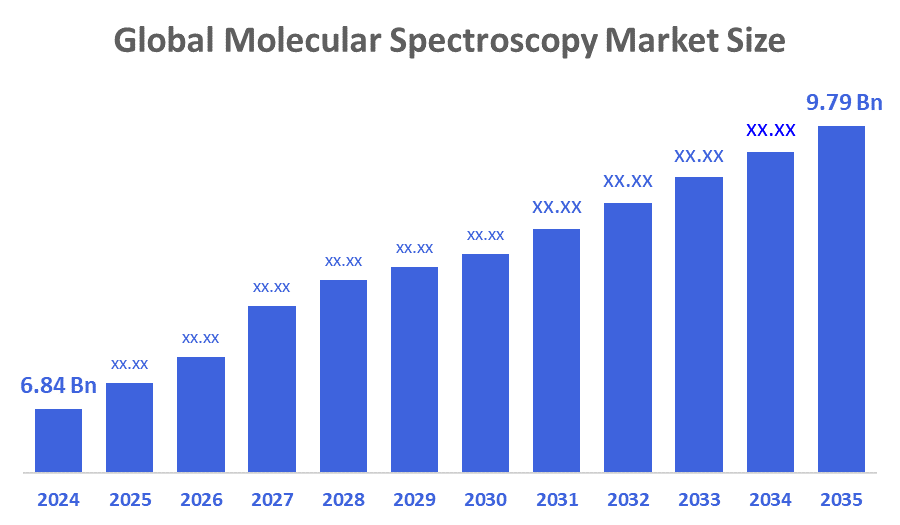
According to a research report published by Decisions Advisors and Consulting, The Global Molecular Spectroscopy Market Size Was Worth Around USD 6.84 Billion In 2024 And Is Predicted To Grow To Around USD 9.79 Billion By 2035 With A Compound Annual Growth Rate (CAGR) Of 3.31% From 2025 To 2035. The market experiences growth through three main factors which include strong research facilities and increased research and development funding and expanding adoption in pharmaceutical and biotechnology fields and environmental testing sector expansion.
Market Overview
The Global Molecular Spectroscopy Market Size refers to the worldwide industry which develops and manufactures instruments and consumables and software used for molecular structure analysis through electromagnetic radiation matter interaction measurement in research and pharmaceutical and environmental and industrial settings. Additionally, the adoption of molecular spectroscopy for environmental applications is increasing because people are more aware of environmental issues and governments are creating programs to support sustainable practices. The process includes treating wastewater and performing environmental assessments and tracking polycyclic aromatic hydrocarbons (PAH) emissions to protect natural resources. Research shows that 62% of consumers will change their purchasing habits to help protect the environment. Nuclear magnetic resonance (NMR) spectroscopy functions as an essential instrument which scientists use to evaluate product quality through purity testing and molecular structure analysis of organic substances. The market growth receives major support from both rising food safety issues and the expanding biotechnology sector.
Report Coverage
This research report categorizes the molecular spectroscopy market based on various segments and regions, forecasts revenue growth, and analyzes trends in each submarket. The report analyses the key growth drivers, opportunities, and challenges influencing the molecular spectroscopy market. Recent market developments and competitive strategies such as expansion, type launch, development, partnership, merger, and acquisition, have been included to draw the competitive landscape in the market. The report strategically identifies and profiles the key market players and analyses their core competencies in each sub-segment of the molecular spectroscopy market.
Driving Factors
The development of food safety and environmental monitoring applications provides businesses with opportunities to expand their operations. The market growth potential exists because businesses now utilize their products for food safety and environmental monitoring outside of laboratory environments. Food manufacturers now use Raman and NIR spectroscopy to verify product composition and detect pesticide contamination in agricultural produce during production processes. Environmental laboratories use UV-Vis and IR techniques to measure heavy metals and pollutants in water and air samples, which helps enforce regulatory standards. The various applications of these technologies lead to their increased usage by different industry sectors.
Restraining Factors
The market expansion process faces obstacles because six factors including high instrument costs and complex operational needs and skilled workforce requirements and maintenance costs and restricted user knowledge in developing areas and regulatory compliance difficulties.
Market Segmentation
The molecular spectroscopy market share is classified into product type and technology
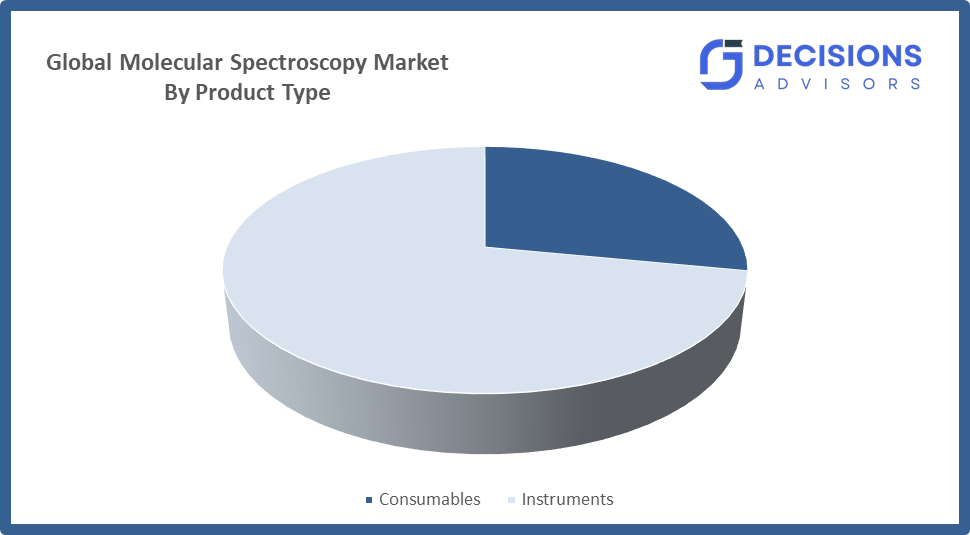
- The instruments segment accounted for the largest share in 2024 and is anticipated to grow at a significant CAGR during the forecast period.
Based on the product type, the molecular spectroscopy market is divided into consumables and instruments. Among these, the instruments segment accounted for the largest share in 2024 and is anticipated to grow at a significant CAGR during the forecast period. Technological improvements which bring better resolution and easier usage of products together with their ability to work with artificial intelligence and machine learning systems for data processing are driving this segment's growth. The pharmaceutical and biotechnology industry shows strong market demand because of their increasing use of Nuclear Magnetic Resonance (NMR) instruments to support drug development and quality control processes. Environmental testing programs depend on instruments which perform essential functions to help industries comply with strict pollution monitoring regulations. The research activities which take place in academic and industrial settings especially in life sciences and material sciences fields contribute to the growth of this segment.
- The NMR spectroscopy segment accounted for the highest market revenue in 2024 and is anticipated to grow at a significant CAGR during the forecast period.
Based on the technology, the molecular spectroscopy market is divided into NMR spectroscopy, raman spectroscopy, UV-visible spectroscopy, mass spectroscopy, infrared spectroscopy, near-infrared spectroscopy, and others. Among these, the NMR spectroscopy segment accounted for the highest market revenue in 2024 and is anticipated to grow at a significant CAGR during the forecast period. The technology serves a prominent role because it provides the most accurate analysis of molecular structures which scientists need to create new drugs. The healthcare industry requires advanced diagnostic tools which include metabolomics and biomarker research to support its growing need for these tests. The non-invasive nature of NMR spectroscopy together with its ability to analyze complex mixtures has made it useful for applications in both pharmaceutical research and food quality assessment and material science testing. The market growth receives additional support from rising academic research funding and the progress made in structural biology. The development of cryogen-free systems together with advanced sensitivity improvements provides users better access to systems while increasing their ability to operate effectively. The growing importance of RE research in battery materials analysis demonstrates its value to multiple industries which leads to increased market expansion.
Regional Segment Analysis of the Molecular Spectroscopy Market
- North America (U.S., Canada, Mexico)
- Europe (Germany, France, U.K., Italy, Spain, Rest of Europe)
- Asia-Pacific (China, Japan, India, Rest of APAC)
- South America (Brazil and the Rest of South America)
- The Middle East and Africa (UAE, South Africa, Rest of MEA)
North America is anticipated to hold the largest share of the molecular spectroscopy market over the predicted timeframe.
North America is anticipated to hold the largest share of the molecular spectroscopy market over the predicted timeframe. The region exhibits growth because of extensive research development activities and advanced healthcare systems and major market players. The region encompasses key markets, including the United States, Canada, and Mexico, with each country contributing uniquely to the spectroscopy market landscape. The region experiences market expansion because established pharmaceutical and biotechnology industries together with high healthcare spending and technological progress.
Asia-Pacific is expected to grow at a rapid CAGR in the molecular spectroscopy market during the forecast period. The region shows expansion through its research activities and pharmaceutical industry growth and increasing healthcare investments. The region encompasses China, Japan, India, Australia, and South Korea as its major markets which together drive market growth. The market experiences growth because of two main factors: the expanding biotechnology sector and the rising research funding and the increasing use of advanced analytical technologies.
Competitive Analysis:
The report offers the appropriate analysis of the key organizations/companies involved within the molecular spectroscopy market, along with a comparative evaluation primarily based on their type of offering, business overviews, geographic presence, enterprise strategies, segment market share, and SWOT analysis. The report also provides an elaborative analysis focusing on the current news and developments of the companies, which includes type development, innovations, joint ventures, partnerships, mergers & acquisitions, strategic alliances, and others. This allows for the evaluation of the overall competition within the market.
List of Key Companies
- Thermo Fisher Scientific Inc.
- Bruker
- Danaher Corporation
- Agilent Technologies, Inc.
- Shimadzu Corporation
- PerkinElmer, Inc.
- ABB Ltd.
- Waters Corporation
- Horiba Ltd.
- Endress+Hauser Group Services AG
- Others
Key Target Audience
- Market Players
- Investors
- End-users
- Government Authorities
- Consulting and Research Firm
- Venture capitalists
- Value-Added Resellers (VARs)
Recent Development
- In August 2024, research engineers at The Hong Kong Polytechnic University (PolyU) created a quantum microprocessor chip that successfully simulated molecular spectroscopy patterns of real, complex large molecules, marking their first worldwide breakthrough.
Market Segment
This study forecasts revenue at global, regional, and country levels from 2020 to 2035. Decisions Advisors has segmented the molecular spectroscopy market based on the below-mentioned segments:
Global Molecular Spectroscopy Market, By Product Type
- Consumables
- Instruments
Global Molecular Spectroscopy Market, By Technology
- NMR Spectroscopy
- Raman Spectroscopy
- UV-Visible Spectroscopy
- Mass Spectroscopy
- Infrared Spectroscopy
- Near-Infrared Spectroscopy
- Others
Global Molecular Spectroscopy Market, By Regional Analysis
- North America
- US
- Canada
- Mexico
- Europe
- Germany
- UK
- France
- Italy
- Spain
- Russia
- Rest of Europe
- Asia Pacific
- China
- Japan
- India
- South Korea
- Australia
- Rest of Asia Pacific
- South America
- Brazil
- Argentina
- Rest of South America
- Middle East & Africa
- UAE
- Saudi Arabia
- Qatar
- South Africa
- Rest of the Middle East & Africa
Frequently Asked Questions (FAQ)
- What is the CAGR of the molecular spectroscopy market over the forecast period?
A: The global Molecular Spectroscopy market is projected to expand at a CAGR of 3.31% during the forecast period.
- What is the market size of the molecular spectroscopy market?
A: The global molecular spectroscopy market size is estimated to grow from USD 6.84 billion in 2024 to USD 9.79 billion by 2035, at a CAGR of 3.31% during the forecast period 2025-2035.
- Which region holds the largest share of the molecular spectroscopy market?
A: North America is anticipated to hold the largest share of the molecular spectroscopy market over the predicted timeframe.
- Who are the top 10 companies operating in the global molecular spectroscopy market?
A: Thermo Fisher Scientific Inc., Bruke, Danaher Corporation, Agilent Technologies, Inc., Shimadzu Corporation, PerkinElmer, Inc., ABB Ltd., Waters Corporation, Horiba Ltd., Endress+Hauser Group Services AG, and Others.
- What are the market trends in the molecular spectroscopy market?
A: The molecular spectroscopy market shows key market trends through three main developments which include its increasing use in pharmaceutical research and development and quality control processes, the development of AI systems together with cloud-based analytical solutions, the growing use of portable and miniaturized devices, and the market expansion of environmental and food safety testing applications.
Check Licence
Choose the plan that fits you best: Single User, Multi-User, or Enterprise solutions tailored for your needs.
We Have You Covered
- 24/7 Analyst Support
- Clients Across the Globe
- Tailored Insights
- Technology Tracking
- Competitive Intelligence
- Custom Research
- Syndicated Market Studies
- Market Overview
- Market Segmentation
- Growth Drivers
- Market Opportunities
- Regulatory Insights
- Innovation & Sustainability
Report Details
| Scope | Global |
| Pages | 250 |
| Delivery | PDF & Excel via Email |
| Language | English |
| Release | Feb 2026 |
| Access | Download from this page |