
Global Multiple Sclerosis Market
 |
Author:
Disha B
|
Pages:
231
|
Author:
Disha B
|
Pages:
231
Global Multiple Sclerosis Market Size, Share, and COVID-19 Impact Analysis, By Drug Type (Immunomodulatory, Immunosuppressant, Interferons, and Corticosteroids), By Route of Administration (Oral, Parenteral, and Others), and By Region (North America, Europe, Asia-Pacific, Latin America, Middle East, and Africa), Analysis and Forecast 2025 - 2035
CAGR
3.75%
REVENUE 2025
USD Billion 25.15
FORECAST 2035
USD Billion 37.72
REPORT COVERAGE
Global
Global Multiple Sclerosis Market Size Insights Forecasts to 2035
- The Global Multiple Sclerosis Market Size Was Estimated at USD 25.15 Billion in 2024
- The Market Size is Expected to Grow at a CAGR of around 3.75% from 2025 to 2035
- The Worldwide Multiple Sclerosis Market Size is Expected to Reach USD 37.72 Billion by 2035
- North America is expected to Grow the fastest during the forecast period.
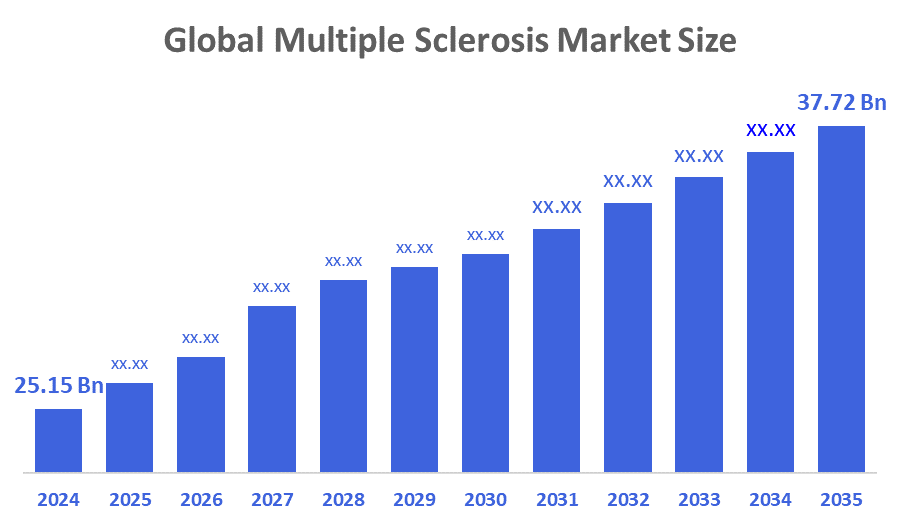
According to a Research Report Published by Decisions Advisors and Consulting, The Global Multiple Sclerosis Market Size was worth around USD 25.15 Billion in 2024 and is predicted to Grow to around USD 37.72 Billion by 2035 with a compound annual growth rate (CAGR) of 3.75% from 2025 to 2035. The increase in the disease's prevalence worldwide and the discovery of disease-modifying treatments (DMTs), which delay the disease's course and better control its symptoms, are the reasons for the market's expansion. The global multiple sclerosis market is anticipated to develop because of the disease's increasing prevalence and more awareness brought about by various governmental and non-governmental organisations.
Market Overview
The multiple sclerosis (MS) market refers to the global industry focused on the diagnosis, treatment, and management of multiple sclerosis, encompassing pharmaceuticals, biologics, biosimilars, and supportive care solutions. Multiple sclerosis (MS) is a long-lasting neurological disorder that affects the central nervous system (CNS), which includes the brain and spinal cord. Multiple Sclerosis is characterised by the immune system incorrectly attacking the myelin that safeguards nerve fibres. Myelin is essential for the precise transmission of nerve signals. The immune system's assault on the myelin leads to the development of scar tissue (sclerosis) in various areas of the central nervous system (CNS). The injury disrupts the normal flow of electrical signals through the nerves, leading to symptoms that can vary greatly among individuals with Multiple Sclerosis. Common symptoms consist of fatigue, reduced mobility, sensations of numbness or tingling, muscle weakness, challenges with movement coordination and balance, vision problems, as well as cognitive and mood issues. Multiple Sclerosis is mainly identified in young adults, typically between 20 and 50 years old, and it is more common in women than in men.
Report Coverage
This research report categorises the multiple sclerosis market based on various segments and regions, forecasts revenue growth, and analyzes trends in each submarket. The report analyses the key growth drivers, opportunities, and challenges influencing the multiple sclerosis market. Recent market developments and competitive strategies, such as expansion, product launch, development, partnership, merger, and acquisition, have been included to draw the competitive landscape in the market. The report strategically identifies and profiles the key market players and analyzes their core competencies in each sub-segment of the multiple sclerosis market.
Driving Factors
The worldwide incidence of multiple sclerosis (MS) is increasing, fueled by more timely and precise diagnoses made possible by advanced imaging techniques like MRI. A wide range of disease-modifying therapies (DMTs) has revolutionised clinical treatment by markedly lowering relapse rates and postponing disease advancement in individuals with relapsing-remitting MS. The MS treatment pipeline is strong, highlighting encouraging investigational drugs such as remibrutinib, fenebrutinib, masitinib, and CNM-Au8, progressing through different clinical phases. The quality of life for people with multiple sclerosis (MS) is being greatly improved by recent technology developments, which are also expected to generate considerable growth prospects in the therapeutic market throughout the projection period. Voice-command interfaces, smartphone apps, assistive robotic arms, and neurotherapeutic methods like transcranial direct current stimulation (tDCS) have all transformed patient care and symptom management.
Restraining Factors
The drugs used to treat multiple sclerosis (MS) have been associated with several adverse effects, such as progressive multifocal leukoencephalopathy, liver damage, infections, and irregular heartbeats. The expansion of the multiple sclerosis market is hampered by these issues, which make it difficult for patients to follow their treatment plans. High treatment costs, restricted accessibility in low-income areas, unfavourable medicine side effects, and patent expirations that allow generics to enter the market and lower profitability are some of the issues facing market growth.
Market Segmentation
The multiple sclerosis market share is classified into drug type and route of administration.
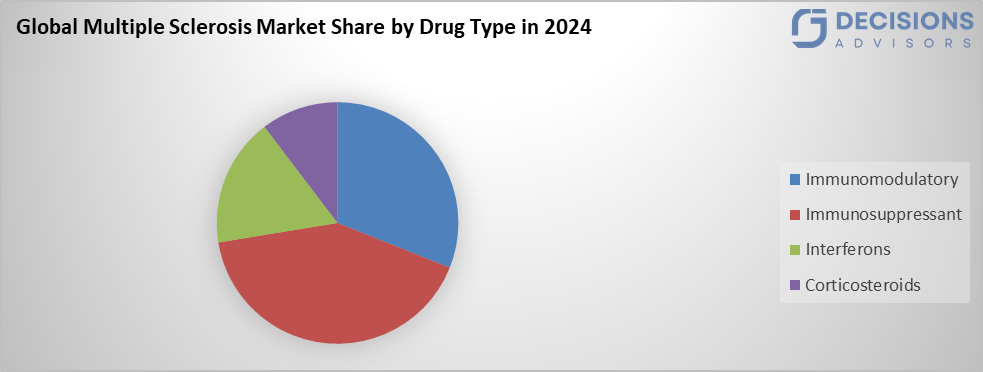
- The immunosuppressant segment accounted for the largest share in 2024 and is anticipated to grow at a significant CAGR during the forecast period.
Based on the drug type, the multiple sclerosis market is divided into immunomodulatory, immunosuppressant, interferons, and corticosteroids. Among these, the immunosuppressant segment accounted for the largest share in 2024 and is anticipated to grow at a significant CAGR during the forecast period. This is due to its exceptional effectiveness in treating patients with RRMS; this segment dominated the multiple sclerosis industry. The segment's growth is reinforced by the growing number of medications approved to treat multiple sclerosis. The drugs have a number of other advantages, such as effective administration at low dosages, few adverse effects, and high efficacy, which support the expansion of the market.
- The oral segment dominated the market in 2024 and is anticipated to grow at a significant CAGR during the forecast period.
Based on the route of administration, the multiple sclerosis market is segmented into oral, parenteral, and others. Among these, the oral segment dominated the market in 2024 and is anticipated to grow at a significant CAGR during the forecast period. This is because doctors and patients prefer oral prescriptions over injectable pharmaceuticals. This can be explained by a number of things, such as customer incentives, convenience, and support from health insurance companies.
Regional Segment Analysis of the Multiple Sclerosis Market
- North America (U.S., Canada, Mexico)
- Europe (Germany, France, U.K., Italy, Spain, Rest of Europe)
- Asia-Pacific (China, Japan, India, Rest of APAC)
- South America (Brazil and the Rest of South America)
- The Middle East and Africa (UAE, South Africa, Rest of MEA)
Asia Pacific is anticipated to hold the largest share of the multiple sclerosis market over the predicted timeframe.
Asia Pacific is anticipated to hold the largest share of the multiple sclerosis market over the predicted timeframe. This is because there is a sizable and untapped patient population, improved healthcare infrastructure, more disposable income, and more government initiatives to support the local Multiple Sclerosis community. Additionally, a number of organisations have expanded funding for research in this field, which speeds up the creation and testing of drugs and therapies for multiple sclerosis. For example, the first adaptive clinical trial for Australians with multiple sclerosis intends to treat neurological impairment brought on by progressive multiple sclerosis with an initial investment of USD 4 million.
North America is expected to grow at a rapid CAGR in the multiple sclerosis market during the forecast period. This is due to its high prevalence of Multiple Sclerosis, advanced healthcare facilities, access to cutting-edge drugs, increased investment in R&D, and favourable reimbursement policies. The North American area is expected to have the largest market share worldwide. According to the National Multiple Sclerosis Society, Canada has the greatest prevalence of multiple sclerosis worldwide, with 291 cases per 100,000 people. Similarly, the National MS Society estimates that approximately 1 million Americans suffer from multiple sclerosis. Companies like Biogen, Novartis AG, and Sanofi SA have made a strong name for themselves in the US market and are continuously focusing more on creating new treatments.
Competitive Analysis:
The report offers the appropriate analysis of the key organizations/companies involved within the multiple sclerosis market, along with a comparative evaluation primarily based on their product offering, business overviews, geographic presence, enterprise strategies, segment market share, and SWOT analysis. The report also provides an elaborative analysis focusing on the current news and developments of the companies, which includes product development, innovations, joint ventures, partnerships, mergers & acquisitions, strategic alliances, and others. This allows for the evaluation of the overall competition within the market.
List of Key Companies
- Actelion Pharmaceuticals Ltd.
- Active Biotech AB
- Bayer AG
- Biogen Inc.
- Celgene Corporation
- EMD Opexa Therapeutics Inc.
- GlaxoSmithKline plc.
- Innate Immunotherapeutics
- InnoBioscience LLC
- Merck and Co.
- Novartis AG
- Pfizer Inc.
- Sanofi
- Synthetic Biologics Inc.
- Others
Key Target Audience
- Market Players
- Investors
- End-users
- Government Authorities
- Consulting and Research Firm
- Venture capitalists
- Value-Added Resellers (VARs)
Recent Development
- In November 2025, Sandoz launched TYRUKO (natalizumab-sztn) in the US, marking the first and only FDA-approved biosimilar for multiple sclerosis. It references Biogen’s Tysabri and is expected to expand patient access while reducing treatment costs.
Market Segment
This study forecasts revenue at global, regional, and country levels from 2020 to 2035. Decisions Advisors has segmented the multiple sclerosis market based on the below-mentioned segments:
Global Multiple Sclerosis Market, By Drug Type
- Immunomodulatory
- Immunosuppressant
- Interferons
- Corticosteroids
Global Multiple Sclerosis Market, By Route of Administration
- Oral
- Parenteral
- Others
Global Multiple Sclerosis Market, By Regional Analysis
- North America
- US
- Canada
- Mexico
- Europe
- Germany
- UK
- France
- Italy
- Spain
- Russia
- Rest of Europe
- Asia Pacific
- China
- Japan
- India
- South Korea
- Australia
- Rest of Asia Pacific
- South America
- Brazil
- Argentina
- Rest of South America
- Middle East & Africa
- UAE
- Saudi Arabia
- Qatar
- South Africa
- Rest of the Middle East & Africa
Frequently Asked Questions (FAQ)
- What is the projected size and growth rate of the global multiple sclerosis market?
The market was valued at USD 25.15 billion in 2024 and is expected to reach USD 37.72 billion by 2035, growing at a CAGR of 3.75% from 2025 to 2035.
- What are the main drivers of market growth?
Key drivers include rising global prevalence of multiple sclerosis, advanced diagnostic tools like MRI, disease-modifying therapies (DMTs) that reduce relapses, and innovations such as smartphone apps, assistive robotics, and neurotherapies improving patient quality of life.
- What segments dominate the market by drug type and route of administration?
Immunosuppressants held the largest share in 2024 due to their effectiveness in relapsing-remitting MS (RRMS), low dosages, and fewer side effects. Oral administration dominated, driven by patient and physician preference for convenience over injectables.
- Which region leads the market, and why?
Asia-Pacific is anticipated to hold the largest share, fueled by untapped patient populations, improving healthcare infrastructure, rising disposable incomes, and government research funding (e.g., USD 4 million for adaptive clinical trials in Australia). North America grows fastest due to high prevalence (e.g., 291 cases per 100,000 in Canada), advanced facilities, and R&D investments.
- What are the primary restraining factors?
High treatment costs, adverse effects (e.g., infections, liver damage), limited access in low-income regions, and patent expirations enabling generics challenge growth and patient adherence.
- Who are the key players in the market?
Major companies include Biogen Inc., Novartis AG, Sanofi, Bayer AG, Teva Pharmaceuticals, Pfizer Inc., Merck and Co., and others like Actelion Pharmaceuticals Ltd. and Celgene Corporation.
- What recent developments highlight market trends?
In November 2025, Sandoz launched TYRUKO (natalizumab-sztn), the first FDA-approved biosimilar to Biogen’s Tysabri in the US, aiming to improve access and lower costs.
- What does the report cover in terms of segmentation and forecast?
It segments by drug type (immunomodulatory, immunosuppressant, interferons, corticosteroids), route of administration (oral, parenteral, others), and regions (North America, Europe, Asia-Pacific, etc.), with forecasts from 2020-2035 and analysis of drivers, challenges, and competitive strategies.
- Introduction
- Objectives of the Study
- Market Definition
- Research Scope
- Research Methodology and Assumptions
- Executive Summary
- Premium Insights
- Porter’s Five Forces Analysis
- Value Chain Analysis
- Top Investment Pockets
- Market Attractiveness Analysis By Drug Type
- Market Attractiveness Analysis By Route of Administration
- Market Attractiveness Analysis By Region
- Industry Trends
- Market Dynamics
- Market Evaluation
- Drivers
- More awareness brought about by various governmental and non-governmental organisations
- Restraints
- High treatment costs, restricted accessibility in low-income areas, unfavourable medicine side effects
- Opportunities
- Disease's prevalence worldwide and the discovery of disease-modifying
- Challenges
- Progressive multifocal leukoencephalopathy, liver damage, infections, and irregular heartbeats
- Global Multiple Sclerosis Market Analysis and Projection, By Drug Type
- Segment Overview
- Immunomodulatory
- Immunosuppressant
- Interferons
- Corticosteroids
- Global Multiple Sclerosis Market Analysis and Projection, By Route of Administration
- Segment Overview
- Oral
- Parenteral
- Others
- Global Multiple Sclerosis Market Analysis and Projection, By Regional Analysis
- Segment Overview
- North America
- U.S.
- Canada
- Mexico
- Europe
- Germany
- France
- U.K.
- Italy
- Spain
- Asia-Pacific
- Japan
- China
- India
- South America
- Brazil
- Middle East and Africa
- UAE
- South Africa
- Global Multiple Sclerosis Market-Competitive Landscape
- Overview
- Market Share of Key Players in the Multiple Sclerosis Market
- Global Company Market Share
- North America Company Market Share
- Europe Company Market Share
- APAC Company Market Share
- Competitive Situations and Trends
- Coverage Launches and Developments
- Partnerships, Collaborations, and Agreements
- Mergers & Acquisitions
- Expansions
- Company Profiles
- Actelion Pharmaceuticals Ltd.
- Business Overview
- Company Snapshot
- Company Market Share Analysis
- Company Coverage Portfolio
- Recent Developments
- SWOT Analysis
- Active Biotech AB
- Business Overview
- Company Snapshot
- Company Market Share Analysis
- Company Coverage Portfolio
- Recent Developments
- SWOT Analysis
- Bayer AG
- Business Overview
- Company Snapshot
- Company Market Share Analysis
- Company Coverage Portfolio
- Recent Developments
- SWOT Analysis
- Biogen Inc.
- Business Overview
- Company Snapshot
- Company Market Share Analysis
- Company Coverage Portfolio
- Recent Developments
- SWOT Analysis
- Celgene Corporation
- Business Overview
- Company Snapshot
- Company Market Share Analysis
- Company Coverage Portfolio
- Recent Developments
- SWOT Analysis
- EMD Opexa Therapeutics Inc.
- Business Overview
- Company Snapshot
- Company Market Share Analysis
- Company Coverage Portfolio
- Recent Developments
- SWOT Analysis
- GlaxoSmithKline plc.
- Business Overview
- Company Snapshot
- Company Market Share Analysis
- Company Coverage Portfolio
- Recent Developments
- SWOT Analysis
- Innate Immunotherapeutics
- Business Overview
- Company Snapshot
- Company Market Share Analysis
- Company Coverage Portfolio
- Recent Developments
- SWOT Analysis
- InnoBioscience LLC
- Business Overview
- Company Snapshot
- Company Market Share Analysis
- Company Coverage Portfolio
- Recent Developments
- SWOT Analysis
- Merck and Co.
- Business Overview
- Company Snapshot
- Company Market Share Analysis
- Company Coverage Portfolio
- Recent Developments
- SWOT Analysis
- Novartis AG
- Business Overview
- Company Snapshot
- Company Market Share Analysis
- Company Coverage Portfolio
- Recent Developments
- SWOT Analysis
- Pfizer Inc.
- Business Overview
- Company Snapshot
- Company Market Share Analysis
- Company Coverage Portfolio
- Recent Developments
- SWOT Analysis
- Sanofi
- Business Overview
- Company Snapshot
- Company Market Share Analysis
- Company Coverage Portfolio
- Recent Developments
- SWOT Analysis
- Synthetic Biologics Inc.
- Business Overview
- Company Snapshot
- Company Market Share Analysis
- Company Coverage Portfolio
- Recent Developments
- SWOT Analysis
- Others
- Business Overview
- Company Snapshot
- Company Market Share Analysis
- Company Coverage Portfolio
- Recent Developments
- SWOT Analysis
- Actelion Pharmaceuticals Ltd.
List of Table
- Global Multiple Sclerosis Market, By Drug Type, 2024-2035(USD Billion)
- Global Immunomodulatory, Multiple Sclerosis Market, By Region, 2024-2035(USD Billion)
- Global Immunosuppressant, Multiple Sclerosis Market, By Region, 2024-2035(USD Billion)
- Global Interferons, Multiple Sclerosis Market, By Region, 2024-2035(USD Billion)
- Global Corticosteroids, Multiple Sclerosis Market, By Region, 2024-2035(USD Billion)
- Global Multiple Sclerosis Market, By Route of Administration, 2024-2035(USD Billion)
- Global Oral, Multiple Sclerosis Market, By Region, 2024-2035(USD Billion)
- Global Parenteral, Multiple Sclerosis Market, By Region, 2024-2035(USD Billion)
- Global Others, Multiple Sclerosis Market, By Region, 2024-2035(USD Billion)
- North America Multiple Sclerosis Market, By Drug Type, 2024-2035(USD Billion)
- North America Multiple Sclerosis Market, By Route of Administration, 2024-2035(USD Billion)
- U.S. Multiple Sclerosis Market, By Drug Type, 2024-2035(USD Billion)
- U.S. Multiple Sclerosis Market, By Route of Administration, 2024-2035(USD Billion)
- Canada Multiple Sclerosis Market, By Drug Type, 2024-2035(USD Billion)
- Canada Multiple Sclerosis Market, By Route of Administration, 2024-2035(USD Billion)
- Mexico Multiple Sclerosis Market, By Drug Type, 2024-2035(USD Billion)
- Mexico Multiple Sclerosis Market, By Route of Administration, 2024-2035(USD Billion)
- Europe Multiple Sclerosis Market, By Drug Type, 2024-2035(USD Billion)
- Europe Multiple Sclerosis Market, By Route of Administration, 2024-2035(USD Billion)
- Germany Multiple Sclerosis Market, By Drug Type, 2024-2035(USD Billion)
- Germany Multiple Sclerosis Market, By Route of Administration, 2024-2035(USD Billion)
- France Multiple Sclerosis Market, By Drug Type, 2024-2035(USD Billion)
- France Multiple Sclerosis Market, By Route of Administration, 2024-2035(USD Billion)
- U.K. Multiple Sclerosis Market, By Drug Type, 2024-2035(USD Billion)
- U.K. Multiple Sclerosis Market, By Route of Administration, 2024-2035(USD Billion)
- Italy Multiple Sclerosis Market, By Drug Type, 2024-2035(USD Billion)
- Italy Multiple Sclerosis Market, By Route of Administration, 2024-2035(USD Billion)
- Spain Multiple Sclerosis Market, By Drug Type, 2024-2035(USD Billion)
- Spain Multiple Sclerosis Market, By Route of Administration, 2024-2035(USD Billion)
- Asia Pacific Multiple Sclerosis Market, By Drug Type, 2024-2035(USD Billion)
- Asia Pacific Multiple Sclerosis Market, By Route of Administration, 2024-2035(USD Billion)
- Japan Multiple Sclerosis Market, By Drug Type, 2024-2035(USD Billion)
- Japan Multiple Sclerosis Market, By Route of Administration, 2024-2035(USD Billion)
- China Multiple Sclerosis Market, By Drug Type, 2024-2035(USD Billion)
- China Multiple Sclerosis Market, By Route of Administration, 2024-2035(USD Billion)
- India Multiple Sclerosis Market, By Drug Type, 2024-2035(USD Billion)
- India Multiple Sclerosis Market, By Route of Administration, 2024-2035(USD Billion)
- South America Multiple Sclerosis Market, By Drug Type, 2024-2035(USD Billion)
- South America Multiple Sclerosis Market, By Route of Administration, 2024-2035(USD Billion)
- Brazil Multiple Sclerosis Market, By Drug Type, 2024-2035(USD Billion)
- Brazil Multiple Sclerosis Market, By Route of Administration, 2024-2035(USD Billion)
- The Middle East and Africa Multiple Sclerosis Market, By Drug Type, 2024-2035(USD Billion)
- The Middle East and Africa Multiple Sclerosis Market, By Route of Administration, 2024-2035(USD Billion)
- UAE Multiple Sclerosis Market, By Drug Type, 2024-2035(USD Billion)
- UAE Multiple Sclerosis Market, By Route of Administration, 2024-2035(USD Billion)
- South Africa Multiple Sclerosis Market, By Drug Type, 2024-2035(USD Billion)
- South Africa Multiple Sclerosis Market, By Route of Administration, 2024-2035(USD Billion)
List of Figures
- Global Multiple Sclerosis Market Segmentation
- Multiple Sclerosis Market: Research Methodology
- Market Size Estimation Methodology: Bottom-Up Approach
- Market Size Estimation Methodology: Top-down Approach
- Data Triangulation
- Porter’s Five Forces Analysis
- Value Chain Analysis
- Top investment pocket in the Multiple Sclerosis Market
- Top Winning Strategies, 2024-2035
- Top Winning Strategies, By Development, 2024-2035(%)
- Top Winning Strategies, By Company, 2024-2035
- Moderate Bargaining power of Buyers
- Moderate Bargaining power of Suppliers
- Moderate Bargaining power of New Entrants
- Low threat of Substitution
- High Competitive Rivalry
- Top Player Positioning, 2024
- Market Share Analysis, 2024
- Restraint and Drivers: Multiple Sclerosis Market
- Multiple Sclerosis Market Segmentation, By Drug Type
- Multiple Sclerosis Market For Immunomodulatory, By Region, 2024-2035 ($ Billion)
- Multiple Sclerosis Market For Immunosuppressant, By Region, 2024-2035 ($ Billion)
- Multiple Sclerosis Market For Interferons, By Region, 2024-2035 ($ Billion)
- Multiple Sclerosis Market For Corticosteroids, By Region, 2024-2035 ($ Billion)
- Multiple Sclerosis Market Segmentation, By Route of Administration
- Multiple Sclerosis Market For Oral, By Region, 2024-2035 ($ Billion)
- Multiple Sclerosis Market For Parenteral, By Region, 2024-2035 ($ Billion)
- Multiple Sclerosis Market For Others, By Region, 2024-2035 ($ Billion)
- Actelion Pharmaceuticals Ltd.: Net Sales, 2024-2035 ($ Billion)
- Actelion Pharmaceuticals Ltd.: Revenue Share, By Segment, 2024 (%)
- Actelion Pharmaceuticals Ltd.: Revenue Share, By Region, 2024 (%)
- Active Biotech AB: Net Sales, 2024-2035 ($ Billion)
- Active Biotech AB: Revenue Share, By Segment, 2024 (%)
- Active Biotech AB: Revenue Share, By Region, 2024 (%)
- Bayer AG: Net Sales, 2024-2035 ($ Billion)
- Bayer AG: Revenue Share, By Segment, 2024 (%)
- Bayer AG: Revenue Share, By Region, 2024 (%)
- Biogen Inc.: Net Sales, 2024-2035 ($ Billion)
- Biogen Inc.: Revenue Share, By Segment, 2024 (%)
- Biogen Inc.: Revenue Share, By Region, 2024 (%)
- Celgene Corporation: Net Sales, 2024-2035 ($ Billion)
- Celgene Corporation: Revenue Share, By Segment, 2024 (%)
- Celgene Corporation: Revenue Share, By Region, 2024 (%)
- EMD Opexa Therapeutics Inc.: Net Sales, 2024-2035 ($ Billion)
- EMD Opexa Therapeutics Inc.: Revenue Share, By Segment, 2024 (%)
- EMD Opexa Therapeutics Inc.: Revenue Share, By Region, 2024 (%)
- GlaxoSmithKline plc.: Net Sales, 2024-2035 ($ Billion)
- GlaxoSmithKline plc.: Revenue Share, By Segment, 2024 (%)
- GlaxoSmithKline plc.: Revenue Share, By Region, 2024 (%)
- Innate Immunotherapeutics: Net Sales, 2024-2035 ($ Billion)
- Innate Immunotherapeutics: Revenue Share, By Segment, 2024 (%)
- Innate Immunotherapeutics: Revenue Share, By Region, 2024 (%)
- InnoBioscience LLC.: Net Sales, 2024-2035 ($ Billion)
- InnoBioscience LLC.: Revenue Share, By Segment, 2024 (%)
- InnoBioscience LLC.: Revenue Share, By Region, 2024 (%)
- Merck and Co.: Net Sales, 2024-2035 ($ Billion)
- Merck and Co.: Revenue Share, By Segment, 2024 (%)
- Merck and Co.: Revenue Share, By Region, 2024 (%)
- Novartis AG: Net Sales, 2024-2035 ($ Billion)
- Novartis AG: Revenue Share, By Segment, 2024 (%)
- Novartis AG: Revenue Share, By Region, 2024 (%)
- Pfizer Inc.: Net Sales, 2024-2035 ($ Billion)
- Pfizer Inc.: Revenue Share, By Segment, 2024 (%)
- Pfizer Inc.: Revenue Share, By Region, 2024 (%)
- Sanofi: Net Sales, 2024-2035 ($ Billion)
- Sanofi: Revenue Share, By Segment, 2024 (%)
- Sanofi: Revenue Share, By Region, 2024 (%)
- Synthetic Biologics Inc.: Net Sales, 2024-2035 ($ Billion)
- Synthetic Biologics Inc.: Revenue Share, By Segment, 2024 (%)
- Synthetic Biologics Inc.: Revenue Share, By Region, 2024 (%)
- Others: Net Sales, 2024-2035 ($ Billion)
- Others: Revenue Share, By Segment, 2024 (%)
- Others: Revenue Share, By Region, 2024 (%)
Check Licence
Choose the plan that fits you best: Single User, Multi-User, or Enterprise solutions tailored for your needs.
We Have You Covered
- 24/7 Analyst Support
- Clients Across the Globe
- Tailored Insights
- Technology Tracking
- Competitive Intelligence
- Custom Research
- Syndicated Market Studies
- Market Overview
- Market Segmentation
- Growth Drivers
- Market Opportunities
- Regulatory Insights
- Innovation & Sustainability
Report Details
| Scope | Global |
| Pages | 231 |
| Delivery | PDF & Excel via Email |
| Language | English |
| Release | Dec 2025 |
| Access | Download from this page |