
Global Mycosis Fungoides Market
 |
Pages:
250
|
Pages:
250
Global Mycosis Fungoides Market Size, Share, and COVID-19 Impact Analysis, By Treatment Type (Photodynamic Therapy, Radiation Therapy, Chemotherapy, Targeted Therapy, and Others), By Route of Administration (Topical, Oral, Intravenous, and Injectable) and By Region (North America, Europe, Asia-Pacific, Latin America, Middle East, and Africa), Analysis and Forecast 2025-2035
REPORT COVERAGE
Global
Global Mycosis Fungoides Market Size Insights Forecasts to 2035
- The Global Mycosis Fungoides Market Size Was valued at USD 1090 Million in 2024
- The Global Mycosis Fungoides Market Size is Expected to Grow at a CAGR of around 8.38% from 2025 to 2035
- The Worldwide Mycosis Fungoides Market Size is Expected to Reach USD 2641.92 Million by 2035
- Asia-Pacific is expected to grow the fastest during the forecast period.
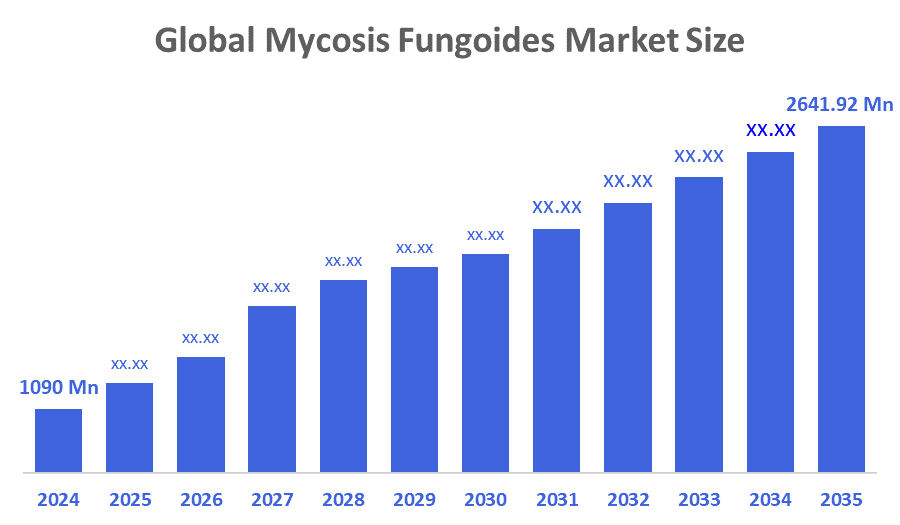
According to a research report published by Decisions Advisors and Consulting, The Global Mycosis Fungoides Market Size Was Worth Around USD 1090 Million In 2024 And Is Predicted To Grow To Around USD 2641.92 Million By 2035 With A Compound Annual Growth Rate (CAGR) Of 8.38% From 2025 To 2035. The global mycosis fungoides market will develop future opportunities through six different elements which include targeted biologic therapy development, increased clinical trial activities, better diagnostic technologies, heightened public knowledge about rare cancers, expanding healthcare systems, and increasing use of personalized medical treatment methods.
Market Overview
The global mycosis fungoides market refers to the healthcare industry focused on the diagnosis, treatment, and management of mycosis fungoides, a rare type of cutaneous T-cell lymphoma that primarily affects the skin and causes patches, plaques, and tumors. The market is expanding because people are now more aware of rare cancers and because diagnostic technologies have improved and because targeted therapies and immunotherapies are becoming more accessible to patients. Governments and health organizations are funding research and treatment development through their funding programs and their rare disease initiatives and their regulatory incentives which include orphan drug designations. These policies encourage pharmaceutical companies to invest in innovative therapies and clinical trials. The market continues to grow worldwide because healthcare infrastructure improvements and specialized dermatology and oncology care expansions enable doctors to diagnose patients earlier and provide them with better treatment solutions.
Report Coverage
This research report categorizes the mycosis fungoides market based on various segments and regions, forecasts revenue growth, and analyzes trends in each submarket. The report analyses the key growth drivers, opportunities, and challenges influencing the mycosis fungoides market. Recent market developments and competitive strategies such as expansion, type launch, development, partnership, merger, and acquisition, have been included to draw the competitive landscape in the market. The report strategically identifies and profiles the key market players and analyses their core competencies in each sub-segment of the mycosis fungoides market.
Driving Factors
The global mycosis fungoides market functions as a result of increasing knowledge about rare skin lymphomas together with rising cases of cutaneous T-cell lymphoma and progress in diagnostic technology. Patient outcomes show improvement through new developments in targeted therapies together with biologics and immunotherapy treatments. The development of better treatment methods receives assistance from expanding clinical trials and research partnerships together with improvements in dermatology and oncology healthcare facilities.
Restraining Factors
The global mycosis fungoides market experiences limitations because high treatment expenses and low awareness of rare diseases and complicated diagnosis methods and therapy side effects and limited access to advanced treatments in developing areas.
Market Segmentation
The mycosis fungoides market share is classified into treatment type and route of administration.
- The chemotherapy segment dominated the market in 2024, approximately 35% and is projected to grow at a substantial CAGR during the forecast period.
Based on the treatment type, the mycosis fungoides market is divided into photodynamic therapy, radiation therapy, chemotherapy, targeted therapy, and others. Among these, the chemotherapy segment dominated the market in 2024, approximately 35% and is projected to grow at a substantial CAGR during the forecast period. Chemotherapy serves as a common treatment option for patients who have advanced mycosis fungoides because of its effectiveness in that medical condition. Chemotherapy helps control cancer cell growth while it also enhances patient symptoms. Physicians often recommend it when other treatments are less effective. The combination of ongoing advancements in combination therapies with supportive care has created better treatment results which has led to increased chemotherapy usage in worldwide clinical practice.
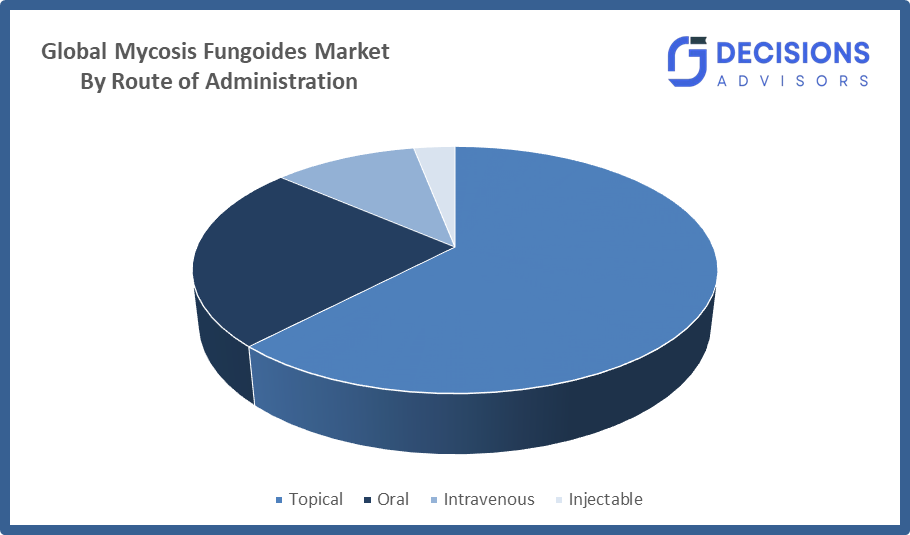
- The topical segment accounted for the largest share in 2024, approximately 45% and is anticipated to grow at a significant CAGR during the forecast period.
Based on the route of administration, the mycosis fungoides market is divided into topical, oral, intravenous, and injectable. Among these, the topical segment accounted for the largest share in 2024, approximately 45% and is anticipated to grow at a significant CAGR during the forecast period. The skin is the primary target of mycosis fungoides which enables doctors to use topical therapies like corticosteroids and retinoids and chemotherapy creams to treat patients with early-stage disease. The therapies provide simple application methods which result in less severe side effects and better treatment adherence from patients. The segment experiences growth because of two factors: more advanced topical formulations become available and dermatology-based treatment methods gain wider acceptance.
Regional Segment Analysis of the Mycosis Fungoides Market
- North America (U.S., Canada, Mexico)
- Europe (Germany, France, U.K., Italy, Spain, Rest of Europe)
- Asia-Pacific (China, Japan, India, Rest of APAC)
- South America (Brazil and the Rest of South America)
- The Middle East and Africa (UAE, South Africa, Rest of MEA)
North America is anticipated to hold the largest share of the mycosis fungoides market over the predicted timeframe.
North America is anticipated to hold the largest share of the mycosis fungoides market over the predicted timeframe. The region experiences market expansion because it possesses advanced healthcare facilities and the population understands rare cancers and research funding is strong and patients can access new medical treatments. The region experiences market growth because supportive regulatory policies and rising clinical trials and major pharmaceutical companies establish their operations in the area.
Asia-Pacific is expected to grow at a rapid CAGR in the mycosis fungoides market during the forecast period. The healthcare system benefits from multiple factors which include better medical facilities, increased knowledge about uncommon cancers, greater number of patients, and improved access to cutting-edge medical treatments. The market development in China, Japan, and India receives support from multiple sources, including the expansion of clinical research activities, government-sponsored healthcare programs, and pharmaceutical companies' financial backing.
Competitive Analysis:
The report offers the appropriate analysis of the key organizations/companies involved within the mycosis fungoides market, along with a comparative evaluation primarily based on their type of offering, business overviews, geographic presence, enterprise strategies, segment market share, and SWOT analysis. The report also provides an elaborative analysis focusing on the current news and developments of the companies, which includes type development, innovations, joint ventures, partnerships, mergers & acquisitions, strategic alliances, and others. This allows for the evaluation of the overall competition within the market.
List of Key Companies
- Kyowa Kirin Co., Ltd.
- Eisai Co., Ltd.
- Takeda Pharmaceutical Co.
- Novartis AG
- Johnson & Johnson (Janssen)
- Bristol-Myers Squibb
- Merck & Co., Inc.
- Seagen Inc. (Seattle Genetics)
- Innate Pharma S.A.
- Spectrum Pharmaceuticals
- Others
Key Target Audience
- Market Players
- Investors
- End-users
- Government Authorities
- Consulting and Research Firm
- Venture capitalists
- Value-Added Resellers (VARs)
Recent Development
- In October 2025, a global PROCLIPI registry study had reported that mogamulizumab had significantly improved survival in patients with advanced mycosis fungoides and Sézary syndrome, showing a median overall survival of 64 months compared with 54 months for patients who had not received the therapy.
Market Segment
This study forecasts revenue at global, regional, and country levels from 2020 to 2035. Decisions Advisors has segmented the mycosis fungoides market based on the below-mentioned segments:
Global Mycosis Fungoides Market, By Treatment Type
- Photodynamic Therapy
- Radiation Therapy
- Chemotherapy
- Targeted Therapy
- Others
Global Mycosis Fungoides Market, By Route of Administration
- Topical
- Oral
- Intravenous
- Injectable
Global Mycosis Fungoides Market, By Regional Analysis
- North America
- US
- Canada
- Mexico
- Europe
- Germany
- UK
- France
- Italy
- Spain
- Russia
- Rest of Europe
- Asia Pacific
- China
- Japan
- India
- South Korea
- Australia
- Rest of Asia Pacific
- South America
- Brazil
- Argentina
- Rest of South America
- Middle East & Africa
- UAE
- Saudi Arabia
- Qatar
- South Africa
- Rest of the Middle East & Africa
Frequently Asked Questions (FAQ)
Q1: What is driving the growth of the Global Mycosis Fungoides Market?
A: Growth is driven by rising awareness of rare skin lymphomas, improved diagnostic technologies, increasing clinical trials, and the development of targeted therapies, biologics, and immunotherapies that enhance treatment outcomes.
Q2: Why did the chemotherapy segment dominate the market in 2024?
A: Chemotherapy dominated because it is widely used for advanced mycosis fungoides, effectively controlling cancer cell growth and symptoms, with improved outcomes through combination therapies and supportive care.
Q3: Why does the topical segment hold the largest share by route of administration?
A: Topical therapies are preferred for early-stage disease as they target skin lesions directly, are easy to apply, have fewer systemic side effects, and improve patient adherence.
Q4: Why is North America expected to lead the mycosis fungoides market?
A: North America leads due to advanced healthcare infrastructure, strong research funding, high awareness of rare cancers, supportive regulatory policies, and the presence of major pharmaceutical companies conducting clinical trials.
Q5: Why is Asia-Pacific projected to grow fastest in this market?
A: Asia-Pacific growth is supported by improving healthcare infrastructure, increasing awareness of rare diseases, expanding clinical research, government healthcare initiatives, and rising access to advanced therapies in countries like China, Japan, and India.
Check Licence
Choose the plan that fits you best: Single User, Multi-User, or Enterprise solutions tailored for your needs.
We Have You Covered
- 24/7 Analyst Support
- Clients Across the Globe
- Tailored Insights
- Technology Tracking
- Competitive Intelligence
- Custom Research
- Syndicated Market Studies
- Market Overview
- Market Segmentation
- Growth Drivers
- Market Opportunities
- Regulatory Insights
- Innovation & Sustainability
Report Details
| Scope | Global |
| Pages | 250 |
| Delivery | PDF & Excel via Email |
| Language | English |
| Release | Mar 2026 |
| Access | Download from this page |