
Global Naloxone Market
 |
Author:
David J
|
Pages:
245
|
Author:
David J
|
Pages:
245
Global Naloxone Market Size, Share, By Strength (2.0 mg/ml, 1 mg/ml, 0.4 mg/ml), By Route of Administration (Intranasal, Injectable, Transdermal), By Distribution Channel (Hospitals, Pharmacies, Clinics, Community Health Centers, Online Retailers), and By Region (North America, Europe, Asia-Pacific, Latin America, Middle East & Africa), Analysis and Forecast 2026-2035
CAGR
8.94%
REVENUE 2025
USD Billion 1.55
FORECAST 2035
USD Billion 3.65
REPORT COVERAGE
Global
Market Snapshot
- Global Naloxone Market Size (2025): USD 1.55 Billion
- Projected Global Naloxone Market Size (2035): USD 3.65 Billion
- Global Naloxone Market Compound Annual Growth Rate (CAGR): 8.94%
- Largest Regional Market: North America
- Fastest Growing Region: Asia-Pacific
- Market 3rd Largest Region: Europe
- Base Year: 2025
- Historical Period: 2021–2024
- Forecast Period: 2026–2035

According to Decision Advisors, the Global Naloxone Market Size is expected to grow from USD 1.55 billion in 2025 to USD 3.65 billion by 2035, at a CAGR of 8.94% during the forecast period 2026-2035. The global naloxone market is projected to grow significantly over the next decade, driven by the urgent need to reverse opioid overdoses, particularly due to the proliferation of synthetic opioids like fentanyl, supportive government policies, over-the-counter availability, and adoption of user-friendly formulations.
Market Overview/ Introduction
The Global Naloxone Market refers to all operations for producing, distributing, and selling this medication, which comes in multiple delivery methods that include injectable solutions and needle-free nasal sprays. Naloxone functions as a life-saving medication that blocks opioid effects to quickly reverse respiratory depression and toxic symptoms that result from an opioid overdose through its ability to bind with brain receptors. The market experiences growth because the worldwide increase in opioid misuse combines with "standing order" regulations, which permit customers to buy products without needing a prescription. The future presents possibilities through implementing AI-powered predictive analytics for supply chain management, creating ultra-high-concentration products for synthetic opioids, and expanding community distribution networks to schools, workplaces, and public spaces. The market will experience substantial growth because harm-reduction strategies have become a worldwide priority for public health organizations.
- The U.S. Food and Drug Administration approved a new carrying case for over-the-counter naloxone nasal spray, improving portability and reducing social stigma associated with carrying the drug. This development enhanced public readiness and increased real-world usage, thereby driving demand for naloxone products globally.
- The Substance Abuse and Mental Health Services Administration expanded the State Opioid Response program, allocating billions for naloxone distribution. California’s Naloxone Distribution Project widened free access, while nationwide standing orders enabled pharmacist dispensing without prescriptions, significantly increasing accessibility, community adoption, and overall demand for naloxone products.
Notable Insights: -
- North America is anticipated to hold the largest share of approximately 45% in the naloxone market over the forecast period.
- Asia Pacific is expected to grow at a rapid CAGR of approximately 10% in the naloxone market during the forecast period.
- The 2.0 mg/ml segment dominated the market in 2025, approximately 55% and is projected to grow at a substantial CAGR during the forecast period.
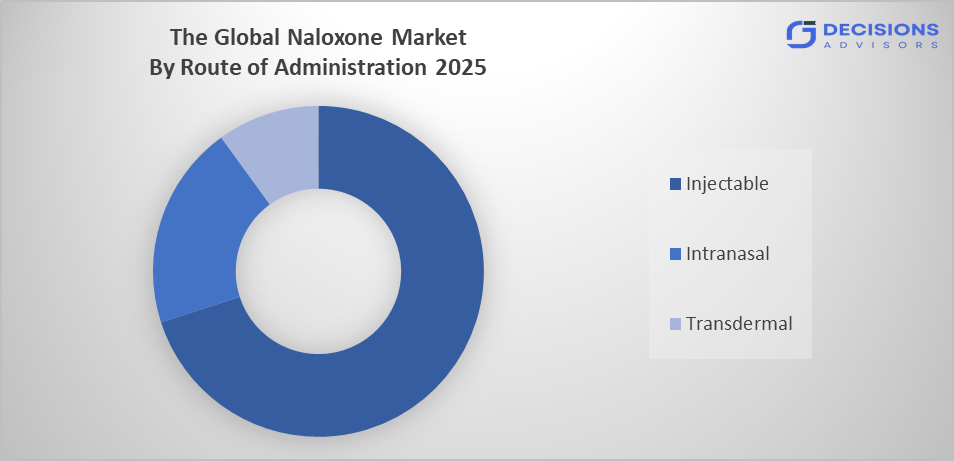
- The injectable segment dominated the market in 2025, approximately 69% and is projected to grow at a substantial CAGR during the forecast period.
- The hospitals segment dominated the market in 2025, approximately 40% and is projected to grow at a substantial CAGR during the forecast period.
- The compound annual growth rate of the Global Naloxone market is 8.94%.
- The market is likely to achieve a valuation of USD 3.65Billion by 2035.
What is role of technology in grooming the market?
Technology plays a vital role in shaping the global naloxone market by enhancing product innovation, accessibility, and distribution efficiency. Advanced drug delivery systems, such as user-friendly nasal sprays and auto-injectors, have improved ease of administration during emergencies, increasing adoption among non-medical users. Digital health technologies, including mobile apps and telehealth platforms, support overdose awareness, training, and real-time guidance on naloxone use. Manufacturing advancements have enabled scalable production of high-quality generic formulations, reducing costs and improving supply consistency. Data analytics and public health surveillance systems help organizations like the Centers for Disease Control and Prevention track overdose trends, enabling targeted distribution strategies. Additionally, innovations such as smart vending machines and publicly accessible naloxone devices enhance availability in high-risk areas, ultimately driving demand and supporting sustained global market growth.
Market Drivers
The Global Naloxone Market is experiencing growth because opioid overdose deaths have increased. The demand for products has increased because "Good Samaritan" laws and community distribution programs received more funding through their regulatory frameworks. The FDA's endorsement of Narcan (4mg) nasal spray as a non-prescription product has improved public access to the medication. The market has moved toward more user-friendly delivery systems, especially intranasal sprays, which allow non-medical professionals to use the system for overdose treatment. Public training programs for law enforcement, first responders, and everyday citizens have made naloxone kits a standard tool. Healthcare providers are now required to prescribe naloxone together with opioid treatments because patients need quick access to the medication.
Restrain
Despite strong growth, the global naloxone market faces restraints such as limited awareness in developing regions, stigma around opioid use, and inconsistent regulatory frameworks. However, ongoing government initiatives, expanding OTC availability, and increasing public health funding are gradually overcoming these barriers, supporting improved access, higher adoption, and sustained positive market growth.
Competitive Analysis:
The report offers the appropriate analysis of the key organizations/companies involved within the global naloxone market, along with a comparative evaluation primarily based on their product offerings, business overviews, geographic presence, enterprise strategies, segment market share, and SWOT analysis. The report also provides an elaborative analysis focusing on the current news and developments of the companies, which includes product development, innovations, joint ventures, partnerships, mergers & acquisitions, strategic alliances, and others. This allows for the evaluation of the overall competition within the market.
Top Companies in Global Naloxone Market
- Pfizer Inc.
- Emergent BioSolutions Inc.
- Amphastar Pharmaceuticals Inc.
- Hikma Pharmaceuticals plc
- Teva Pharmaceutical Industries Ltd.
- Sandoz International GmbH
- Viatris Inc.
- Indivior PLC
- Amneal Pharmaceuticals Inc.
- kaleo Inc.
- Adapt Pharma Inc.
- Fresenius Kabi
Government Initiatives
|
Country |
Key Government Initiatives |
|
US |
The U.S. Food and Drug Administration approved over-the-counter (OTC) naloxone nasal sprays in March 2023, significantly expanding public access without prescriptions. This policy increased pharmacy availability and reduced costs, while federal and state programs further supported large-scale naloxone distribution to combat the opioid crisis. |
|
Europe |
Several European governments have expanded take-home naloxone (THN) programs and are actively working on regulatory reforms to improve emergency access. For example, the UK Government initiated consultations in 2025 to widen legal access to naloxone for community and emergency use, aiming to reduce opioid-related deaths through broader harm-reduction policies. |
|
India |
India has introduced harm-reduction strategies through government and NGO programs, including limited take-home naloxone initiatives and opioid substitution therapy support. However, access remains restricted and primarily institutional, indicating growing but still developing policy support for overdose prevention in the country. |
Study on the Supply, Demand, Distribution, and Market Environment of the Naloxone market
The global naloxone market demonstrates a balanced supply-demand dynamic driven by rising opioid overdose cases and strong public health initiatives. Demand is increasing across hospitals, pharmacies, and community programs, supported by government funding and harm reduction policies. Supply is ensured through pharmaceutical manufacturers producing both branded and generic formulations, improving availability and affordability. Key raw materials include opioid antagonist compounds synthesized from chemical intermediates used in active pharmaceutical ingredient (API) production, requiring strict quality and regulatory compliance. Distribution channels have expanded from hospitals to retail pharmacies, NGOs, and public access points, enhancing reach. The overall market environment is highly policy-driven, with regulatory support, awareness campaigns, and global health initiatives fostering growth, encouraging innovation, and ensuring a stable and scalable naloxone supply chain globally.
Price Analysis and Consumer Behaviour Analysis
Price analysis in the global naloxone market shows a positive shift toward affordability, driven by increasing availability of generic formulations and government-supported distribution programs. Over-the-counter approvals and bulk procurement initiatives have reduced per-unit costs, making naloxone more accessible across diverse income groups. Consumer behavior has also evolved significantly, with rising awareness of opioid overdose risks encouraging proactive purchasing by individuals, caregivers, and community organizations. Demand is increasingly influenced by convenience, such as easy-to-use nasal sprays and retail pharmacy availability. Additionally, stigma reduction campaigns have improved willingness to carry and use naloxone in public settings. Institutional buyers, including hospitals and NGOs, continue to dominate volume demand, while retail consumer uptake is growing steadily. Overall, favorable pricing trends and shifting consumer attitudes are driving broader adoption and sustained market expansion globally.
Market Segmentation
The Naloxone Market share is classified into strength, route of administration, and distribution channel
- The 2.0 mg/ml segment dominated the market in 2025, approximately 55%, and is projected to grow at a substantial CAGR during the forecast period.
Based on the strength, the naloxone market is divided into 2.0 mg/ml, 1 mg/ml, and 0.4 mg/ml. Among these, the 2.0 mg/ml segment dominated the market in 2025, approximately 55%, and is projected to grow at a substantial CAGR during the forecast period. The 2.0 mg/ml segment dominated due to its proven effectiveness in rapidly reversing opioid overdoses, widespread clinical adoption, and availability in emergency kits. Increasing opioid misuse and government distribution programs further support its strong demand and projected growth.
- The injectable segment dominated the market in 2025, approximately 69%, and is projected to grow at a substantial CAGR during the forecast period.
Based on the route of administration, the naloxone market is divided into intranasal, injectable, and transdermal. Among these, the injectable segment dominated the market in 2025, approximately 69%, and is projected to grow at a substantial CAGR during the forecast period. The growth of the injectable segment is growing due to its rapid onset of action, high reliability in emergency overdose situations, and widespread use by healthcare professionals. Established clinical protocols, cost-effectiveness, and increasing distribution through hospitals and emergency services continue to drive its strong growth.
- The hospitals segment dominated the market in 2025, approximately 40%, and is projected to grow at a substantial CAGR during the forecast period.
Based on the distribution channel, the naloxone market is divided into hospitals, pharmacies, clinics, community health centers, and online retailers. Among these, the hospitals segment dominated the market in 2025, approximately 40%, and is projected to grow at a substantial CAGR during the forecast period. The growth of the hospitals segment is growing due to the high volume of emergency overdose cases treated in clinical settings, availability of trained professionals, and access to injectable formulations. Increasing hospital admissions related to opioid misuse continues to support segment growth.
Strategies to Implement for Growth of the Market in Non-Leading Regions
Expanding the global naloxone market in non-leading regions requires targeted, scalable strategies focused on accessibility, awareness, and affordability. Governments and health agencies should prioritize regulatory reforms to allow over-the-counter availability and community-based distribution through pharmacies, NGOs, and outreach programs. Increasing public awareness about opioid overdose risks and naloxone usage through training campaigns can significantly boost adoption. Partnerships with international organizations such as the World Health Organization can support policy alignment and funding. Local manufacturing and generic production should be encouraged to reduce costs and ensure consistent supply. Additionally, implementing innovative distribution models like mobile clinics and public access naloxone points can improve reach in underserved areas. These combined efforts will enhance accessibility, drive demand, and support sustainable market growth in emerging and underpenetrated regions.
Regional Segment Analysis of the Naloxone market
- North America (U.S., Canada, Mexico)
- Europe (Germany, France, U.K., Italy, Spain, Rest of Europe)
- Asia-Pacific (China, Japan, India, Rest of APAC)
- South America (Brazil and the Rest of South America)
- The Middle East and Africa (UAE, South Africa, Rest of MEA)
North America is anticipated to hold the largest share of approximately 45% the naloxone market over the forecast period.
North America is anticipated to hold the largest share of approximately 45% the naloxone market over the forecast period. The dominance of this region is primarily driven by high opioid overdose prevalence, strong government funding, widespread harm-reduction programs, and favourable regulatory policies enabling over-the-counter access. Additionally, advanced healthcare infrastructure, extensive distribution networks, and heightened public awareness significantly support large-scale adoption and consistent demand across the region.
Asia Pacific is expected to grow at a rapid CAGR of approximately 10% in the naloxone market during the forecast period.
Asia Pacific is expected to grow at a rapid CAGR of approximately 10% in the naloxone market during the forecast period. This growth is driven by rising opioid misuse awareness, improving healthcare infrastructure, and increasing government and NGO initiatives for overdose prevention. Expanding access to emergency care, growing pharmaceutical distribution networks, and supportive public health policies are further accelerating adoption across emerging economies in the region.
Europe is the 3rd largest region to grow in the naloxone market during the period.
Europe’s position as the third-largest region in the naloxone market is supported by established healthcare systems, increasing opioid misuse concerns, and expanding harm-reduction initiatives. Government-backed awareness programs, wider pharmacy-based distribution, and supportive regulatory frameworks are driving steady adoption, although growth remains moderate compared to rapidly emerging regions.
Future Market Trends in Global Naloxone market: -
1. Expansion of Over-the-Counter (OTC) Availability
The shift toward OTC naloxone will continue to accelerate globally, removing prescription barriers and expanding access through pharmacies, retail stores, and online platforms. This trend will increase consumer awareness and convenience, driving higher adoption rates. As more countries adopt similar regulatory frameworks, manufacturers will benefit from increased sales volumes and broader market penetration across both urban and rural regions.
2. Growth of Community-Based Distribution Programs
Future strategies will emphasize community-level distribution through NGOs, public health agencies, and harm reduction programs. Initiatives such as free naloxone kits, vending machines, and public access boxes will expand, particularly in high-risk areas. This approach will significantly improve real-time availability, reduce overdose fatalities, and create sustained demand driven by government funding and public health priorities.
3. Innovation in Drug Delivery Systems
Advancements in naloxone delivery systems, including higher-dose nasal sprays, auto-injectors, and user-friendly packaging, will shape the market. These innovations will enhance ease of use, effectiveness, and rapid administration during emergencies. Improved formulations targeting potent synthetic opioids will further boost adoption, encouraging pharmaceutical companies to invest in R&D and differentiate their product offerings globally.
Recent Development
- In February 2026, the Biden-Harris Administration expanded the State Opioid Response (SOR) grant program, allocating billions to enhance naloxone distribution. The U.S. Food and Drug Administration enabled OTC access for Narcan and RiVive, while the Centers for Disease Control and Prevention expanded access, significantly increasing demand.
- In December 2025, the UK Government launched a legislative consultation enabling non-prescription naloxone supply through community services. It introduced public naloxone boxes in high-risk areas to address Nitazenes threats, significantly improving accessibility, rapid response, and overall demand for naloxone products.
- In April 2025, community-based initiatives such as naloxone vending machines were introduced in the United States, enabling free and rapid public access to overdose reversal medication. This innovation increased distribution efficiency and real-time availability, thereby accelerating adoption and demand for naloxone in public health programs.
- In March 2025, Health Canada approved KLOXXADO (naloxone HCl) 8 mg nasal spray, expanding treatment options for opioid overdose with higher-dose intranasal delivery. This advancement improved clinical effectiveness and accessibility, supporting wider adoption and increasing demand for naloxone across emergency and community healthcare settings.
How is Recent Developments Helping the Market?
Recent developments in the global naloxone market have significantly improved accessibility, distribution, and overall adoption, thereby driving strong market growth. Government initiatives, such as expanded funding programs and harm reduction strategies, have enabled large-scale procurement and free community-level distribution of naloxone. Regulatory advancements, including over-the-counter approvals, have removed prescription barriers, allowing pharmacies and retail outlets to widely stock naloxone products. In addition, innovative distribution models such as public access naloxone boxes and vending machines have increased real-time availability in high-risk locations. Increased awareness campaigns and training programs for first responders and community organizations have further enhanced usage rates. These combined efforts have strengthened demand across both developed and emerging markets, encouraging manufacturers to expand production, invest in product innovation, and improve supply chains, ultimately supporting sustained global market expansion.
Market Segment
This study forecasts revenue at global, regional, and country levels from 2020 to 2035. Decision Advisors has segmented the naloxone market based on the below-mentioned segments:
Global Naloxone Market, By Strength
- 2.0 mg/ml
- 1 mg/ml
- 0.4 mg/ml
Global Naloxone Market, By Route of Administration
- Intranasal
- Injectable
- Transdermal
Global Naloxone Market, By Distribution Channel
- Hospitals
- Pharmacies
- Clinics
- Community Health Centers
- Online Retailers
Global Naloxone Market, By Regional Analysis
- North America
- US
- Canada
- Mexico
- Europe
- Germany
- UK
- France
- Italy
- Spain
- Russia
- Rest of Europe
- Asia Pacific
- China
- Japan
- India
- South Korea
- Australia
- Rest of Asia Pacific
- South America
- Brazil
- Argentina
- Rest of South America
- Middle East & Africa
- UAE
- Saudi Arabia
- Qatar
- South Africa
- Rest of the Middle East & Africa
Frequently Asked Questions (FAQ)
Q What factors are driving the growth of the global naloxone market?
A. The global naloxone market is driven by the rising incidence of opioid overdoses, increasing prevalence of synthetic opioids like fentanyl, supportive government policies, and expanding over-the-counter availability. Additionally, growing awareness, community distribution programs, and user-friendly drug delivery systems are significantly boosting market demand.
Q. Why does North America dominate the global naloxone market?
A. North America dominates the market due to high opioid overdose rates, strong government funding, and favourable regulatory frameworks such as OTC approvals. Advanced healthcare infrastructure, widespread harm-reduction programs, and high public awareness further support large-scale adoption and consistent demand in the region.
Q. How is technology contributing to the naloxone market growth?
A. Technology enhances the market through innovations like nasal sprays and auto-injectors, improving ease of use. Digital health tools, data analytics, and public health surveillance systems help track overdose trends and optimize distribution. Advanced manufacturing also ensures cost-effective and scalable production of naloxone.
Q. What are the key distribution channels in the naloxone market?
A. The key distribution channels include hospitals, pharmacies, clinics, community health centers, and online retailers. Among these, hospitals hold the largest share due to high patient inflow and emergency care demand, while pharmacies and community programs are expanding access through OTC availability and outreach initiatives.
Check Licence
Choose the plan that fits you best: Single User, Multi-User, or Enterprise solutions tailored for your needs.
We Have You Covered
- 24/7 Analyst Support
- Clients Across the Globe
- Tailored Insights
- Technology Tracking
- Competitive Intelligence
- Custom Research
- Syndicated Market Studies
- Market Overview
- Market Segmentation
- Growth Drivers
- Market Opportunities
- Regulatory Insights
- Innovation & Sustainability
Report Details
| Scope | Global |
| Pages | 245 |
| Delivery | PDF & Excel via Email |
| Language | English |
| Release | Apr 2026 |
| Access | Download from this page |