
Global Natural Fatty Acids Market
 |
Author:
Disha B
|
Pages:
210
|
Author:
Disha B
|
Pages:
210
Natural Fatty Acids Market Size, Share, By Product Type (Saturated Fatty Acids, Unsaturated Fatty Acids), By Application (Soaps & Detergents, Personal Care & Cosmetics, Food & Beverages, Industrial Applications), By End User (Consumer Goods Industry, Food Industry, Chemical Industry, Pharmaceutical Industry), and By Region (North America, Europe, Asia-Pacific, Latin America, Middle East & Africa), Analysis and Forecast 2025?2035
CAGR
3.76%
REVENUE 2025
USD Billion 29.1
FORECAST 2035
USD Billion 42.11
REPORT COVERAGE
Global
Market Snapshot
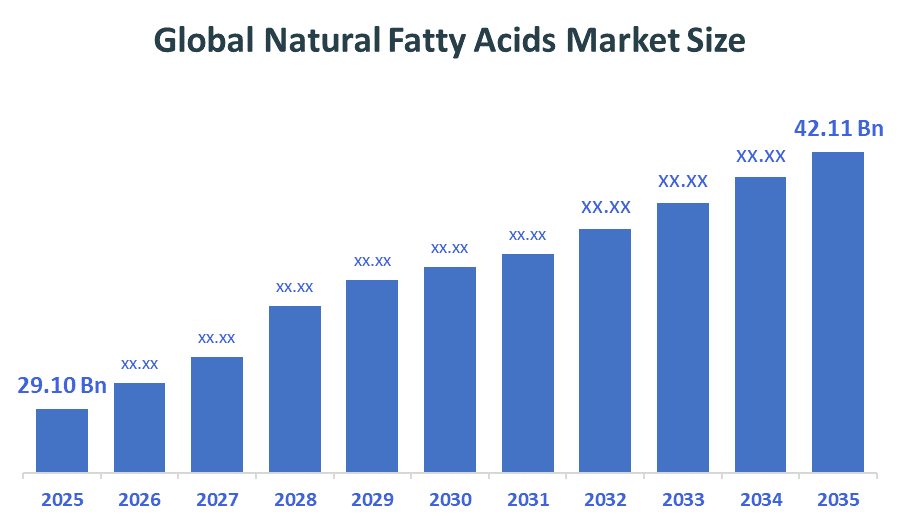
- Global Natural Fatty Acids Market Size (2025): USD 29.10 Billion
- Projected Global Natural Fatty Acids Market Size (2035): USD 42.11 Billion
- Global Natural Fatty Acids Market Compound Annual Growth Rate (CAGR): 3.76%
- Fastest Regional Market: Asia Pacific
- Largest Growing Region: North America
- 3rd Largest Region: Europe
- Base Year: 2025
- Historical Period: 2021–2024
- Forecast Period: 2026–2035
Market Overview/ Introduction
The global natural fatty acids market is defined by the production of organic carboxylic acids derived from renewable sources like vegetable oils (palm, coconut, soy) and animal fats, which serve as essential building blocks for the Green Chemistry movement. This market is all about moving away from synthetics and toward renewable sources like coconut, palm, and soy oils. This shift is being sparked by us, the consumers, as we push for clean-label ingredients in everything from the soap in our showers to the laundry detergent in our cabinets. Big players like Wilmar International, which controls approximately 10% to 15% of the global market, aren't just sitting back, they are overhauling their supply chains to meet strict new environmental rules, like the EU’s Deforestation Regulation. It’s no longer just about making a product, it’s about making it responsibly. Looking toward the future, the market is on track to hit a large number. The market is seeing incredible tech breakthroughs, like precision fermentation, which allows us to grow high-quality fatty acids in labs. Plus, as more people look for plant-based heart and brain health supplements (like Omega-3s), these natural acids are becoming a staple in the global food and wellness industries.
- Launched to promote chemical-free farming, this scheme provides ?4,000 per acre incentive to farmers producing the very oilseeds (like mustard and soy) used for natural fatty acids.
- Many countries have lowered taxes on the machinery used to process bio-oils. India, for instance, offers reduced GST rates of 5-12% on biomass equipment.
Notable Insights: -
- Asia Pacific is the fastest growing region in the Global Natural Fatty Acids Market during the forecast period, holding approximately 45% share.
- North America is anticipated to hold approximately 25% share of the Global Natural Fatty Acids Market over the predicted timeframe.
- By product type, the unsaturated fatty acids segment dominated the market and holds approximately 55% share in 2025, and is projected to grow at a substantial CAGR during the forecast period.
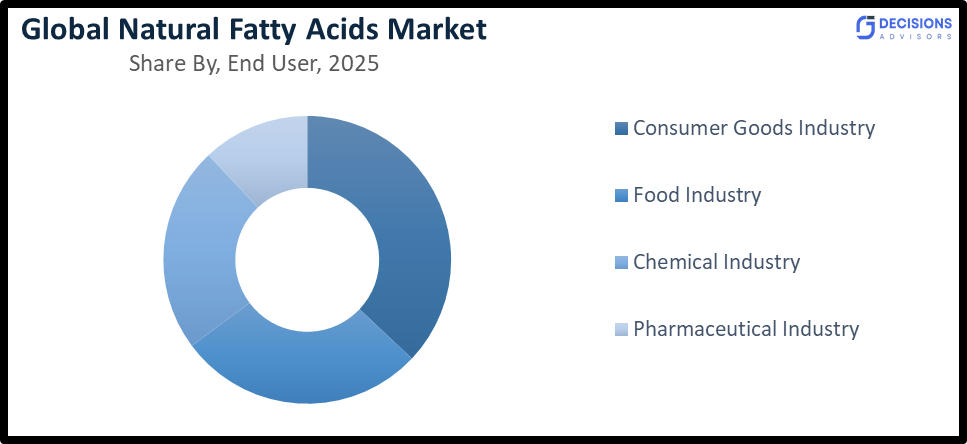
- By end user, the consumer goods industry segment dominated the market and holds approximately 40% share in 2025 and is projected to grow at a substantial CAGR during the forecast period.
- The compound annual growth rate of the Global Natural Fatty Acids Market is 3.76%.
- The market is likely to achieve a valuation of USD 42.11 Billion by 2035.
What is the role of technology in grooming the market?
Technology plays a crucial role in shaping the natural fatty acids market by improving extraction efficiency, product quality, and sustainability. Advanced processing technologies such as enzymatic hydrolysis and fractional distillation enable manufacturers to obtain high-purity fatty acids from natural feedstocks like palm and coconut oil while reducing waste and energy consumption. Additionally, innovations in biotechnology are supporting the development of bio-based fatty acids with consistent quality for use in cosmetics, food, and industrial applications. For example, companies like Wilmar International have adopted integrated biorefinery processes to optimize the conversion of vegetable oils into high-value fatty acids, enhancing both production efficiency and environmental performance.
Market Drivers
The real engine behind the natural fatty acids market is a fundamental shift in our daily habits and what we value as consumers. The market is moving into an era of Green Chemistry, in which consumers are moving away from harsh, petroleum-based synthetics in our homes. Instead, consumers are actively hunting for clean-label products, choosing laundry detergents and face creams made from plants because they were better for us and the planet. This isn’t just a passing trend; it’s a global demand that has forced even the biggest corporations to totally rethink their recipes. At the same time, consumers are seeing a much-needed push for honesty in the supply chain. New environmental laws are finally stepping up to make sure that the oils used in our products, like palm and soy, aren't tied to deforestation. On a personal level, the pandemic sparked a huge health-first mindset. More of us are now reaching for plant-based Omega-3s and Omega-6s to keep our hearts and brains healthy.
Restrain
The natural fatty acids market faces restraints primarily due to fluctuating raw material prices, especially for palm and coconut oil, which directly impact production costs. Additionally, sustainability concerns related to deforestation and strict environmental regulations limit the expansion of raw material supply, posing challenges for market growth.
Competitive Analysis:
The report offers the appropriate analysis of the key organizations/companies involved within the Global natural fatty acids market, along with a comparative evaluation primarily based on their product of offering, business overviews, geographic presence, enterprise strategies, segment market share, and SWOT analysis. The report also provides an elaborative analysis focusing on the current news and developments of the companies, which includes product development, innovations, joint ventures, partnerships, mergers & acquisitions, strategic alliances, and others. This allows for the evaluation of the overall competition within the market.
Top Companies in the Global Natural Fatty Acids Market
- Wilmar International Limited
- BASF SE
- Cargill, Incorporated
- KLK OLEO
- Oleon N.V.
- Croda International Plc
- Emery Oleochemicals
- Godrej Industries Group
- Musim Mas Group
- Kao Corporation
Government Initiatives
|
Country |
Key Government Initiatives |
|
India |
Production Linked Incentive (PLI) Scheme for Pharmaceuticals: With a ?15,000 crore outlay, this scheme encourages the production of high-value chemicals, including drug intermediates and Active Pharmaceutical Ingredients (APIs) that rely on natural fatty acids. |
|
Europe |
The EU approved a €7.9 billion biomass package in September 2025, expanding Germany’s support program, securing over 2,500 plants, and increasing biogas tender volumes, which stabilized feedstocks overlapping with the natural fatty acids market.
|
|
US |
Department of Energy (DOE) Grants: In early 2025, the DOE announced $23 million in funding specifically for sustainable propane and renewable chemicals derived from biomass and waste.
|
Study on the Supply, Demand, Distribution, and Market Environment of the Global Natural Fatty Acids Market
The global natural fatty acids market is supported by a strong supply chain primarily based on abundant natural feedstocks such as palm oil and coconut oil, with Asia-Pacific acting as the major production hub due to raw material availability and large-scale manufacturing facilities. Demand is driven by widespread applications in personal care, food processing, detergents, and industrial sectors, fuelled by increasing preference for bio-based and sustainable products. Distribution occurs through integrated supply chains, direct industrial contracts, and global trade networks, while many companies adopt vertical integration to ensure raw material security and cost efficiency. The overall market environment remains favorable due to rising environmental awareness and regulatory support for green chemicals, although challenges such as supply chain optimization and raw material price fluctuations persist
Price Analysis and Consumer Behaviour Analysis
Price trends in the natural fatty acids market are largely influenced by feedstock costs, especially palm oil and other vegetable oils, which show a strong correlation (around 88%) with fatty acid pricing. For instance, oleic acid prices in 2026 ranged between USD 1,250–1,520 per metric ton, while other fatty acids in major markets like the U.S., China, and Germany have fluctuated between USD 2,100–4,000 per metric ton depending on demand, purity, and regional supply conditions. From a consumer behaviour perspective, buyers are increasingly shifting toward contract-based purchasing to manage price volatility and ensure stable supply. There is also a growing preference for sustainable, plant-based fatty acids, even at premium prices, driven by clean-label trends and environmental concerns, with industries prioritizing consistent quality, traceability, and long-term sourcing agreements over short-term cost savings
Market Segmentation
The Global Natural Fatty Acids Market is classified into product type, application and end user.
- The unsaturated fatty acids segment dominated the market and holds approximately 55% share in 2025, and is projected to grow at a substantial CAGR during the forecast period.
Based on the product type, the global natural fatty acids Market is divided into saturated fatty acids and unsaturated fatty acids. Among these, the unsaturated fatty acids segment dominated the market and holds approximately 55% share in 2025, and is projected to grow at a substantial CAGR during the forecast period. This dominance is attributed to their extensive use in personal care, food, and nutraceutical applications due to their beneficial functional and health properties. The increasing global demand for bio-based and sustainable ingredients has significantly boosted the adoption of unsaturated fatty acids derived from natural sources such as vegetable oils. Recent developments further support this trend, as manufacturers are investing in advanced refining and extraction technologies to enhance product quality and efficiency. Additionally, rising consumer awareness regarding health benefits and growing demand for clean-label products in regions like North America and Europe are accelerating the growth of this segment.
- The soaps & detergents segment accounted for the largest share of approximately 35% in 2025 and is anticipated to grow at a significant CAGR during the forecast period.
Based on the application, the global natural fatty acids market is divided into soaps & detergents, personal care & cosmetics, food & beverages, and industrial applications. Among these, the soaps & detergents segment accounted for the largest share of approximately 35% in 2025 and is anticipated to grow at a significant CAGR during the forecast period. This is primarily due to the widespread use of natural fatty acids in the production of surfactants, which are essential for cleaning and foaming properties in household and industrial cleaning products. Additionally, the increasing demand for biodegradable and eco-friendly cleaning solutions is further driving the adoption of natural fatty acids in this segment. Supporting this trend, industry insights highlight a growing shift toward sustainable formulations, with manufacturers focusing on reducing reliance on petrochemicals. Furthermore, rapid urbanization and rising hygiene awareness, particularly in emerging economies, are significantly boosting demand.
- The consumer goods industry segment dominated the market and holds approximately 40% share in 2025 and is projected to grow at a substantial CAGR during the forecast period.
Based on end user, the global natural fatty acids market is divided into the consumer goods industry, food industry, chemical industry, and the pharmaceutical industry. Among these, the consumer goods industry segment dominated the market and holds approximately 40% share in 2025 and is projected to grow at a substantial CAGR during the forecast period, owing to the extensive use of natural fatty acids in products such as soaps, detergents, cosmetics, and personal care items. The increasing demand for eco-friendly and biodegradable consumer products has made natural fatty acids a preferred raw material among manufacturers. Recent industry trends also support this dominance, as companies are focusing on sustainable product development and green chemistry practices. Moreover, the rapid expansion of the personal care and household products sector, particularly in Asia-Pacific, is boosting consumption. Additionally, innovation in product formulations and the rising preference for natural ingredients are further strengthening the growth of this segment.
Strategies to Implement for Growth of the Market in Non-Leading Regions
Growth in non-leading regions of the natural fatty acids market can be achieved by focusing on localized production, cost optimization, and awareness of sustainable products. Companies should invest in setting up processing facilities near raw material sources such as vegetable oil hubs to reduce logistics costs and ensure stable supply. Strengthening distribution networks and forming partnerships with regional consumer goods, food, and chemical manufacturers can enhance market penetration. Additionally, increasing awareness about the benefits of bio-based and biodegradable fatty acids, along with offering competitively priced products, can drive adoption in regions such as Latin America, the Middle East, and Africa. Government support for green chemicals and sustainable manufacturing can further accelerate market growth in these regions.
Regional Segment Analysis of the Global Natural Fatty Acids Market
- North America (U.S., Canada, Mexico)
- Europe (Germany, France, U.K., Italy, Spain, Rest of Europe)
- Asia-Pacific (China, Japan, India, Rest of APAC)
- South America (Brazil and the Rest of South America)
- The Middle East and Africa (UAE, South Africa, Rest of MEA)
Asia Pacific is the fastest growing region in the global natural fatty acids market during the forecast period, holding approximately 45% share.
Asia Pacific is the fastest growing region in the global natural fatty acids market during the forecast period, holding approximately 45% share. This growth is driven by the strong presence of oleochemical manufacturing hubs, abundant availability of raw materials such as palm oil and coconut oil, and expanding consumer goods and industrial sectors in countries such as China, Indonesia, Malaysia, India, and Thailand. The region benefits from low production costs, well-established refining infrastructure, and integrated supply chains, making it the global hub for natural fatty acids production. Recent developments indicate strong government and industry support, particularly in Indonesia and Malaysia, where investments in sustainable palm oil production and downstream processing are increasing. Additionally, the rapid growth of the personal care, food processing, and detergent industries, along with rising demand for eco-friendly products, is accelerating fatty acids consumption and strengthening the region’s dominance.
North America is anticipated to hold approximately 25% share of the global natural fatty acids market over the predicted timeframe.
North America is anticipated to hold approximately 25% share of the global natural fatty acids market over the predicted timeframe. It maintains a strong market presence due to the high demand for bio-based and sustainable ingredients, well-established personal care and food industries, and increasing adoption of natural fatty acids in industrial and pharmaceutical applications. The United States is the key driver, supported by rising consumer preference for clean-label and environmentally friendly products and growing investments in green chemistry and biotechnology. Recent developments further support this growth, as regulatory bodies encourage the use of renewable and biodegradable materials. Moreover, leading manufacturers in the region are expanding their portfolios with sustainable formulations, increasing the adoption of plant-based fatty acids and strengthening the region’s market position.
Europe is expected to grow at a rapid CAGR in the Global natural fatty acids market, holding approximately 21% of the share during the forecast period.
Europe is expected to grow at a rapid CAGR in the global natural fatty acids market, holding approximately 21% of the share during the forecast period. The region’s growth is supported by strict environmental regulations, increasing demand for sustainable and bio-based chemicals, and a strong emphasis on reducing dependence on petrochemical-derived products. Countries such as Germany, France, and the United Kingdom are leading the adoption of natural fatty acids in personal care, food, and industrial applications. Recent industry trends highlight that regulatory frameworks and sustainability certifications are encouraging the use of responsibly sourced raw materials, driving demand for natural fatty acids. Additionally, the growing focus on circular economy practices, rising innovation in green products, and increasing use in cosmetics and biodegradable detergents are significantly contributing to market expansion across the region.
Future Market Trends in the Global Natural Fatty Acids Market: -
1. Shift Toward Bio-Based and Sustainable Products
The market is witnessing a strong transition from petrochemical-based ingredients to natural, bio-based fatty acids due to increasing environmental concerns and regulatory pressure. Industries such as personal care, detergents, and packaging are rapidly adopting biodegradable and renewable raw materials. This trend is driven by consumer preference for eco-friendly products and government initiatives promoting green chemistry, making sustainability a core growth driver for the market.
2. Rising Demand from Personal Care and Clean-Label Products
Natural fatty acids are increasingly used in cosmetics, skincare, and food products due to their non-toxic and natural properties. The growing clean-label movement is pushing manufacturers to replace synthetic additives with plant-based alternatives. Personal care alone accounts for a significant share of demand, with increasing use of fatty acids as emollients, surfactants, and stabilizers in formulations.
3. Expansion of Industrial Applications and Biofuels
The use of natural fatty acids is expanding beyond traditional applications into industrial lubricants, bio-lubricants, and biofuels. Fatty acid derivatives are gaining traction due to their high performance, thermal stability, and environmental benefits. Additionally, government mandates for biodiesel blending are ensuring long-term demand for fatty acid-based intermediates, further boosting market growth.
Recent Development
- In February 2026, GC Rieber VivoMega expanded its omega-3 portfolio by launching a high-potency vegan DHA and EPA algal oil, Algae 1045 TG, designed to support the growing demand for sustainable, plant-based nutraceutical ingredients.
- In May 2025, Hofseth Biocare launched a full-spectrum fish oil ingredient, OmeGo, in partnership with Nestlé-owned Garden of Life in the U.S., featuring a broad range of omega fatty acids (3, 5, 6, 7, 9, and 11) and enhanced bioavailability through a gentle enzymatic process
- In February 2025, Everwell Health acquired proprietary plant-based cetylated fatty acid technology and the Celadrin brand from Things of That Nature, Inc., expanding its portfolio of functional ingredients for use in human, pet, and cosmetic applications
- In Novem24, Nanocarriers Made of Natural Fatty Acids: Modulation of Their Release Profiles through Photo-Crosslinking
How is Recent Developments Helping the Market?
Recent developments are significantly helping the natural fatty acids market by enhancing production capacity, improving sustainability, and expanding application areas. Major industry players are investing in capacity expansion and advanced processing technologies, to meet rising global demand and ensure stable supply chains. At the same time, companies are launching innovative bio-based products such as specialty surfactants, bio-lubricants, and plant-based emulsifiers, which are replacing petrochemical alternatives across industries like personal care, automotive, and industrial manufacturing. Additionally, advancements in enzymatic processing and AI-driven manufacturing are improving efficiency, reducing energy consumption, and enabling high-purity fatty acid production, making the market more cost-effective and environmentally sustainable
Market Segment
This study forecasts revenue at global, regional, and country levels from 2020 to 2035. Decision Advisors has segmented the global natural fatty acids market based on the below-mentioned segments:
Global Natural Fatty Acids Market, By Product Type
- Saturated Fatty Acids
- Unsaturated Fatty Acids
Global Natural Fatty Acids Market, By Applications
- Soaps & Detergents
- Personal Care & Cosmetics
- Food & Beverages
- Industrial Applications
Global Natural Fatty Acids Market, By End User
- Consumer Goods Industry
- Food Industry
- Chemical Industry
- Pharmaceutical Industry
Global Natural Fatty Acids Market, By Regional Analysis
- North America
- US
- Canada
- Mexico
- Europe
- Germany
- UK
- France
- Italy
- Spain
- Russia
- Rest of Europe
- Asia Pacific
- China
- Japan
- India
- South Korea
- Australia
- Rest of Asia Pacific
- South America
- Brazil
- Argentina
- Rest of South America
- Middle East & Africa
- UAE
- Saudi Arabia
- Qatar
- South Africa
- Rest of the Middle East & Africa
Frequently Asked Questions (FAQ)
Q. What are the primary sources used for producing natural fatty acids?
A. Natural fatty acids are primarily derived from vegetable oils such as palm oil, coconut oil, soybean oil, and sunflower oil, along with some animal fats. Among these, plant-based sources are more widely used due to sustainability and consumer preference.
Q. How do natural fatty acids contribute to biodegradable product development?
A. Natural fatty acids are easily biodegradable and non-toxic, making them ideal for producing eco-friendly products such as green detergents, bio-lubricants, and sustainable packaging materials, reducing environmental impact.
Q. What role do natural fatty acids play in industrial manufacturing?
A. Natural fatty acids act as key intermediates in producing surfactants, lubricants, plastics, and coatings, improving product performance while supporting the shift toward bio-based industrial solutions.
Q. Which factors influence the quality of natural fatty acids?
A. Quality is influenced by factors such as the type of raw material used, extraction and refining processes, purity levels, and storage conditions, all of which determine their effectiveness in end-use applications.
Q. How is sustainability certification impacting the natural fatty acids market?
A. Certifications such as RSPO (Roundtable on Sustainable Palm Oil) are encouraging responsible sourcing and production practices, increasing consumer trust and driving demand for sustainably produced natural fatty acids.
Check Licence
Choose the plan that fits you best: Single User, Multi-User, or Enterprise solutions tailored for your needs.
We Have You Covered
- 24/7 Analyst Support
- Clients Across the Globe
- Tailored Insights
- Technology Tracking
- Competitive Intelligence
- Custom Research
- Syndicated Market Studies
- Market Overview
- Market Segmentation
- Growth Drivers
- Market Opportunities
- Regulatory Insights
- Innovation & Sustainability
Report Details
| Scope | Global |
| Pages | 210 |
| Delivery | PDF & Excel via Email |
| Language | English |
| Release | Apr 2026 |
| Access | Download from this page |