
Global Neurostimulation Device Market
 |
Pages:
240
|
Pages:
240
Global Neurostimulation Device Market Size, Share, and COVID-19 Impact Analysis, By Product Type (Spinal Cord Stimulators, Deep Brain Stimulators, Transcranial Magnetic Stimulators, and Vagus Nerve Stimulators), By Technology (Electrical Stimulation, Magnetic Stimulation, and Chemical Stimulation), By End Users (Hospitals, Specialty Clinics, and Home Care Settings), and By Region (North America, Europe, Asia-Pacific, Latin America, Middle East, and Africa), Analysis and Forecast 2025-2035
REPORT COVERAGE
Global
Global Neurostimulation Device Market Size Insights Forecasts to 2035
- The Global Neurostimulation Device Market Size Was Estimated at USD 7.67 Billion in 2024
- The Market Size is Expected to Grow at a CAGR of around 10.71 % from 2025 to 2035
- The Worldwide Neurostimulation Device Market Size is Expected to Reach USD 23.48 Billion by 2035
- North America is expected to grow the fastest during the forecast period.
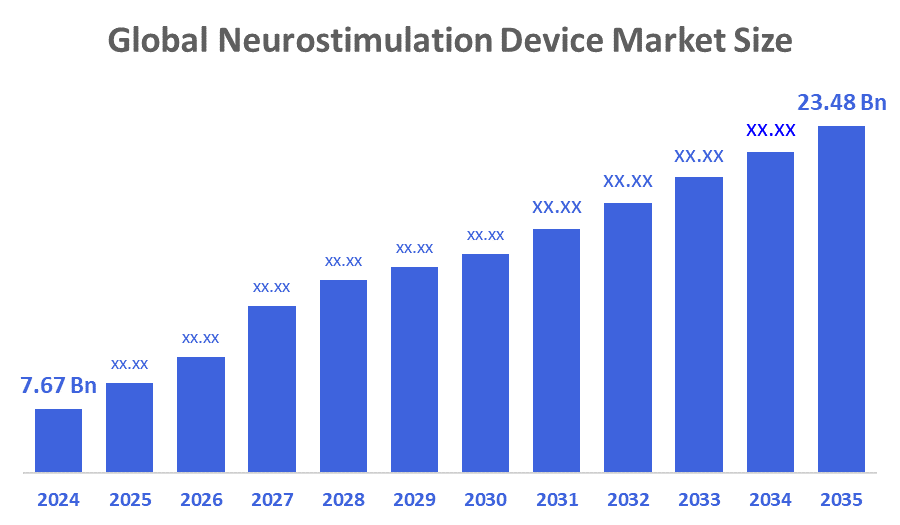
According to a research report published by Decisions Advisors and Consulting, The Global Neurostimulation Device Market Size Was Worth Around USD 7.67 Billion In 2024 And Is Predicted To Grow To Around USD 23.48 Billion By 2035 With A Compound Annual Growth Rate (CAGR) Of 10.71 % From 2025 To 2035. The market is expanding because neurological illnesses are becoming more common, minimally invasive therapies are becoming more popular, and there is a growing need for long-term pain management options. Further driving market expansion are the growing uses of neurostimulation for ailments like depression, Parkinson's disease, chronic pain, epilepsy, and spinal cord injuries, as well as favourable reimbursement practices in many areas.
Market Overview
Neurostimulation devices, sometimes referred to as neurostimulators or neuromodulation devices, are medical devices that intentionally alter the nervous system's activity by means of electrical impulses. These devices can interfere with pain signals, change brain activity, or restore lost function by sending modest electrical signals to particular nerves or parts of the brain or spinal cord. Neurostimulation devices are constructed to send precise electrical impulses to particular parts of the nervous system. Several neurological disorders, including depression, Parkinson's disease, epilepsy, and chronic pain, are managed and treated with the aid of these devices. Devices can be applied externally or implanted, and they are frequently less invasive, improving patients' quality of life. Furthermore, these technologies are now more efficient and easier to use thanks to major technological improvements. Their use is growing with two innovations, including smaller, rechargeable implants, "closed-loop" systems that react to brain activity instantly, and the creation of non-invasive alternatives like Transcranial Magnetic Stimulation (TMS). Additionally, these medicines are becoming more accessible to patients due to better reimbursement policies and a more favourable regulatory environment.
Valencia Technologies secured up to $35 million in strategic investment to accelerate the growth of its eCoin neurostimulator, a coin-sized implant designed to treat urge urinary incontinence (UUI). Alongside the funding, the company appointed James D. Surek as its new CEO. Implanted near the ankle in a minimally invasive outpatient procedure, the eCoin device delivers periodic stimulation to the tibial nerve, aiming to reduce UUI episodes. The capital infusion and Surek’s commercial leadership are expected to drive commercialisation, reimbursement strategies, and broader adoption of the system.
Cleveland-based medtech company Neuronoff Inc. has closed an oversubscribed $4.5 million financing round to advance its Injectrode® platform, a minimally invasive neuromodulation device for chronic pain. The funding will support scaling production to 1,000 units annually and prepare for a limited U.S. launch in 2026. Neuronoff aims to secure FDA clearance and bring its needle-delivered, rice-grain-sized implant to interventional pain physicians, spinal surgeons, and podiatrists.
Report Coverage
This research report categorizes the neurostimulation device market based on various segments and regions, forecasts revenue growth, and analyzes trends in each submarket. The report analyses the key growth drivers, opportunities, and challenges influencing the neurostimulation device market. Recent market developments and competitive strategies, such as expansion, product launch, development, partnership, merger, and acquisition, have been included to draw the competitive landscape in the market. The report strategically identifies and profiles the key market players and analyzes their core competencies in each sub-segment of the neurostimulation device market.
Driving Factors
The neurostimulation device market is presently under evolution stages due to advancements in technological breakthroughs & more thorough understanding of neurological disorders. The combination of advanced material usages integrated with smaller-sized products is causing improvements in both the effectiveness of devices and patients' comfort. In addition, as chronic pain conditions increase in frequency and the number of neurological disorders becomes more prevalent, providers will continue to pursue options that offer successful treatment alternatives for patients; therefore, increasing demand for these devices. Regulatory agencies have a direct influence on new businesses entering the neuromodulation market; they require new device types to adhere to standards for safety & efficacy, thereby building confidence among consumers. Additionally, there has been a great deal of focus in the market on personalised medicine approaches to therapy, through the optimisation of treatments to specific patient needs with the continued expansion of targeted research and development efforts. The growth rate of telehealth (telemedicine) & remote monitoring technologies will continue to impact the neuromodulation market by enhancing overall management and follow-up of patients. As the neurostimulation device business continues to develop, working cooperatively with manufacturers, health care providers and regulatory agencies will help the industry succeed in potential growth.
Scientists are exploring home-based noninvasive brain stimulation as a therapy for mild Alzheimer’s disease, aiming to slow cognitive decline. Using techniques like transcranial direct current stimulation (tDCS), caregivers can administer sessions at home, offering a safe, accessible complement to traditional treatments.
The FDA approved the Flow Neuroscience FL-100, the world’s first at-home brain stimulation device for treating major depressive disorder (MDD) in adults. The headset delivers transcranial direct current stimulation (tDCS) to the dorsolateral prefrontal cortex, a brain region tied to mood regulation.
Restraining Factors
Adoption is hampered by high gadget prices, little reimbursement, and demanding regulatory approvals. Acceptance is hampered by surgical risks, gadget faults, and patient safety concerns. Although there is a lot of room for innovation, alternative therapies lessen dependence, while poor awareness and the need for specialised knowledge slow market adoption.
Market Segmentation
The neurostimulation device market share is classified into product type, technology, and end user.
- The spinal cord stimulators segment accounted for the largest market share in 2024 and is anticipated to grow at a substantial CAGR over the forecast period.
Based on the product type, the neurostimulation device market is divided into spinal cord stimulators, deep brain stimulators, transcranial magnetic stimulators, and vagus nerve stimulators. Among these, the spinal cord stimulators segment accounted for the largest market share in 2024 and is anticipated to grow at a substantial CAGR over the forecast period. This is intended to help patients with intractable pain control their discomfort and enhance their quality of life. A wide range of applications and patient acceptability are credited with their dominance.
For instance, A first-of-its-kind study showed visibility into real-time spinal cord stimulation utilisation, offering insights into patient therapy patterns. The findings supported a new standard for long-term device management, highlighting improved monitoring and personalised care approaches that could enhance outcomes and set benchmarks for future neuromodulation practices.
- The electrical stimulation segment accounted for the highest share in 2024 and is anticipated to grow at a notable CAGR during the forecast period.
Based on the technology, the neurostimulation device market is divided into electrical stimulation, magnetic stimulation, and chemical stimulation. Among these, the electrical stimulation segment accounted for the highest share in 2024 and is anticipated to grow at a notable CAGR during the forecast period. This is because of utilising its extensive clinical uses and proven methods to successfully treat a range of ailments. This section uses well-known methods, including spinal cord stimulators and transcutaneous electrical nerve stimulation (TENS), which are preferred due to their shown effectiveness in pain relief and rehabilitation.
For instance, Vivani Medical’s subsidiary Cortigent presented promising six-year study results for its Orion visual cortical prosthesis system. The implant, designed to restore meaningful visual perception in profoundly blind patients, demonstrated sustained feasibility and safety, supporting its potential as a breakthrough in artificial vision and long-term neurostimulation therapies.
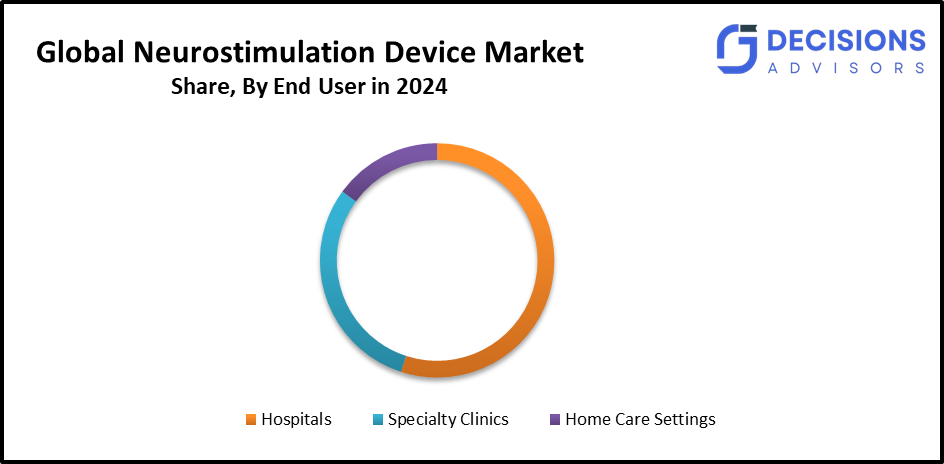
- The hospitals segment accounted for the highest market revenue in 2024 and is anticipated to grow at a remarkable CAGR over the forecast period.
Based on the end user, the neurostimulation device market is divided into hospitals, speciality clinics, and home care settings. Among these, the hospitals segment accounted for the highest market revenue in 2024 and is anticipated to grow at a remarkable CAGR over the forecast period. Their wide range of services and capacity to use state-of-the-art neurostimulation technology make them a powerful force that determines the size of the neuromodulation market. Neurostimulation devices can be integrated into a variety of medical specialities, including pain treatment, neurology, and mental health, thanks to their all-encompassing approach to patient care.
Regional Segment Analysis of the Neurostimulation Device Market
- North America (U.S., Canada, Mexico)
- Europe (Germany, France, U.K., Italy, Spain, Rest of Europe)
- Asia-Pacific (China, Japan, India, Rest of APAC)
- South America (Brazil and the Rest of South America)
- The Middle East and Africa (UAE, South Africa, Rest of MEA)
Asia Pacific is anticipated to hold the largest share of the neurostimulation device market over the predicted timeframe.
Asia Pacific is anticipated to hold the largest share of the neurostimulation device market over the predicted timeframe. The market for neurostimulation devices in the Asia-Pacific area is driven by the existence of many local producers in nations like China and Japan, who are launching cutting-edge, locally tailored products that increase competition and accessibility. The need for enhanced treatment alternatives is being driven by the ageing population and the rising frequency of neurological illnesses, such as chronic pain and mobility problems. The effectiveness, patient outcomes, and general usefulness of spinal cord and sacral nerve stimulation devices are being enhanced by technological advancements. Additionally, favourable government policies and programs are supporting both domestic and foreign businesses by fostering research, innovation, and greater accessibility.
The ADAPT-PD study in China is a groundbreaking clinical trial exploring personalised deep-brain stimulation (DBS) for Parkinson’s disease. Unlike traditional DBS, which delivers continuous electrical stimulation, this new approach—called adaptive DBS (aDBS)—uses real-time brain activity to adjust stimulation dynamically.
North America is expected to grow at a rapid CAGR in the neurostimulation device market during the forecast period. Rapid technical development, the existence of important local manufacturers, increased R&D expenditures, and encouraging government programs and financing are all contributing factors to this market's growth. Neurostimulation device technological developments, such as the creation of closed-loop systems and wireless capabilities, are improving patient outcomes and treatment effectiveness. Additionally, the market is expanding due to favourable regulatory regulations, rising healthcare spending, and a growing emphasis on personalised therapy.
The FDA approved the Flow Neuroscience FL-100, the first at-home brain stimulation device for treating major depressive disorder (MDD) in adults. This headset uses transcranial direct current stimulation (tDCS), targeting the dorsolateral prefrontal cortex—a brain region linked to mood regulation.
Competitive Analysis:
The report offers the appropriate analysis of the key organizations/companies involved within the neurostimulation device market, along with a comparative evaluation primarily based on their product offering, business overviews, geographic presence, enterprise strategies, segment market share, and SWOT analysis. The report also provides an elaborative analysis focusing on the current news and developments of the companies, which includes product development, innovations, joint ventures, partnerships, mergers & acquisitions, strategic alliances, and others. This allows for the evaluation of the overall competition within the market.
List of Key Companies
- Abbott Laboratories
- Aleva Neurotherapeutics
- BioControl Medical
- Boston Scientific
- ElectroCore
- Endostim
- Helbling Holding
- Innovative Health Solutions
- Laborie
- LivaNova
- Medtronic
- MicroTransponder
- Neuronetics
- Parasym
- Others
Key Target Audience
- Market Players
- Investors
- End-users
- Government Authorities
- Consulting and Research Firm
- Venture capitalists
- Value-Added Resellers (VARs)
Recent Development
- In February 2026, A new wave of neurotechnology emerged with the world’s first AI-powered device designed to sync with the menstrual cycle. This innovation used artificial intelligence to track hormonal fluctuations and delivered personalised neurostimulation, aiming to ease symptoms like mood swings, fatigue, and cognitive changes. By aligning stimulation with each phase of the cycle, the technology promised a more tailored approach to women’s health, blending neuroscience with precision wellness.
- In July 2025, Helius Medical Technologies announced that its PoNS® neurostimulation device has advanced toward a stroke rehabilitation indication following positive registrational program data. The portable device, which stimulates cranial nerves via the tongue to promote neuroplasticity, met key endpoints in pivotal trials, supporting its potential FDA label expansion for chronic stroke patients.
- In January 2024, Neurolief announced that it received FDA clearance for its Relivion non-invasive neuromodulation system to treat migraines, and also secured a regulatory approval and partnership in Japan with Sawai Pharmaceutical Co., Ltd. According to the company The FDA clearance is based on a multi-centre, RCT… 46% of patients in the active group were pain-free, and 75% of patients in the active group had complete freedom from the most bothersome symptoms (such as photophobia and nausea) within two hours of treatment.
Market Segment
This study forecasts revenue at global, regional, and country levels from 2020 to 2035. Decisions Advisors has segmented the neurostimulation device market based on the below-mentioned segments:
Global Neurostimulation Device Market, By Product Type
- Spinal Cord Stimulators
- Deep Brain Stimulators
- Transcranial Magnetic Stimulators
- Vagus Nerve Stimulators
Global Neurostimulation Device Market, By Technology
- Electrical Stimulation
- Magnetic Stimulation
- Chemical Stimulation
Global Neurostimulation Device Market, By End User
- Hospitals
- Specialty Clinics
- Home Care Settings
Global Neurostimulation Device Market, By Regional Analysis
- North America
- US
- Canada
- Mexico
- Europe
- Germany
- UK
- France
- Italy
- Spain
- Russia
- Rest of Europe
- Asia Pacific
- China
- Japan
- India
- South Korea
- Australia
- Rest of Asia Pacific
- South America
- Brazil
- Argentina
- Rest of South America
- Middle East & Africa
- UAE
- Saudi Arabia
- Qatar
- South Africa
- Rest of the Middle East & Africa
Frequently Asked Questions (FAQ)
1. What is the difference between invasive and non-invasive neurostimulation devices?
Invasive neurostimulation devices require surgical implantation inside the body (e.g., spinal cord stimulators or deep brain stimulators), offering long-term therapeutic benefits for chronic neurological disorders. Non-invasive devices, such as transcranial magnetic stimulation (TMS) and transcranial direct current stimulation (tDCS), are externally applied and do not require surgery, making them suitable for outpatient or home-based treatment settings.
2. How do closed-loop neurostimulation systems improve patient outcomes?
Closed-loop systems continuously monitor neural activity and automatically adjust stimulation levels in real time. This personalised feedback mechanism improves therapeutic precision, reduces side effects, enhances battery efficiency, and optimises symptom control compared to traditional open-loop systems.
3. Which neurological conditions represent emerging opportunities beyond chronic pain and Parkinson’s disease?
Emerging applications include treatment-resistant depression, obsessive-compulsive disorder (OCD), Alzheimer’s disease, post-stroke rehabilitation, urinary incontinence, migraine management, and epilepsy. Research is also exploring neurostimulation for cognitive enhancement and women’s health-related hormonal mood disorders.
4. What role does artificial intelligence (AI) play in the future of neurostimulation?
AI enhances neurostimulation by enabling adaptive therapy based on patient-specific data, predictive analytics for symptom flare-ups, and real-time optimisation of stimulation parameters. AI-powered devices are expected to significantly expand personalised neuromodulation therapies over the next decade.
5. How does reimbursement impact market penetration?
Favourable reimbursement policies increase accessibility and encourage hospital adoption. However, inconsistent reimbursement across developing regions can delay widespread usage, particularly for high-cost implantable devices.
6. What are the major risks associated with implantable neurostimulators?
Potential risks include infection, device malfunction, lead migration, battery depletion, surgical complications, and inconsistent therapeutic response. Long-term device maintenance and replacement procedures may also increase overall treatment costs.
7. How is the shift toward home-based care influencing the neurostimulation market?
Home-based neurostimulation devices, particularly wearable and portable systems, are expanding rapidly due to convenience, reduced hospital visits, and integration with telehealth platforms. This shift supports remote monitoring and improves treatment adherence.
8. Which technology type is expected to witness the fastest innovation over the forecast period?
Magnetic stimulation technologies and adaptive electrical stimulation systems are expected to witness strong innovation due to non-invasive capabilities and advancements in digital health integration.
9. How does demographic ageing influence market demand?
An ageing population increases the prevalence of neurodegenerative disorders such as Parkinson’s disease, Alzheimer’s disease, and chronic pain conditions, thereby significantly driving demand for neurostimulation therapies.
Check Licence
Choose the plan that fits you best: Single User, Multi-User, or Enterprise solutions tailored for your needs.
We Have You Covered
- 24/7 Analyst Support
- Clients Across the Globe
- Tailored Insights
- Technology Tracking
- Competitive Intelligence
- Custom Research
- Syndicated Market Studies
- Market Overview
- Market Segmentation
- Growth Drivers
- Market Opportunities
- Regulatory Insights
- Innovation & Sustainability
Report Details
| Scope | Global |
| Pages | 240 |
| Delivery | PDF & Excel via Email |
| Language | English |
| Release | Mar 2026 |
| Access | Download from this page |