
Global Nipah Virus Infection Market
 |
Author:
David J
|
Pages:
210
|
Author:
David J
|
Pages:
210
Global Nipah Virus Infection Market Size, Share by Product Type (Diagnostics, Vaccines, Therapeutics, Infection Control Solutions), by Diagnosis Method (RT-PCR, ELISA, Next-Generation Sequencing, Virus Isolation), by Treatment Type (Supportive Care, Antiviral Therapy, Immunotherapy), by End User (Hospitals, Reference Laboratories, Research Institutes, Public Health Agencies), and by Region (Asia-Pacific, North America, Europe, Latin America, Middle East & Africa), Analysis and Forecast 2026-2035
CAGR
13.34%
REVENUE 2025
USD Million 60.1
FORECAST 2035
USD Million 210.2
REPORT COVERAGE
Global
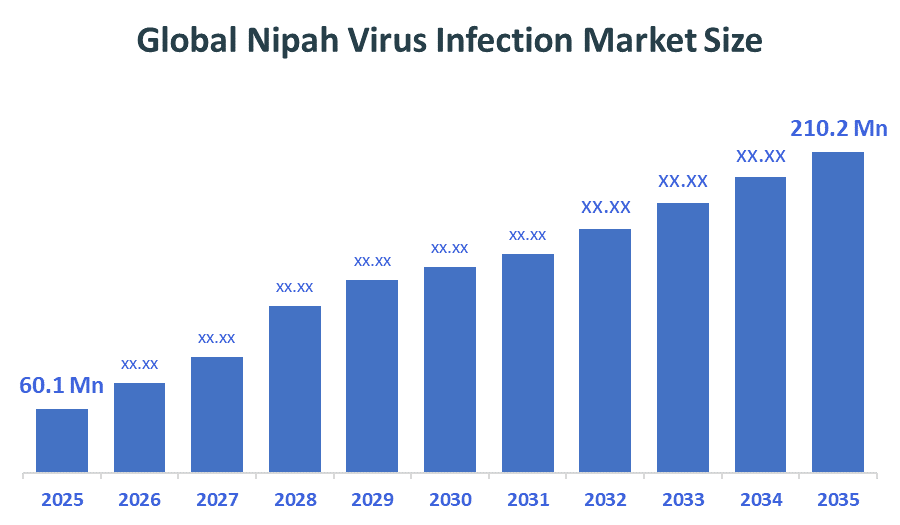
The Global Nipah Virus Infection Market Size is foreseen to grow from USD 60.1 Million in 2025 and is govern to reach around USD 210.2 Million by 2035. According to Decision Advisors, a detailed research report on the Global Nipah Virus Infection Market is boosted by transition toward decentralized, accounting for nearly up to the 20-25% share of the total share worldwide. Thermo Fisher Scientific is the prime player in the market with approximately USD 39.60 Billion in annual turnover and a 50-60% market share, positioning it as the primary driver of the Global Nipah Virus Infection Market.
Market Snapshot
- Global Nipah Virus Infection Market Size (2025): USD 60.1 Million
- Projected Global Nipah Virus Infection Market Size (2035): USD 210.2 Million
- Global Nipah Virus Infection Market Compound Annual Growth Rate (CAGR): 13.34%
- 1st Largest Region: Asia Pacific
- 2nd Largest Region: North America
- 3rd Largest Region: Europe
- Base Year: 2025
- Historical Period: 2021–2024
- Forecast Period: 2026–2035
Market Overview/ Introduction
The Global Nipah Virus (NiV) Infection Market is defined as a specialised segment of the biopharmaceutical and diagnostic sectors focused on the detection, containment, and research of the Nipah virus, a high-fatality zoonotic pathogen. This market is about preparedness, it’s the collective effort of scientists, tech companies, and governments to make sure we aren’t achieved off guard by a virus that is both rare and incredibly dangerous. The growth is being powered by a fundamental shift, market is shifting away from waiting for outbreaks to happen and toward stopping them at the source. Huge names like Thermo Fisher and Roche are providing the high-tech kits needed for rapid detection, while companies like the Serum Institute of India are working on the world’s first vaccines to protect people before the next spillover occurs. What makes this market human is the One Health approach a recognition that our health is tied to the animals and environment around us. Governments are now funding mobile labs that travel to remote villages, and international groups like CEPI are pouring hundreds of millions of dollars into research to ensure that a localised outbreak doesn't become a global crisis. The future here isn't just about selling products; it’s about using AI and advanced science to create a world where a virus from a fruit bat no longer poses a terminal threat to a community.
- In India, the government supports Nipah virus preparedness through the ICMR Emerging Infectious Disease Research Scheme, the Integrated Disease Surveillance Programme (IDSP), and the Virus Research & Diagnostic Laboratories (VRDL) network, along with the National One Health Mission.
- In January 2026, a Nipah virus outbreak was reported in West Bengal, where two confirmed cases were detected and validated using RT-PCR and ELISA testing, highlighting the growing importance of advanced diagnostic technologies in outbreak management.
- In the United States, Nipah virus-related initiatives are supported through the NIH Pandemic Preparedness (Prototype Pathogen Program), NIAID vaccine research programs, and BARDA biodefense funding initiatives.
- In the United Kingdom, Nipah virus preparedness is supported through the UK Health Security Agency (UKHSA) emerging disease surveillance programs, the University of Oxford vaccine development initiative (ChAdOx1 platform).
Notable Insights: -
- Asia-Pacific is anticipated to hold the largest share, approximately 55% of the global Nipah virus infection market over the predicted timeframe.
- North America is the second largest region in the global Nipah virus infection Market during the forecast period, holding approximately 25% share.
- By product type, the electrocautery (hot snares) segment dominated the market in 2025 with approximately 45% share, and is projected to grow at a substantial CAGR during the forecast period.
- By end user, the hospitals segment dominated the market in 2025 with approximately 513.34% share, and is projected to grow at a substantial CAGR during the forecast period.
- The compound annual growth rate of the global Nipah virus infection market is 13.34%.
6. The market is likely to achieve a valuation of USD 210.2 Million by 2035.
What is the role of technology in grooming the market?
Technology plays a crucial role in shaping the Nipah Virus Infection Market by enabling early detection, rapid response, and advanced treatment development. Innovations such as RT-PCR diagnostics, AI-based outbreak prediction, and mRNA vaccine platforms have significantly improved the ability to control and manage outbreaks. For example, during Nipah outbreaks in Kerala, institutions like the National Institute of Virology used real-time RT-PCR testing to quickly identify infected individuals, helping authorities contain the spread efficiently. This demonstrates how technology enhances surveillance, reduces mortality, and strengthens overall outbreak preparedness.
Market Drivers
The market drivers are a global shift from being reactive to proactive. We aren't just waiting for a crisis anymore, we’re actively trying to outsmart the virus before it starts. The biggest spark is the rising frequency of outbreaks. As our cities grow and push deeper into nature, we’re coming into closer contact with the wildlife that carries the virus. This has turned pandemic preparedness from a buzzword into a massive investment priority. Because Nipah is so dangerous, international health groups are pouring hundreds of millions of dollars into research, effectively footing the bill to encourage companies to develop vaccines that might otherwise be too expensive to make. Another huge driver is our interconnectedness. We’ve realised that human health can’t be separated from animal health. This One Health mindset is pushing the market to create tests not just for people, but for the livestock and environments where the virus hides. Finally, there’s a real human push for fairness in technology. We are seeing a move to get high-tech diagnostic tools out of fancy city labs and into the hands of local doctors in remote villages. It’s about making sure that the person living in a rural outbreak zone has the same access to a quick, life-saving diagnosis as someone in a major medical hub.
Restrain
The Nipah Virus Infection Market faces significant restraints due to the lack of approved vaccines or specific antiviral treatments, which limit widespread adoption and commercialisation. Additionally, the sporadic nature of outbreaks reduces consistent demand, making it less attractive for large-scale investment by pharmaceutical companies. High biosafety requirements for handling the virus and limited healthcare infrastructure in outbreak-prone regions such as Bangladesh further hinder market growth. These factors collectively slow down research progress and restrict market expansion.
Competitive Analysis:
The report offers the appropriate analysis of the key organizations/companies involved within the global nipah virus infection market, along with a comparative evaluation primarily based on their product of offering, business overviews, geographic presence, enterprise strategies, segment market share, and SWOT analysis. The report also provides an elaborative analysis focusing on the current news and developments of the companies, which includes product development, innovations, joint ventures, partnerships, mergers & acquisitions, strategic alliances, and others. This allows for the evaluation of the overall competition within the market.
Top Companies in the Global Nipah Virus Infection Market
- Abbott Laboratories
- Thermo Fisher Scientific
- Roche Diagnostics
- Bio-Rad Laboratories
- QIAGEN
- Molbio Diagnostics Pvt. Ltd.
- BioMerieux SA
- Siemens Healthineers
- Krishgen Biosystems
- Liferiver Bio-Technology Co., Ltd.
Government Initiatives
|
Country |
Key Government Initiatives |
|
Germany |
CEPI, supported by government partners (Germany, and Norway), awarded up to $25 million to US-based firms to advance vaccines previously developed at the Uniformed Services University. |
|
India |
CEPI supported the Serum Institute of India and Oxford University with funding (around USD 7.3 million) to establish process development and manufacturing readiness for the ChAdOx1 NipahB vaccine candidate, strengthening emergency deployment capacity in outbreak regions. |
|
Japan |
CEPI awards contract worth up to US$ 31 million to The University of Tokyo to develop vaccine against Nipah virus. |
Study on the Supply, Demand, Distribution, and Market Environment of the Global Nipah Virus Infection Market
The Global Nipah Virus Infection Market shows a highly outbreak-driven supply demand pattern, where demand spikes suddenly during outbreaks while remaining low in non-outbreak periods. For instance, since 2001, over 429 cases and 307 deaths have been reported globally, reflecting the disease’s high fatality and urgent need for diagnostics and treatment solutions. Supply is limited and mainly supported by government labs and research organizations due to the absence of commercialised vaccines. Distribution is concentrated in public hospitals, diagnostic labs, and emergency response units, especially in regions like Bangladesh and India, where outbreaks occur almost annually. Overall, the market environment remains highly regulated, research-focused, and dependent on global health funding, rather than continuous commercial demand.
Price Analysis and Consumer Behaviour Analysis
Price analysis in the Nipah Virus Infection Market shows that diagnostic tests (such as RT-PCR) are moderately priced but experience price surges of up to approximately 25% during outbreak periods due to sudden demand spikes and limited supply. In contrast, upcoming treatments like monoclonal antibodies and vaccines are expected to be high-cost biologics, often funded by governments or global organizations. From a consumer behaviour perspective, over 75% of healthcare providers prioritise accuracy, rapid results, and reliability over cost, especially in high-risk regions like India and Bangladesh, where quick diagnosis is critical to controlling fatality rates that can reach up to 70%.
Market Segmentation
The Global Nipah Virus Infection Market share is classified into product type, diagnostic methods, treatment type, and end user.
- The diagnostics segment dominated the market in 2025 with approximately 48% share, and is projected to grow at a substantial CAGR during the forecast period.
Based on the product type, the global Nipah virus infection market is divided into diagnostics, vaccines, therapeutics, and infection control solutions. Among these, the diagnostics segment dominated the market in 2025 with approximately 48% share, owing to the urgent need for early and accurate detection during outbreaks. For instance, RT-PCR testing is widely used during Nipah outbreaks in regions like Kerala to quickly identify infected individuals and contain transmission. Additionally, advancements in rapid diagnostic kits and molecular testing technologies have significantly improved detection speed and accuracy, boosting adoption. Vaccines are expected to witness the fastest growth due to increasing global investments in preventive healthcare and ongoing clinical development.
- The RT-PCR segment accounted for the largest share in 2025 with approximately 55%, and is anticipated to grow at a significant CAGR during the forecast period.
Based on the diagnosis method, the global Nipah virus infection market is divided into RT-PCR, ELISA, next-generation sequencing, and virus isolation. Among these, the RT-PCR segment accounted for the largest share in 2025 with approximately 55%, driven by its high sensitivity and reliability in detecting viral RNA during early infection stages. For example, RT-PCR has been the primary diagnostic tool used in outbreak management across countries like Bangladesh, ensuring timely isolation and treatment of infected individuals. Moreover, technological advancements in molecular diagnostics and increased availability of testing infrastructure are enhancing diagnostic efficiency. Next-generation sequencing is also gaining traction for viral mutation tracking and research purposes.
- The supportive care segment dominated the market in 2025 with approximately 60% share, and is projected to grow at a steady CAGR during the forecast period.
Based on the treatment type, the global Nipah virus infection market is divided into supportive care, antiviral therapy, and immunotherapy. Among these, the supportive care segment dominated the market in 2025 with approximately 60% share, due to the absence of approved specific antiviral treatments or vaccines. For instance, patients are primarily managed through intensive care, including respiratory support and fluid management, to reduce mortality risk. Additionally, improvements in critical care infrastructure and hospital preparedness (2023–2025) are supporting segment growth. Antiviral therapies and immunotherapies are expected to grow significantly as clinical trials progress.
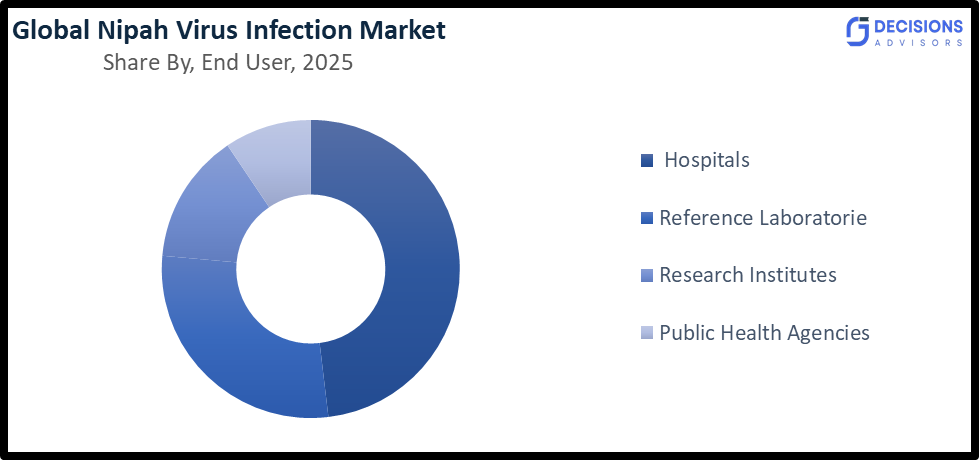
• The hospitals segment dominated the market in 2025 with approximately 52% share, and is projected to grow at a substantial CAGR during the forecast period.
Based on the end user, the global Nipah virus infection market is divided into hospitals, reference laboratories, research institutes, and public health agencies. Among these, the hospitals segment dominated the market in 2025 with approximately 52% share, due to high patient admission rates during outbreaks and availability of critical care facilities. For instance, hospitals serve as primary centers for diagnosis, isolation, and treatment of Nipah patients. Furthermore, increasing government investments in healthcare infrastructure and emergency response systems are supporting segment growth. Public health agencies are expected to grow rapidly due to their role in surveillance and outbreak management.
Strategies to Implement for Growth of the Market in Non-Leading Regions
To drive growth of the surgical snares market in non-leading regions, companies should focus on improving accessibility, affordability, and clinical training for endoscopic procedures. Expanding distribution networks through local partnerships and offering cost-effective disposable snares can significantly enhance adoption in price-sensitive markets. Additionally, investing in physician training programs and mobile endoscopy units can increase procedural volumes in rural and semi-urban areas. A real-world example is India, where government-backed initiatives under public healthcare schemes have supported the expansion of endoscopy services in tier-2 and tier-3 cities, leading to increased adoption of minimally invasive tools such as surgical snares in public hospitals.
Regional Segment Analysis of the Global Nipah Virus Infection Market
- North America (U.S., Canada, Mexico)
- Europe (Germany, France, U.K., Italy, Spain, Rest of Europe)
- Asia-Pacific (China, Japan, India, Rest of APAC)
- South America (Brazil and the Rest of South America)
- The Middle East and Africa (UAE, South Africa, Rest of MEA)
Asia-Pacific is anticipated to hold the largest share, approximately 55% of the global nipah virus infection market over the predicted timeframe.
Asia-Pacific is anticipated to hold the largest share, approximately 55% of the global nipah virus infection market over the predicted timeframe. The region dominates due to the frequent occurrence of Nipah virus outbreaks, particularly in countries like India and Bangladesh, which drives strong demand for diagnostics, surveillance, and supportive care. Additionally, increasing government initiatives, such as enhanced virus monitoring and emergency response systems, are supporting market growth. A key development includes the expansion of diagnostic laboratories and rapid response units between 2023–2025, improving outbreak containment. Rising awareness about zoonotic diseases and improving healthcare infrastructure are further strengthening the region’s dominance.
North America is the second largest region in the Global Nipah Virus Infection Market during the forecast period, holding approximately 25% share.
North America is the second largest region in the global nipah virus infection market during the forecast period, holding approximately 25% share, driven by strong research and development capabilities and significant funding for emerging infectious diseases. The region benefits from advanced healthcare infrastructure and active involvement of organisations like the National Institutes of Health in supporting vaccine and therapeutic development. Additionally, the presence of leading pharmaceutical and biotechnology companies is accelerating innovation in vaccines and antiviral therapies. Increased focus on pandemic preparedness and biosurveillance systems (2023–2025) is further boosting market growth.
Europe is the third largest region in the Global Nipah Virus Infection Market during the forecast period, holding approximately 15% share.
Europe is the third largest region in the Global Nipah Virus Infection Market during the forecast period, holding approximately 15% share, supported by strong public health systems and growing investments in infectious disease research. The region benefits from collaborative initiatives and funding programs aimed at developing vaccines and improving outbreak preparedness. Countries such as Germany, France, and United Kingdom are leading contributors due to their advanced research infrastructure. Additionally, increasing focus on global health security and cross-border disease monitoring (2023–2025) is supporting steady market growth across the region.
Future Market Trends in the Global Nipah Virus Infection Market: -
1. Rapid Development of Vaccines and Biologics
One of the most significant trends is the increasing focus on vaccine and monoclonal antibody development, driven by the absence of approved treatments. Multiple vaccine platforms, including mRNA, viral vector, and subunit vaccines, are currently under research and clinical evaluation. This trend is gaining momentum as Nipah virus is recognised as a potential pandemic threat pathogen, prompting global investments in preventive solutions.
2. Advancement in Rapid and Point-of-Care Diagnostics
There is a growing shift toward rapid diagnostic technologies, such as RT-PCR, portable testing kits, and next-generation sequencing, enabling early detection and faster outbreak control. Improved diagnostic capabilities are crucial, as early identification significantly reduces transmission and mortality. Recent outbreaks have demonstrated the importance of quick testing and contact tracing systems, especially in high-risk regions.
3. Increasing Focus on Global Surveillance and One Health Approach
A major future trend is the adoption of the One Health approach, integrating human, animal, and environmental health to prevent zoonotic spillovers. Governments and organisations are strengthening biosurveillance systems, AI-based outbreak prediction, and cross-border monitoring to manage risks associated with bat-to-human transmission. This holistic approach is becoming essential due to the recurring outbreaks and zoonotic nature of the virus.
Recent Development
- In October 2025, global research efforts focused on the m102.4 monoclonal antibody candidate, which progressed further in development under international partnerships. The program emphasized scaling up manufacturing capabilities and evaluating broader clinical applicability for post-exposure treatment of Nipah virus infection.
- In March 2025, the Indian Council of Medical Research (ICMR) initiated collaboration with pharmaceutical companies to develop and manufacture indigenous monoclonal antibody therapies against Nipah virus, marking one of the most significant therapeutic development programs aimed at establishing large-scale emergency treatment capacity during outbreaks.
Market Segment
This study forecasts revenue at global, regional, and country levels from 2020 to 2035. Decision Advisors has segmented the Global Nipah Virus Infection Market based on the below-mentioned segments:
Global Nipah Virus Infection Market, By Product Type
- Diagnostics
- Vaccines
- Therapeutics
- Infection Control Solutions
Global Nipah Virus Infection Market, By Diagnostic Method
- RT-PCR
- ELISA
- Next-Generation Sequencing
- Virus Isolation
Global Nipah Virus Infection Market, By End User
- Supportive Care
- Antiviral Therapy
- Immunotherapy
Global Nipah Virus Infection Market, By End User
- Hospitals
- Reference Laboratories
- Research Institutes
- Public Health Agencies
Global Nipah Virus Infection Market, By Regional Analysis
- North America
- US
- Canada
- Mexico
- Europe
- Germany
- UK
- France
- Italy
- Spain
- Russia
- Rest of Europe
- Asia Pacific
- China
- Japan
- India
- South Korea
- Australia
- Rest of Asia Pacific
- South America
- Brazil
- Argentina
- Rest of South America
- Middle East & Africa
- UAE
- Saudi Arabia
- Qatar
- South Africa
- Rest of the Middle East & Africa
Frequently Asked Questions (FAQ)
1. How does seasonality affect Nipah virus outbreak patterns and market demand?
Seasonal factors such as fruit harvesting periods and bat migration patterns can influence outbreak frequency, leading to temporary spikes in demand for diagnostics and surveillance tools.
2. What role do animal host monitoring programs play in shaping the Nipah Virus Infection Market?
Monitoring animal reservoirs, especially bats and livestock, helps in early outbreak prediction, increasing demand for surveillance technologies and preventive healthcare solutions.
3. How could emergency-use regulatory pathways impact product commercialisation in this market?
Fast-track approvals during outbreaks can accelerate the availability of vaccines and therapeutics, but may also create challenges in long-term regulatory compliance and market sustainability.
4. What are the key challenges in conducting clinical trials for Nipah virus treatments?
Limited patient populations and unpredictable outbreaks make it difficult to conduct large-scale clinical trials, slowing down drug and vaccine development.
5. How does international collaboration influence innovation in the Nipah Virus Infection Market?
Global partnerships between governments, research institutes, and biotech firms enable shared funding, data exchange, and faster innovation, which is crucial for tackling rare but high-risk diseases like Nipah.
Check Licence
Choose the plan that fits you best: Single User, Multi-User, or Enterprise solutions tailored for your needs.
We Have You Covered
- 24/7 Analyst Support
- Clients Across the Globe
- Tailored Insights
- Technology Tracking
- Competitive Intelligence
- Custom Research
- Syndicated Market Studies
- Market Overview
- Market Segmentation
- Growth Drivers
- Market Opportunities
- Regulatory Insights
- Innovation & Sustainability
Report Details
| Scope | Global |
| Pages | 210 |
| Delivery | PDF & Excel via Email |
| Language | English |
| Release | Apr 2026 |
| Access | Download from this page |