
Global Non-Small Cell Lung Cancer Market
 |
Pages:
240
|
Pages:
240
Global Non-Small Cell Lung Cancer Market Size, Share, and COVID-19 Impact Analysis, By Cancer Type (Squamous Cell Carcinoma, Adenocarcinoma, and Large-cell Carcinoma), By Treatment (Chemotherapy, Targeted Therapy, and Immunotherapy) and By Region (North America, Europe, Asia-Pacific, Latin America, Middle East, and Africa), Analysis and Forecast 2025-2035
REPORT COVERAGE
Global
Global Non-Small Cell Lung Cancer Market Size Insights Forecasts to 2035
- The Global Non-Small Cell Lung Cancer Market Size Was valued at USD 12.3 Billion in 2024
- The Global Non-Small Cell Lung Cancer Market Size is Expected to Grow at a CAGR of around 6.85% from 2025 to 2035
- The Worldwide Non-Small Cell Lung Cancer Market Size is Expected to Reach USD 25.5 Billion by 2035
- Asia-Pacific is expected to grow the fastest during the forecast period.
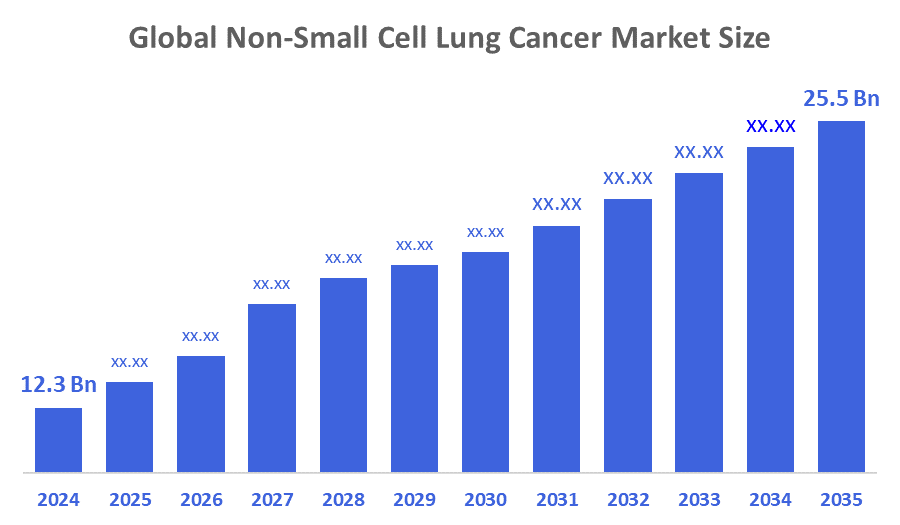
According to a research report published by Decisions Advisors and Consulting, The Global Non-Small Cell Lung Cancer Market Size Was Worth Around USD 12.3 Billion In 2024 And Is Predicted To Grow To Around USD 25.5 Billion By 2035 With A Compound Annual Growth Rate (CAGR) Of 6.85% From 2025 To 2035. Future opportunities include targeted therapies and expansion of immunotherapy and biomarker-driven precision medicine research and AI-enabled diagnostic development and adoption of early screening methods and combination treatment methods and development of new biologic agents and construction of personalized treatment pathways and growth of clinical trial programs and extensive market development in Asia-Pacific and emerging regions.
Market Overview
The Global Non-Small Cell Lung Cancer Market Size refers to the worldwide industry which develops and manufactures and sells treatments and diagnostic tools and medical technologies used to treat non-small cell lung cancer, which represents the most common form of lung cancer. Additionally, the Non-Small Cell Lung Cancer Market is currently experiencing a dynamic evolution, driven by advancements in treatment modalities and a growing understanding of the disease's biology. Innovative therapies, including targeted agents and immunotherapies, are gaining traction, offering new hope to patients. The increasing worldwide occurrence of lung cancer together with enhanced public awareness and better screening programs is driving the market expansion. The ongoing research into personalized medicine development will enhance treatment effectiveness by constructing patient-specific treatment strategies. The Non-Small Cell Lung Cancer Market currently experiences increasing collaboration between pharmaceutical companies and research institutions and healthcare providers. The partnerships work to speed up drug development while making advanced medical treatments available to patients. The regulatory bodies help the market grow by making the treatment approval process more efficient for new therapies. Stakeholders need to monitor new developments while changing their strategies so they can fulfill patient and healthcare system requirements in the transforming environment.
Report Coverage
This research report categorizes the non-small cell lung cancer market based on various segments and regions, forecasts revenue growth, and analyzes trends in each submarket. The report analyses the key growth drivers, opportunities, and challenges influencing the non-small cell lung cancer market. Recent market developments and competitive strategies such as expansion, type launch, development, partnership, merger, and acquisition, have been included to draw the competitive landscape in the market. The report strategically identifies and profiles the key market players and analyses their core competencies in each sub-segment of the non-small cell lung cancer market.
Driving Factors
The non-small cell lung cancer market is experiencing growth because more funding is dedicated to research and development, which exists to address the need for better treatment solutions. Pharmaceutical companies and research institutions are allocating substantial resources to explore novel therapies, which include targeted agents and immunotherapies. Recent funding trends indicate that researchers are increasingly interested in conducting clinical trials, which will assess new drug candidates together with treatment combinations. The current funding surge will boost innovation speed throughout the Non-Small Cell Lung Cancer Market, which will result in the creation of innovative therapies that will change patient treatment methods. The scientific environment created through academic partnerships with industry organizations will drive upcoming advancements in non-small cell lung cancer treatment development.
Restraining Factors
The factors that hinder progress include expensive treatment fees, restricted medical services in poverty-stricken areas, negative treatment outcomes, complicated medicine approval processes, resistance of patients to treatments, medical professionals discovering diseases at advanced stages, difficulties in receiving insurance coverage for medical expenses and developing healthcare systems that lack essential biomarker testing facilities.
Market Segmentation
The non-small cell lung cancer market share is classified into cancer type and treatment.
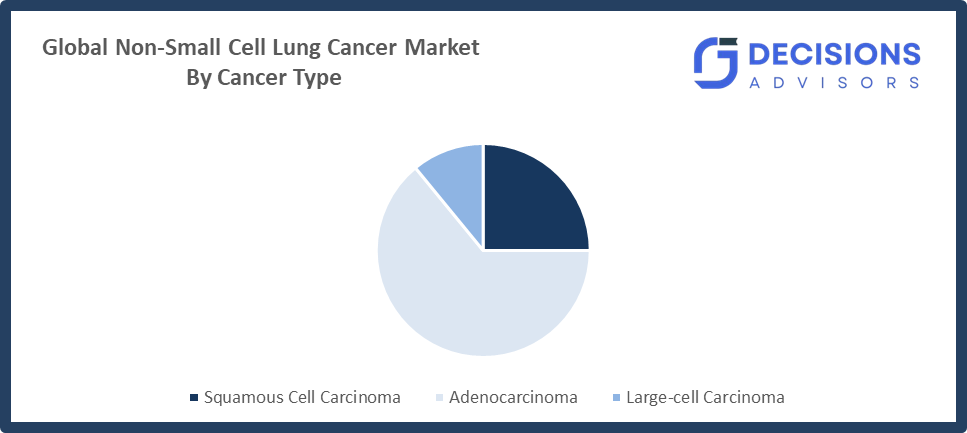
- The adenocarcinoma segment dominated the market in 2024, approximately 40% and is projected to grow at a substantial CAGR during the forecast period.
Based on the cancer type, the non-small cell lung cancer market is divided into squamous cell carcinoma, adenocarcinoma, and large-cell carcinoma. Among these, the adenocarcinoma segment dominated the market in 2024, approximately 40% and is projected to grow at a substantial CAGR during the forecast period. The treatment shows effectiveness for all non-small cell lung cancer subtypes because of its highest success rate during actual clinical applications. The rising use of targeted therapies together with biomarker-based treatments leads to better treatment results. The segment development receives backing from molecular diagnostic progress, expanding screening initiatives, and the existence of active clinical development programs, while pharmaceutical companies accelerate the creation of customized medicine and combined treatment methods that they develop for use across the globe.
- The immunotherapy segment accounted for the largest share in 2024, approximately 45% and is anticipated to grow at a significant CAGR during the forecast period.
Based on the treatment, the non-small cell lung cancer market is divided into chemotherapy, targeted therapy, and immunotherapy. Among these, the immunotherapy segment accounted for the largest share in 2024, approximately 45% and is anticipated to grow at a significant CAGR during the forecast period. The treatment method shows better patient outcomes because it delivers constant treatment effects while causing fewer side effects than standard chemotherapy. The medical field now accepts immune checkpoint inhibitors because doctors use them together with other treatments and approved them for initial patient treatment. The segment experiences international growth because of its robust clinical pipelines and patient selection through biomarkers and increasing doctor adoption.
Regional Segment Analysis of the Non-Small Cell Lung Cancer Market
- North America (U.S., Canada, Mexico)
- Europe (Germany, France, U.K., Italy, Spain, Rest of Europe)
- Asia-Pacific (China, Japan, India, Rest of APAC)
- South America (Brazil and the Rest of South America)
- The Middle East and Africa (UAE, South Africa, Rest of MEA)
North America is anticipated to hold the largest share of the non-small cell lung cancer market over the predicted timeframe.
North America is anticipated to hold the largest share of the non-small cell lung cancer market over the predicted timeframe. The territory shows better market competitiveness because it has leading pharmaceutical companies which conduct multiple clinical studies and implement early detection programs and receive beneficial government regulations while spending extensively on healthcare. The advanced oncology infrastructure together with high disease rates and complete reimbursement systems and fast adoption of targeted treatments and immunotherapy systems.
Asia-Pacific is expected to grow at a rapid CAGR in the non-small cell lung cancer market during the forecast period. The patient pool of the facility combined with the increasing rate of lung cancer cases and the development of better medical facilities and the introduction of modern treatment options. The regional market experiences accelerated growth during the forecast period because of multiple factors which include increasing government health programs and rising medical tourism and higher healthcare expenditure and expanding clinical research and strong pharmaceutical investments.
Competitive Analysis:
The report offers the appropriate analysis of the key organizations/companies involved within the non-small cell lung cancer market, along with a comparative evaluation primarily based on their type of offering, business overviews, geographic presence, enterprise strategies, segment market share, and SWOT analysis. The report also provides an elaborative analysis focusing on the current news and developments of the companies, which includes type development, innovations, joint ventures, partnerships, mergers & acquisitions, strategic alliances, and others. This allows for the evaluation of the overall competition within the market.
List of Key Companies
- Hoffmann-La Roche Ltd (Roche)
- AstraZeneca plc
- Bristol-Myers Squibb (BMS)
- Merck & Co., Inc. (MSD)
- Pfizer Inc
- Novartis AG
- Johnson & Johnson (Janssen Pharmaceuticals)
- Eli Lilly and Company
- Takeda Pharmaceutical Company Ltd.
- Amgen Inc.
- Others
Key Target Audience
- Market Players
- Investors
- End-users
- Government Authorities
- Consulting and Research Firm
- Venture capitalists
- Value-Added Resellers (VARs)
Recent Development
- In May 2024, Roche stated that Tecentriq had steadily improved outcomes in patients with early lung cancer. Data from all 1,005 randomized Stage II–IIIA NSCLC patients indicated a 21% reduction in the chance of cancer recurrence or death after a median follow-up of 32.2 months. In this experiment, Tecentriq’s safety profile was comparable to its prior profile, with no safety signals reported. The medication had adversely affected 92.7% of the entire randomized group, compared to 70.7% of those on BSC.
Market Segment
This study forecasts revenue at global, regional, and country levels from 2020 to 2035. Decisions Advisors has segmented the non-small cell lung cancer market based on the below-mentioned segments:
Global Non-Small Cell Lung Cancer Market, By Cancer Type
- Squamous Cell Carcinoma
- Adenocarcinoma
- Large-cell Carcinoma
Global Non-Small Cell Lung Cancer Market, By Treatment
- Chemotherapy
- Targeted Therapy
- Immunotherapy
Global Non-Small Cell Lung Cancer Market, By Regional Analysis
- North America
- US
- Canada
- Mexico
- Europe
- Germany
- UK
- France
- Italy
- Spain
- Russia
- Rest of Europe
- Asia Pacific
- China
- Japan
- India
- South Korea
- Australia
- Rest of Asia Pacific
- South America
- Brazil
- Argentina
- Rest of South America
- Middle East & Africa
- UAE
- Saudi Arabia
- Qatar
- South Africa
- Rest of the Middle East & Africa
Frequently Asked Questions (FAQ)
1. What is the projected growth outlook of the global non-small cell lung cancer market?
A: The market is projected to grow from USD 12.3 billion in 2024 to USD 25.5 billion by 2035, registering a CAGR of 6.85% due to treatment innovation and rising prevalence.
2. Which cancer type segment leads the market and why?
A: Adenocarcinoma leads with around 40% share, driven by high prevalence, strong clinical success rates, expanding screening programs, and increasing adoption of targeted and biomarker-based personalized treatment approaches.
3. Which treatment segment dominates the market?
A: Immunotherapy dominates with approximately 45% share, supported by superior survival outcomes, durable responses, fewer side effects, expanding first-line approvals, combination regimens, and growing physician preference worldwide.
4. Which region holds the largest and fastest-growing positions?
A: North America holds the largest share due to advanced infrastructure and funding, while Asia-Pacific grows fastest because of large patient populations, healthcare expansion, and rising investments.
5. What key factors drive market growth?
A: Market growth is driven by rising R&D investments, expanding clinical trials, targeted therapy advancements, immunotherapy adoption, personalized medicine development, regulatory support, early screening initiatives, and strategic collaborations among pharmaceutical and research organizations.
Check Licence
Choose the plan that fits you best: Single User, Multi-User, or Enterprise solutions tailored for your needs.
We Have You Covered
- 24/7 Analyst Support
- Clients Across the Globe
- Tailored Insights
- Technology Tracking
- Competitive Intelligence
- Custom Research
- Syndicated Market Studies
- Market Overview
- Market Segmentation
- Growth Drivers
- Market Opportunities
- Regulatory Insights
- Innovation & Sustainability
Report Details
| Scope | Global |
| Pages | 240 |
| Delivery | PDF & Excel via Email |
| Language | English |
| Release | Mar 2026 |
| Access | Download from this page |