
Global Occupancy Sensors Market
 |
Author:
Shruti G
|
Pages:
240
|
Author:
Shruti G
|
Pages:
240
Global Occupancy Sensors Market Size, Share By Type (Passive Infrared Sensors, Ultrasonic Sensors, Dual Technology Sensors, and Photoelectric Sensors), By Application (Lighting Control, HVAC Control, Security Systems, and Energy Management), By End Use (Residential, Commercial, Industrial, and Institutional), and By Region (North America, Europe, Asia-Pacific, Latin America, Middle East & Africa), Analysis and Forecast 2026-2035
CAGR
11.05%
REVENUE 2025
USD Billion 4.9
FORECAST 2035
USD Billion 13.98
REPORT COVERAGE
Global
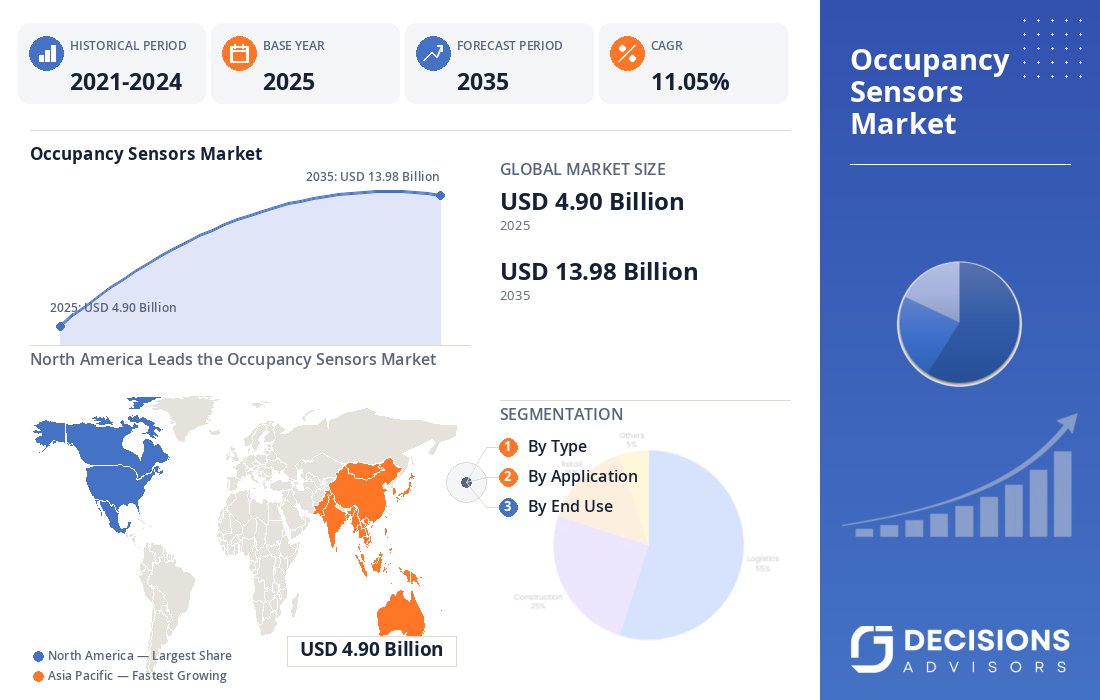
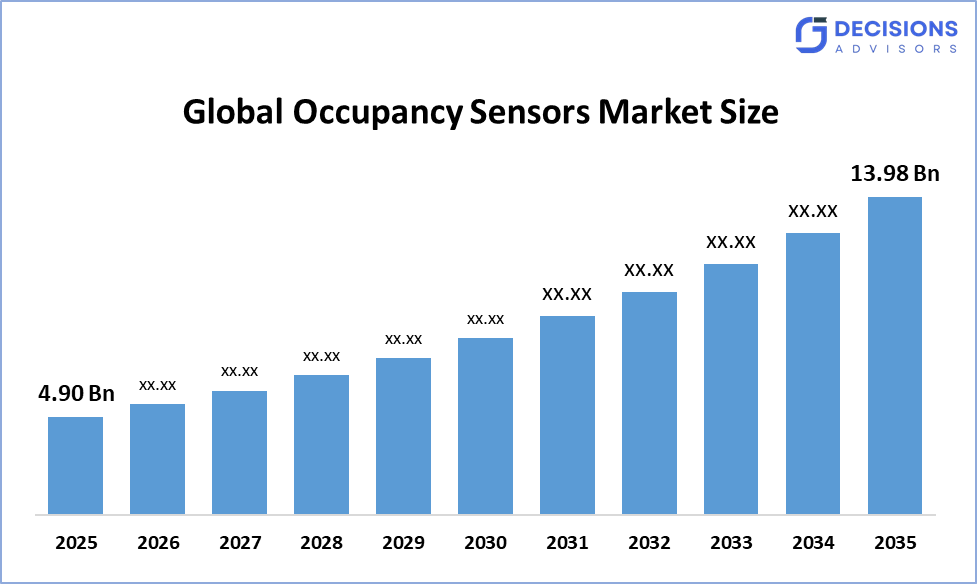
The Global Occupancy Sensors Market Size is predicted to grow from USD 4.90 Billion in 2025 and is likely to reach around USD 13.98 Billion by 2035 with a CAGR of 11.05%. According to Decision Advisors, a detailed research report on the market reflects that the touchless sensing adoption trend dominates the Global Occupancy Sensors Market, accounting for approximately 52% of the total share worldwide. Signify leads the market with annual revenue of approximately EUR 6.0 billion and a strong global presence in connected lighting and occupancy-sensing solutions, making it a key contributor to global market development and growth dynamics.
Market Snapshot
- Global Occupancy Sensors Market Size (2025): USD 4.90 Billion
- Projected Global Occupancy Sensors Market Size (2035): USD 13.98 Billion
- Global Occupancy Sensors Market Compound Annual Growth Rate (CAGR): 11.05%
- Largest Regional Market: North America
- 2nd Largest Region: Europe
- Fastest Growing Region: Asia Pacific
- Base Year: 2025
- Historical Period: 2021-2024
- Market Forecast Period: 2026-2035
Market Overview/ Introduction
The Global Occupancy Sensors Market refers to the industry that develops sensors capable of detecting human presence to automate the control of lighting, heating, ventilation, and air conditioning systems within buildings. The market is experiencing substantial growth because of increasing demand for energy-efficient building automation, rising construction of smart buildings, and businesses implementing sustainability and cost-saving measures. Government building energy codes such as ASHRAE 90.1 in the United States and the EU Energy Performance of Buildings Directive are creating stronger conditions for occupancy-sensing adoption. Key companies, including Signify, Honeywell International, Schneider Electric, Johnson Controls, and Acuity Brands are developing compact sensing solutions that use less power while achieving high precision. The market provides customers with products that combine high sensitivity features through compact designs which provide long-lasting durability and low power consumption. The global market will experience future expansion through the development of IoT technologies, smart home systems and industrial automation solutions, wireless retrofit sensors, and advanced building management interfaces.
- The United States government supports occupancy-sensing adoption through ASHRAE 90.1 and the International Energy Conservation Code, which mandate automatic lighting shutoff and occupancy-based controls in commercial buildings, reinforcing steady procurement across new construction and retrofit projects.
- Smart city and green building programs in Asia Pacific, including China’s Green Building Star Standard, are driving the adoption of advanced occupancy sensing ICs, supporting the development of connected, intelligent infrastructure and IoT-enabled buildings across urban environments.
Notable Insights: -
- North America is anticipated to hold approximately 36% share of the Global Occupancy Sensors Market over the predicted timeframe.
- Asia Pacific is expected to grow at the fastest CAGR in the Global Occupancy Sensors Market by holding approximately 28% of the share during the forecast period,
- By type, the Passive Infrared Sensors segment dominated the market and holds approximately 52% share in 2025 and is projected to grow at a substantial CAGR during the forecast period.
- By application, the Lighting Control segment dominated the market and holds approximately 44% share in 2025 and is projected to grow at a substantial CAGR during the forecast period.
- The compound annual growth rate of the Global Occupancy Sensors Market is 11.05%
- The market is likely to achieve a valuation of USD 13.98 Billion by 2035.
Market Drivers
The Global Occupancy Sensors Market experiences growth because more building owners and enterprises use automated lighting, HVAC, and security systems to reduce unnecessary energy consumption. The expansion of smart homes and Internet of Things (IoT) ecosystems drives increased adoption of presence and motion sensing technologies in devices that use these technologies. Building automation and green building initiatives drive the adoption of occupancy sensors in offices, healthcare facilities, and industrial infrastructure. The commercial construction sector shows increasing demand because of the rising use of intelligent building management systems and code-driven lighting controls. The market expands because facility managers use occupancy data for space utilization and energy management. The global construction industry moves towards sustainable, energy-efficient buildings, driving manufacturers to implement low-power, high-precision occupancy sensing systems.
Restrain
The Global Occupancy Sensors Market faces challenges such as limited awareness and technical expertise regarding advanced sensing technologies in developing regions. Inconsistency issues related to wireless network systems and the technical limitations of certain sensor types also increase installation and integration costs.
Competitive Analysis:
The report offers the appropriate analysis of the key organizations/companies involved within the Global Occupancy Sensors Market along with a comparative evaluation primarily based on their product offerings, business overviews, geographic presence, enterprise strategies, segment market share, and SWOT analysis. The report also provides an elaborative analysis focusing on the current news and developments of the companies, which includes product development, innovations, joint ventures, partnerships, mergers & acquisitions, strategic alliances, and others. This allows for the evaluation of the overall competition within the market.
Top Companies in the Global Occupancy Sensors Market
- Signify
- Honeywell International
- Schneider Electric
- Johnson Controls
- Acuity Brands
- Legrand
- Leviton Manufacturing
- Lutron Electronics
- Siemens
- Eaton Corporation
Government Initiatives
|
Country |
Key Government Initiatives |
|
US |
The U.S. government, through ASHRAE 90.1 and the International Energy Conservation Code (IECC), mandates automatic lighting shutoff and occupancy-based controls in commercial buildings, driving consistent demand for occupancy sensing technology across federal and state construction and retrofit projects. |
|
Europe |
The EU’s Energy Performance of Buildings Directive requires member states to equip non-residential buildings with building automation and control systems, including occupancy-based controls, where technically and economically feasible, supporting sensor adoption across commercial construction in the region. |
|
China |
The Green Building Star Standard administered by China’s Ministry of Housing and Urban-Rural Development has certified more than 2 billion square meters of green building area since 2006, with occupancy sensing a standard requirement in top-tier 3-star certified buildings, accelerating sensor adoption nationwide. |
Market Segmentation
The Global Occupancy Sensors Market share is classified into type, application and end use
- The Passive Infrared Sensors segment dominated the market and holds approximately 52% share in 2025 and is projected to grow at a substantial CAGR during the forecast period.
Based on the type of sensor, the Global Occupancy Sensors Market is divided into Passive Infrared Sensors, Ultrasonic Sensors, Dual Technology Sensors, Photoelectric Sensors, and Others. Among these, the Passive Infrared Sensors segment dominates the market and holds approximately 52% share in 2025. This dominance is due to its economic feasibility, robust reliability, low power consumption, and easy operation through changes in heat and movement levels. These sensors are widely used in automatic lighting controls and security applications, making them the most preferred choice across building automation projects globally.
- The Lighting Control segment accounted for the largest share of approximately 44% in 2025 and is anticipated to grow at a significant CAGR during the forecast period.
Based on the application, the market is divided into Lighting Control, HVAC Control, Security Systems, and Energy Management. Among these, Lighting Control accounted for the largest share and holds approximately 44% share in 2025. This dominance is due to rising demand for automated lighting management in offices, schools, and commercial structures. Increasing awareness of green building concepts and IoT-enabled building automation further supports segment growth, making lighting control the primary revenue contributor in the Global Occupancy Sensors Market.
- The Commercial segment accounted for the largest share of approximately 46% in 2025 and is anticipated to grow at a significant CAGR during the forecast period, while Residential is the fastest-growing end-use segment.
Based on end use, the market is divided into Residential, Commercial, Industrial, and Institutional. Among these, Commercial dominates the market and holds approximately 46% share in 2025. This dominance is due to the wide number of occupancy sensors installed in offices, retail stores, hospitals, and schools requiring efficient lighting control, space management, and reduced energy consumption. Residential is expected to register the fastest growth due to increased adoption of smart home technology and rising energy-efficiency awareness among homeowners.
Regional Segment Analysis of the Global Occupancy Sensors Market
- North America (U.S., Canada, Mexico)?
- Europe (Germany, France, U.K., Italy, Spain, Rest of Europe)
- Asia-Pacific (China, Japan, India, Rest of APAC)
- South America (Brazil and the Rest of South America)?
- The Middle East and Africa (UAE, South Africa, Rest of MEA)
North America is anticipated to hold approximately 36% share of the Global Occupancy Sensors Market over the predicted timeframe.
North America holds approximately 36% share of the Global Occupancy Sensors Market due to high utilization of automated building systems and energy-efficient solutions. The region benefits from the presence of smart infrastructure powered by IoT in commercial buildings, healthcare settings, and residential applications. Regulations related to energy efficiency and sustainability, including ASHRAE 90.1 and the International Energy Conservation Code, also contribute to the growth of this market. The presence of leading building automation companies along with rapid adoption of wireless and AI-driven sensors is a key factor supporting the dominance of this region in the global market.
Asia Pacific is expected to grow at the fastest CAGR in the Global Occupancy Sensors Market holding approximately 28% of the share during the forecast period
Asia Pacific is expected to grow at the fastest CAGR in the Global Occupancy Sensors Market during the forecast period due to high rates of urbanization, large-scale building construction, and deployment of IoT-enabled home automation systems. The region benefits from high investment in infrastructure, automation technology, and energy-saving solutions. Growing consciousness about energy conservation and smart city programs by governments, including China’s Green Building Star Standard, is contributing to market growth. Increased use of wireless sensors and the growing affordability of smart devices are further boosting adoption rates across the region.
Europe is a steadily growing region in the Global Occupancy Sensors Market during the period, holding approximately 23% share.
The Europe Occupancy Sensors Market is experiencing consistent growth due to its focus on energy-efficient regulations, building automation, and sustainability efforts under the EU Energy Performance of Buildings Directive. The installation of automated systems in office buildings, healthcare facilities, and educational institutions has been aiding demand for occupancy sensors. Europe is known for strict environmental policies that encourage lower energy usage and fewer greenhouse gas emissions. The growing implementation of IoT-based systems, wireless sensors, and smart lighting systems across countries such as Germany, France, and the UK is expected to increase the adoption of occupancy sensors across multiple end-use industries.
Future Market Trends in Global Occupancy Sensors Market: -
-
- Growth of AI-Enabled and Radar-Based Occupancy Sensing
AI integration and radar-based detection are enhancing occupancy sensing by enabling on-device machine learning that distinguishes between temporary passage and sustained occupancy. These advancements improve detection accuracy, reduce false triggers, and personalize building automation responses across commercial and residential spaces. This trend is driving more intuitive, responsive, and efficient building management systems worldwide.
-
- Expansion of Wireless and IoT-Integrated Sensor Networks
Wireless occupancy sensors are increasingly used in retrofit projects, smart offices, and connected buildings due to their easy installation and minimal infrastructural demands. They enable centralized energy analytics, improved space-utilization efficiency, and seamless integration with building management systems. Growing demand for smart building retrofits is accelerating adoption globally.
-
- Rising Adoption in Smart Homes and Residential Automation
Occupancy sensors are increasingly integrated into smart home devices such as lighting systems, thermostats, and security controls to enable seamless presence-based automation. Their low power consumption and high responsiveness make them ideal for residential IoT ecosystems. Rising smart home adoption and cost-effective sensor pricing are significantly boosting this trend globally.
-
- Integration of Multi-Parameter Environmental Sensing with Occupancy Detection
Occupancy sensors are increasingly combined with temperature, humidity, CO2, and volatile organic compound sensing in a single IoT device, providing the multi-parameter environmental data required for green building certifications. This convergence enables retrofit deployments without additional wiring while improving overall building health monitoring. Growing sustainability requirements are accelerating market expansion globally.
Recent Development
- In June 2025, Signify launched its Interact Office occupancy intelligence platform with dense, per-desk sensor deployment, real-time occupancy heatmaps, and Microsoft 365 calendar integration that correlates sensor-detected occupancy with meeting bookings for corporate real estate teams.
- In January 2025, Johnson Controls released its NSW8000 Series Wireless Network Sensor, combining occupancy, temperature, humidity, and CO2 sensing in a single IoT device with a 5-year battery life, enabling retrofit deployments without wiring work while supporting WELL Building Standard certification requirements.
Market Segment
This study forecasts revenue at global, regional, and country levels from 2020 to 2035. Decision Advisors has segmented the Global Occupancy Sensors Market based on the below-mentioned segments:
Global Occupancy Sensors Market, By Type
- Passive Infrared Sensors
- Ultrasonic Sensors
- Dual Technology Sensors
- Photoelectric Sensors
- Others
Global Occupancy Sensors Market, By Application
- Lighting Control
- HVAC Control
- Security Systems
- Energy Management
- Others
Global Occupancy Sensors Market, By End Use
- Residential
- Commercial
- Industrial
- Institutional
Global Occupancy Sensors Market, By Regional Analysis
- North America
- US
- Canada
- Mexico
- Europe
- Germany
- UK
- France
- Italy
- Spain
- Russia
- Rest of Europe
- Asia Pacific
- China
- Japan
- India
- South Korea
- Australia
- Rest of Asia Pacific
- South America
- Brazil
- Argentina
- Rest of South America
- Middle East & Africa
- UAE
- Saudi Arabia
- Qatar
- South Africa
- Rest of the Middle East & Africa
Frequently Asked Questions (FAQ)
Q. How do occupancy sensors improve energy efficiency in modern buildings?
A. Occupancy sensors enable automatic lighting, HVAC, and security control based on real-time presence detection, allowing manufacturers and facility managers to design energy-efficient buildings with reduced operational costs and improved sustainability performance.
Q. Why are Passive Infrared (PIR) sensors preferred over other occupancy sensing technologies?
A. They offer economic feasibility, low power consumption, robust reliability, and easy installation, making them more suitable for automatic lighting controls and security applications across modern commercial and residential buildings.
Q. What role do occupancy sensors play in building automation and space management?
A. They help detect real-time presence and space utilization patterns, enabling facility managers to optimize energy usage, improve HVAC scheduling, and make informed decisions about workspace allocation in commercial environments.
Q. How are government energy codes influencing occupancy sensor adoption?
A. Regulations such as ASHRAE 90.1, the International Energy Conservation Code, and the EU Energy Performance of Buildings Directive are mandating automated lighting and building controls, creating consistent baseline demand for occupancy sensor installation in new and retrofit construction.
Check Licence
Choose the plan that fits you best: Single User, Multi-User, or Enterprise solutions tailored for your needs.
We Have You Covered
- 24/7 Analyst Support
- Clients Across the Globe
- Tailored Insights
- Technology Tracking
- Competitive Intelligence
- Custom Research
- Syndicated Market Studies
- Market Overview
- Market Segmentation
- Growth Drivers
- Market Opportunities
- Regulatory Insights
- Innovation & Sustainability
Report Details
| Scope | Global |
| Pages | 240 |
| Delivery | PDF & Excel via Email |
| Language | English |
| Release | Aug 2026 |
| Access | Download from this page |