
Global Office Real Estate Market
 |
Author:
Mayuri S
|
Pages:
220
|
Author:
Mayuri S
|
Pages:
220
Global Office Real Estate Market Size, Share By Property Type (High-Rise, Mid-Rise, Low-Rise, Business Park, and Co-Working Space), By Lease Structure (Net Lease, Gross Lease, Modified Gross Lease, Flexible Lease, and Percentage Lease), By Tenant Industry (Technology Firms, Financial Services, Legal Services, Consulting Agencies, Creative Agencies), and By Region (North America, Europe, Asia-Pacific, Latin America, Middle East & Africa), Analysis and Forecast 2026-2035.
CAGR
3.86%
REVENUE 2025
USD Trillion 1.8
FORECAST 2035
USD Trillion 2.63
REPORT COVERAGE
Global
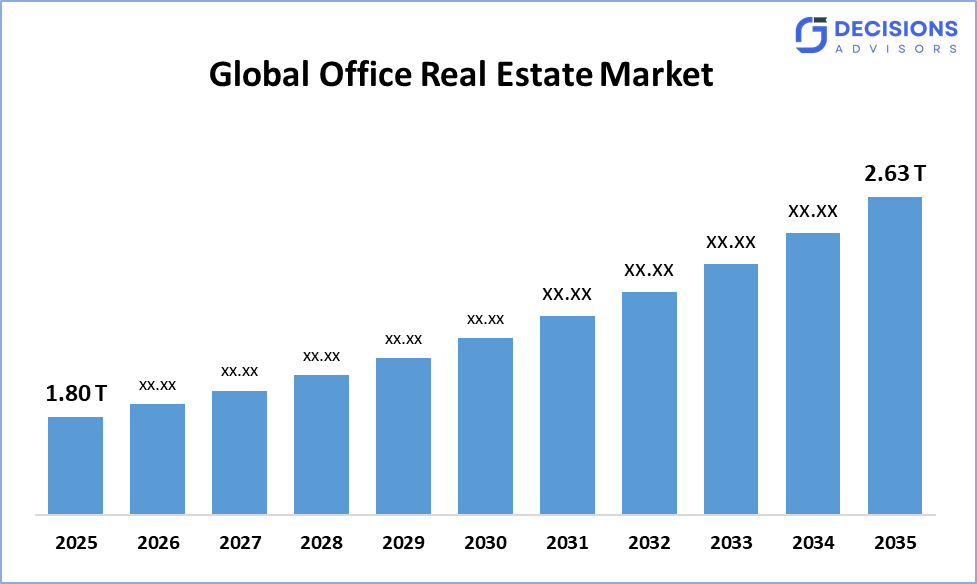
The Global Office Real Estate Market Size is predicted to grow from USD 1.80 Trillion in 2025 and is likely to reach around USD 2.63 Trillion by 2035 with a CAGR of 3.86%. According to MarkWide Research, a detailed research report on the market reflects that the hybrid work stabilization trend dominates the Global Office Real Estate Market, with High-Rise properties accounting for approximately 38% of the total share worldwide. CBRE Investment Management leads the market with an extensive global portfolio of institutional-grade office assets and strong presence across major metropolitan corridors, making it a key contributor to global market development and growth dynamics.
Market Snapshot
- Global Office Real Estate Market Size (2025): USD 1.80 Trillion
- Projected Global Office Real Estate Market Size (2035): USD 2.63 Trillion
- Global Office Real Estate Market Compound Annual Growth Rate (CAGR): 3.86%
- Largest Regional Market: North America
- 2nd Largest Region: Asia Pacific
- Fastest Growing Region: Europe
- Base Year: 2025
- Historical Period: 2021-2024
- Market Forecast Period: 2026-2035
Market Overview/ Introduction
The Global Office Real Estate Market refers to the industry encompassing the development, leasing, management, and investment of purpose-built commercial structures designed for professional services occupancy. The market is experiencing steady growth because of stabilizing hybrid work models, rising corporate demand for energy-efficient buildings, and growing enterprise adoption of flexible workspace formats. Regulatory programs such as the EU Green Deal building performance standards, the UK’s MEES regulations, and green building incentives across Asia-Pacific markets are creating stronger conditions for sustainable construction and long-term asset value. Key companies, including CBRE Investment Management, Blackstone, Brookfield, Hines, and PGIM Real Estate, are developing energy-efficient, tenant-focused office assets that combine advanced building automation with high-quality amenities. The market provides occupiers with properties that combine centralized HVAC systems, fiber-optic connectivity, and wellness-oriented amenities with strong sustainability credentials. The global market will experience future expansion through the development of smart building technologies, green-certified towers, flexible workspace formats, and evolving corporate real estate strategies.
- The UK government enforces MEES regulations that prohibit sub-standard energy performance certificate ratings for new office leases, promoting the adoption of energy-efficient retrofits across commercial building stock.
- Green building and smart city initiatives across the European Union are driving the adoption of building performance certification standards, supporting the development of sustainable, connected office infrastructure.
Notable Insights: -
- North America is anticipated to hold approximately 34% share of the Global Office Real Estate Market over the predicted timeframe.
- Asia Pacific is expected to grow at a rapid CAGR in the Global Office Real Estate Market by holding approximately 29% of the share during the forecast period.
- By property type, the High-Rise segment dominated the market and holds approximately 38% share in 2025 and is projected to grow at a substantial CAGR during the forecast period.
- By lease structure, the net lease segment dominated the market and holds approximately 40% share in 2025 and is projected to grow at a substantial CAGR during the forecast period.
- The compound annual growth rate of the Global Office Real Estate Market is 3.86%.
- The market is likely to achieve a valuation of USD 2.63 Trillion by 2035.
Market Drivers
The global office real estate market experiences growth because more corporations stabilize hybrid work policies which require modernized, amenity-rich office space to support in-office collaboration days. The expansion of green building certification standards and ESG reporting requirements drives increased adoption of energy-efficient building systems and smart automation technologies. The growth of flexible workspace formats and co-working enterprise adoption drives demand for adaptable lease structures among technology and professional services tenants. The financial services sector shows increasing demand because of security-intensive operations requiring redundant infrastructure and trading floor specifications. The market expands because technology firms continue to require dense, well-connected floor plates to support hybrid team anchoring. The global commercial property industry moves towards sustainability-focused, tenant-experience-driven assets which drives landlords to implement smart building automation and wellness-oriented amenities.
Restrain
The Global Office Real Estate Market faces challenges such as elevated construction and retrofit costs driven by steel and concrete price volatility, along with interest rate sensitivity that widens cap rate spreads and slows transaction activity. Bifurcation between certified, high-quality stock and obsolete secondary buildings also increases stranded asset risk for owners of older properties.
Competitive Analysis:
The report offers the appropriate analysis of the key organizations/companies involved within the Global Office Real Estate Market along with a comparative evaluation primarily based on their product offerings, business overviews, geographic presence, enterprise strategies, segment market share, and SWOT analysis. The report also provides an elaborative analysis focusing on the current news and developments of the companies, which includes product development, innovations, joint ventures, partnerships, mergers & acquisitions, strategic alliances, and others. This allows for the evaluation of the overall competition within the market.
Top Companies in the Global Office Real Estate Market
- PGIM Real Estate
- Nuveen Real Estate
- Blackstone
- Starwood Capital Group
- Invesco Real Estate
- Brookfield
- CBRE Investment Management
- LaSalle Investment Management
- Hines
- Tishman Speyer
Government Initiatives
|
Country |
Key Government Initiatives |
|
US |
The U.S. General Services Administration (GSA) promotes sustainable office construction and energy-efficient federal leasing standards, driving demand for green-certified building upgrades and next-generation smart office infrastructure. |
|
United Kingdom |
The UK's Minimum Energy Efficiency Standards (MEES) regulations prohibit new leases on commercial buildings below a set Energy Performance Certificate rating, accelerating retrofit investment and adoption of energy-efficient office technologies. |
|
Germany (EU) |
The European Union's Green Deal building performance standards mandate Energy Performance Certificate ratings for commercial stock, driving innovation and increasing adoption of smart building automation across Germany's Frankfurt and Munich office corridors. |
Market Segmentation
The Global Office Real Estate Market share is classified into property type, lease structure and tenant industry
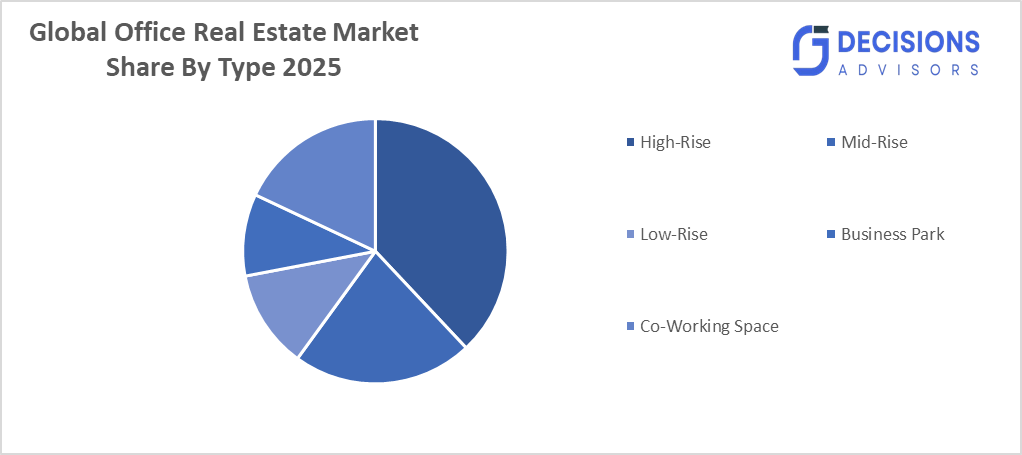
- The High-Rise segment dominated the market and holds approximately 38% share in 2025 and is projected to grow at a substantial CAGR during the forecast period.
Based on the property type, the global office real estate market is divided into High-Rise, Mid-Rise, Low-Rise, Business Park, and Co-Working Space. Among these, the High-Rise segment dominates the market and holds approximately 38% share in 2025. This dominance is due to centralized HVAC systems, fiber-optic backbone infrastructure, and strong tenant demand from technology and financial services firms in major metropolitan corridors. These properties are widely used by large enterprises and multinational corporations, making them the most preferred choice across dense urban office markets globally.
- The Net Lease segment accounted for the largest share of approximately 40% in 2025 and is anticipated to grow at a significant CAGR during the forecast period.
Based on the lease structure, the market is divided into Net Lease, Gross Lease, Modified Gross Lease, Flexible Lease, and Percentage Lease. Among these, Net Lease accounted for the largest share and holds approximately 40% share in 2025. This dominance is due to income certainty for institutional investors, as operating expense obligations shift to tenants under this structure. Increasing adoption of income-stable investment strategies further supports segment growth, making net lease the primary structure across institutional-grade office portfolios.
- The Technology Firms segment accounted for the largest share of approximately 33% in 2025 and is anticipated to grow at a significant CAGR during the forecast period.
Based on tenant industry, the market is divided into Technology Firms, Financial Services, Legal Services, Consulting Agencies, and Creative Agencies. Among these, Technology Firms dominate the market and hold approximately 33% share in 2025. This dominance is due to widespread demand for dense floor plates, smart building automation, and flexible lease terms to support hybrid team anchoring. Their large footprint requirements and rapid space procurement cycles make them essential drivers of modern office leasing activity, driving strong global adoption across multiple metropolitan corridors.
Regional Segment Analysis of the Global Office Real Estate Market
- North America (U.S., Canada, Mexico)?
- Europe (Germany, France, U.K., Italy, Spain, Rest of Europe)
- Asia-Pacific (China, Japan, India, Rest of APAC)
- South America (Brazil and the Rest of South America)?
- The Middle East and Africa (UAE, South Africa, Rest of MEA)
North America is anticipated to hold approximately 34% share of the Global Office Real Estate Market over the predicted timeframe.
North America holds approximately 34% share of the global office real estate market due to a mature, high-value office stock concentrated in major metropolitan financial and technology hubs across the United States and Canada. The region benefits from the presence of major institutional investors and asset managers, which support continuous capital deployment into green-certified and technology-enabled office assets. High adoption of hybrid work stabilization, smart building automation, and flexible lease structures further strengthens market growth. Additionally, advanced digital infrastructure and rapid deployment of tenant experience platforms contribute to sustained demand. The financial services sector also plays a key role, with increasing integration of security-intensive infrastructure and trading floor specifications across the region.
Asia Pacific is expected to grow at a rapid CAGR in the Global Office Real Estate Market, holding approximately 29% of the share during the forecast period
Asia Pacific is expected to grow at a rapid CAGR in the global office real estate market, holding approximately 29% share during the forecast period due to strong demand from technology firms, financial services, and rapidly urbanizing metropolitan corridors. The region benefits from the presence of expanding institutional capital platforms, which drive continuous investment in high-quality, transit-connected office assets. High adoption of flexible lease structures, co-working formats, and smart building automation further supports market expansion. Additionally, the growing integration of green building certification standards across China, Japan, and India contributes to sustained demand across the region, strengthening Asia Pacific’s position in the global market.
Europe is the fastest-growing region in the Global Office Real Estate Market during the period, holding approximately 21% share.
Europe is the fastest-growing region in the global office real estate market during the forecast period, holding approximately 21% share due to strong adoption of the EU Green Deal’s building performance standards, which are accelerating energy retrofit timelines across commercial stock. The region benefits from increasing deployment of net-zero carbon commitments by institutional landlords, which widely integrate smart building automation and tenant wellness amenities. Additionally, the UK’s MEES regulations are encouraging the use of energy-efficient and high-performance building technologies. Growing demand for flexible workspace formats, technology sector tenant expansion, and connected office infrastructure further supports market expansion. Continuous investment in green bond issuance and digital infrastructure across countries such as Germany, France, and the UK are accelerating the adoption of sustainable office real estate solutions across multiple metropolitan corridors.
Future Market Trends in Global Office Real Estate Market:
- Expansion of Green-Certified and Net-Zero Buildings
Green-certified office towers are increasingly favored by institutional investors and enterprise tenants due to their lower operating costs, regulatory compliance, and rent premiums. They enable long-term asset value protection, improved tenant retention, and alignment with corporate ESG reporting requirements. Growing demand for sustainable commercial infrastructure is accelerating adoption globally.
- AI-Enabled Smart Building Automation
AI integration enhances office building management by enabling intelligent HVAC optimization, real-time space utilization analytics, and predictive maintenance scheduling. It improves operational efficiency, reduces energy costs, and personalizes tenant experience across technology, financial services, and professional services occupiers. This trend is driving more responsive, efficient, and cost-effective building operations worldwide.
- Growth in Flexible and Co-Working Formats
Enterprise tenants are increasingly adopting flexible lease structures and co-working formats to support satellite office strategies without long-term capital commitments. These formats offer better space utilization, reduced overhead, and improved workforce agility. Rising hybrid work adoption and demand for network-accessible office portfolios are significantly boosting this trend globally.
- Rising Adoption of Wellness-Oriented Tenant Amenities
Office landlords are increasingly integrating fitness centers, wellness programming, and experiential amenities to support tenant retention and workforce wellbeing. Their alignment with workforce retention strategies makes them ideal differentiators in competitive leasing markets. Growing emphasis on employee experience is accelerating amenity-driven market expansion globally.
Recent Development
- In September 2025, Vanbarton Group acquired an office building at 6 East 43rd Street in Midtown Manhattan, reflecting continued institutional investor confidence in well-located, repositioned office assets in gateway markets.
- In December 2025, Brookfield Properties and Waterman Interests announced plans related to Lever House at 390 Park Avenue, highlighting ongoing investment activity in premier New York office assets amid a broader institutional re-entry into gateway city markets.
- In January 2024, CBRE assumed property management responsibilities for Brookfield Properties’ U.S. office portfolio, expanding CBRE’s operational technology capabilities and investor portfolio management services across the office real estate sector.
Market Segment
This study forecasts revenue at global, regional, and country levels from 2020 to 2035. Decision Advisors has segmented the Global Office Real Estate Market based on the below-mentioned segments:
Global Office Real Estate Market, By Property Type
- High-Rise
- Mid-Rise
- Low-Rise
- Business Park
- Co-Working Space
Global Office Real Estate Market, By Lease Structure
- Net Lease
- Gross Lease
- Modified Gross Lease
- Flexible Lease
- Percentage Lease
Global Office Real Estate Market, By Tenant Industry
- Technology Firms
- Financial Services
- Legal Services
- Consulting Agencies
Global Office Real Estate Market, By Regional Analysis
- North America
- US
- Canada
- Mexico
- Europe
- Germany
- UK
- France
- Italy
- Spain
- Russia
- Rest of Europe
- Asia Pacific
- China
- Japan
- India
- South Korea
- Australia
- Rest of Asia Pacific
- South America
- Brazil
- Argentina
- Rest of South America
- Middle East & Africa
- UAE
- Saudi Arabia
- Qatar
- South Africa
- Rest of the Middle East & Africa
Frequently Asked Questions (FAQ)
Q. How is hybrid work influencing office real estate demand and design?
A. Hybrid work stabilization is prompting occupiers to prioritize amenity-rich, well-connected office space with flexible floor plates, allowing companies to reduce overall footprint while enhancing space quality for in-office collaboration days.
Q. Why are net lease structures increasingly preferred by institutional investors?
A. Net lease structures shift operating expense volatility to tenants, delivering greater income certainty and predictable cash flows, making them attractive to investors prioritizing stable, long-term returns.
Q. What role do green building certifications play in office asset valuation?
A. Green-certified buildings command rent premiums, lower operating costs, and reduced vacancy risk, helping owners meet ESG reporting requirements while protecting long-term asset value against regulatory obsolescence.
Q. How is smart building automation transforming office property management?
A. Advances in AI-driven HVAC optimization and space utilization analytics are enabling more efficient, responsive, and cost-effective building operations across technology, financial services, and professional services tenant portfolios.
Check Licence
Choose the plan that fits you best: Single User, Multi-User, or Enterprise solutions tailored for your needs.
We Have You Covered
- 24/7 Analyst Support
- Clients Across the Globe
- Tailored Insights
- Technology Tracking
- Competitive Intelligence
- Custom Research
- Syndicated Market Studies
- Market Overview
- Market Segmentation
- Growth Drivers
- Market Opportunities
- Regulatory Insights
- Innovation & Sustainability
Report Details
| Scope | Global |
| Pages | 220 |
| Delivery | PDF & Excel via Email |
| Language | English |
| Release | Aug 2026 |
| Access | Download from this page |