
Global Oil and Gas Midstream Market
 |
Author:
Mayuri S
|
Pages:
200
|
Author:
Mayuri S
|
Pages:
200
Global Oil and Gas Midstream Market Size, Share By Type (Gasoline, Diesel, Jet Fuel, Asphalt, and Lubricants), By Application (Transportation, Storage and Terminals), and By Region (North America, Europe, Asia-Pacific, Latin America, Middle East & Africa), Analysis and Forecast 2026-2035
CAGR
4.3%
REVENUE 2026
USD Billion 75.21
FORECAST 2035
USD Billion 114.58
REPORT COVERAGE
Global
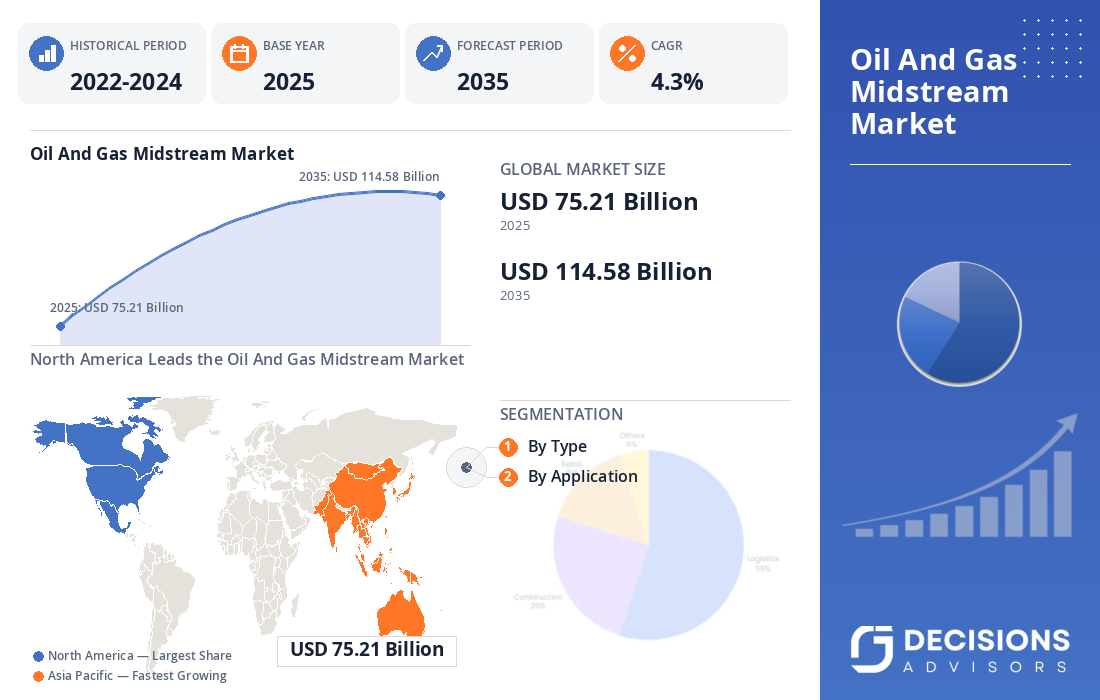
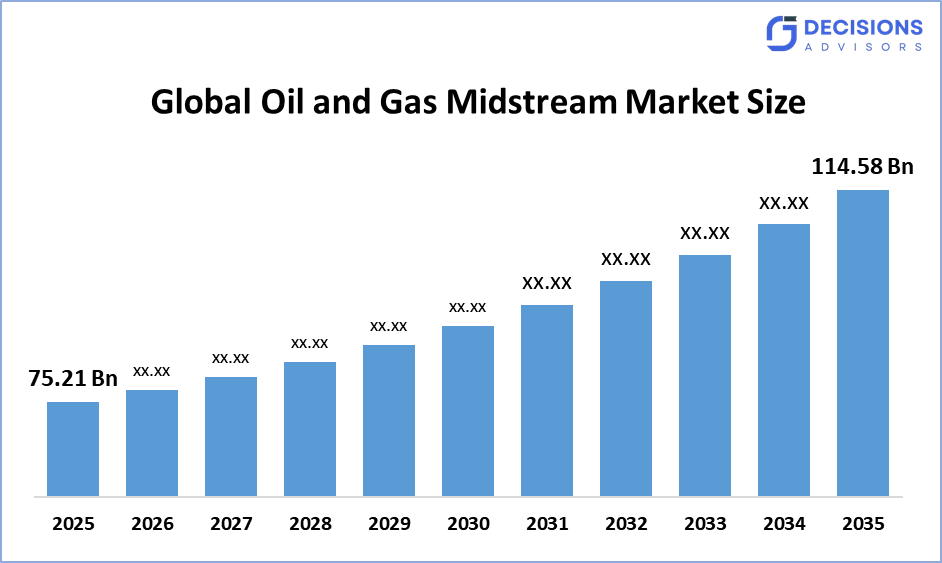
The Global Oil and Gas Midstream Market Size is predicted to grow from USD 75.21 Billion in 2026 and is likely to reach around USD 114.58 Billion by 2035 with a CAGR of 4.3%. According to Decision Advisors, a detailed research report on the market reflects that pipeline transportation dominates the Global Oil and Gas Midstream Market, accounting for approximately 58–62% of the total share worldwide. Kinder Morgan leads the market with annual revenue of approximately USD 15–16 billion and approximately 8–10% global market share, making it the key contributor to global market development and growth dynamics.
Market Snapshot
- Global Oil and Gas Midstream Market Size (2026): USD 75.21 Billion
- Projected Global Oil and Gas Midstream Market Size (2035): USD 114.58 Billion
- Global Oil and Gas Midstream Market Compound Annual Growth Rate (CAGR): 4.3 %
- Largest Regional Market: North America
- 2nd Largest Region: Asia-Pacific
- Fastest Growing Region: Asia-Pacific
- Base Year: 2025
- Historical Period: 2022-2024
- Market Forecast Period: 2026-2035
Market Overview/ Introduction
The Global Oil and Gas Midstream Market refers to the industry that handles the transportation, storage, and wholesale marketing of crude oil and refined petroleum products, connecting upstream exploration and production with downstream refining and distribution. The market is experiencing steady growth because of rising global energy consumption, expanding pipeline and LNG infrastructure, and growing investments in storage and terminal facilities. Government programs such as the U.S. federal pipeline capacity initiatives, Canada's Building Canada Act, and Asia-Pacific LNG infrastructure incentives are creating better conditions for midstream infrastructure development and energy supply chain security. Key companies, including Kinder Morgan, Enbridge, TC Energy, Enterprise Products Partners, and Williams Companies are expanding pipeline networks, storage terminals, and LNG export capacity while adopting digital monitoring technologies. The market provides customers with efficient and reliable transportation and storage solutions that combine large-scale capacity with improving safety and operational efficiency. The global market will experience future expansion through the development of LNG export facilities, digital pipeline monitoring systems, carbon capture integration, and hydrogen-ready infrastructure.
- The U.S. government supports large-scale natural gas pipeline capacity expansion through federal energy planning, promoting the adoption of digital monitoring and modernization across midstream transportation and storage infrastructure.
- Canada's federal Building Canada Act and the Major Projects Office are driving the adoption of fast-tracked pipeline approvals, supporting the development of new crude oil and natural gas export infrastructure across the country.
Notable Insights: -
- North America is anticipated to hold approximately 42% share of the Global Oil and Gas Midstream Market over the predicted timeframe.
- Asia-Pacific is expected to grow at a rapid CAGR in the Global Oil and Gas Midstream Market by holding approximately 28% of the share during the forecast period.
- By type, the Gasoline segment dominated the market and holds approximately 33% share in 2025 and is projected to grow at a substantial CAGR during the forecast period.
- By application, the Transportation segment dominated the market and holds approximately 61% share in 2025 and is projected to grow at a substantial CAGR during the forecast period.
- The compound annual growth rate of the Global Oil and Gas Midstream Market is 4.3 %.
- The market is likely to achieve a valuation of USD 114.58 Billion by 2035.
Market Drivers
The Global Oil and Gas Midstream Market experiences growth because of increasing global energy consumption, with natural gas demand rising and oil transportation capacity expanding worldwide. The expansion of liquefied natural gas (LNG) infrastructure drives increased investment in pipelines, storage terminals, and export facilities as countries diversify their energy supply sources. Technological advancements in pipeline infrastructure, including smart sensors and real-time monitoring systems, are improving the efficiency and safety of midstream operations while reducing downtime and operational costs. The automotive and industrial sectors show increasing demand for refined product distribution, while the growing adoption of digital pipeline monitoring and automation technologies is improving operational efficiency by over 35%, further strengthening market growth.
Restrain
The Global Oil and Gas Midstream Market faces challenges such as tightening environmental regulations, which are causing operational cost increases of nearly 18% and delays in around 22% of infrastructure projects. Volatility in crude oil and natural gas prices further complicates investment planning, as price fluctuations directly affect transportation volumes, storage demand, and the overall utilization of midstream infrastructure.
Competitive Analysis:
The report offers the appropriate analysis of the key organizations/companies involved within the Global Oil and Gas Midstream Market along with a comparative evaluation primarily based on their product offerings, business overviews, geographic presence, enterprise strategies, segment market share, and SWOT analysis. The report also provides an elaborative analysis focusing on the current news and developments of the companies, which includes product development, innovations, joint ventures, partnerships, mergers & acquisitions, strategic alliances, and others. This allows for the evaluation of the overall competition within the market.
Top Companies in the Global Oil and Gas Midstream Market
- Kinder Morgan, Inc.
- Enbridge Inc.
- TC Energy Corporation
- Williams Companies, Inc.
- Enterprise Products Partners L.P.
- Cheniere Energy, Inc.
- Pembina Pipeline Corporation
- Plains All American Pipeline, L.P.
- ONEOK, Inc.
- Gazprom
Government Initiatives
|
Country |
Key Government Initiatives |
|
US |
The U.S. government supports natural gas pipeline capacity expansion through federal energy planning, driving innovation in digital pipeline monitoring and enhancing development of next-generation midstream transportation and storage infrastructure. |
|
Canada |
The Building Canada Act, passed in June 2025, established the Major Projects Office to fast-track critical pipeline and midstream infrastructure by coordinating federal, provincial, and Indigenous reviews into a single approval process. |
|
China |
Policies focusing on energy security, LNG terminal expansion, and pipeline network integration are driving innovation and increasing investment in midstream storage and transportation infrastructure across industrial and residential applications. |
Market Segmentation
The Global Oil and Gas Midstream Market share is classified into type and application
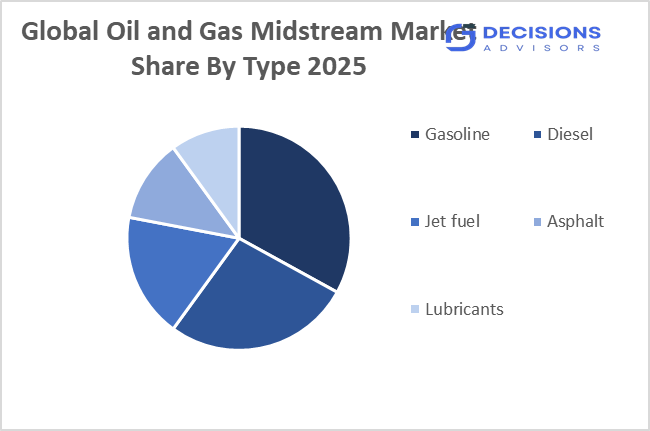
- The Gasoline segment dominated the market and holds approximately 33% share in 2025 and is projected to grow at a substantial CAGR during the forecast period.
Based on the type of product, the Global Oil and Gas Midstream Market is divided into Gasoline, Diesel, Jet Fuel, Asphalt, and Lubricants. Among these, the Gasoline segment dominates the market and holds approximately 33% share in 2025. This dominance is due to its widespread use as fuel for internal combustion engines and its critical role in the transportation sector. Gasoline is transported from refineries to storage terminals through pipelines, rail, or tankers, making efficient and safe transportation a central focus of midstream operations globally.
- The Transportation segment accounted for the largest share of approximately 61% in 2025 and is anticipated to grow at a significant CAGR during the forecast period.
Based on application, the market is divided into Transportation and Storage and Terminals. Among these, Transportation accounted for the largest share and holds approximately 61% share in 2025. This dominance is due to the extensive movement of crude oil and refined products from extraction sites and refineries to storage and distribution terminals through pipelines, rail, ships, and tankers. Growing investment in pipeline networks and rising demand for reliable energy transportation further support segment growth, making transportation the primary revenue contributor in the Global Oil and Gas Midstream Market.
Regional Segment Analysis of the Global Oil and Gas Midstream Market
- North America (U.S., Canada, Mexico)?
- Europe (Germany, France, U.K., Italy, Spain, Rest of Europe)
- Asia-Pacific (China, Japan, India, Rest of APAC)
- South America (Brazil and the Rest of South America)?
- The Middle East and Africa (UAE, South Africa, Rest of MEA)
North America is anticipated to hold approximately 42% share of the Global Oil and Gas Midstream Market over the predicted timeframe.
North America holds approximately 42% share of the Global Oil and Gas Midstream Market due to its extensive shale oil and natural gas production base, well-developed pipeline networks, and strong position in LNG exports. The region benefits from the presence of major midstream operators, which support continuous investment in pipeline modernization, storage facilities, and export terminals. High demand for reliable energy transportation and growing LNG export capacity further strengthens market growth. Additionally, regulatory support for domestic energy production and infrastructure fast-tracking contributes to sustained demand across the region.
Asia-Pacific is expected to grow at a rapid CAGR in the Global Oil and Gas Midstream Market, holding approximately 28% of the share during the forecast period.
Asia-Pacific is expected to grow at a rapid CAGR in the Global Oil and Gas Midstream Market, holding approximately 28% share during the forecast period due to rising energy demand from China, India, and Japan. The region benefits from rapid industrialization and urbanization, driving substantial investment in pipeline networks and LNG import facilities. High adoption of natural gas as a cleaner alternative to coal, along with expanding storage and terminal infrastructure, further supports market expansion. Additionally, growing government initiatives promoting energy security and infrastructure development contribute to sustained demand across the region.
Europe's Oil and Gas Midstream Market is undergoing notable transformation, holding a significant share during the forecast period.
Europe's midstream oil and gas market has experienced considerable changes, particularly because of geopolitical tensions related to the Russia-Ukraine conflict. The region has been heavily dependent on Russian natural gas; however, recent disruptions have pushed European nations to diversify their energy sources and invest in alternative supply routes. There has been significant growth in the development of LNG import terminals in countries like Germany, France, and Poland. Additionally, the focus has shifted toward expanding pipeline connections with non-Russian suppliers, reinforcing the region's role in global energy security during the transition phase.
Future Market Trends in Global Oil and Gas Midstream Market: -
- Expansion of LNG Infrastructure
The shift toward cleaner energy and geopolitical pressures are driving increased investment in LNG terminals, storage facilities, and transportation systems. This trend reflects the market's response to diversifying energy supply sources and reducing reliance on traditional pipeline networks vulnerable to geopolitical tensions.
- Digitalization and Smart Pipeline Monitoring
The adoption of digital pipeline monitoring systems and automation technologies is improving operational efficiency and safety across midstream operations. Real-time monitoring, predictive maintenance, and AI-enabled analytics are reducing downtime and minimizing leakages, driving further investment in digital infrastructure.
- Diversification of Energy Supply Routes
Rising geopolitical tensions are prompting countries to diversify energy supply routes and reduce dependence on single suppliers. This trend is accelerating investment in new pipeline corridors, cross-border interconnections, and alternative transportation infrastructure across multiple regions.
- Growth in Carbon Capture and Hydrogen-Ready Pipelines
Midstream operators are increasingly investing in carbon capture integration and hydrogen-ready pipeline infrastructure to align with global decarbonization goals. This trend is enhancing sustainability across midstream operations while supporting the long-term energy transition.
Recent Development
- In June 2025, Canada passed the Building Canada Act, establishing the Major Projects Office to fast-track critical pipeline and midstream infrastructure by coordinating federal, provincial, and Indigenous reviews into a single approval process.
- In July 2023, Kinder Morgan announced the completion of the expansion of its Permian Highway Pipeline, increasing the transportation capacity of natural gas from the Permian Basin to meet rising domestic and international demand, including growing LNG exports from the Gulf Coast.
- In May 2024, the Trans Mountain pipeline system's capacity was increased from 300 thousand barrels per day to 890 thousand barrels per day, enhancing the transportation of heavy crude, refined products, and light oil from Alberta to Canada's western coast.
Market Segment
This study forecasts revenue at global, regional, and country levels from 2020 to 2035. Decision Advisors has segmented the Global Oil and Gas Midstream Market based on the below-mentioned segments:
Global Oil and Gas Midstream Market, By Type
- Gasoline
- Diesel
- Jet Fuel
- Asphalt
- Lubricants
Global Oil and Gas Midstream Market, By Application
- Transportation
- Storage and Terminals
Global Oil and Gas Midstream Market, By Regional Analysis
- North America
- US
- Canada
- Mexico
- Europe
- Germany
- UK
- France
- Italy
- Spain
- Russia
- Rest of Europe
- Asia Pacific
- China
- Japan
- India
- South Korea
- Australia
- Rest of Asia Pacific
- South America
- Brazil
- Argentina
- Rest of South America
- Middle East & Africa
- UAE
- Saudi Arabia
- Qatar
- South Africa
- Rest of the Middle East & Africa
Frequently Asked Questions (FAQ)
Q. How is digitalization improving efficiency in midstream pipeline operations?
A. Digital pipeline monitoring enables smoother, more responsive, and highly accurate operations, allowing operators to implement predictive maintenance, real-time leak detection, and automated controls with improved safety and reduced operational costs.
Q. Why is LNG infrastructure becoming increasingly important in the midstream sector?
A. LNG infrastructure offers greater flexibility, supports energy diversification, and enables countries to reduce reliance on traditional pipeline networks, making it more suitable for evolving global energy security needs.
Q. What role do midstream operators play in supporting energy security?
A. They help ensure the efficient and reliable transportation and storage of crude oil and refined products, enabling stable supply chains and reducing the risk of disruptions caused by geopolitical or infrastructure challenges.
Q. How are government initiatives influencing midstream infrastructure development?
A. Fast-tracked approval processes and federal infrastructure programs are enabling faster development of pipelines, storage terminals, and LNG facilities, encouraging increased investment across mobile, industrial, and export-oriented midstream applications.
Check Licence
Choose the plan that fits you best: Single User, Multi-User, or Enterprise solutions tailored for your needs.
We Have You Covered
- 24/7 Analyst Support
- Clients Across the Globe
- Tailored Insights
- Technology Tracking
- Competitive Intelligence
- Custom Research
- Syndicated Market Studies
- Market Overview
- Market Segmentation
- Growth Drivers
- Market Opportunities
- Regulatory Insights
- Innovation & Sustainability
Report Details
| Scope | Global |
| Pages | 200 |
| Delivery | PDF & Excel via Email |
| Language | English |
| Release | Aug 2026 |
| Access | Download from this page |