
Global Oil and Gas Upstream Market
 |
Author:
Mayuri S
|
Pages:
180
|
Author:
Mayuri S
|
Pages:
180
Global Oil and Gas Upstream Market Size, Share By Resource Type (Crude Oil and Natural Gas), By Location (Onshore and Offshore), By Well Type (Conventional and Unconventional), and By Region (North America, Europe, Asia-Pacific, Latin America, Middle East & Africa), Analysis and Forecast 2026-2035
CAGR
19.1%
REVENUE 2025
USD Billion 8.61
FORECAST 2035
USD Billion 49.43
REPORT COVERAGE
Global
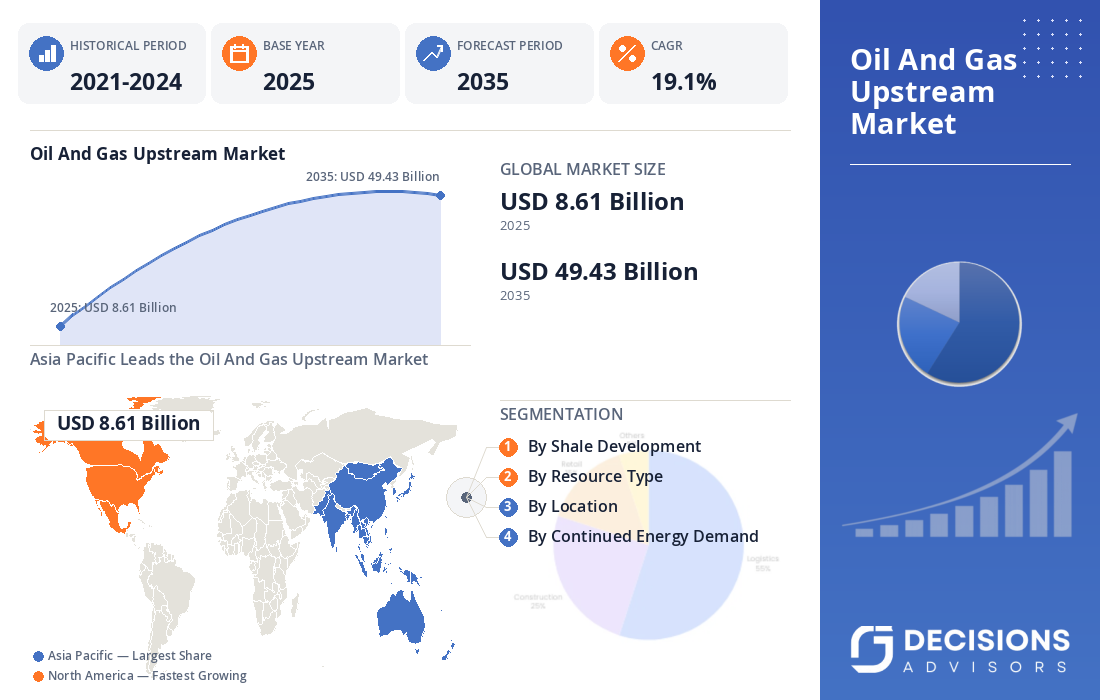
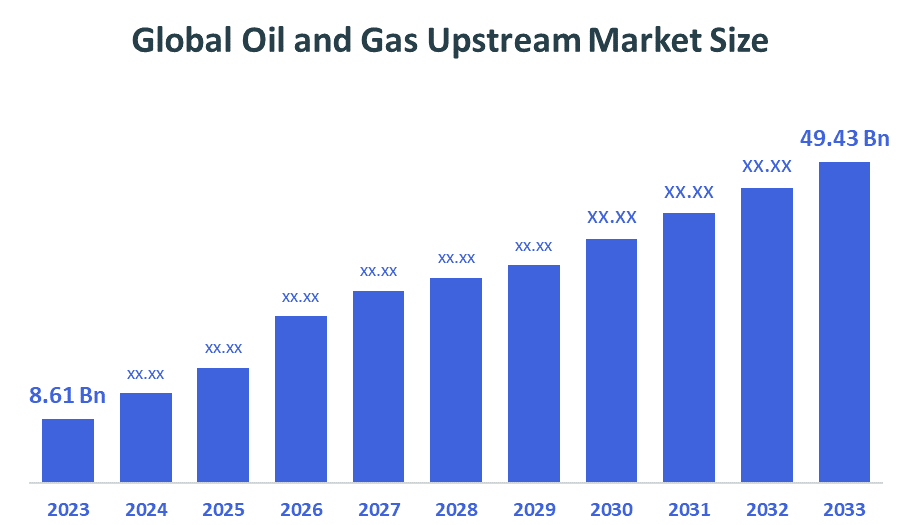
The Global Oil and Gas Upstream Market Size is predicted to grow from USD 8.61 Billion in 2025 and is likely to reach around USD 49.43 Billion by 2035 with a CAGR of 19.1%. The market is supported by continued global energy demand, replacement of declining production from mature fields, offshore and deepwater exploration, unconventional resource development, and increasing upstream investment in major producing regions. The International Energy Agency estimates that global upstream oil and gas investment remains substantial, with around USD 570 billion expected in 2025, highlighting the continuing importance of exploration and production investment.
Market Snapshot
- Global Oil and Gas Upstream Market Size (2025): USD 8.61 Billion
- Projected Global Oil and Gas Upstream Market Size (2035): USD 49.43 Billion
- Global Oil and Gas Upstream Market Compound Annual Growth Rate (CAGR): 19.1%
- Largest Regional Market: Asia-Pacific
- 2nd Largest Region: Middle East & Africa
- Fastest Growing Region: North America
- Base Year: 2025
- Historical Period: 2021-2024
- Market Forecast Period: 2026-2035.
Market Overview/ Introduction
The Global Oil and Gas Upstream Market covers the exploration, drilling, development, completion, and production of crude oil and natural gas. Upstream operations begin with geological and seismic evaluation and extend through well construction, reservoir management, production optimization, and field maintenance. The sector is strategically important to global energy systems because hydrocarbons remain widely used in transportation, industrial production, petrochemicals, electricity generation, heating, and other energy-intensive applications. The market is experiencing continued investment despite substantial uncertainty surrounding commodity prices, energy-transition policies, geopolitical conditions, and capital costs. The International Energy Agency reports that nearly 90% of annual upstream oil and gas investment since 2019 has been directed toward offsetting production declines, demonstrating the importance of maintaining output from existing fields. The IEA also notes that more than 70% of recent conventional project approvals are offshore, highlighting the increasing role of offshore development.
- United States, Shale production, horizontal drilling, hydraulic fracturing, and advanced oilfield services continue to support domestic upstream activity. The IEA expects U.S. tight-oil investment to remain an important indicator of changing upstream market conditions.
- China, China continues developing domestic oil and gas resources, including deep formations, deepwater resources, and unconventional deposits, as part of its broader energy-security strategy.
- Middle East, The Middle East remains a major upstream investment center. The IEA expects the region's oil and gas supply investment to reach approximately USD 130 billion in 2025, around 15% of the global total.
Notable Insights: -
- Asia-Pacific is anticipated to hold approximately 30% share of the Global Oil and Gas Upstream Market over the predicted timeframe, supported by large energy-consuming economies, domestic exploration programs, and expanding offshore activity.
- North America is expected to grow at a rapid CAGR in the Global Oil and Gas Upstream Market, holding approximately 25% share during the forecast period, supported by shale development, advanced drilling, and offshore projects.
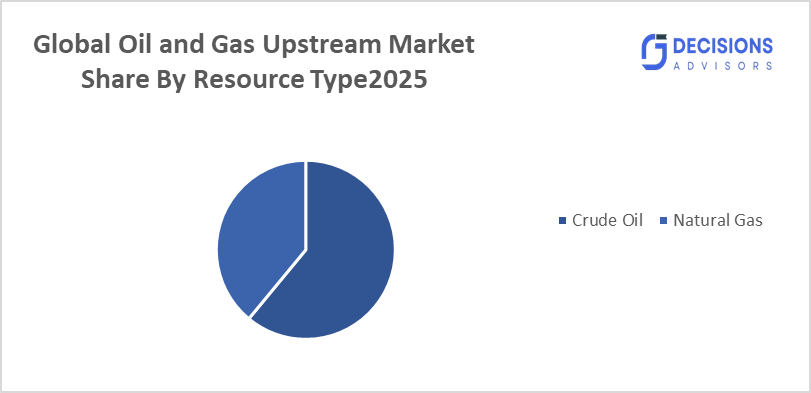
- By Resource Type, the Crude Oil segment dominated the market and holds approximately 61% share in 2025 and is projected to grow at a substantial CAGR during the forecast period.
- By Location, the Onshore segment dominated the market and holds approximately 57% share in 2025 and is projected to grow at a substantial CAGR during the forecast period.
- The compound annual growth rate of the Global Oil and Gas Upstream Market is 19.1%.
- The market is likely to achieve a valuation of USD 49.43 Billion by 2035.
Market Drivers
The global oil and gas upstream market is primarily driven by continued energy demand, production replacement requirements, exploration of new reserves, and increasing investment in advanced extraction technologies. Population growth, urbanization, industrialization, transportation requirements, and petrochemical consumption continue to support demand for crude oil and natural gas, particularly in emerging economies. Production decline from existing fields is another important driver. As mature fields experience natural depletion, operators must invest in additional wells, workovers, enhanced recovery, reservoir monitoring, and new field development to maintain supply. The IEA estimates that existing oil fields can experience substantial natural decline without investment, making upstream capital expenditure essential for maintaining global supply. Technological improvements are also supporting market growth. Advanced seismic imaging improves subsurface characterization, while horizontal drilling, hydraulic fracturing, automated drilling, artificial lift, enhanced oil recovery, artificial intelligence, digital twins, and real-time production monitoring improve operational efficiency and resource recovery.
Restrain
The Global Oil and Gas Upstream Market faces constraints from crude oil and natural gas price volatility, high capital expenditure, geopolitical risks, environmental regulations, and long project-development cycles. Offshore and deepwater projects can require substantial investment and several years before production begins, making project economics sensitive to commodity prices and financing conditions. Environmental requirements concerning methane emissions, gas flaring, oil spills, water consumption, biodiversity, and greenhouse-gas emissions can increase development and operating costs. In addition, rising costs for steel, equipment, drilling services, and specialized labor can affect project economics. The IEA reported that upstream oil and gas costs were expected to increase in 2025 amid broader cost pressures.
Competitive Analysis:
The report offers the appropriate analysis of the key organizations/companies involved within the global oil and gas upstream market, along with a comparative evaluation primarily based on their product offerings, business overviews, geographic presence, enterprise strategies, segment market share, and SWOT analysis. The report also provides an elaborative analysis focusing on the current news and developments of the companies, which includes product development, innovations, joint ventures, partnerships, mergers & acquisitions, strategic alliances, and others. This allows for the evaluation of the overall competition within the market.
Top Companies in the Global Oil and Gas Upstream Market
- Saudi Aramco
- ExxonMobil
- Chevron Corporation
- Shell plc
- TotalEnergies SE
- BP plc
- ConocoPhillips
- Equinor ASA
- Eni S.p.A.
- Petrobras.
Government Initiatives
|
Country |
Key Government Initiatives |
|
United States |
U.S. upstream activity continues to be supported by domestic oil and gas development, shale production, offshore resources, and investment in drilling and production technologies |
|
Japan |
Japan's energy-security policies emphasize securing stable oil and natural-gas supplies through overseas upstream investments, diversification, and stronger resource partnerships |
|
China |
China continues supporting domestic exploration and production, including deepwater, deep formations, shale gas, and other unconventional resources to strengthen domestic energy security |
Market Segmentation
The Global Oil and Gas Upstream Market share is classified into Resource Type, Location, and Well Type.
- The Crude Oil segment dominated the market and holds approximately 61% share in 2025 and is projected to grow at a substantial CAGR during the forecast period.
Based on resource type, the global oil and gas upstream market is divided into crude oil and natural gas. Crude oil maintains the largest share because it remains essential to transportation fuels and petrochemical manufacturing. Large conventional and unconventional oil reserves across North America, the Middle East, Latin America, and other regions continue to support exploration and production. Natural gas is nevertheless gaining importance because of LNG trade, electricity-generation requirements, industrial demand, and the role of gas in energy-security strategies.
- The Onshore segment accounted for the largest share of approximately 57% in 2025 and is anticipated to grow at a significant CAGR during the forecast period.
Based on location, the market is divided into onshore and offshore. onshore operations benefit from established infrastructure, mature producing basins, relatively accessible drilling locations, and established service networks. The United States, Middle East, China, Russia, and several other major producers have extensive onshore assets. Offshore activity, however, is expected to gain importance because major new discoveries increasingly occur in offshore and deepwater environments.
- The Conventional segment accounted for the largest share of approximately 64% in 2025 and is anticipated to grow at a significant CAGR during the forecast period.
Based on well type, the market is divided into conventional and unconventional. conventional resources continue to represent a substantial portion of global oil and gas production because of large established reserves and existing infrastructure. However, unconventional production has become increasingly important, particularly in the United States, where shale oil and shale gas have transformed the domestic upstream industry. Advances in horizontal drilling, hydraulic fracturing, completion technologies, and reservoir analytics will continue supporting unconventional production.
Regional Segment Analysis of the Global Oil and Gas Upstream Market
- North America (U.S., Canada, Mexico)?
- Europe (Germany, U.K., France, Italy, Spain, Netherlands, Rest of Europe).
- Asia-Pacific (China, Japan, India, Australia, South Korea, Rest of Asia-Pacific).
- South America (Brazil, Argentina, Rest of South America).
- Middle East & Africa (UAE, Saudi Arabia, South Africa, Rest of MEA).
Asia-Pacific is anticipated to hold approximately 30% share of the Global Oil and Gas Upstream Market over the predicted timeframe.
Asia-Pacific remains a major upstream region because of its large population, rapidly growing industrial base, expanding transportation requirements, and increasing energy consumption. China is a key contributor through domestic exploration and production, while India is expanding exploration and offshore development. Southeast Asian countries continue investing in offshore oil and gas resources, while Australia remains important in LNG and natural-gas development. Increasing use of advanced seismic imaging, offshore drilling, automation, and digital reservoir-management systems will support regional upstream activity.
North America is expected to grow at a rapid CAGR in the Global Oil and Gas Upstream Market, holding approximately 25% share during the forecast period.
The region benefits from extensive shale resources, advanced drilling capabilities, mature oilfield-service infrastructure, and strong investment in unconventional production. The U.S. Permian Basin remains one of the world's major oil-producing regions, while the Gulf of America supports deepwater exploration and production. Canada contributes through oil sands, conventional resources, and other upstream activities.
Future Market Trends in Global Oil and Gas Upstream Market: -
-
- Expansion of Deepwater and Ultra-Deepwater Exploration
Deepwater and ultra-deepwater development will remain a major source of future oil and gas supply. Offshore projects are becoming increasingly important as companies seek large, long-life reserves. The IEA reports that more than 70% of recent conventional oil and gas project approvals have been offshore.
-
- AI-Enabled Exploration and Digital Oilfields
Artificial intelligence and machine learning will increasingly be applied to seismic interpretation, geological modeling, drilling optimization, production forecasting, and predictive maintenance. Digital twins and real-time reservoir monitoring will allow operators to make faster decisions and improve production efficiency.
-
- Growth of Unconventional Resources
Shale oil, shale gas, tight oil, and tight gas will remain important contributors to global supply. North America will continue to lead unconventional development, while technological improvements are enabling operators to improve recovery rates and reduce drilling and completion costs.
-
- Mature-Field Optimization and Enhanced Recovery
As global production becomes increasingly dependent on mature fields, operators will invest in enhanced oil recovery, infill drilling, artificial lift, water injection, workovers, and reservoir monitoring. The IEA estimates that nearly 90% of annual upstream investment since 2019 has been directed toward offsetting production declines.
Recent Development
- In July 2025, Chevron completed its acquisition of Hess Corporation, strengthening Chevron's upstream portfolio and providing a 30% interest in Guyana's Stabroek Block.
- In November 2025, TotalEnergies signed an agreement related to Guyana's Block S4, becoming operator under a production-sharing contract, supporting further offshore exploration and upstream development.
- In 2025, TotalEnergies expanded its upstream portfolio in Namibia, including agreements involving the PEL83, PEL56, PEL91, and PEL104 exploration licences.
Market Segment
This study forecasts revenue at global, regional, and country levels from 2021 to 2035. Decision Advisors has segmented the Global Oil and Gas Upstream Market based on the below-mentioned segment:
Global Oil and Gas Upstream Market, By Resource Type.
- Crude Oil
- Natural Gas.
Global Oil and Gas Upstream Market, By Location.
- Onshore
- Offshore.
Global Oil and Gas Upstream Market, By Well Type.
- Conventional
- Unconventional.
Global Oil and Gas Upstream Market, By Regional Analysis.
- North America
- US
- Canada
- Mexico
- Europe
- Germany
- UK
- France
- Italy
- Spain
- Russia
- Rest of Europe
- Asia Pacific
- China
- Japan
- India
- South Korea
- Australia
- Rest of Asia Pacific
- South America
- Brazil
- Argentina
- Rest of South America
- Middle East & Africa
- UAE
- Saudi Arabia
- Qatar
- South Africa
- Rest of the Middle East & Africa
Frequently Asked Questions (FAQ)
Q. What is included in the Global Oil and Gas Upstream Market?
A. The upstream market includes exploration, geological and seismic evaluation, drilling, well completion, field development, crude oil and natural gas production, reservoir management, and supporting upstream services.
Q. What are the major factors driving the oil and gas upstream market?
A. Major factors include global energy demand, production declines from mature fields, exploration for new reserves, offshore and deepwater development, unconventional resource production, and technological improvements in seismic imaging and drilling. The IEA identifies production-decline replacement as a major reason for continued upstream investment.
Q. Why is deepwater exploration becoming increasingly important?
A. Large offshore discoveries can provide substantial long-life reserves, while improvements in subsea equipment, drilling systems, seismic imaging, and floating production facilities have improved the ability of operators to develop technically challenging resources.
Q. How is artificial intelligence changing upstream oil and gas operations?
A. AI is being used for seismic interpretation, geological analysis, drilling optimization, production forecasting, predictive maintenance, and reservoir management. Its integration with real-time field data and digital twins can improve operational efficiency and reduce unplanned downtime.
Check Licence
Choose the plan that fits you best: Single User, Multi-User, or Enterprise solutions tailored for your needs.
We Have You Covered
- 24/7 Analyst Support
- Clients Across the Globe
- Tailored Insights
- Technology Tracking
- Competitive Intelligence
- Custom Research
- Syndicated Market Studies
- Market Overview
- Market Segmentation
- Growth Drivers
- Market Opportunities
- Regulatory Insights
- Innovation & Sustainability
Report Details
| Scope | Global |
| Pages | 180 |
| Delivery | PDF & Excel via Email |
| Language | English |
| Release | Aug 2026 |
| Access | Download from this page |