
Global Onshore Wind Energy Market
 |
Author:
Somesh R
|
Pages:
240
|
Author:
Somesh R
|
Pages:
240
Global Onshore Wind Energy Market Size, Share, and COVID-19 Impact Analysis, Impact of Tariff and Trade War Analysis, By Turbine Rating (Below 1.5 MW, 1.5-3 MW, and Above 3 MW), By Component (Turbines, Installation, and Electrical Infrastructure), and By Region (North America, Europe, Asia-Pacific, Latin America, Middle East, and Africa), Analysis and Forecast 2025-2035
CAGR
4.59%
REVENUE 2024
USD Billion 94.1
FORECAST 2035
USD Billion 154.2
REPORT COVERAGE
Global
Onshore Wind Energy Market Summary, Size & Emerging Trends
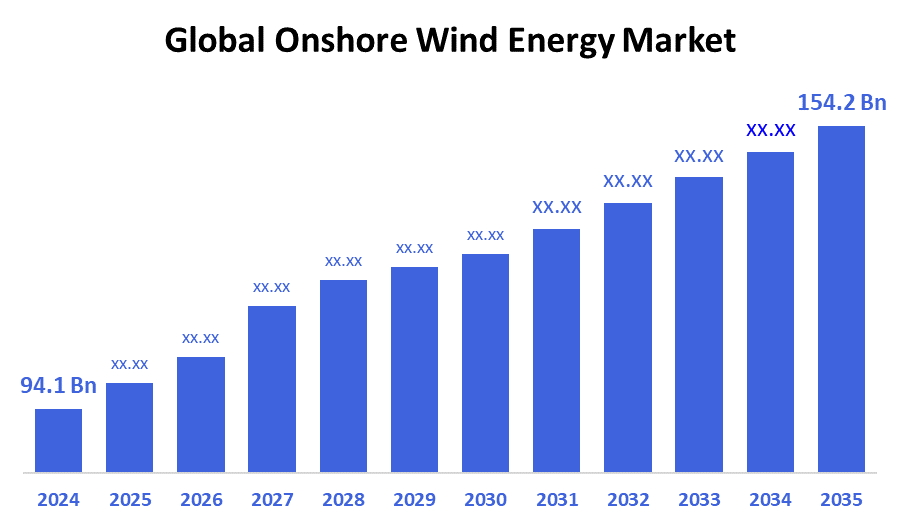
According to Decision Advisor, The Global Onshore Wind Energy Market Size is expected to grow from USD 94.1 Billion in 2024 to USD 154.2 Billion by 2035, at a CAGR of 4.59% during the forecast period 2025-2035. The shift toward renewable energy, declining wind turbine costs, and strong policy support for decarbonization are major factors driving the onshore wind energy market.
Key Market Insights
- Asia Pacific is expected to dominate the global onshore wind energy market throughout the forecast period.
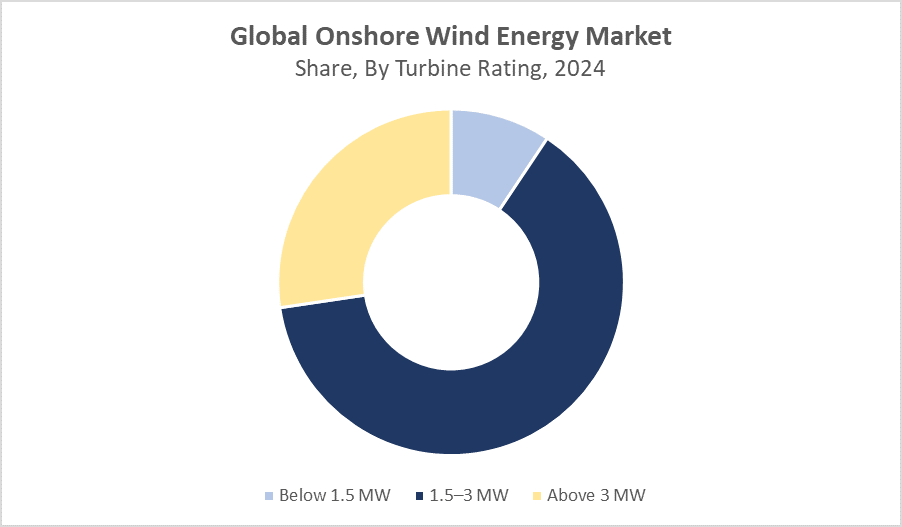
- By turbine rating, the 1.5–3 MW segment accounts for the largest market share due to its optimal balance between performance and cost.
- By component, turbines are the most revenue-generating segment due to their central role in power generation.
Global Market Forecast and Revenue Outlook
- 2024 Market Size: USD 94.1 Billion
- 2035 Projected Market Size: USD 154.2 Billion
- CAGR (2025-2035): 4.59%
- Asia Pacific: Largest market in 2024
- North America: Fastest growing market
Onshore Wind Energy Market
The onshore wind energy market is a vital driver in the global transition to clean and sustainable power. It involves the generation of electricity using wind turbines installed on land, harnessing natural wind resources efficiently. Advances in turbine technology, along with declining costs of key components, have made onshore wind one of the most affordable renewable energy options available. Supportive policies and government incentives worldwide further accelerate market growth. Besides significantly reducing greenhouse gas emissions, onshore wind projects stimulate economic development by creating jobs in manufacturing, installation, and maintenance. The growing demand for energy security and climate change mitigation is fueling continuous expansion of onshore wind capacity across regions. As nations set more ambitious renewable energy goals, the onshore wind sector is expected to remain a cornerstone of the clean energy landscape, contributing to a greener and more resilient future.
Onshore Wind Energy Market Trends
- Larger Turbines: Manufacturers are developing turbines with higher ratings and longer blades to maximize energy output.
- Hybrid Projects: Integration of onshore wind with solar and battery storage is gaining momentum.
- Digital Monitoring: AI and IoT-based systems are being used for predictive maintenance and performance optimization.
Onshore Wind Energy Market Dynamics
Driving Factors: Increasing demand for renewable energy and technological advancements
Key growth drivers for the onshore wind energy market include rising global demand for clean energy and declining costs of wind turbine installations per megawatt. Supportive government policies such as tax incentives, feed-in tariffs, and renewable energy targets stimulate market expansion. Growing concerns over energy security and the need to reduce carbon emissions further accelerate adoption. Technological improvements in turbine design and reliability have enhanced energy output and lowered maintenance costs, making onshore wind a competitive alternative to fossil fuels worldwide.
Restraint Factors: High initial investment and local opposition
Challenges limiting market growth include the substantial upfront capital required for wind farm development and difficulties related to land acquisition. The intermittent nature of wind energy causes variability in power supply, complicating grid integration. Additionally, local opposition due to noise and visual impacts often delays projects. Regulatory complexities and inadequate grid infrastructure in many regions create further barriers, hindering smooth project execution and expansion in emerging markets.
Opportunity: Emerging markets and technological innovations
The rising energy demand in emerging economies, fueled by rapid industrialization and electrification, offers significant growth potential. Innovations like modular turbine designs, remote monitoring, and automation facilitate wind farm deployment in remote or difficult terrains. Government green energy auctions and an increase in corporate power purchase agreements (PPAs) provide strong investment support. These trends open new avenues for market players to expand their footprint and accelerate adoption of onshore wind energy globally.
Challenges: Grid congestion, supply chain volatility, and regulatory issues
Key challenges faced by the onshore wind sector include grid congestion and a shortage of skilled labor, which slow project development. Lengthy permitting processes and geopolitical tensions add uncertainty to supply chains. Fluctuating prices of critical raw materials such as steel and rare earth metals impact manufacturing costs. Furthermore, growing environmental and biodiversity concerns lead to stricter regulations and compliance costs, potentially increasing project timelines and expenses.
Global Onshore Wind Energy Market Ecosystem Analysis
The market ecosystem consists of turbine manufacturers (e.g., Vestas, Siemens Gamesa), component suppliers, installation contractors, project developers, and grid operators. Governments and regulatory agencies influence project approval and subsidy structures. R&D institutions and certification bodies ensure efficiency and safety. Stakeholder collaboration, innovation, and policy alignment are vital for scaling up onshore wind capacity across diverse geographies.
Global Onshore Wind Energy Market, By Turbine Rating
What key advantages helped the 1.5–3 MW segment outperform others to dominate the onshore wind energy market?
The 1.5–3 MW segment dominates the onshore wind energy market due to its optimal balance between power output and cost-efficiency, making it well-suited for a wide range of geographical locations. Its proven reliability, ease of installation, and adaptability to varying wind conditions have contributed to widespread adoption. Additionally, technological advancements and supportive government policies have further strengthened the segment's market position.
Why is the above 3 MW segment gaining popularity in the onshore wind energy market?
The above 3 MW segment is gaining popularity in the onshore wind energy market due to its higher power generation capacity, which is ideal for large-scale projects. Technological advancements have improved efficiency and reliability at these capacities, while decreasing costs have made the segment more economically viable. Additionally, growing demand for renewable energy and supportive government policies are driving increased adoption of above 3 MW turbines in the market.
Global Onshore Wind Energy Market, By Component
How have turbines gained a competitive edge to secure the largest market share in the onshore wind energy market?
Turbines constitute the core of onshore wind energy systems and account for the highest market share due to their critical role in converting wind energy into electricity. Their advanced design, reliability, and continuous technological improvements have enhanced efficiency and reduced costs. Additionally, turbines’ scalability and adaptability to different wind conditions make them indispensable, securing their dominant position in the onshore wind energy market.
What makes the installation segment a growing focus in the onshore wind energy market?
The installation segment is experiencing growth in the onshore wind energy market due to increasing investments in wind infrastructure, expanding renewable energy projects, and the need for efficient deployment of wind turbines. Improved installation technologies, skilled labor availability, and supportive government policies are also accelerating the expansion of this segment, making it a critical contributor to the overall market growth.
Asia Pacific dominates the onshore wind energy market, holding around 45% of the global share.
This leadership is fueled by aggressive renewable energy targets and rapidly increasing energy demand, particularly in China and India. Both countries have embarked on large-scale wind power installations supported by strong government incentives and policies. Additionally, nations like Vietnam and Australia are actively expanding their wind energy capacity. The region benefits from robust local manufacturing capabilities and ample land availability, which together create a favorable environment for sustained market growth and infrastructure development.
North America is the fastest-growing market for onshore wind energy, with an estimated CAGR of 7.8%.
The United States leads this growth, driven by federal tax credits, increasing demand for power purchase agreements (PPAs), and extensive utility-scale projects. The region’s advanced technological innovation and modern infrastructure position it as a leader in turbine development and operational efficiency. Canada is also expanding its wind energy portfolio, focusing on diversifying its clean energy sources to meet climate goals and reduce reliance on fossil fuels.
WORLDWIDE TOP KEY PLAYERS IN THE ONSHORE WIND ENERGY MARKET INCLUDE
- Vestas Wind Systems A/S
- Siemens Gamesa Renewable Energy
- GE Renewable Energy
- Goldwind
- Nordex SE
- Suzlon Energy Ltd.
- Enercon GmbH
- Mingyang Smart Energy Group
- Envision Energy
- Senvion
- Others
Product Launches in Onshore Wind Energy Market
- In April 2024, Siemens Gamesa unveiled a next-generation 4.2 MW onshore wind turbine featuring longer blades and optimized gear systems. This model is designed to deliver higher capacity in medium wind sites and reduce cost per megawatt hour. The launch supports developers seeking efficient solutions for large-scale projects in variable terrains.
Market Segment
This study forecasts revenue at global, regional, and country levels from 2020 to 2035. Decision Advisor has segmented the onshore wind energy market based on the below-mentioned segments:
Global Onshore Wind Energy Market, By Turbine Rating
- Below 1.5 MW
- 1.5–3 MW
- Above 3 MW
Global Onshore Wind Energy Market, By Component
- Turbines
- Installation
- Electrical Infrastructure
Global Onshore Wind Energy Market, By Regional Analysis
- North America
- US
- Canada
- Mexico
- Europe
- Germany
- UK
- France
- Italy
- Spain
- Russia
- Rest of Europe
- Asia Pacific
- China
- Japan
- India
- South Korea
- Australia
- Rest of Asia Pacific
- South America
- Brazil
- Argentina
- Rest of South America
- Middle East & Africa
- UAE
- Saudi Arabia
- Qatar
- South Africa
- Rest of the Middle East & Africa
FAQs
Q: Which turbine rating segment holds the largest market share and why?
A: The 1.5–3 MW turbine segment holds the largest market share due to its optimal balance between power output and cost-efficiency.
Q: Why is the above 3 MW turbine segment gaining popularity?
A: The above 3 MW segment is gaining popularity because of its higher power generation capacity, improved efficiency, and decreasing costs, making it ideal for large-scale projects.
Q: Which component generates the highest revenue in the onshore wind energy market?
A: Turbines generate the highest revenue due to their central role in converting wind energy into electricity.
Q: What factors contribute to the growth of the installation segment in the onshore wind market?
A: The installation segment is growing due to increasing investments in wind infrastructure, improved installation technologies, and supportive government policies.
Q: Which region is the fastest growing in the onshore wind energy market?
A: North America is the fastest growing region, with a CAGR estimated at 7.8%, driven largely by the United States.
Q: What are the key drivers of growth in the onshore wind energy market?
A: Growth is driven by rising demand for renewable energy, declining turbine costs, government incentives, and technological advancements.
Q: What are the main challenges limiting the adoption of onshore wind energy?
A: High initial investment costs, land acquisition difficulties, intermittent power supply, local opposition, and regulatory complexities limit growth.
Q: How are emerging markets contributing to the onshore wind energy market?
A: Emerging markets offer significant growth potential due to rapid industrialization, electrification, government green energy initiatives, and expanding infrastructure.
Q: Who are the top key players in the Global Onshore Wind Energy Market?
A: Key players include Vestas Wind Systems A/S, Siemens Gamesa Renewable Energy, GE Renewable Energy, Goldwind, Nordex SE, Suzlon Energy Ltd., Enercon GmbH, Mingyang Smart Energy Group, Envision Energy, and Senvion.
Q: Can you provide examples of recent product launches in the onshore wind energy market?
A: Yes. In April 2024, Siemens Gamesa launched a next-generation 4.2 MW onshore wind turbine with longer blades and optimized gear systems, designed for medium wind sites.
Q: What are the latest trends in the Global Onshore Wind Energy Market?
A: Key trends include development of larger turbines, hybrid projects integrating solar and storage, and digital monitoring through AI and IoT systems.
Q: What is the long-term outlook for the onshore wind energy market?
A: The market is expected to grow steadily due to continuous technological improvements, policy support for decarbonization, and increasing global energy demand.
Check Licence
Choose the plan that fits you best: Single User, Multi-User, or Enterprise solutions tailored for your needs.
We Have You Covered
- 24/7 Analyst Support
- Clients Across the Globe
- Tailored Insights
- Technology Tracking
- Competitive Intelligence
- Custom Research
- Syndicated Market Studies
- Market Overview
- Market Segmentation
- Growth Drivers
- Market Opportunities
- Regulatory Insights
- Innovation & Sustainability
Report Details
| Scope | Global |
| Pages | 240 |
| Delivery | PDF & Excel via Email |
| Language | English |
| Release | Oct 2025 |
| Access | Download from this page |