
Global Open Angle Glaucoma Market
 |
Pages:
250
|
Pages:
250
Global Open Angle Glaucoma Market Size, Share, and COVID-19 Impact Analysis, By Type (Closed Angle Glaucoma (CAG), Open Angle Glaucoma (OAG), Secondary Glaucoma, Congenital Glaucoma, and Others), By Drug Class (Beta Blockers, Prostaglandins, Alpha Adrenergic Agonist, Carbonic Anhydrase Inhibitors, Combination Drugs, and Others) and By Region (North America, Europe, Asia-Pacific, Latin America, Middle East, and Africa), Analysis and Forecast 2025-2035
REPORT COVERAGE
Global
Global Open Angle Glaucoma Market Size Insights Forecasts to 2035
- The Global Open Angle Glaucoma Market Size was valued at USD 6.2 Billion in 2024
- The Global Open Angle Glaucoma Market Size is Expected to Grow at a CAGR of around 3.75% from 2025 to 2035
- The Worldwide Open Angle Glaucoma Market Size is Expected to Reach USD 9.3 Billion by 2035
- Asia-Pacific is expected to grow the fastest during the forecast period.
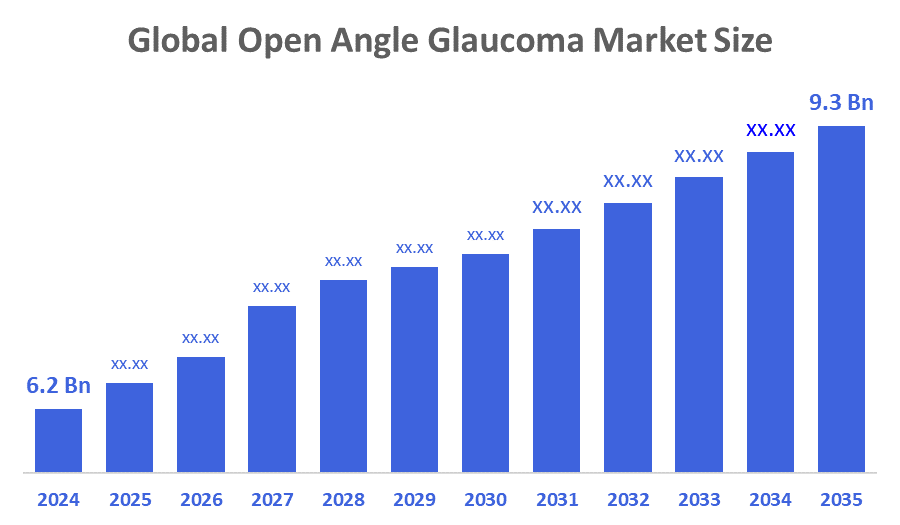
According to a research report published by Decisions Advisors and Consulting, the Global Open Angle Glaucoma Market Size was worth around USD 6.2 Billion in 2024 and is predicted to grow to around USD 9.3 Billion by 2035 with a Compound Annual Growth Rate (CAGR) of 3.75% from 2025 to 2035. Future opportunities include a rising aging population, AI-based diagnostics, minimally invasive glaucoma surgeries, sustained-release drug delivery, expanding emerging markets, tele-ophthalmology adoption, combination therapies, and increased screening awareness which will create more worldwide demand for early detection and treatment.
Market Overview
Open-angle glaucoma represents a long-term eye disease which progresses over time and results in permanent optic nerve destruction and subsequent vision deterioration because of blocked aqueous humor drainage and increased eye pressure. The global open-angle glaucoma market is expanding steadily because of three factors which include the growing elderly population and the rising diabetes rates and the increasing public understanding of initial eye examinations. New diagnostic imaging technologies which include Optical Coherence Tomography provide medical professionals with enhanced tools for detecting diseases at earlier stages with improved precision. The medical field introduced new treatment methods which include minimally invasive glaucoma surgeries (MIGS) and sustained-release drug implants and preservative-free eye drops that help patients follow their treatment plans. The combination of digital health systems with artificial intelligence-based disease monitoring together with tele-ophthalmology platforms creates better solutions for extended health management. The worldwide market expansion receives support from two factors which include the developing healthcare systems in emerging markets and the strong pharmaceutical product development capabilities.
Report Coverage
This research report categorizes the open angle glaucoma market based on various segments and regions, forecasts revenue growth, and analyzes trends in each submarket. The report analyses the key growth drivers, opportunities, and challenges influencing the open-angle glaucoma market. Recent market developments and competitive strategies such as expansion, type launch, development, partnership, merger, and acquisition, have been included to draw the competitive landscape in the market. The report strategically identifies and profiles the key market players and analyses their core competencies in each sub-segment of the open-angle glaucoma market.
Driving Factors
The global open-angle glaucoma market experiences growth because two main factors drive the market. Improved public knowledge, together with new medical testing equipment and treatment methods and easier access to healthcare services, drive market expansion. The worldwide development of glaucoma diagnosis and treatment services receives additional support from government funding of eye-health screening and blindness prevention programs.
Restraining Factors
The global open angle glaucoma market faces major restrictions because high treatment costs and restricted advanced care options prevent patients from receiving treatment. The industry faces two main obstacles which include the shortage of qualified workers and the difficulty patients experience when following extended treatment programs. The market growth faces two major challenges which stem from strict rules for product approval and the tendency to miss diagnosing patients with early asymptomatic conditions.
Market Segmentation
The open angle glaucoma market share is classified into type and drug class.
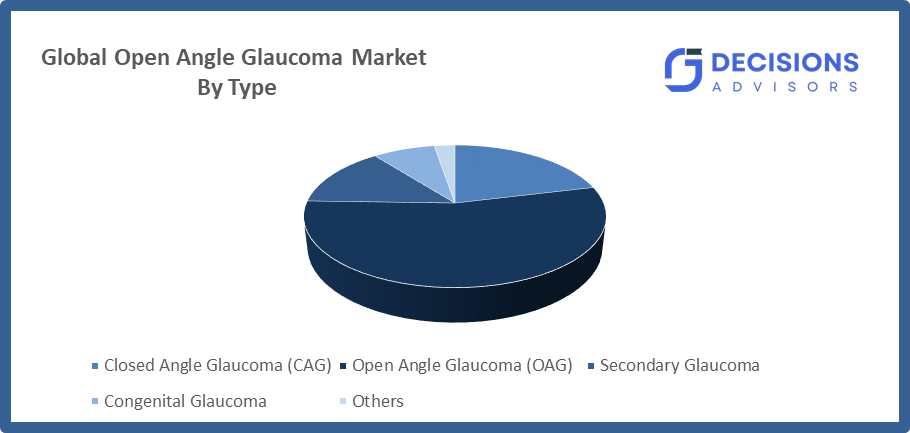
- The open angle glaucoma (OAG) segment dominated the market in 2024, approximately 66% and is projected to grow at a substantial CAGR during the forecast period.
Based on the type, the open angle glaucoma market is divided into closed angle glaucoma (CAG), open angle glaucoma (OAG), secondary glaucoma, congenital glaucoma, and others. Among these, the open angle glaucoma (OAG) segment dominated the market in 2024, approximately 66% and is projected to grow at a substantial CAGR during the forecast period. The disease affects a large number of people worldwide who suffer from it, which has become a major health problem that particularly affects older adults. The disease develops at a slow pace because patients do not show symptoms for extended periods, which results in an increase of people who will require treatment throughout their lives. The healthcare system requires ongoing medical attention because patients need to receive continuous treatment and special medical procedures. The segment maintains a strong market share because increased public knowledge and better testing methods and wider availability of eye care services. The segment maintains a strong market share because increased public knowledge and better testing methods and wider availability of eye care services.
- The prostaglandins segment accounted for the largest share in 2024, approximately 33% and is anticipated to grow at a significant CAGR during the forecast period.
Based on the drug class, the open angle glaucoma market is divided into beta blockers, prostaglandins, alpha adrenergic agonist, carbonic anhydrase inhibitors, combination drugs, and others. Among these, the prostaglandins segment accounted for the largest share in 2024, approximately 33% and is anticipated to grow at a significant CAGR during the forecast period. The primary treatment goal in open angle glaucoma received established medical acceptance because it works better than any other method to reduce intraocular pressure. Their dosing schedule of one daily dose helps patients stick to treatment better than using multiple doses throughout the day. Physicians prefer the system because it creates fewer overall dangers to patients. The first-line treatment shows strong backing from clinical guidelines which supported its use throughout the world because glaucoma patients need continuous treatment.
Regional Segment Analysis of the Open Angle Glaucoma Market
- North America (U.S., Canada, Mexico)
- Europe (Germany, France, U.K., Italy, Spain, Rest of Europe)
- Asia-Pacific (China, Japan, India, Rest of APAC)
- South America (Brazil and the Rest of South America)
- The Middle East and Africa (UAE, South Africa, Rest of MEA)
North America is anticipated to hold the largest share of the Open Angle Glaucoma market over the predicted timeframe.
North America is anticipated to hold the largest share of the open angle glaucoma market over the predicted timeframe. The glaucoma prevalence in the region reaches high levels which leads to people having better awareness of the disease and better access to early diagnosis methods. The combination of advanced healthcare infrastructure and favorable reimbursement policies and fast drug and surgical technology adoption drives business expansion for the company. The region receives additional strength because of its substantial research funding and the presence of major pharmaceutical companies.
Asia-Pacific is expected to grow at a rapid CAGR in the open angle glaucoma market during the forecast period. The population of elderly citizens in the area together with the increasing incidence of glaucoma creates a need for better healthcare services. The expansion of treatment facilities together with insurance system improvements and higher healthcare funding enables more patients to receive medical care. The regional market growth accelerates because of increased public awareness and government-sponsored blindness prevention initiatives together with the rising use of advanced diagnostic tools and medical treatments.
Competitive Analysis:
The report offers the appropriate analysis of the key organizations/companies involved within the open angle glaucoma market, along with a comparative evaluation primarily based on their type of offering, business overviews, geographic presence, enterprise strategies, segment market share, and SWOT analysis. The report also provides an elaborative analysis focusing on the current news and developments of the companies, which includes type development, innovations, joint ventures, partnerships, mergers & acquisitions, strategic alliances, and others. This allows for the evaluation of the overall competition within the market.
List of Key Companies
- Aerie Pharmaceuticals, Inc.
- Abbvie, Inc
- Bausch Health Companies Inc
- Merck & Co. Inc.
- Pfizer Inc.
- Fera Pharmaceuticals
- Teva Pharmaceutical Industries Ltd.
- EyePoint Pharmaceuticals,Inc
- Amorphex Therapeutics Holdings, Inc
- Kubota Vision Inc
- Others
Key Target Audience
- Market Players
- Investors
- End-users
- Government Authorities
- Consulting and Research Firm
- Venture capitalists
- Value-Added Resellers (VARs)
Recent Development
- In May 2024, Sight Sciences, Inc. revealed the results of a large-scale, comparative real-world clinical outcomes study of patients treated with three leading minimally invasive glaucoma surgery (MIGS) technologies, which were published in the American Journal of Ophthalmology. The U.S. Food and Drug Administration had approved OMNI technology for canaloplasty and trabeculotomy to lower intraocular pressure (IOP) in adult patients with primary open-angle glaucoma.
Market Segment
This study forecasts revenue at global, regional, and country levels from 2020 to 2035. Decisions Advisors has segmented the open angle glaucoma market based on the below-mentioned segments:
Global Open Angle Glaucoma Market, By Type
- Closed Angle Glaucoma (CAG)
- Open Angle Glaucoma (OAG)
- Secondary Glaucoma
- Congenital Glaucoma
- Others
Global Open Angle Glaucoma Market, By Drug Class
- Beta Blockers
- Prostaglandins
- Alpha Adrenergic Agonist
- Carbonic Anhydrase Inhibitors
- Combination Drugs
- Others
Global Open Angle Glaucoma Market, By Regional Analysis
- North America
- US
- Canada
- Mexico
- Europe
- Germany
- UK
- France
- Italy
- Spain
- Russia
- Rest of Europe
- Asia Pacific
- China
- Japan
- India
- South Korea
- Australia
- Rest of Asia Pacific
- South America
- Brazil
- Argentina
- Rest of South America
- Middle East & Africa
- UAE
- Saudi Arabia
- Qatar
- South Africa
- Rest of the Middle East & Africa
Frequently Asked Questions (FAQ)
1. What is the projected growth of the Global Open Angle Glaucoma Market?
A: The market is expected to grow from USD 6.2 billion in 2024 to USD 9.3 billion by 2035, registering a CAGR of 3.75% during the forecast period.
2. Which type segment leads the Open Angle Glaucoma Market?
A: The Open Angle Glaucoma (OAG) segment dominated in 2024 with about 66% share due to high prevalence, slow disease progression, and lifelong treatment requirements.
3. Which drug class holds the largest market share?
A: Prostaglandins led the drug class segment in 2024 with nearly 33% share because of superior intraocular pressure reduction, once-daily dosing convenience, and strong physician preference.
4. Why does North America dominate the market?
A: North America leads due to high disease awareness, strong healthcare infrastructure, favorable reimbursement policies, rapid technology adoption, significant research funding, and presence of major pharmaceutical companies.
5. Why is Asia-Pacific the fastest-growing region?
A: Asia-Pacific grows fastest due to its aging population, rising glaucoma prevalence, improving healthcare access, expanding insurance coverage, government blindness prevention programs, and increasing adoption of advanced diagnostics and treatments.
Check Licence
Choose the plan that fits you best: Single User, Multi-User, or Enterprise solutions tailored for your needs.
We Have You Covered
- 24/7 Analyst Support
- Clients Across the Globe
- Tailored Insights
- Technology Tracking
- Competitive Intelligence
- Custom Research
- Syndicated Market Studies
- Market Overview
- Market Segmentation
- Growth Drivers
- Market Opportunities
- Regulatory Insights
- Innovation & Sustainability
Report Details
| Scope | Global |
| Pages | 250 |
| Delivery | PDF & Excel via Email |
| Language | English |
| Release | Mar 2026 |
| Access | Download from this page |