
Global Open Type Heat Pump Market
 |
Author:
Mayuri S
|
Pages:
240
|
Author:
Mayuri S
|
Pages:
240
Global Open Type Heat Pump Market Size, By Product Type (Air Source Heat Pump, Water Source Heat Pump, and Ground Source Heat Pump), By Capacity (Up to 10 kW, 10-20 kW, and Above 20 kW), By Application (Residential, Commercial, and Industrial), and By Region (North America, Europe, Asia-Pacific, Latin America, Middle East, and Africa), Analysis and Forecast 2026 â 2035.
CAGR
7.3%
REVENUE 2025
USD Billion 4.31
FORECAST 2035
USD Billion 8.72
REPORT COVERAGE
Global
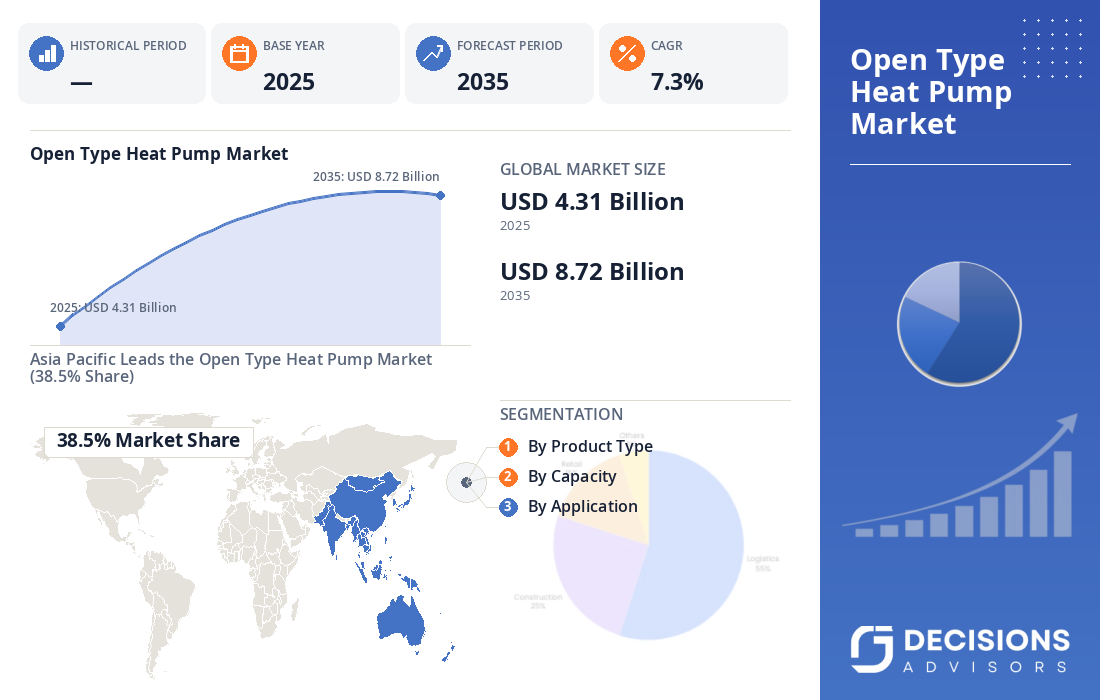
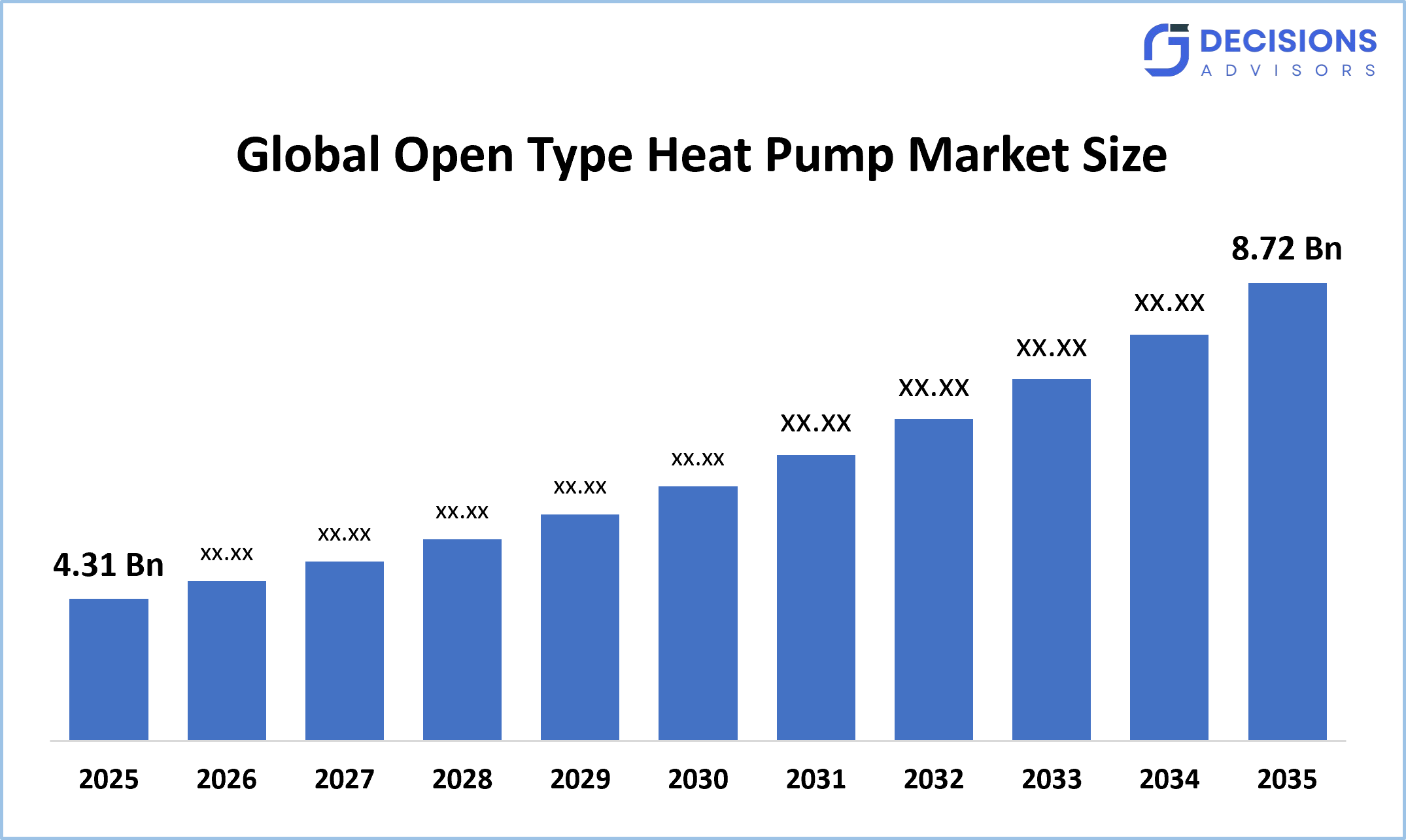
According to Decision Advisors, The Global Open Type Heat Pump Market Size was valued at USD 4.31 Billion in 2025 and is anticipated to reach USD 8.72 Billion by 2035 to grow with a CAGR of 7.3% during the forecast period 2026-2035. The growing demand for efficient heating and energy savings is driving the open type heat pump market, as these systems support efficient heating and industrial processes.
Global Open Type Heat Pump Market Insights Forecasts to 2035
- The Global Open Type Heat Pump Market Size Was Estimated at USD 4.31 Billion in 2025
- The Market Size is Expected to Grow at a CAGR of around 7.3% 2025 to 2035
- The Worldwide Open Type Heat Pump Market Size is Expected to Reach USD 8.72 Billion by 2035
- Europe is Expected to Grow the Fastest during the Forecast Period.
What is the Open Type Heat Pump?
An open type heat pump is a heating system that uses heat from sources such as air, water, or industrial processes and transfers it to another area. Unlike closed systems, open type heat pumps can use external fluids or gases during the heating process. These systems are used in industrial, commercial, and other applications where efficient heating is needed. They can provide heat at useful temperatures while reducing energy use compared with traditional heating methods. Open type heat pumps are commonly used for heating buildings, drying materials, and supporting industrial processes. Their ability to recover and reuse available heat makes them useful for improving energy efficiency and reducing operating costs.
Report Coverage
This research report categorizes the open type heat pump market based on various segments and regions, forecasts revenue growth, and analyzes trends in each submarket. The report analyses the key growth drivers, opportunities, and challenges influencing the open type heat pump market developments and competitive strategies, such as expansion, product launch, development, partnership, merger, and acquisition, have been included to draw the competitive landscape in the market. The report strategically identifies and profiles the key market players and analyses their core competencies in each sub-segment of the open type heat pump market.
Trending Factors
- Rising use of industrial waste heat recovery: Industries are recovering unused heat from refrigeration and production systems. Open type heat pumps reuse this heat for water heating, steam generation, and other processes.
- Growing industrial electrification: Industries are shifting toward electric heating systems to reduce fuel use. Open type heat pumps provide efficient heating for low- and medium-temperature industrial processes.
- Increasing demand for high-temperature heating: Many industries need higher temperatures for production processes. New heat pump technologies can provide high-temperature heat for industrial heating, drying, and other applications.
- Greater use in food and beverage processing: Food and beverage plants need heat for cooking, drying, cleaning, and hot water. Open type heat pumps provide heat for these processes efficiently.
- Rising use in chemical and manufacturing industries: Chemical and manufacturing plants need steady heat for production activities. Open type heat pumps provide process heating, hot water, and steam for industrial operations.
What is the use of AI in the Open Type Heat Pump Market?
AI is increasingly used in open type heat pump systems to improve performance, energy use, and system control. AI-based software can monitor temperature, pressure, energy consumption, and operating conditions in real time. It can identify changes in system performance and adjust operating settings for better efficiency. AI can also support predictive maintenance by detecting unusual equipment behavior and identifying possible problems before system failure. In industrial facilities, AI can analyze production and heating data to manage heat pump operation according to process requirements. Smart controls can further support automatic temperature management and energy optimization, making open type heat pumps more efficient for industrial heating applications.
Market Outlook
Driving Factor
The growing use of renewable electricity is driving the growth of the open-type heat pump market. Industries are increasingly using electricity from solar, wind, and other renewable sources for their energy needs. Electric heat pumps can use this power to recover and reuse heat from industrial processes, refrigeration systems, and other sources. This reduces the need for traditional fuel-based heating systems. Open-type heat pumps can provide heat for hot water, steam, drying, and other industrial processes. The growing availability of renewable electricity is making electric heating systems more attractive to industries. The focus on cleaner energy and lower emissions is further increasing the demand for these systems.
Restraining Factors
High initial costs, installation complexity, maintenance needs, limited availability of suitable heat sources, and the need for skilled workers can restrain the growth of the Open Type Heat Pump Market.
Opportunities
Advances in compressors and system design are creating new opportunities for the open-type heat pump market. Improved compressors can increase heating performance and reduce energy use. Variable-speed drives allow the system to adjust its operation based on changing heat needs. New designs also support better heat recovery from industrial refrigeration and production systems. These improvements are expanding the use of open-type heat pumps in the food and beverage, chemical, pharmaceutical, and manufacturing industries. As industries look for better ways to recover waste heat and reduce energy use, advanced compressors and improved heat pump designs are creating new opportunities for market growth.
Market Segmentation
By Product Type
The air source heat pump segment held the largest share of the market in 2025, driven by its widespread use in residential, commercial, and industrial heating applications.
The water source heat pump segment is expected to grow at the fastest rate during the forecast period, due to the high energy efficiency and increasing adoption in commercial and industrial heating applications.
By Capacity
The above 20 kW segment held the largest share of the market in 2025, supported by the extensive use of high-capacity heat pumps in commercial and industrial heating applications.
The 10–20 kW segment is expected to grow at the fastest rate during the forecast period, driven by increasing demand for efficient heating systems across commercial and small industrial facilities.
By Application
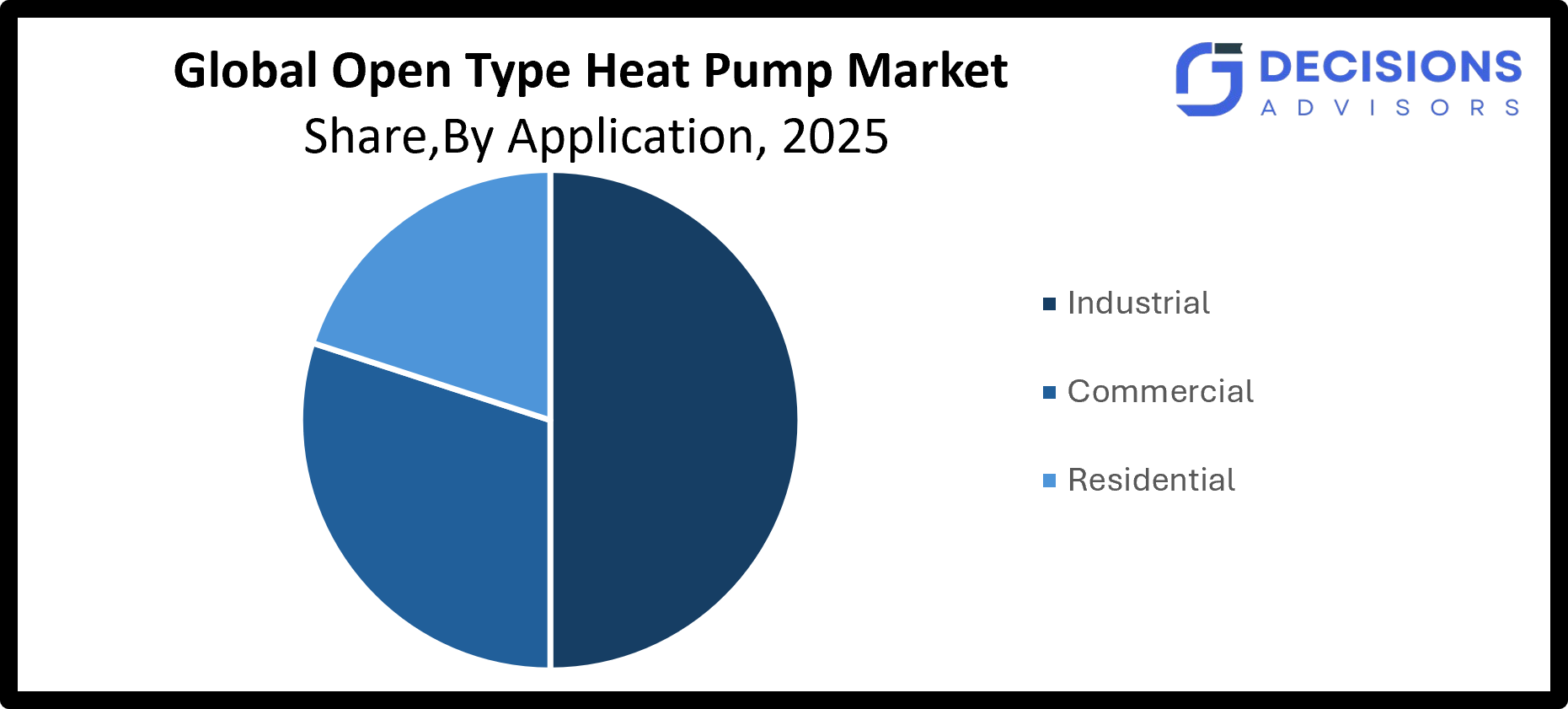
The industrial segment held the largest share of the market in 2025, supported by the increasing use of open type heat pumps for process heating, heat recovery, hot water, and other industrial applications.
The commercial segment is expected to grow at the fastest rate during the forecast period, driven by rising demand for energy-efficient heating systems in commercial buildings and facilities.
Asia-Pacific dominated the open type heat pump market in 2025 accounting for approximately 38.5% of the global market share.
Asia-Pacific dominated the open type heat pump market in 2025. The regional growth is supported by expanding industrial manufacturing, food and beverage processing, chemical production, and increasing demand for energy-efficient process heating and waste heat recovery. China and Japan are leading countries, driven by large manufacturing industries, industrial refrigeration capacity, and growing adoption of heat recovery technologies. the Korea Energy Agency announced an energy-efficiency support program that includes water-source heat pumps. The program encourages businesses to use energy-efficient equipment, supporting the adoption of heat pump systems. Leading companies such as GEA and Mayekawa support the regional market through open-type and ammonia heat pump solutions for industrial heating and heat recovery applications.
In March 2026, the Korea Energy Agency announced a KRW 33.26 billion energy-efficiency support program. The program provides up to 70% of installation costs for eight high-efficiency equipment types, including water-source heat pumps, supporting heat-pump adoption.
Europe is expected to grow at a rapid CAGR of approximately 28.2% in the open type heat pump market during the forecast period. The region’s growth is supported by increasing industrial electrification, replacement of fossil-fuel heating systems, rising demand for high-temperature process heat, and greater use of industrial heat recovery technologies. Germany and France are leading countries, supported by strong industrial activity, established heating infrastructure, and increasing investment in low-carbon technologies. The European Commission’s Innovation Fund Heat Auction supports industrial heat projects, including heat pumps, encouraging industries to use cleaner heating systems and reduce the use of fossil fuels. Leading European companies such as MAN Energy Solutions, and Danfoss support the regional market through industrial heat-pump and heat-recovery technologies.
In June 2026, the European Commission announced around €400 million for 65 industrial heat projects under the Innovation Fund Heat Auction. The projects include heat pumps and are expected to produce 16.3 TWh of decarbonized heat during their first five years.
SWOT Analysis
|
Strengths |
High heat recovery capability |
|
Weaknesses |
System design complexity |
|
Opportunities |
Expansion of industrial heat recovery |
|
Threats |
Growing Demand for Industrial Electric Boilers |
List of Key Companies
- GEA Group AG
- Mayekawa Mfg. Co., Ltd.
- Johnson Controls International plc
- Copeland
- Danfoss A/S
- BITZER SE
- ENGIE Refrigeration GmbH
- MAN Energy Solutions SE
- Mitsubishi Heavy Industries Ltd
- Kawasaki Heavy Industries Ltd
- Carrier Global Corporation
- Emerson Electric Co.
- Frascold S.p.A.
- Combitherm GmbH
- Other
Key Target Audience
- Market Players
- Investors
- End-users
- Government Authoritiesâ¯
- Consulting and Research Firm
- Venture capitalists
- Value-Added Resellers (VARs)
Recent Development
- In September 2026, Johnson Controls launched its Sabroe HitemHP industrial heat pump line. It provides temperatures up to 122°C using natural refrigerants and supports industrial process heating, energy efficiency, and replacement of traditional boilers.
- In June 2026, Danfoss announced a €10 million investment in its Reyrieux, France facility to expand heat-pump component production. The investment supports commercial and industrial heat-pump applications and strengthens European heat-pump manufacturing capacity.
Market Segment
This study forecasts revenue at global, regional, and country levels from 2020 to 2035. Decision Advisors has segmented the open type heat pump market based on the below-mentioned segments:
Global Open Type Heat Pump Market, By Product Type
- Air Source Heat Pump
- Water Source Heat Pump
- Ground Source Heat Pump
Global Open Type Heat Pump Market, By Capacity
- Up to 10 kW
- 10-20 kW
- Above 20 kW
Global Open Type Heat Pump Market, By Application
- Residential
- Commercial
- Industrial
Global Open Type Heat Pump Market, By Regional Analysis
- North America
- US
- Canada
- Mexico
- Europe
- Germany
- UK
- France
- Italy
- Spain
- Russia
- Rest of Europe
- Asia Pacific
- China
- Japan
- India
- South Korea
- Australia
- Rest of Asia Pacific
- South America
- Brazil
- Argentina
- Rest of South America
- Middle East & Africa
-
- UAE
- Saudi Arabia
- Qatar
- South Africa
- Rest of the Middle East & Africa
Frequently Asked Questions (FAQ)
- What is the market size of the open type heat Pump market?
The global open type heat pump market was valued at USD 4.31 billion in 2025 and is expected to reach USD 8.72 billion by 2035, growing at a CAGR of 7.3% during the forecast period.
- What are the key driving factors of the open type heat Pump market?
Key driving factors include growing industrial waste heat recovery, increasing industrial electrification, rising demand for high-temperature heating, greater use in food processing, and growing adoption in chemical and manufacturing industries.
- What are the main features of the open type heat Pump market?
Open type heat pumps recover heat from sources such as industrial processes and refrigeration systems. They use technologies such as ammonia compressors and heat exchangers to provide efficient heating for hot water, drying, and industrial processes.
- What are the key trends in the open type heat Pump market?
Key trends include rising industrial heat recovery, growing use of natural refrigerants, increasing demand for high-temperature heating, improved compressor technologies, greater use of smart controls, and growing adoption of heat pumps for industrial process heating.
- What are the key applications of open type heat Pump market?
Key applications include industrial process heating, hot water production, drying, heat recovery, food processing, chemical manufacturing, and refrigeration systems. Industrial applications are significant due to increasing demand for efficient heating and reuse of available waste heat.
Check Licence
Choose the plan that fits you best: Single User, Multi-User, or Enterprise solutions tailored for your needs.
We Have You Covered
- 24/7 Analyst Support
- Clients Across the Globe
- Tailored Insights
- Technology Tracking
- Competitive Intelligence
- Custom Research
- Syndicated Market Studies
- Market Overview
- Market Segmentation
- Growth Drivers
- Market Opportunities
- Regulatory Insights
- Innovation & Sustainability
Report Details
| Scope | Global |
| Pages | 240 |
| Delivery | PDF & Excel via Email |
| Language | English |
| Release | Oct 2026 |
| Access | Download from this page |