
Global Ophthalmology Market
 |
Author:
Disha B
|
Pages:
253
|
Author:
Disha B
|
Pages:
253
Global Ophthalmology Market Size, Share, and COVID-19 Impact Analysis, By Product (Device, Drugs, and Others), By Disease (Glaucoma, Cataract, Age-Related Macular Degeneration, Inflammatory Diseases, Refractive Disorders, and Others), By Route of Administration (Oral, Topical, Injectable, Local Ocular, and Others), and By Region (North America, Europe, Asia-Pacific, Latin America, Middle East, and Africa), Analysis and Forecast 2025 - 2035
CAGR
6.27%
REVENUE 2024
USD Billion 75.71
FORECAST 2035
USD Billion 147.87
REPORT COVERAGE
Global
Global Ophthalmology Market Size Insights Forecasts to 2035
- The Global Ophthalmology Market Size Was Estimated at USD 75.71 Billion in 2024
- The Market Size is Expected to Grow at a CAGR of around 6.27% from 2025 to 2035
- The Worldwide Ophthalmology Market Size is Expected to Reach USD 147.87 Billion by 2035
- North America is expected to Grow the fastest during the forecast period.
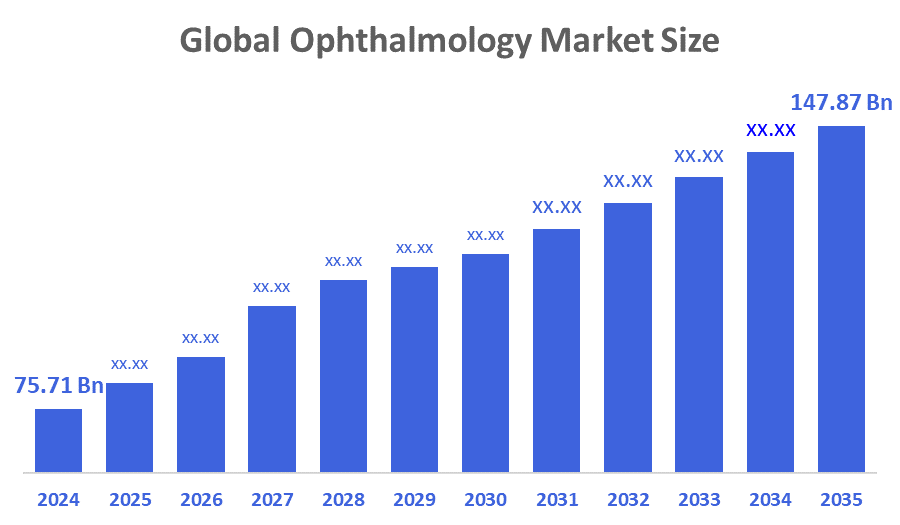
According to a Research Report Published by Decisions Advisors and Consulting, The Global Ophthalmology Market Size was worth around USD 75.71 Billion in 2024 and is predicted to Grow to around USD 147.87 Billion by 2035 with a compound annual growth rate (CAGR) of 6.27% from 2025 to 2035. Demand for ophthalmology is rising as a result of two important variables coming together: the frequency of eye problems and rising healthcare knowledge among people worldwide. Consumers are looking for proactive and all-encompassing eye care solutions as conditions like myopia, diabetic retinopathy, and dry eye syndrome grow more common.
Market Overview
The market for ophthalmology is a broad industry devoted to the investigation, diagnosis, and management of illnesses and disorders of the eyes. It includes ocular surgery, optometry, and vision science research, among other medical specialisations. The industry treats ailments such as cataracts, glaucoma, refractive errors, and retinal illnesses with an emphasis on visual health and well-being. Improvements in pharmaceutical treatments, diagnostic tools, and surgical methods all help to improve patient outcomes. Further, throughout the continuous research, innovation, and medical treatment, the market plays a critical role in maintaining and restoring vision, improving the quality of life, and reducing vision-related disorders. The market is committed to enhancing patient outcomes, advancing visual health, and adjusting to changing technologies and treatment modalities as a crucial component of healthcare.
In September 2025, Ollin Biosciences launched with $100M in funding, aiming to challenge Roche’s blockbuster eye drug Vabysmo with new clinical-stage therapies. Its treatments may change how vision-threatening illnesses are treated and increase rivalry with market titans like Roche and Amgen.
In June 2025, the privately owned ophthalmic biotechnology business SpyGlass Pharma announced the completion of a $75 million Series D funding round. The goal of SpyGlass' Drug Delivery Platform is to meet the demand for long-term care of glaucoma and other chronic ocular illnesses by offering medicinal therapy for several years.
In July 2024, Beacon Therapeutics raised $170 million in Series B funding to accelerate the development of its ophthalmic gene therapy pipeline, including its lead candidate for X-linked retinitis pigmentosa (XLRP).
Report Coverage
This research report categorises the ophthalmology market based on various segments and regions, forecasts revenue growth, and analyzes trends in each submarket. The report analyses the key growth drivers, opportunities, and challenges influencing the ophthalmology market. Recent market developments and competitive strategies, such as expansion, product launch, development, partnership, merger, and acquisition, have been included to draw the competitive landscape in the market. The report strategically identifies and profiles the key market players and analyzes their core competencies in each sub-segment of the ophthalmology market.
Driving Factors
The ophthalmology sector is changing with encouraging opportunities that improve accessibility, innovation, and patient results. Telemedicine facilitates remote consultations and diagnostics, especially aiding underserved areas, while tailored treatments derived from genetics enhance efficacy. Collaborative efforts among pharmaceutical companies, healthcare organisations, and research entities propel innovation and growth in the market. The growth potential exists in developing areas, bolstered by increased awareness and greater affordability. Diagnostics powered by AI, regenerative therapies, and wearable monitoring technology are revolutionising efficiency, precision, and preventive care. A movement towards patient-focused models highlights improved results and participation, while worldwide efforts tackling avoidable blindness promote long-term development. Moreover, rising awareness of environmental effects like screen time and pollution is driving the demand for preventive solutions and specialised eyewear products. Collectively, these developments set the ophthalmology field up for considerable improvement, aligning innovation with accessibility and worldwide health demands.
Restraining Factors
High treatment prices, which restrict patient access and postpone therapy, pose significant issues for the ophthalmology sector. Simultaneously, strict regulatory procedures increase operational costs and lengthen product approvals. These elements hinder innovation, make the market less accessible, and limit its overall expansion.
Market Segmentation
The ophthalmology market share is classified into product, disease, and route of administration.
- The drugs segment accounted for a significant share in 2024 and is projected to grow at a rapid pace over the forecast period.
Based on the product, the ophthalmology market is divided into device, drugs, and others. Among these, the drugs segment accounted for a significant share in 2024 and is projected to grow at a rapid pace over the forecast period. Ophthalmic medications are essential for treating a wide range of eye disorders, including glaucoma, age-related macular degeneration, infections, and inflammation. Additionally, there is an increasing focus on creating tailored treatments, investigating gene therapy for hereditary eye disorders, and improving the effectiveness of currently available medications. The ophthalmology market's pharmaceutical sector is always changing to treat a variety of eye disorders using cutting-edge medication formulations and therapeutic approaches.
- The glaucoma segment accounted for a substantial share in 2024 and is anticipated to grow at a significant CAGR during the forecast period.
Based on the disease, the ophthalmology market is segmented into glaucoma, cataract, age-related macular degeneration, inflammatory diseases, refractive disorders, and others. Among these, the glaucoma segment accounted for a substantial share in 2024 and is anticipated to grow at a significant CAGR during the forecast period. Trends in the ophthalmology market show that early glaucoma identification and treatment are becoming increasingly important. Innovative imaging technology and pressure monitoring devices are examples of diagnostic tool advancements that allow ophthalmologists to identify glaucoma early on, improving care and averting irreparable vision loss.
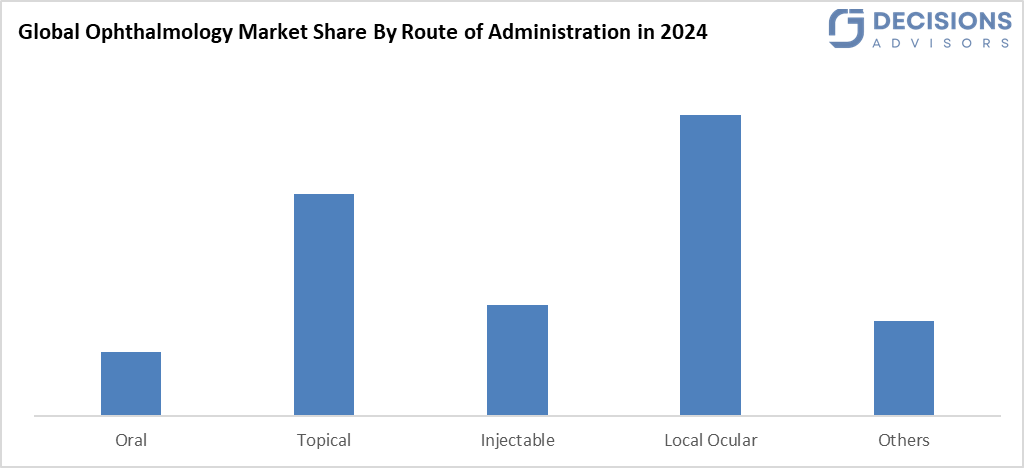
- The local ocular segment accounted for the highest market revenue in 2024 and is anticipated to grow at a significant CAGR during the forecast period.
Based on the route of administration, the ophthalmology market is classified into oral, topical, injectable, local ocular, and others. Among these, the local ocular segment accounted for the highest market revenue in 2024 and is anticipated to grow at a significant CAGR during the forecast period. It improves treatment efficacy while reducing systemic side effects by providing targeted drug delivery right to the site of action. Ocular inserts, gels, and nanoparticles are examples of formulation innovations that are expected to improve drug absorption and retention in the eye. Furthermore, the need for efficient local treatments that offer quick relief is fueled by the rising prevalence of eye conditions such as glaucoma and dry eye syndrome.
Regional Segment Analysis of the Ophthalmology Market
- North America (U.S., Canada, Mexico)
- Europe (Germany, France, U.K., Italy, Spain, Rest of Europe)
- Asia-Pacific (China, Japan, India, Rest of APAC)
- South America (Brazil and the Rest of South America)
- The Middle East and Africa (UAE, South Africa, Rest of MEA)
Asia Pacific is anticipated to hold the largest share of the ophthalmology market over the predicted timeframe.
Asia Pacific is anticipated to hold the largest share of the ophthalmology market over the predicted timeframe. The increasing prevalence of vision-related issues, combined with a growing elderly population, is anticipated to boost the need for different eye care services. Nations such as India and China are expected to make substantial investments in healthcare infrastructure, improving access to cutting-edge ophthalmic technologies. The growing emphasis on preventive eye health and routine examinations is expected to boost the need for ophthalmic instruments and treatments. Furthermore, government efforts to enhance awareness and accessibility of eye health are anticipated to aid in the continued expansion of the market in the Asia Pacific region.
In June 2023, Eye-Q launched a tailor-made and advanced LASIK machine at its eye-care centre in Rewari, India. This cutting-edge system revolutionised laser vision correction, providing better treatment alternatives for individuals wanting to enhance their eyesight.
North America is expected to grow at a rapid CAGR in the ophthalmology market during the forecast period. The ophthalmology market in North America is seeing a strong trend due to rising healthcare spending, technological advancements, and sophisticated healthcare infrastructure. Ophthalmic diagnoses and therapies are in high demand due to the region's high frequency of eye illnesses, especially those connected to ageing. Furthermore, a proactive approach to healthcare and a strong regulatory framework that encourages the adoption of cutting-edge treatments and surgical procedures.
The NIH’s National Eye Institute (NEI) has awarded Ohio State University its first-ever P30 Core Grant to strengthen vision research through shared expertise, technical support, and collaborative infrastructure. The program is anticipated to stimulate innovation in ophthalmology and visual sciences by promoting collaboration across disciplines and institutions, ultimately improving patient outcomes and enhancing global eye health.
Competitive Analysis:
The report offers the appropriate analysis of the key organizations/companies involved within the ophthalmology market, along with a comparative evaluation primarily based on their product offering, business overviews, geographic presence, enterprise strategies, segment market share, and SWOT analysis. The report also provides an elaborative analysis focusing on the current news and developments of the companies, which includes product development, innovations, joint ventures, partnerships, mergers & acquisitions, strategic alliances, and others. This allows for the evaluation of the overall competition within the market.
List of Key Companies
- Alkem Laboratories
- Bausch+Lomb
- Carl Zeiss Meditec AG
- Essilor International S.A.
- Haag-Streit AG
- Hoya Corporation
- Iridex Corporation
- Lumenis Ltd.
- NIDEK CO., LTD.
- Novartis AG
- Optovue, Inc. (A Subsidiary of Carl Zeiss Meditec AG)
- STAAR Surgical Company
- Topcon Corporation
- Ziemer Ophthalmic Systems AG
- Others
Key Target Audience
- Market Players
- Investors
- End-users
- Government Authorities
- Consulting and Research Firm
- Venture capitalists
- Value-Added Resellers (VARs)
Recent Development
- In December 2025, Bascom Palmer Eye Institute Abu Dhabi and the Emirates Society of Ophthalmology (ESO) signed a landmark strategic partnership to advance ophthalmic education, research, and clinical practice across the UAE. The occasion marked the beginning of a collaborative effort to enhance ophthalmology education, research, and clinical standards throughout the United Arab Emirates, alongside a formal agreement.
- In September 2025, Eyexora officially launched with a hub?and?spoke model to accelerate global ophthalmology innovation, backed by strong investor support and industry expertise. The Singapore Eye Research Institute (SERI) is the source of Eyexora's initial assets, and as it expands internationally, it is looking to form alliances in Singapore and Europe.
- In September 2024, Lindus Health launched an “All-in-One Ophthalmology CRO,” designed to streamline and accelerate clinical trials for eye care innovations across the US, UK, and Europe. It includes the creation of over-the-counter (OTC) and prescription-grade medications for a wide range of ophthalmic diseases, such as dry eye, diabetic retinopathy, myopia, and macular degeneration.
Market Segment
This study forecasts revenue at global, regional, and country levels from 2020 to 2035. Decisions Advisors and Consulting has segmented the Ophthalmology market based on the below-mentioned segments:
Global Ophthalmology Market, By Product
- Device
- Drugs
- Others
Global Ophthalmology Market, By Disease
- Glaucoma
- Cataract
- Age-Related Macular Degeneration
- Inflammatory Diseases
- Refractive Disorders
- Others
Global Ophthalmology Market, By Route of Administration
- Oral
- Topical
- Injectable
- Local Ocular
- Others
Global Ophthalmology Market, By Regional Analysis
- North America
- US
- Canada
- Mexico
- Europe
- Germany
- UK
- France
- Italy
- Spain
- Russia
- Rest of Europe
- Asia Pacific
- China
- Japan
- India
- South Korea
- Australia
- Rest of Asia Pacific
- South America
- Brazil
- Argentina
- Rest of South America
- Middle East & Africa
- UAE
- Saudi Arabia
- Qatar
- South Africa
- Rest of the Middle East & Africa
Frequently Asked Questions (FAQ)
- What is the projected size of the global ophthalmology market in 2024 and 2035?
The market was valued at USD 75.71 billion in 2024 and is expected to reach USD 147.87 billion by 2035.
- What is the forecasted CAGR for the global ophthalmology market?
It is projected to grow at a CAGR of 6.27% during the forecast period from 2025 to 2035.
- Which region is expected to hold the largest share of the ophthalmology market?
Asia Pacific is anticipated to hold the largest share over the forecast period, driven by rising vision issues, an ageing population, and healthcare investments in countries like India and China.
- Which region will grow the fastest during the forecast period?
North America is expected to grow at the fastest CAGR, fueled by high healthcare spending, advanced infrastructure, and a high prevalence of age-related eye diseases.
- What are the main product segments in the ophthalmology market?
The market segments by product into devices, drugs, and others, with drugs holding a significant share in 2024 and projected for rapid growth due to innovations in treatments for glaucoma and macular degeneration.
- Which disease segment dominated in 2024?
The glaucoma segment accounted for a substantial share in 2024 and is expected to grow at a significant CAGR, supported by advances in early detection tools like imaging and pressure monitors.
- What route of administration led the market in 2024?
The local ocular segment generated the highest revenue in 2024 and is poised for strong growth, offering targeted delivery with minimal systemic side effects via innovations like ocular inserts and nanoparticles.
- What are the primary drivers of ophthalmology market growth?
Key drivers include rising prevalence of eye disorders (e.g., myopia, diabetic retinopathy), increasing healthcare awareness, telemedicine, AI diagnostics, personalised treatments, and investments in emerging markets.
- What challenges restrain the ophthalmology market?
High treatment costs limit access, while stringent regulatory approvals raise expenses and delay innovations, hindering overall expansion.
- Who are some key players in the global ophthalmology market?
Major companies include Novartis AG, Bausch + Lomb, Carl Zeiss Meditec AG, Alkem Laboratories, Topcon Corporation, and others like Hoya Corporation and STAAR Surgical Company.
- Introduction
- Objectives of the Study
- Market Definition
- Research Scope
- Research Methodology and Assumptions
- Executive Summary
- Premium Insights
- Porter’s Five Forces Analysis
- Value Chain Analysis
- Top Investment Pockets
- Market Attractiveness Analysis By Product
- Market Attractiveness Analysis By Disease
- Market Attractiveness Analysis By Route of Administration
- Market Attractiveness Analysis By Region
- Industry Trends
- Market Dynamics
- Market Evaluation
- Drivers
- Eye problems and rising healthcare knowledge among consumers worldwide
- Restraints
- Strict regulatory procedures increase operational costs and lengthen product approvals
- Opportunities
- Diagnostics powered by AI, regenerative therapies, and wearable monitoring technology
- Challenges
- Postponing therapy poses significant issues for the ophthalmology sector
- Global Ophthalmology Market Analysis and Projection, By Product
- Segment Overview
- Device
- Drugs
- Others
- Global Ophthalmology Market Analysis and Projection, By Disease
- Segment Overview
- Glaucoma
- Cataract
- Age-Related Macular Degeneration
- Inflammatory Diseases
- Refractive Disorders
- Others
- Global Ophthalmology Market Analysis and Projection, By Route of Administration
- Segment Overview
- Oral
- Topical
- Injectable
- Local Ocular
- Others
- Global Ophthalmology Market Analysis and Projection, By Regional Analysis
- Segment Overview
- North America
- U.S.
- Canada
- Mexico
- Europe
- Germany
- France
- U.K.
- Italy
- Spain
- Asia-Pacific
- Japan
- China
- India
- South America
- Brazil
- Middle East and Africa
- UAE
- South Africa
- Global Ophthalmology Market-Competitive Landscape
- Overview
- Market Share of Key Players in the Ophthalmology Market
- Global Company Market Share
- North America Company Market Share
- Europe Company Market Share
- APAC Company Market Share
- Competitive Situations and Trends
- Coverage Launches and Developments
- Partnerships, Collaborations, and Agreements
- Mergers & Acquisitions
- Expansions
- Company Profiles
- Alkem Laboratories
- Business Overview
- Company Snapshot
- Company Market Share Analysis
- Company Coverage Portfolio
- Recent Developments
- SWOT Analysis
- Bausch+Lomb
- Business Overview
- Company Snapshot
- Company Market Share Analysis
- Company Coverage Portfolio
- Recent Developments
- SWOT Analysis
- Carl Zeiss Meditec AG
- Business Overview
- Company Snapshot
- Company Market Share Analysis
- Company Coverage Portfolio
- Recent Developments
- SWOT Analysis
- Essilor International S.A.
- Business Overview
- Company Snapshot
- Company Market Share Analysis
- Company Coverage Portfolio
- Recent Developments
- SWOT Analysis
- Haag-Streit AG
- Business Overview
- Company Snapshot
- Company Market Share Analysis
- Company Coverage Portfolio
- Recent Developments
- SWOT Analysis
- Hoya Corporation
- Business Overview
- Company Snapshot
- Company Market Share Analysis
- Company Coverage Portfolio
- Recent Developments
- SWOT Analysis
- Iridex Corporation
- Business Overview
- Company Snapshot
- Company Market Share Analysis
- Company Coverage Portfolio
- Recent Developments
- SWOT Analysis
- Lumenis Ltd.
- Business Overview
- Company Snapshot
- Company Market Share Analysis
- Company Coverage Portfolio
- Recent Developments
- SWOT Analysis
- NIDEK CO., LTD.
- Business Overview
- Company Snapshot
- Company Market Share Analysis
- Company Coverage Portfolio
- Recent Developments
- SWOT Analysis
- Novartis AG
- Business Overview
- Company Snapshot
- Company Market Share Analysis
- Company Coverage Portfolio
- Recent Developments
- SWOT Analysis
- Optovue, Inc.
- Business Overview
- Company Snapshot
- Company Market Share Analysis
- Company Coverage Portfolio
- Recent Developments
- SWOT Analysis
- STAAR Surgical Company
- Business Overview
- Company Snapshot
- Company Market Share Analysis
- Company Coverage Portfolio
- Recent Developments
- SWOT Analysis
- Topcon Corporation
- Business Overview
- Company Snapshot
- Company Market Share Analysis
- Company Coverage Portfolio
- Recent Developments
- SWOT Analysis
- Ziemer Ophthalmic Systems AG
- Business Overview
- Company Snapshot
- Company Market Share Analysis
- Company Coverage Portfolio
- Recent Developments
- SWOT Analysis
- Others
- Business Overview
- Company Snapshot
- Company Market Share Analysis
- Company Coverage Portfolio
- Recent Developments
- SWOT Analysis
- Alkem Laboratories
List of Table
- Global Ophthalmology Market, By Product, 2024-2035(USD Billion)
- Global Device, Ophthalmology Market, By Region, 2024-2035(USD Billion)
- Global Drugs, Ophthalmology Market, By Region, 2024-2035(USD Billion)
- Global Others, Ophthalmology Market, By Region, 2024-2035(USD Billion)
- Global Ophthalmology Market, By Disease, 2024-2035(USD Billion)
- Global Glaucoma, Ophthalmology Market, By Region, 2024-2035(USD Billion)
- Global Cataract, Ophthalmology Market, By Region, 2024-2035(USD Billion)
- Global Age-Related Macular Degeneration, Ophthalmology Market, By Region, 2024-2035(USD Billion)
- Global Inflammatory Diseases, Ophthalmology Market, By Region, 2024-2035(USD Billion)
- Global Refractive Disorders, Ophthalmology Market, By Region, 2024-2035(USD Billion)
- Global Others, Ophthalmology Market, By Region, 2024-2035(USD Billion)
- Global Ophthalmology Market, By Route of Administration, 2024-2035(USD Billion)
- Global Oral, Ophthalmology Market, By Region, 2024-2035(USD Billion)
- Global Topical, Ophthalmology Market, By Region, 2024-2035(USD Billion)
- Global Injectable, Ophthalmology Market, By Region, 2024-2035(USD Billion)
- Global Local Ocular, Ophthalmology Market, By Region, 2024-2035(USD Billion)
- Global Others, Ophthalmology Market, By Region, 2024-2035(USD Billion)
- North America Ophthalmology Market, By Product, 2024-2035(USD Billion)
- North America Ophthalmology Market, By Disease, 2024-2035(USD Billion)
- North America Ophthalmology Market, By Route of Administration, 2024-2035(USD Billion)
- U.S. Ophthalmology Market, By Product, 2024-2035(USD Billion)
- U.S. Ophthalmology Market, By Disease, 2024-2035(USD Billion)
- U.S. Ophthalmology Market, By Route of Administration, 2024-2035(USD Billion)
- Canada Ophthalmology Market, By Product, 2024-2035(USD Billion)
- Canada Ophthalmology Market, By Disease, 2024-2035(USD Billion)
- Canada Ophthalmology Market, By Route of Administration, 2024-2035(USD Billion)
- Mexico Ophthalmology Market, By Product, 2024-2035(USD Billion)
- Mexico Ophthalmology Market, By Disease, 2024-2035(USD Billion)
- Mexico Ophthalmology Market, By Route of Administration, 2024-2035(USD Billion)
- Europe Ophthalmology Market, By Product, 2024-2035(USD Billion)
- Europe Ophthalmology Market, By Disease, 2024-2035(USD Billion)
- Europe Ophthalmology Market, By Route of Administration, 2024-2035(USD Billion)
- Germany Ophthalmology Market, By Product, 2024-2035(USD Billion)
- Germany Ophthalmology Market, By Disease, 2024-2035(USD Billion)
- Germany Ophthalmology Market, By Route of Administration, 2024-2035(USD Billion)
- France Ophthalmology Market, By Product, 2024-2035(USD Billion)
- France Ophthalmology Market, By Disease, 2024-2035(USD Billion)
- France Ophthalmology Market, By Route of Administration, 2024-2035(USD Billion)
- U.K. Ophthalmology Market, By Product, 2024-2035(USD Billion)
- U.K. Ophthalmology Market, By Disease, 2024-2035(USD Billion)
- U.K. Ophthalmology Market, By Route of Administration, 2024-2035(USD Billion)
- Italy Ophthalmology Market, By Product, 2024-2035(USD Billion)
- Italy Ophthalmology Market, By Disease, 2024-2035(USD Billion)
- Italy Ophthalmology Market, By Route of Administration, 2024-2035(USD Billion)
- Spain Ophthalmology Market, By Product, 2024-2035(USD Billion)
- Spain Ophthalmology Market, By Disease, 2024-2035(USD Billion)
- Spain Ophthalmology Market, By Route of Administration, 2024-2035(USD Billion)
- Asia Pacific Ophthalmology Market, By Product, 2024-2035(USD Billion)
- Asia Pacific Ophthalmology Market, By Disease, 2024-2035(USD Billion)
- Asia Pacific Ophthalmology Market, By Route of Administration, 2024-2035(USD Billion)
- Japan Ophthalmology Market, By Product, 2024-2035(USD Billion)
- Japan Ophthalmology Market, By Disease, 2024-2035(USD Billion)
- Japan Ophthalmology Market, By Route of Administration, 2024-2035(USD Billion)
- China Ophthalmology Market, By Product, 2024-2035(USD Billion)
- China Ophthalmology Market, By Disease, 2024-2035(USD Billion)
- China Ophthalmology Market, By Route of Administration, 2024-2035(USD Billion)
- India Ophthalmology Market, By Product, 2024-2035(USD Billion)
- India Ophthalmology Market, By Disease, 2024-2035(USD Billion)
- India Ophthalmology Market, By Route of Administration, 2024-2035(USD Billion)
- South America Ophthalmology Market, By Product, 2024-2035(USD Billion)
- South America Ophthalmology Market, By Disease, 2024-2035(USD Billion)
- South America Ophthalmology Market, By Route of Administration, 2024-2035(USD Billion)
- Brazil Ophthalmology Market, By Product, 2024-2035(USD Billion)
- Brazil Ophthalmology Market, By Disease, 2024-2035(USD Billion)
- Brazil Ophthalmology Market, By Route of Administration, 2024-2035(USD Billion)
- The Middle East and Africa Ophthalmology Market, By Product, 2024-2035(USD Billion)
- The Middle East and Africa Ophthalmology Market, By Disease, 2024-2035(USD Billion)
- The Middle East and Africa Ophthalmology Market, By Route of Administration, 2024-2035(USD Billion)
- UAE Ophthalmology Market, By Product, 2024-2035(USD Billion)
- UAE Ophthalmology Market, By Disease, 2024-2035(USD Billion)
- UAE Ophthalmology Market, By Route of Administration, 2024-2035(USD Billion)
- South Africa Ophthalmology Market, By Product, 2024-2035(USD Billion)
- South Africa Ophthalmology Market, By Disease, 2024-2035(USD Billion)
- South Africa Ophthalmology Market, By Route of Administration, 2024-2035(USD Billion)
List of Figures
- Global Ophthalmology Market Segmentation
- Ophthalmology Market: Research Methodology
- Market Size Estimation Methodology: Bottom-Up Approach
- Market Size Estimation Methodology: Top-down Approach
- Data Triangulation
- Porter’s Five Forces Analysis
- Value Chain Analysis
- Top investment pocket in the Ophthalmology Market
- Top Winning Strategies, 2024-2035
- Top Winning Strategies, By Development, 2024-2035(%)
- Top Winning Strategies, By Company, 2024-2035
- Moderate Bargaining power of Buyers
- Moderate Bargaining power of Suppliers
- Moderate Bargaining power of New Entrants
- Low threat of Substitution
- High Competitive Rivalry
- Top Player Positioning, 2024
- Market Share Analysis, 2024
- Restraint and Drivers: Ophthalmology Market
- Ophthalmology Market Segmentation, By Product
- Ophthalmology Market For Device, By Region, 2024-2035 ($ Billion)
- Ophthalmology Market For Drugs, By Region, 2024-2035 ($ Billion)
- Ophthalmology Market For Others, By Region, 2024-2035 ($ Billion)
- Ophthalmology Market Segmentation, By Disease
- Ophthalmology Market For Glaucoma, By Region, 2024-2035 ($ Billion)
- Ophthalmology Market For Cataract, By Region, 2024-2035 ($ Billion)
- Ophthalmology Market For Age-Related Macular Degeneration, By Region, 2024-2035 ($ Billion)
- Ophthalmology Market For Inflammatory Diseases, By Region, 2024-2035 ($ Billion)
- Ophthalmology Market For Refractive Disorders, By Region, 2024-2035 ($ Billion)
- Ophthalmology Market For Others, By Region, 2024-2035 ($ Billion)
- Ophthalmology Market Segmentation, By Route of Administration
- Ophthalmology Market For Oral, By Region, 2024-2035 ($ Billion)
- Ophthalmology Market For Topical, By Region, 2024-2035 ($ Billion)
- Ophthalmology Market For Injectable, By Region, 2024-2035 ($ Billion)
- Ophthalmology Market For Local Ocular, By Region, 2024-2035 ($ Billion)
- Ophthalmology Market For Others, By Region, 2024-2035 ($ Billion)
- Alkem Laboratories: Net Sales, 2024-2035 ($ Billion)
- Alkem Laboratories: Revenue Share, By Segment, 2024 (%)
- Alkem Laboratories: Revenue Share, By Region, 2024 (%)
- Bausch+Lomb: Net Sales, 2024-2035 ($ Billion)
- Bausch+Lomb: Revenue Share, By Segment, 2024 (%)
- Bausch+Lomb: Revenue Share, By Region, 2024 (%)
- Carl Zeiss Meditec AG: Net Sales, 2024-2035 ($ Billion)
- Carl Zeiss Meditec AG: Revenue Share, By Segment, 2024 (%)
- Carl Zeiss Meditec AG: Revenue Share, By Region, 2024 (%)
- Essilor International S.A.: Net Sales, 2024-2035 ($ Billion)
- Essilor International S.A.: Revenue Share, By Segment, 2024 (%)
- Essilor International S.A.: Revenue Share, By Region, 2024 (%)
- Haag-Streit AG: Net Sales, 2024-2035 ($ Billion)
- Haag-Streit AG: Revenue Share, By Segment, 2024 (%)
- Haag-Streit AG: Revenue Share, By Region, 2024 (%)
- Hoya Corporation: Net Sales, 2024-2035 ($ Billion)
- Hoya Corporation: Revenue Share, By Segment, 2024 (%)
- Hoya Corporation: Revenue Share, By Region, 2024 (%)
- Iridex Corporation: Net Sales, 2024-2035 ($ Billion)
- Iridex Corporation: Revenue Share, By Segment, 2024 (%)
- Iridex Corporation: Revenue Share, By Region, 2024 (%)
- Lumenis Ltd.: Net Sales, 2024-2035 ($ Billion)
- Lumenis Ltd.: Revenue Share, By Segment, 2024 (%)
- Lumenis Ltd.: Revenue Share, By Region, 2024 (%)
- NIDEK CO., LTD: Net Sales, 2024-2035 ($ Billion)
- NIDEK CO., LTD: Revenue Share, By Segment, 2024 (%)
- NIDEK CO., LTD: Revenue Share, By Region, 2024 (%)
- Novartis AG: Net Sales, 2024-2035 ($ Billion)
- Novartis AG: Revenue Share, By Segment, 2024 (%)
- Novartis AG: Revenue Share, By Region, 2024 (%)
- Optovue, Inc.: Net Sales, 2024-2035 ($ Billion)
- Optovue, Inc.: Revenue Share, By Segment, 2024 (%)
- Optovue, Inc.: Revenue Share, By Region, 2024 (%)
- STAAR Surgical Company: Net Sales, 2024-2035 ($ Billion)
- STAAR Surgical Company: Revenue Share, By Segment, 2024 (%)
- STAAR Surgical Company: Revenue Share, By Region, 2024 (%)
- Topcon Corporation: Net Sales, 2024-2035 ($ Billion)
- Topcon Corporation: Revenue Share, By Segment, 2024 (%)
- Topcon Corporation: Revenue Share, By Region, 2024 (%)
- Ziemer Ophthalmic Systems AG: Net Sales, 2024-2035 ($ Billion)
- Ziemer Ophthalmic Systems AG: Revenue Share, By Segment, 2024 (%)
- Ziemer Ophthalmic Systems AG: Revenue Share, By Region, 2024 (%)
- Others: Net Sales, 2024-2035 ($ Billion)
- Others: Revenue Share, By Segment, 2024 (%)
- Others: Revenue Share, By Region, 2024 (%)
Check Licence
Choose the plan that fits you best: Single User, Multi-User, or Enterprise solutions tailored for your needs.
We Have You Covered
- 24/7 Analyst Support
- Clients Across the Globe
- Tailored Insights
- Technology Tracking
- Competitive Intelligence
- Custom Research
- Syndicated Market Studies
- Market Overview
- Market Segmentation
- Growth Drivers
- Market Opportunities
- Regulatory Insights
- Innovation & Sustainability
Report Details
| Scope | Global |
| Pages | 253 |
| Delivery | PDF & Excel via Email |
| Language | English |
| Release | Dec 2025 |
| Access | Download from this page |