
Global Opioids Agonist Drugs Market
 |
Author:
David J
|
Pages:
210
|
Author:
David J
|
Pages:
210
Global Opioids Agonist Drugs Market Size, Share, By Product Type (Methadone, Buprenorphine, Naltrexone, Morphine and Oxycodone), By Application (Pain Management, Opioid Use Disorder Treatment, Palliative Care, Anesthesia and Cough Suppression), By Distribution Channel (Hospital Pharmacies, Retail Pharmacies, Online Pharmacies, Drug Stores and Clinics), and By Region (North America, Europe, Asia-Pacific, Latin America, Middle East & Africa), Analysis and Forecast 2026?2035
CAGR
5.8%
REVENUE 2025
USD Billion 15.9
FORECAST 2035
USD Billion 27.95
REPORT COVERAGE
Global
Market Snapshot
- Global Opioids Agonist Drugs Market Size (2025): USD 15.9 Billion
- Projected Global Opioids Agonist Drugs Market Size (2035): USD 27.95 Billion
- Global Opioids Agonist Drugs Market Compound Annual Growth Rate (CAGR): 5.8%
- Largest Regional Market: North America
- Fastest Growing Region: Asia-Pacific
- Market 3rd Largest Region: Europe
- Base Year: 2025
- Historical Period: 2021–2024
- Forecast Period: 2026–2035
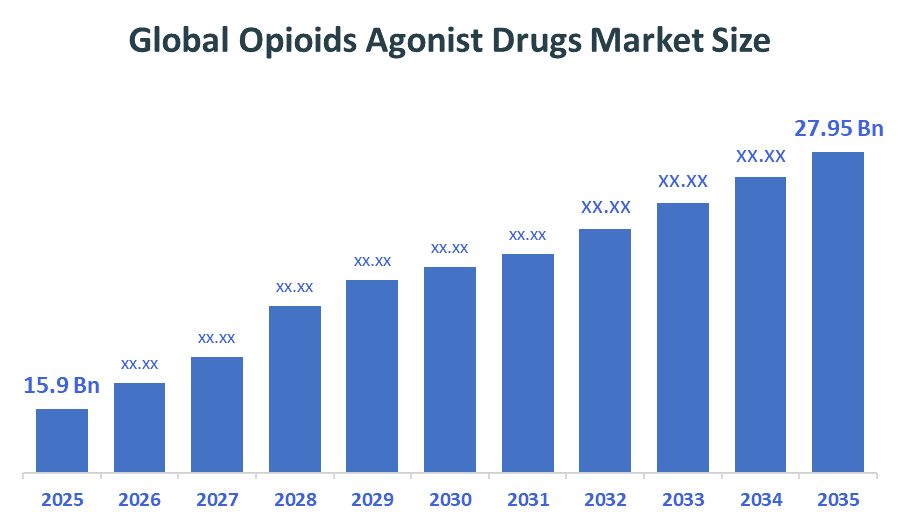
According to Decision Advisors, the Global Opioids Agonist Drugs Market Size is expected to grow from USD 15.9 billion in 2025 to USD 27.95 billion by 2035, at a CAGR of 5.8% during the forecast period 2026-2035. The global opioids agonist drugs market is projected to grow significantly over the next decade, driven by high prevalence of chronic pain, an aging geriatric population, rise in surgical procedures, growth of addiction treatment, advancements in drug formulations, and expansion in emerging markets.
Market Overview/ Introduction
The global opioid agonist market exists to provide primary services, which include chronic pain treatment and support for individuals who seek to overcome opioid addiction. The body receives relief from withdrawal symptoms and pain through medications, which include methadone and buprenorphine, because these drugs interact with the body's receptor system. The field experiences rapid growth because people throughout the world now face difficulties with both chronic pain and opioid use disorders. The industry responds to this requirement by developing new treatment methods, which include extended-release medications and digital treatment management systems. Governments allocate additional funding for addiction recovery programs while developing nations improve healthcare access, which enables people to obtain critical treatments that enhance their health outcomes.
- The World Health Organization is advancing global access to opioid agonist therapies through updated treatment frameworks. In February 2025, WHO initiated updates to its opioid dependence treatment guidelines, promoting wider use of opioid agonist maintenance treatment (OAMT) such as methadone and buprenorphine, alongside overdose prevention programs (naloxone distribution). This scheme aims to improve global access, reduce mortality, and strengthen evidence-based treatment systems.
- The Substance Abuse and Mental Health Services Administration implemented major reforms under the Federal Opioid Treatment Program (OTP) Guidelines Update. The final rule published in February 2024 (effective April 2024) modernizes opioid agonist treatment by expanding access to methadone and buprenorphine, making telehealth initiation and take-home dosing permanent, and improving patient-centered care delivery.
- Multiple high-income countries (e.g., UK, France, Australia) have implemented national opioid substitution therapy (OST) expansion programs, enabling primary care prescribing and pharmacy-based dispensing of buprenorphine and methadone. These schemes (ongoing, strengthened through 2024–2025 reforms) improve accessibility and retention in treatment, particularly in rural and underserved populations
Notable Insights: -
- North America is anticipated to hold the largest share of approximately 45% in the opioids agonist drugs market over the forecast period.
- Asia Pacific is expected to grow at a rapid CAGR of approximately 4% in the opioids agonist drugs market during the forecast period.
- The morphine segment dominated the market in 2025, approximately 35%, and is projected to grow at a substantial CAGR during the forecast period.
- The pain management segment dominated the market in 2025, approximately 45%, and is projected to grow at a substantial CAGR during the forecast period.
- The hospital pharmacies segment dominated the market in 2025, approximately 39%, and is projected to grow at a substantial CAGR during the forecast period.
- The compound annual growth rate of the Global Opioids agonist drugs market is 5.8%.
- The market is likely to achieve a valuation of USD 27.95 Billion by 2035.
What is role of technology in grooming the market?
Technology plays a crucial role in advancing the global opioid agonist drugs market by improving treatment delivery, monitoring, and patient outcomes. Digital health platforms and telemedicine enable remote consultations, e-prescriptions, and continuous care, expanding access to therapies like buprenorphine in underserved areas. Advanced drug delivery technologies, including long-acting injectables and implants, enhance adherence and reduce misuse risks. Data analytics and AI-driven tools help healthcare providers track patient progress, predict relapse risks, and personalize treatment plans. Additionally, electronic health records and mobile health apps improve coordination between providers and patients. Regulatory support from agencies such as the U.S. Food and Drug Administration is also accelerating the adoption of innovative solutions, ultimately driving efficiency, safety, and scalability across the market.
Market Drivers
The Global Opioids Agonist Drugs Market shows expansion because major factors combine with increasing global rates of chronic pain, orthopedic disease, and cancer-related pain conditions that require oxycodone and fentanyl as opioid pain treatments. The elderly population who suffers from chronic diseases will require continuous pain management because they experience both cardiovascular diseases and arthritis. The rise in post-surgical treatment demand has created a need for increased hospital use of both anesthetic and analgesic medications, which contain opioids. The rising issue of opioid addiction has created a higher need for treatment facilities that use methadone and buprenorphine to provide Medication-Assisted Treatment (MAT) for people with substance dependence. The market expands because of Abuse-Deterrent Formulations (ADF). Palliative care services and healthcare infrastructure development have led to increased opioid consumption in developing regions.
Restrain
The global opioid agonist drugs market faces restraints due to strict regulations enforced by bodies like the U.S. Food and Drug Administration and stigma around addiction treatment. Limited access in developing regions, risk of misuse, high treatment costs, and supply chain restrictions for drugs like methadone further hinder market growth.
Competitive Analysis:
The report offers the appropriate analysis of the key organizations/companies involved within the global opioids agonist drugs market, along with a comparative evaluation primarily based on their product offerings, business overviews, geographic presence, enterprise strategies, segment market share, and SWOT analysis. The report also provides an elaborative analysis focusing on the current news and developments of the companies, which includes product development, innovations, joint ventures, partnerships, mergers & acquisitions, strategic alliances, and others. This allows for the evaluation of the overall competition within the market.
Top Companies in Global Opioids Agonist Drugs Market
- Indivior PLC
- Alkermes plc
- Orexo AB
- Titan Pharmaceuticals Inc.
- Mallinckrodt Pharmaceuticals
- Viatris Inc.
- Hikma Pharmaceuticals PLC
- Camurus AB
- Teva Pharmaceutical Industries Ltd.
- Pfizer Inc.
- Johnson & Johnson
- Endo International plc
Government Initiatives
|
Country |
Key Government Initiatives |
|
US |
The U.S. Food and Drug Administration and federal government have expanded access to opioid agonist treatments through regulatory reforms. In February 2024, the government made permanent pandemic-era policies allowing telehealth initiation of buprenorphine and take-home methadone doses, improving access to medication-assisted treatment (MAT). Additionally, legislation such as the Modernizing Opioid Treatment Access Act (March 2023) aims to expand methadone dispensing through pharmacies, enhancing treatment reach and flexibility. |
|
Europe |
The European Union Drugs Agency and regional governments continue to strengthen opioid agonist treatment (OAT) programs. According to the European Drug Report (June 2025), over half of high-risk opioid users receive OAT, with ongoing initiatives promoting expanded access, harm reduction strategies, and long-acting formulations (e.g., buprenorphine injections). Policies also integrate OAT into public health systems and infectious disease prevention programs. |
|
India |
The Ministry of Social Justice and Empowerment and National AIDS Control Organization are actively expanding opioid substitution therapy (OST). Under the National Action Plan for Drug Demand Reduction (2018–2025) and Nasha Mukt Bharat Abhiyan (ongoing), the government promotes treatment, rehabilitation, and awareness programs, along with scaling opioid substitution therapy (methadone, buprenorphine) nationwide. The National Strategic Plan for HIV/AIDS (2017–2024) also emphasizes expanding OST and needle exchange programs to reduce harm. |
Study on the Supply, Demand, Distribution, and Market Environment of the Opioids Agonist Drugs Market
The global opioid agonist drugs market is shaped by a complex interplay of supply, demand, distribution, and regulatory environment. Supply is largely dependent on active pharmaceutical ingredients (APIs) derived from opiate raw materials such as morphine and the baine, as well as synthetic chemical precursors, with global availability generally sufficient to meet medical demand. However, manufacturing bottlenecks and raw material shortages can disrupt production of drugs like buprenorphine. Demand is rising due to increasing opioid dependence treatment needs, yet access remains limited, with many patients not receiving therapy. Distribution challenges, including limited pharmacy stocking and regulatory restrictions, further constrain availability. The market environment is highly regulated to prevent misuse, requiring strict quality control and monitoring, which ensures drug safety but can slow supply chain efficiency and market expansion.
Price Analysis and Consumer Behaviour Analysis
Price analysis in the global opioid agonist drugs market reflects a combination of medication costs, service fees, and broader healthcare expenses. Treatments such as methadone and buprenorphine are generally cost-effective, yet patients often bear additional costs like dosing, monitoring, and transportation, which can significantly impact affordability and treatment adherence. Consumer behavior is highly influenced by price sensitivity, accessibility, and social factors, with many patients discontinuing therapy due to financial constraints. Studies indicate that a notable proportion of patients face difficulty paying for treatment, directly affecting retention rates. Additionally, behavioral economics shows that demand for opioid treatment varies with income levels and availability of alternatives, while stigma, awareness, and perceived effectiveness also shape patient preferences and long-term engagement in therapy.
Market Segmentation
The Opioids Agonist Drugs Market share is classified into product type, application, and distribution channel
- The morphine segment dominated the market in 2025, approximately 35%, and is projected to grow at a substantial CAGR during the forecast period.
Based on the product type, the opioids agonist drugs market is divided into methadone, buprenorphine, naltrexone, morphine and oxycodone. Among these, the morphine segment dominated the market in 2025, approximately 35%, and is projected to grow at a substantial CAGR during the forecast period. The morphine segment dominated due to its widespread clinical use, strong efficacy in pain management, and established role as a primary opioid agonist. Its cost-effectiveness, global availability, and inclusion in essential medicines lists further support high demand, while increasing medical needs contribute to sustained growth.
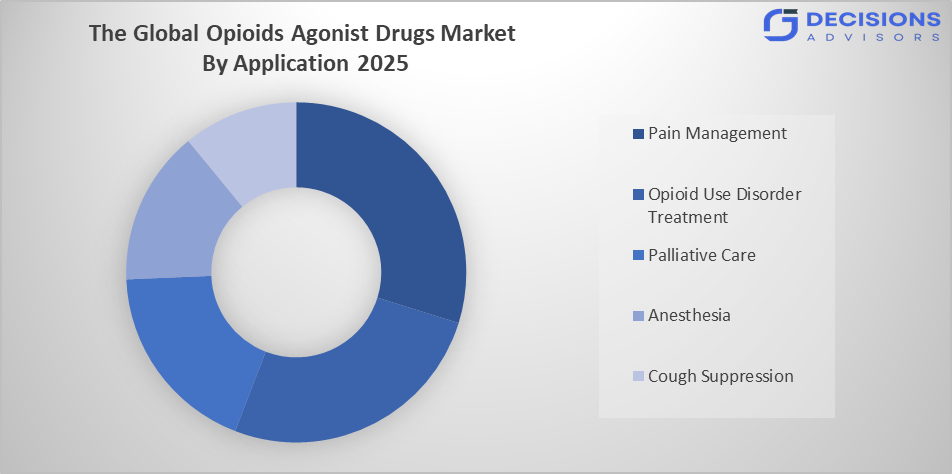
- The pain management segment dominated the market in 2025, approximately 45%, and is projected to grow at a substantial CAGR during the forecast period.
Based on the application, the opioids agonist drugs market is divided into pain management, opioid use disorder treatment, palliative care, anesthesia and cough suppression. Among these, the pain management segment dominated the market in 2025, approximately 45%, and is projected to grow at a substantial CAGR during the forecast period. The growth of the pain management segment is growing due to the high prevalence of chronic and acute pain conditions, including cancer and post-surgical cases. Opioid agonists like morphine and methadone are widely prescribed due to their strong analgesic efficacy, supporting continued demand and growth.
- The hospital pharmacies segment dominated the market in 2025, approximately 39%, and is projected to grow at a substantial CAGR during the forecast period.
Based on the distribution channel, the opioids agonist drugs market is divided into hospital pharmacies, retail pharmacies, online pharmacies, drug stores and clinics. Among these, the hospital pharmacies segment dominated the market in 2025, approximately 39%, and is projected to grow at a substantial CAGR during the forecast period. The growth of the hospital pharmacies segment is growing due to the high volume of inpatient treatments, surgical procedures, and emergency care requiring controlled opioid administration. Hospitals ensure strict regulatory compliance and safe dispensing of drugs like methadone, supporting reliability, patient monitoring, and sustained demand growth.
Strategies to Implement for Growth of the Market in Non-Leading Regions
To drive growth of the global opioid agonist drugs market in non-leading regions, stakeholders should focus on expanding access, awareness, and infrastructure. Governments and health bodies can collaborate with organizations like the World Health Organization to implement supportive policies and integrate addiction treatment into primary healthcare systems. Increasing availability of cost-effective therapies such as methadone and buprenorphine through public health programs is essential. Additionally, investment in telemedicine and mobile clinics can improve reach in rural areas. Training healthcare professionals and reducing social stigma through awareness campaigns will enhance adoption. Partnerships with global agencies, local governments, and pharmaceutical companies can strengthen supply chains, ensure regulatory alignment, and promote sustainable market expansion in emerging and underserved regions.
Regional Segment Analysis of the Opioids Agonist Drugs Market
- North America (U.S., Canada, Mexico)
- Europe (Germany, France, U.K., Italy, Spain, Rest of Europe)
- Asia-Pacific (China, Japan, India, Rest of APAC)
- South America (Brazil and the Rest of South America)
- The Middle East and Africa (UAE, South Africa, Rest of MEA)
North America is anticipated to hold the largest share of approximately 45% the opioids agonist drugs market over the forecast period.
North America is anticipated to hold the largest share of approximately 45% the opioids agonist drugs market over the forecast period. The dominance of this region is primarily driven by the high prevalence of chronic and acute pain conditions, including cancer and post-surgical cases. Opioid agonists like morphine and methadone are widely prescribed due to their strong analgesic efficacy, supporting continued demand and growth.
Asia Pacific is expected to grow at a rapid CAGR of approximately 4% in the opioids agonist drugs market during the forecast period.
Asia Pacific is expected to grow at a rapid CAGR of approximately 4% in the opioids agonist drugs market during the forecast period. This growth is driven by rising awareness of addiction treatment, improving healthcare infrastructure, and increasing government initiatives across countries like India and China. Expanding access to therapies such as methadone further supports regional market expansion.
Europe is the 3rd largest region to grow in the opioids agonist drugs market during the period.
Europe holds the position of the third-largest region in the global opioid agonist drugs market due to well-established healthcare systems and increasing focus on addiction treatment programs. Countries like Germany and United Kingdom support market growth through government initiatives and widespread adoption of therapies such as buprenorphine.
Future Market Trends in Global Opioids Agonist Drugs Market: -
1. Expansion of Medication-Assisted Treatment (MAT) Programs
A major future trend in the global opioid agonist drugs market is the rapid expansion of medication-assisted treatment (MAT), which combines drugs like methadone and buprenorphine with behavioural therapy. Governments and healthcare providers are increasingly adopting MAT as the gold standard for opioid dependence due to its proven ability to reduce relapse rates and improve outcomes. Rising opioid addiction cases and policy support are driving broader implementation globally.
2. Shift Toward Long-Acting and Innovative Drug Delivery Systems
The market is witnessing a strong shift toward long-acting formulations such as injectables, implants, and depot therapies. These advanced delivery systems enhance patient adherence, reduce misuse risks, and provide sustained drug release over time. Pharmaceutical companies are investing heavily in R&D to develop such innovations, as they improve treatment convenience and effectiveness. This trend is expected to dominate future market growth and differentiation.
3. Integration of Telemedicine and Digital Addiction Care
The integration of telemedicine and digital health platforms is transforming opioid agonist treatment delivery. Virtual consultations, remote prescribing, and digital adherence monitoring are improving access, especially in rural and underserved regions. This trend reduces stigma and logistical barriers while enabling continuous patient support. Increasing adoption of telehealth-enabled care models is expected to significantly expand market reach and patient engagement worldwide.
Recent Development
- In May 2025, peripherally acting μ-opioid receptor antagonists such as naldemedine are designed to reduce gastrointestinal side effects of opioid agonists without affecting analgesia. China’s NMPA accepted the NDA for naldemedine, highlighting growing regulatory support for OIC therapies that improve opioid treatment tolerability.
- In May 2025, Approved by the US FDA as an extended-release subcutaneous injection for moderate to severe opioid use disorder, offering both weekly and monthly dosing options; commercially launched in September 2023, enhancing long-acting treatment options in the opioid agonist drugs market.
- In January 2025, The US FDA approved Vertex Pharmaceuticals’ first-in-class non-opioid analgesic for moderate-to-severe acute pain, acting via selective NaV1.8 sodium channel inhibition; while not an opioid agonist, it serves as a key alternative therapy that may reduce reliance on opioid analgesics.
- In August 2020, Pharmaceutical companies are exploring novel synthetic opioid agonists, such as biased μ-opioid receptor agonists, designed to provide effective pain relief with reduced adverse effects. For instance, oliceridine was approved by the US FDA, demonstrating a mechanism that may lower certain side effects, although abuse potential remains comparable to conventional opioids.
How is Recent Developments Helping the Market?
Recent developments are significantly strengthening the growth of the global opioids agonist drugs market by improving treatment accessibility, safety, and effectiveness. Regulatory support from organizations like the World Health Organization and initiatives by the U.S. Food and Drug Administration have accelerated approvals of safer formulations such as extended-release buprenorphine and combination therapies. Technological advancements, including digital health monitoring and telemedicine, enable better patient adherence and remote treatment management. Additionally, increasing public health programs targeting opioid dependence and overdose prevention are boosting demand. Pharmaceutical companies are investing in novel drug delivery systems, such as implants and depot injections, which reduce misuse risks. These innovations, along with rising awareness and reduced stigma around addiction treatment, are collectively enhancing treatment outcomes and expanding the global market reach.
Market Segment
This study forecasts revenue at global, regional, and country levels from 2020 to 2035. Decision Advisors has segmented the opioids agonist drugs market based on the below-mentioned segments:
Global Opioids Agonist Drugs Market, By Product Type
- Methadone
- Buprenorphine
- Naltrexone
- Morphine
- Oxycodone
Global Opioids Agonist Drugs Market, By Application
- Pain Management
- Opioid Use Disorder Treatment
- Palliative Care
- Anesthesia
- Cough Suppression
Global Opioids Agonist Drugs Market, By Distribution Channel
- Hospital Pharmacies
- Retail Pharmacies
- Online Pharmacies
- Drug Stores
- Clinics
Global Opioids Agonist Drugs Market, By Regional Analysis
- North America
- US
- Canada
- Mexico
- Europe
- Germany
- UK
- France
- Italy
- Spain
- Russia
- Rest of Europe
- Asia Pacific
- China
- Japan
- India
- South Korea
- Australia
- Rest of Asia Pacific
- South America
- Brazil
- Argentina
- Rest of South America
- Middle East & Africa
- UAE
- Saudi Arabia
- Qatar
- South Africa
- Rest of the Middle East & Africa
Frequently Asked Questions (FAQ)
Q How do regulatory classifications impact the availability of opioid agonist drugs globally?
A. Regulatory classifications significantly influence the availability and distribution of opioid agonist drugs. Agencies like the U.S. Food and Drug Administration and European Medicines Agency categorize these drugs as controlled substances, requiring strict prescribing, dispensing, and monitoring protocols. While these regulations ensure patient safety and prevent misuse, they can also limit accessibility, especially in low- and middle-income countries where regulatory frameworks may restrict supply chains and prescribing authority.
Q. What role do public-private partnerships play in expanding opioid agonist treatment access?
A. Public-private partnerships are crucial in improving access to opioid agonist therapies. Collaborations between governments, pharmaceutical companies, and organizations like the World Health Organization help scale up treatment programs, fund research, and improve drug affordability. These partnerships enable distribution of essential medicines such as methadone and buprenorphine in underserved regions while supporting training programs for healthcare providers and strengthening healthcare infrastructure.
Q. How is the rise of biosimilars and generics affecting the opioid agonist drugs market?
A The increasing availability of generic formulations of opioid agonists is making treatment more affordable and accessible. Generic versions of drugs like methadone and buprenorphine reduce treatment costs, particularly in developing regions. This trend encourages wider adoption of medication-assisted treatment (MAT) programs, improves patient adherence, and intensifies market competition, pushing companies to innovate with advanced formulations such as long-acting injectables.
Q. What are the key challenges in ensuring equitable access to opioid agonist therapies worldwide?
A. Ensuring equitable access remains a major challenge due to disparities in healthcare infrastructure, stigma associated with addiction, and uneven policy implementation. Many regions lack trained professionals and proper treatment facilities. Additionally, social stigma and legal barriers discourage patients from seeking treatment. Addressing these issues requires coordinated efforts in policy reform, education, and integration of addiction care into mainstream healthcare systems.
Check Licence
Choose the plan that fits you best: Single User, Multi-User, or Enterprise solutions tailored for your needs.
We Have You Covered
- 24/7 Analyst Support
- Clients Across the Globe
- Tailored Insights
- Technology Tracking
- Competitive Intelligence
- Custom Research
- Syndicated Market Studies
- Market Overview
- Market Segmentation
- Growth Drivers
- Market Opportunities
- Regulatory Insights
- Innovation & Sustainability
Report Details
| Scope | Global |
| Pages | 210 |
| Delivery | PDF & Excel via Email |
| Language | English |
| Release | Apr 2026 |
| Access | Download from this page |