
Global ORC Waste Heat to Power Market
 |
Author:
Somesh R
|
Pages:
245
|
Author:
Somesh R
|
Pages:
245
Global ORC Waste Heat to Power Market Size, Share, By Capacity (Up to 1 MW, 1?5 MW, Above 5 MW), By Model (Subcritical ORC, Supercritical ORC), By Application (Industrial Processes, Biomass & Waste-to-Energy, Geothermal Power Generation, Oil & Gas, and Others ) and By Region (North America, Europe, Asia-Pacific, Latin America, Middle East, and Africa), Analysis and Forecast 2026-2035
CAGR
10.88%
REVENUE 2025
USD Billion 4.7
FORECAST 2035
USD Billion 13.2
REPORT COVERAGE
Global
Market Snapshot
- Global ORC Waste Heat to Power Market Size (2025): USD 4.7 Billion
- Projected Global ORC Waste Heat to Power Market Size (2035): USD 13.2 Billion
- Global ORC Waste Heat to Power Compound Annual Growth Rate (CAGR): 10.88%
- Largest Regional Market: Asia Pacific
- Fastest Growing Region: Europe
- 3rd Largest Region: Middle East
- Base Year: 2025
- Historical Period: 2021–2024
- Forecast Period: 2026–2035
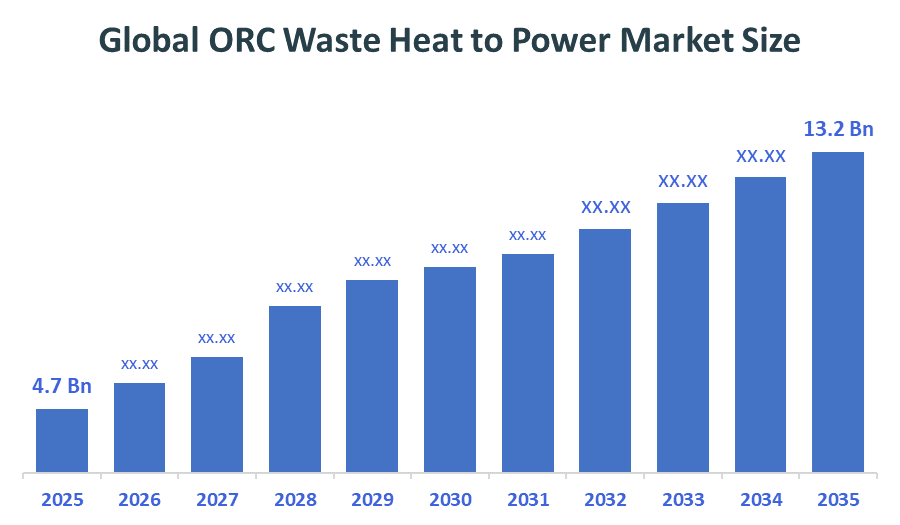
According to Decision Advisors, the Global ORC Waste Heat to Power Market Size is expected to grow from USD 4.7 Billion in 2025 to USD 13.2 Billion by 2035, at a CAGR of 10.88% during the forecast period 2026-2035. Global ORC Waste Heat to Power Market is projected to grow significantly over the next decade due to increasing demand for energy efficiency, rising industrialization, and strict environmental regulations aimed at reducing carbon emissions. Growing adoption of waste heat recovery systems across industries such as cement, steel, oil & gas, and chemicals is driving market expansion.
Market Overview/ Introduction
The ORC waste heat to power market refers to technologies that convert low- to medium-temperature waste heat from industrial processes into electricity using organic working fluids. The market experiences strong growth because industrial sectors demand better energy efficiency, environmental laws require lower carbon emissions, and industrial activities expand. The European, Chinese and Indian governments support clean energy together with energy conservation through their programs that assist businesses in implementing waste heat recovery technologies. Siemens Energy Ormat Technologies, and Turboden pursue business growth through their focus on technology development and strategic partnership establishment. The market provides benefits which include lower energy expenses, better operational productivity, and decreased harm to the environment. The ability to use energy that was previously lost results in increased productivity for the business. Future growth will result from businesses increasing their investments in sustainable energy solutions and infrastructure development and the worldwide market expansion of high-efficiency ORC systems.
Notable Insights: -
- Asia Pacific holds the largest regional market share approximately 39% in the global ORC Waste Heat to Power Market.
- Europe is the fastest-growing region in the global ORC Waste Heat to Power Market.
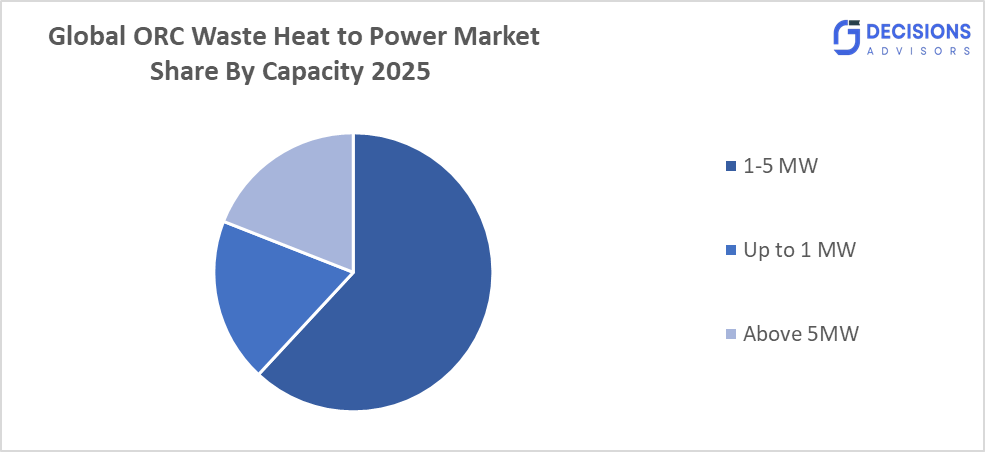
- By capacity, the 1-5 MW segment held a dominant position with approximately 61% in terms of market share in 2025.
- By model, the subcritical ORC segment is the dominating accounting for over 70% of the global market share in 2025.
- The compound annual growth rate of the global ORC Waste Heat to Power Market is 10.88%.
- The market is likely to achieve a valuation of USD 13.2 Billion by 2035.
What is the role of technology in grooming the market?
Technology serves as an essential component that enables the ORC waste heat to power market to achieve its growth through enhancements that boost system efficiency and operational flexibility, and system scalability. The combination of advanced turbine designs with high-performance organic fluids enables power generation from low-temperature heat sources to achieve maximum energy conversion. The use of automation together with digital monitoring systems allows for immediate performance improvements, which help to forecast maintenance needs while decreasing operational downtime and costs. The system achieves enhanced energy management through its integration with Internet of Things and smart grid technologies, which enable remote system control. The installation process of ORC units becomes easier because their modular and compact design enables use in multiple industrial sectors. The ongoing development of ORC systems results in more affordable and dependable technologies that can serve a wider variety of needs in industrial operations and renewable energy systems.
How are recent developments helping the market?
Technological advancements and project implementation work together to create strong support for the ORC waste heat to power market. The implementation of advanced modular ORC systems together with hybrid integration systems enables industries to achieve flexible installation and retrofitting capabilities. The development of multi-source heat recovery systems together with solar-assisted ORC technologies helps improve energy conversion efficiency while expanding their range of applications. New ORC installations can provide industrial facilities with electricity that matches up to 80% of their total grid electricity usage. The combination of R&D efforts with digital monitoring technologies leads to better system performance and reliability, which results in faster adoption across oil & gas manufacturing and power generation industries.
Market Drivers
Industrial energy usage increases, which creates demand for energy efficiency solutions across various industries, including cement, steel and oil and gas operations. The implementation of waste heat recovery technologies receives support from strict emission regulations and worldwide decarbonization goals, that require industries to adopt these technologies. Companies now generate electricity from their unused heat sources because they face increasing energy costs, which drive all their operational expenses. The clean energy transition is receiving faster progress because government policies and financial incentives support sustainable industrial practices and clean energy technologies. The global industrial sector expands its use of ORC systems because ongoing research improves system efficiency and reliability.
Restrain
High initial investment costs and complex system integration are key challenges limiting market adoption. ORC systems require specialized design and maintenance expertise, which increases operational complexity. Additionally, competition from alternative technologies such as steam Rankine cycles and Kalina cycles may restrict market penetration in certain applications.
Competitive Analysis:
The report offers the appropriate analysis of the key organizations/companies involved within the global ORC waste heat to power market, along with a comparative evaluation primarily based on their product offerings, business overviews, geographic presence, enterprise strategies, segment market share, and SWOT analysis. The report also provides an elaborate analysis focusing on the current news and developments of the companies, which includes product development, innovations, joint ventures, partnerships, mergers & acquisitions, strategic alliances, and others. This allows for the evaluation of the overall competition within the market.
Top Companies in Global ORC Waste Heat to Power Market
- Ormat Technologies
- Turboden S.p.A
- Alfa Laval
- Atlas Copco AB
- Exergy International
- General Electric
- Siemens Energy
- Mitsubishi Heavy Industries
- Orcan Energy AG
- Enogia SAS
- Calnetix Technologies
- Kaishan USA
- ABB Ltd.
Government Initiatives
|
Country |
Key Government Initiatives |
|
China |
China promotes waste-to-energy and waste heat recovery to reduce emissions, indirectly supporting the ORC waste heat to power market, though projects like Xi’an Gaoling are not exclusively based on ORC technology. |
Study on the Supply, Demand, Distribution, and Market Environment of the Global ORC Waste Heat to Power Market
The worldwide ORC waste heat to power market functions according to matching patterns between its supply and demand relationship and its distribution system and complete market system. The supply exists because technology providers deliver modular ORC systems, which provide scalable solutions that enhance system performance through better operational efficiency and higher equipment reliability. The energy-intensive industries, which include cement production, steel manufacturing and petrochemical operations, experience increased demand because of rising energy costs and their need to reduce emissions. The global distribution network operates through direct industrial partnerships together with EPC contractors and energy service companies. The market environment experiences disturbances from high capital expenses and competing technologies, while environmental regulations, clean energy initiatives and industrial decarbonisation objectives shape its development.
Price Analysis and Consumer Behaviour Analysis
The ORC waste heat to power market price analysis depends on three factors, which are system capacity, system customization and system technology complexity. The industrial sector requires substantial upfront expenditures, which restrict companies from implementing their major industrial projects. The system costs have decreased over time because of economies of scale and technological progress, which have made it more affordable. Consumers today prefer solutions that deliver both affordable initial costs and future financial benefits because ORC systems help lower their energy costs while boosting their operational performance. The industrial sector leads demand. It accounts for more than 60 % of all system installations, whereas emerging markets are adopting energy-efficient and sustainable practices because people now understand their importance.
Market Segmentation
The ORC Waste Heat to Power Market share is classified into capacity, model and application.
- The 1-5 MW segment dominated the market in 2025, and is projected to grow at a substantial CAGR of approximately 61% during the forecast period.
Based on the capacity, the ORC waste heat to power market is divided into up to 1 MW, 1–5 MW, and above 5 MW. Among these, the 1-5 MW segment dominated the market in 2025, and is projected to grow at a substantial CAGR of approximately 61% during the forecast period. It is due to its optimal cost-to-efficiency ratio, high adoption in industries like cement, chemicals, and steel, ease of integration, scalability, and supportive government policies.
- The subcritical ORC segment accounted for the largest share in 2025, and is anticipated to grow at a significant CAGR of approximately 70 % during the forecast period.
Based on the model, the ORC waste heat to power market is divided into subcritical ORC, supercritical ORC. Among these, the subcritical ORC segment accounted for the largest share in 2025, and is anticipated to grow at a significant CAGR of approximately 70 % during the forecast period. This dominance is driven due to its lower operating pressure, reduced capital and maintenance costs, and strong suitability for medium- to low-temperature waste heat sources. Its simpler design, proven reliability, and easier integration across industrial applications further drive widespread adoption compared to more complex supercritical systems.
- The industrial processes segment dominated the market in 2025, and is projected to grow at a substantial CAGR of approximately 58 % during the forecast period.
Based on the application, the ORC waste heat to power market is divided into industrial processes, biomass & waste-to-energy, geothermal power generation, oil & gas, and others. Among these, the industrial processes segment dominated the market in 2025, and is projected to grow at a substantial CAGR of approximately 58 % during the forecast period. This is due to the high availability of continuous waste heat from industries like cement, steel, and chemicals. These sectors benefit from significant energy cost savings, improved efficiency, and easy integration of ORC systems into existing operations, driving widespread adoption and higher market share.
Strategies to Implement for Growth of the Market in Non-Leading Regions
Cost optimization and localization and strategic partnerships will drive economic development in non-leading regions. Companies should develop smaller, modular ORC systems to suit budget constraints and varying industrial needs. Project execution will benefit from partnerships with local EPC contractors and energy service providers because they will enhance market accessibility. Government agencies need to participate in waste heat recovery programs because they provide financial incentives and help people understand waste heat recovery advantages. Training programs together with technical support will help organizations solve their skill shortages while implementing new technologies. The organization can speed up market entry by targeting fast-growing sectors which include cement and steel and biomass energy and by using leasing and energy-as-a-service financing models.
Regional Segment Analysis of the ORC Waste Heat to Power Market
- North America (U.S., Canada, Mexico)
- Europe (Germany, France, U.K., Italy, Spain, Rest of Europe)
- Asia-Pacific (China, Japan, India, Rest of APAC)
- South America (Brazil and the Rest of South America)
- The Middle East and Africa (UAE, South Africa, Rest of MEA)
Asia Pacific is anticipated to hold the largest share of the ORC Waste Heat to Power Market over the predicted timeframe.
Asia Pacific is anticipated to hold the largest share of the ORC Waste Heat to Power Market over the predicted timeframe, accounting for approximately 39% of the global market. The region’s dominance is driven by rapid industrialization, expanding manufacturing sectors, and rising energy demand across countries such as China, India, and Japan. Strong government support for energy efficiency and waste heat recovery projects further accelerates adoption. China leads the region, contributing over 45% of regional revenue due to large-scale industrial deployment. Additionally, increasing investments in sustainable energy infrastructure and cost optimization initiatives continue to strengthen market growth across Asia Pacific.
Europe is expected to grow at a rapid CAGR in the ORC Waste Heat to Power Market during the forecast period.
Europe is expected to grow at a rapid CAGR of approximately 13% in the ORC Waste Heat to Power Market during the forecast period. This growth is driven by stringent carbon reduction targets, strong regulatory frameworks, and increasing investments in industrial energy efficiency. Countries such as Germany, Italy, and France are leading adoption due to well-established manufacturing sectors and supportive government policies. Additionally, the region’s focus on renewable energy integration and waste heat recovery technologies is accelerating deployment. Continuous technological advancements and funding for sustainable infrastructure further support steady market expansion across Europe.
Middle East is the 3rd largest region to grow in the ORC Waste Heat to Power Market during the region.
Middle East is the third-largest region in the ORC Waste Heat to Power Market. Growth in the region is driven by increasing industrial activities, particularly in oil & gas and petrochemicals, where waste heat recovery is highly applicable. Countries such as Saudi Arabia and the UAE are investing in energy efficiency and sustainable technologies to reduce carbon emissions. Additionally, government initiatives supporting industrial diversification and clean energy adoption are further contributing to the steady expansion of the ORC waste heat to power market across the Middle East.
Future Market Trends in Global ORC Waste Heat to Power Market: -
1.Integration with Renewable Energy Systems
ORC systems are increasingly integrated with renewable sources such as geothermal, biomass, and solar thermal to create hybrid energy solutions. This trend enhances energy reliability and supports decarbonisation goals, making ORC a key component in sustainable and distributed power generation systems.
2. Advancements in Working Fluids and System Efficiency
Continuous innovation in organic fluids, supercritical CO2 cycles, and high-efficiency turbines is improving thermal performance and expanding applicability to low-temperature heat sources. These advancements are reducing operational costs and increasing system efficiency across industries.
3. Growth of Modular and Scalable ORC Systems
Manufacturers are developing compact, modular ORC units that enable flexible installation and scalability. These systems are particularly suitable for small and medium industries, remote locations, and distributed energy systems, increasing overall market penetration.
4. Adoption of Digital Monitoring and Predictive Maintenance
Integration of IoT, automation, and predictive maintenance tools is improving system reliability, reducing downtime, and optimizing performance. Digitalization is becoming a key trend in enhancing lifecycle efficiency and operational control.
Recent Development
- In August 2025, Exergy launched the X-Heat series, integrating industrial heat pumps with ORC technology for large-scale waste heat recovery, highlighting innovation and expanding applications in the ORC waste heat to power market.
- In March 2023, new digital twin platforms enabled real-time monitoring and predictive maintenance for ORC systems, improving operational efficiency, reducing downtime, and increasing ROI in waste heat to power applications.
- In March 2023, Durr Group launched the Cyplan ORC?70?NT, a modular unit generating electricity from heat sources as low as 85?°C, highlighting innovation and expanding applications in the ORC waste heat to power market.
Market Segment
This study forecasts revenue at global, regional, and country levels from 2020 to 2035. Decision Advisors has segmented the ORC Waste Heat to Power Market based on the below-mentioned segments:
Global ORC Waste Heat to Power Market, By Capacity
- Up to 1 MW
- 1–5 MW
- Above 5 MW
Global ORC Waste Heat to Power Market, By Model
- Subcritical ORC
- Supercritical ORC
Global ORC Waste Heat to Power Market, By Application
- Industrial Processes
- Biomass & Waste-to-Energy
- Geothermal Power Generation
- Oil & Gas
- Others
Global ORC Waste Heat to Power Market, By Regional Analysis
- North America
- US
- Canada
- Mexico
- Europe
- Germany
- UK
- France
- Italy
- Spain
- Russia
- Rest of Europe
- Asia Pacific
- China
- Japan
- India
- South Korea
- Australia
- Rest of Asia Pacific
- South America
- Brazil
- Argentina
- Rest of South America
- Middle East & Africa
- UAE
- Saudi Arabia
- Qatar
- South Africa
- Rest of the Middle East & Africa
Frequently Asked Questions (FAQ)
Q. How does ORC technology compare with traditional steam Rankine cycles?
A. ORC systems operate efficiently at lower temperatures and pressures compared to steam Rankine cycles, making them more suitable for recovering low-grade waste heat and reducing operational complexity in industrial applications.
Q. What is the typical payback period for ORC installations?
A. The payback period generally ranges between 3 to 7 years, depending on system size, heat source availability, energy costs, and operational efficiency improvements.
Q. Can ORC systems operate with variable heat sources?
A. Yes, modern ORC systems are designed to handle fluctuations in heat input, maintaining stable performance through advanced control systems and flexible operating conditions.
Q. What role does ORC play in carbon reduction strategies?
A. ORC systems reduce carbon emissions by converting waste heat into usable electricity, lowering fuel consumption and improving overall energy efficiency in industrial operations.
Check Licence
Choose the plan that fits you best: Single User, Multi-User, or Enterprise solutions tailored for your needs.
We Have You Covered
- 24/7 Analyst Support
- Clients Across the Globe
- Tailored Insights
- Technology Tracking
- Competitive Intelligence
- Custom Research
- Syndicated Market Studies
- Market Overview
- Market Segmentation
- Growth Drivers
- Market Opportunities
- Regulatory Insights
- Innovation & Sustainability
Report Details
| Scope | Global |
| Pages | 245 |
| Delivery | PDF & Excel via Email |
| Language | English |
| Release | Apr 2026 |
| Access | Download from this page |