
Global Osteoarthritis Therapeutics Market
 |
Author:
David J
|
Pages:
249
|
Author:
David J
|
Pages:
249
Global Osteoarthritis Therapeutics Market Size, Share, and COVID-19 Impact Analysis, By Anatomy Type (Knee, Hip, Hand, Spine, and Others), By Drug Type (Nonsteroidal Anti-Inflammatory Drugs, Analgesics, Corticosteroids, and Others), By Route of Administration (Parenteral, Topical, and Oral), and By Region (North America, Europe, Asia-Pacific, Latin America, Middle East, and Africa), Analysis and Forecast 2025 - 2035
CAGR
7.27%
REVENUE 2024
USD Billion 8.66
FORECAST 2035
USD Billion 18.75
REPORT COVERAGE
Global
Global Osteoarthritis Therapeutics Market Size Insights Forecasts to 2035
- The Global Osteoarthritis Therapeutics Market Size Was Estimated at USD 8.66 Billion in 2024
- The Market Size is Expected to Grow at a CAGR of around 7.27% from 2025 to 2035
- The Worldwide Osteoarthritis Therapeutics Market Size is Expected to Reach USD 18.75 Billion by 2035
- Europe is expected to Grow the fastest during the forecast period.
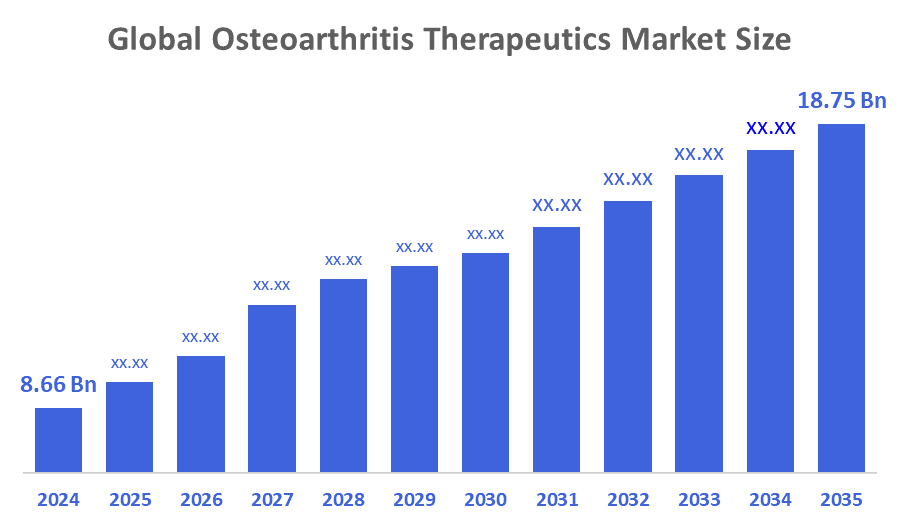
According to a Research Report Published by Decisions Advisors and Consulting, The Global Osteoarthritis Therapeutics Market Size was worth around USD 8.66 Billion in 2024 and is predicted to Grow to around USD 18.75 Billion by 2035 with a compound annual growth rate (CAGR) of 7.27 % from 2025 to 2035. The market for osteoarthritis treatments is growing rapidly because of the rising incidence of this condition and the serious effect on the quality of life for people with OA. The overall burden of osteoarthritis (OA) on the global population is increasing primarily as a result of the increased number of older consumers suffering from OA and their associated disability. According to the World Health Organisation (WHO), OA is one of the leading causes of disability for older adults, with a serious effect on their ability to move.
Market Overview
The osteoarthritis therapeutics market refers to the global industry focused on the development, commercialisation, and distribution of drugs, biologics, and advanced therapies that aim to manage symptoms or modify the progression of osteoarthritis, the most common degenerative joint disease. It includes traditional pain-relief medications, intra-articular injections, regenerative therapies, and emerging disease-modifying treatments. Degenerative Joint Disease (DJD) is a term used to describe several conditions that involve the progressive degeneration of cartilage in joints of the knees, hips, hands, feet, spine, shoulders, and neck. Symptoms associated with DJD include stiffness, swelling, tenderness, chronic pain, reduced range of motion, crepitus (grating sensation), bone spurs, and disrupted sleep patterns.
Under the NITRO program, ARPA-H awarded up to $33 million to a Duke-led consortium that included UCLA and Boston Children's for injectable/implantable OA therapeutics; UCLA's portion is up to $12.3 million, with the goal of FDA Phase 1 trials by 2027–2029.
€7.6 million ($8.2 million) was obtained by 4Moving Biotech. 4P004, a first-in-class disease-modifying OA medication (DMOAD) in Phase 2a for knee OA, will be advanced with a France 2030 award in April 2025.
Report Coverage
This research report categorises the osteoarthritis therapeutics market based on various segments and regions, forecasts revenue growth, and analyzes trends in each submarket. The report analyses the key growth drivers, opportunities, and challenges influencing the osteoarthritis therapeutics market. Recent market developments and competitive strategies, such as expansion, product launch, development, partnership, merger, and acquisition, have been included to draw the competitive landscape in the market. The report strategically identifies and profiles the key market players and analyzes their core competencies in each sub-segment of the osteoarthritis therapeutics market.
Driving Factors
With an increase in sedentary lifestyles, the prevalence of obesity and elevated blood glucose levels and poor dietary habits, and this increase in the prevalence of these types of conditions in combination with an ageing population has created an increase in the levels of risk for OA. One of the primary drivers propelling the OA therapeutics market is the increase in the number of patients who are becoming OA due to a variety of reasons. Another growing driver of the OA therapeutics market is the increase in MRI availability. Developing imaging-based biomarkers and developing new analgesic medications will also introduce new growth to the OA therapeutics market. Further aiding in the growth of the OA therapeutics market are increasing amounts spent on R&D and healthcare infrastructure improvements.
In September 2021, Novartis received FDA Fast Track designation for LNA043, a potential first-in-class therapy for osteoarthritis of the knee, aimed at regenerating damaged cartilage and slowing disease progression.
Restraining Factors
The absence of curative or disease-modifying medicines, with the majority of available alternatives concentrating on symptom management rather than stopping joint deterioration, is a significant obstacle in the osteoarthritis therapeutics market. Although biologics and stem cell treatments have potential, their accessibility is hampered by their high costs, drawn-out trials, and complicated restrictions. Furthermore, the exorbitant cost of cutting-edge treatments like biologics, PRP injections, and personalised implants continues to be unaffordable, particularly in areas with little healthcare reimbursement.
Market Segmentation
The osteoarthritis therapeutics market share is classified into anatomical type, drug type, and route of administration.
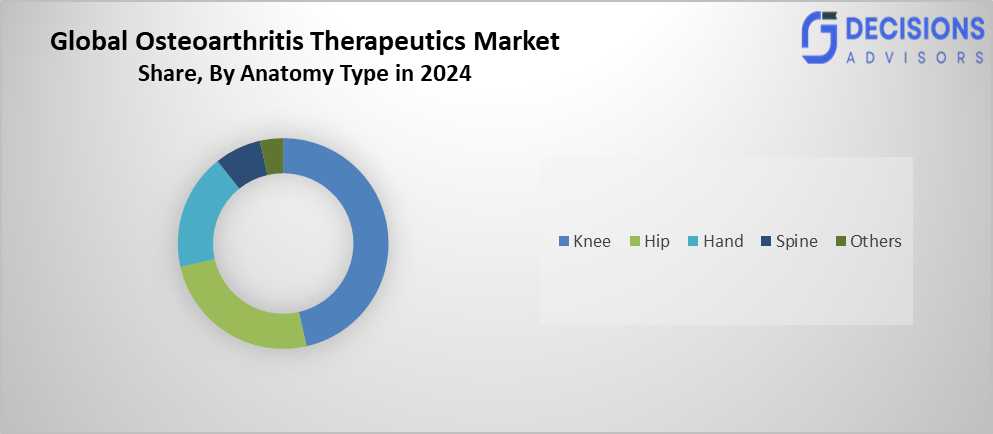
- The knee segment accounted for the largest market share in 2024 and is projected to grow at a substantial CAGR over the forecast period.
Based on the anatomy type, the osteoarthritis therapeutics market is segmented into knee, hip, hand, spine, and others. Among these, the knee segment accounted for the largest market share in 2024 and is projected to grow at a substantial CAGR over the forecast period. This is because there are a variety of treatment options available for knee osteoarthritis (OA). These options range from conservative methods, including physical therapy, to more invasive options like knee replacement surgery. The increasing demand for minimally invasive methods has resulted in the development of new treatment modalities, including injections of hyaluronic acid, platelet-rich plasma (PRP) therapy and genicular artery embolisation (GAE), that provide patients with effective relief of symptoms with minimal recovery time. In addition, advancements in wearable medical devices and digital health records are contributing to improved compliance among patients.
- The nonsteroidal anti-inflammatory drugs segment accounted for the largest share in 2024 and is anticipated to grow at a rapid pace during the forecast period.
Based on the drug type, the osteoarthritis therapeutics market is classified into nonsteroidal anti-inflammatory drugs, analgesics, corticosteroids, and others. Among these, the nonsteroidal anti-inflammatory drugs segment accounted for the largest share in 2024 and is anticipated to grow at a rapid pace during the forecast period. This is due to the growing demand for painkillers and their extensive over-the-counter availability. They are a popular option in both developed and developing countries due to their cost and efficacy for mild to severe symptoms.
- The oral segment accounted for the highest revenue share in 2024 and is projected to grow at a significant CAGR during the forecast period.
Based on the route of administration, the osteoarthritis therapeutics market is divided into parenteral, topical, and oral. Among these, the oral segment accounted for the highest revenue share in 2024 and is projected to grow at a significant CAGR during the forecast period. This is due to the high patient compliance and ease of tablets and capsules, that contributes to the oral route segment for the biggest market revenue share. Moreover, the first-line therapy, oral NSAIDs and analgesics are frequently recommended.
Regional Segment Analysis of the Osteoarthritis Therapeutics Market
- North America (U.S., Canada, Mexico)
- Europe (Germany, France, U.K., Italy, Spain, Rest of Europe)
- Asia-Pacific (China, Japan, India, Rest of APAC)
- South America (Brazil and the Rest of South America)
- The Middle East and Africa (UAE, South Africa, Rest of MEA)
Asia Pacific is anticipated to hold the largest share of the osteoarthritis therapeutics market over the predicted timeframe.
Asia Pacific is anticipated to hold the largest share of the osteoarthritis therapeutics market over the predicted timeframe. The Asia-Pacific region is also contributing to the growth of the world market, as it has the highest growth rate. This growth is due to the massive number of patients in that region, the supportive regulatory environment in China, and the increasing costs of healthcare. China has a unique combination of an established dual healthcare system combining Western medicine with traditional Chinese medicine to address symptoms and unmet needs in patients suffering from osteoarthritis and other chronic pain conditions. With the advancements in research on cartilage repair materials, the market will continue to broaden its reach with innovative therapies such as regenerative medicine and biologics.
Europe is projected to grow at a rapid CAGR in the osteoarthritis therapeutics market during the forecast period. One of the primary reasons for the high prevalence rate of the osteoarthritis treatment market in Europe is that Rheumatoid Arthritis also continues to rise in prevalence, along with the rapidly expanding elderly population, accompanied with the growing number of people who have become overweight or obese throughout many European countries and are now suffering with osteoarthritis due to: increased incidence of sports-related injuries/accidents which has created an opportunity for existing and newly established companies to grow by providing solutions for these patients through innovative research. The regional market growth of biologic products and the increasing number of approvals for drugs to treat osteoarthritis in patients.
In Germany, the osteoarthritis therapeutics market trend is driven by a rapidly ageing population, which results in significant demand for effective treatment options. Biologics and personalised medicine continue to gain traction and utilisation, as their approach focuses on treating the underlying causes of diseases rather than just the symptoms.
Competitive Analysis:
The report offers the appropriate analysis of the key organizations/companies involved within the osteoarthritis therapeutics market, along with a comparative evaluation primarily based on their product offering, business overviews, geographic presence, enterprise strategies, segment market share, and SWOT analysis. The report also provides an elaborative analysis focusing on the current news and developments of the companies, which includes product development, innovations, joint ventures, partnerships, mergers & acquisitions, strategic alliances, and others. This allows for the evaluation of the overall competition within the market.
List of Key Companies
- Abbott Laboratories
- Anika Therapeutics Inc.
- Bayer Aktiengesellschaft
- Eli Lilly and Company
- Flexion Therapeutics Inc.
- GlaxoSmithKline Plc
- Horizon Therapeutics Plc
- Johnson & Johnson Inc.
- Pfizer Inc.
- Sanofi S.A
- Others
Key Target Audience
- Market Players
- Investors
- End-users
- Government Authorities
- Consulting and Research Firm
- Venture capitalists
- Value-Added Resellers (VARs)
Recent Development
- In January 2026, Biosplice Therapeutics submitted a New Drug Application (NDA) to the U.S. FDA for lorecivivint (LOR), a first-in-class small-molecule therapy designed to slow the progression of knee osteoarthritis rather than just treating symptoms. One or two injections of Lorecivivint are administered directly into the knee joint each year. It differs from short-term steroid shots or daily pills just based on that information.
- In December 2025, Cipla partnered with Stempeutics Research to launch Ciplostem, India’s first DCGI-approved stem cell therapy for Grade II and III knee osteoarthritis. This marks Cipla’s entry into orthobiologic medicine, offering a disease-modifying option beyond traditional pain relief treatments.
- In July 2025, Johnson & Johnson MedTech entered into a strategic co-promotion agreement with Pacira BioSciences to expand early intervention options for knee osteoarthritis, focusing on wider access to Pacira’s ZILRETTA (triamcinolone acetonide extended-release injectable suspension). The collaboration aims to enhance patient outcomes by promoting non-opioid, non-surgical treatments for one of the most common musculoskeletal conditions in the U.S.
Market Segment
This study forecasts revenue at global, regional, and country levels from 2020 to 2035. Decisions Advisors has segmented the osteoarthritis therapeutics market based on the below-mentioned segments:
Global Osteoarthritis Therapeutics Market, By Anatomy Type
- Knee
- Hip
- Hand
- Spine
- Others
Global Osteoarthritis Therapeutics Market, By Drug Type
- Nonsteroidal Anti-Inflammatory Drugs
- Analgesics
- Corticosteroids
- Others
Global Osteoarthritis Therapeutics Market, By Application
- Parenteral
- Topical
- Oral
Global Osteoarthritis Therapeutics Market, By Regional Analysis
- North America
- US
- Canada
- Mexico
- Europe
- Germany
- UK
- France
- Italy
- Spain
- Russia
- Rest of Europe
- Asia Pacific
- China
- Japan
- India
- South Korea
- Australia
- Rest of Asia Pacific
- South America
- Brazil
- Argentina
- Rest of South America
- Middle East & Africa
- UAE
- Saudi Arabia
- Qatar
- South Africa
- Rest of the Middle East & Africa
Frequently Asked Questions (FAQ)
1. What is the current size and projected growth of the Global Osteoarthritis Therapeutics Market?
The market was valued at USD 8.66 billion in 2024 and is expected to reach USD 18.75 billion by 2035, growing at a CAGR of 7.27% from 2025 to 2035. This expansion is driven by rising OA prevalence due to ageing populations and lifestyle factors.
2. What are the main market segments by anatomy type, drug type, and route of administration?
- Anatomy Type: Knee (largest share in 2024), Hip, Hand, Spine, Others.
- Drug Type: Nonsteroidal Anti-Inflammatory Drugs (NSAIDs, largest share), Analgesics, Corticosteroids, Others.
- Route of Administration: Oral (highest revenue share), Parenteral, Topical.
3. Which region holds the largest market share, and which is expected to grow the fastest?
Asia-Pacific is anticipated to hold the largest share due to high patient numbers, supportive regulations in China, and healthcare advancements. Europe is projected to grow at the fastest CAGR, fueled by an ageing population, obesity, and biologic approvals.
4. What are the primary driving factors for market growth?
Key drivers include rising OA incidence from obesity, sedentary lifestyles, and ageing; increased MRI availability; R&D investments; and healthcare infrastructure improvements. Innovations like imaging biomarkers and new analgesics further boost growth.
5. What are the main restraining factors in the market?
Challenges include the lack of curative disease-modifying drugs (focus remains on symptom relief), high costs of biologics/stem cells, lengthy trials, and limited reimbursement in low-access regions.
6. Who are the key players in the Global Osteoarthritis Therapeutics Market?
Major companies include Abbott Laboratories, Anika Therapeutics Inc., Bayer Aktiengesellschaft, Eli Lilly and Company, Flexion Therapeutics Inc., GlaxoSmithKline Plc, Horizon Therapeutics Plc, Johnson & Johnson Inc., Pfizer Inc., and Sanofi S.A.
7. What are some recent developments in the market?
January 2026: Biosplice Therapeutics submitted an FDA NDA for lorecivivint (LOR), a disease-modifying injection for knee OA.
Check Licence
Choose the plan that fits you best: Single User, Multi-User, or Enterprise solutions tailored for your needs.
We Have You Covered
- 24/7 Analyst Support
- Clients Across the Globe
- Tailored Insights
- Technology Tracking
- Competitive Intelligence
- Custom Research
- Syndicated Market Studies
- Market Overview
- Market Segmentation
- Growth Drivers
- Market Opportunities
- Regulatory Insights
- Innovation & Sustainability
Report Details
| Scope | Global |
| Pages | 249 |
| Delivery | PDF & Excel via Email |
| Language | English |
| Release | Feb 2026 |
| Access | Download from this page |