
Global Outpatient Services Market
 |
Pages:
190
|
Pages:
190
Global Outpatient Services Market Size, Share, By Service Type (Primary Care Services, Diagnostic Services, Minor Surgical Procedures, Rehabilitation Services), By Facility Type (Clinics & Physician Offices, Hospital Outpatient Departments (OPDs), Ambulatory Surgical Centers (ASCs), Diagnostic Centers, Telemedicine Platforms), By Application (General Medicine, Cardiology, Orthopedics, Dermatology, Neurology, Gynecology), and By Region (North America, Europe, Asia-Pacific, Latin America, Middle East & Africa), Analysis and Forecast 2025?2035
REPORT COVERAGE
Global
Market Snapshot
- Market Size (2025): USD 590.4 Billion
- Projected Market Size (2035): USD 1120.5 Billion
- Compound Annual Growth Rate (CAGR): 6.62%
- Largest Regional Market: North America
- Fastest Growing Region: Asia-Pacific
- 3rd Largest Region: Europe
- Base Year: 2025
- Historical Period: 2021–2024
- Forecast Period: 2026–2035
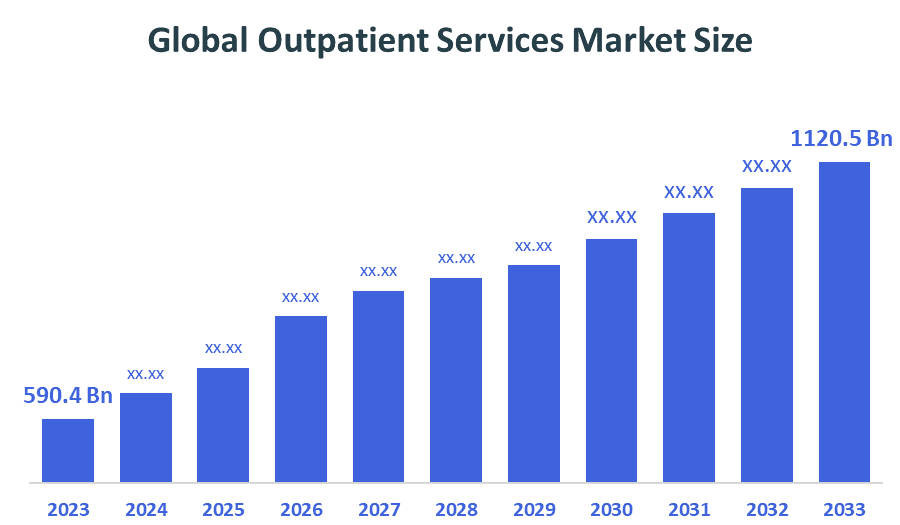
According to Decision Advisors, the Global Outpatient Services Market Size is expected to grow from USD 590.4 billion in 2024 to USD 1120.5 billion by 2035, at a CAGR of 6.62% during the forecast period 2025-2035. The global outpatient services market is projected to grow significantly over the next decade due to an aging population, rising chronic diseases, increased telehealth adoption, demand for preventive care, cost efficiency and reimbursement pressures, shift to preventive care, and consumer preference.
Market Overview/ Introduction
The outpatient services market refers to all healthcare facilities that provide medical treatment, diagnostic services and patient treatment, but do not require patients to stay overnight. The service package encompasses physician consultations, diagnostic testing, minor surgical procedures, and preventive care and rehabilitation services. Clinics, ambulatory surgical centers, and telemedicine platforms serve as the delivery platforms for these services. The market provides affordable healthcare options that deliver simple access to medical services because the demand for early diagnosis, chronic disease management, and medical technology progress continues to rise. The outpatient services market is growing because more patients prefer home and community-based treatment options instead of hospital-based care, which provides better patient comfort and reduces pressure on medical facilities. The increasing elderly population requires ongoing medical care that should be delivered outside hospital settings. Insurance companies promote outpatient medical services because they help reduce treatment expenses.
- India operates one of the world’s largest outpatient care networks through Ayushman Arogya Mandir (AAM), formerly Health and Wellness Centres. Over 1,84,235 centres provide 12 essential services, including maternal care, NCD screenings, and free drugs. By 2025, they conducted 39.5 crore hypertension and 36.7 crore diabetes screenings, strengthening outpatient access.
- Pradhan Mantri Bhartiya Janaushadhi Pariyojana aims to provide affordable generic medicines through over 18,646 Jan Aushadhi Kendras. It offers 2,110 medicines and 315 devices. Low-cost sanitary pads and major savings of ?8,000 crore in 2024–25—reduce healthcare expenses and improve access to essential treatments across India.
- In the United Kingdom, the National Health Service is implementing an Outpatient Transformation Programme to modernize care. It promotes virtual consultations and Patient-Initiated Follow-Up, reducing unnecessary visits. This improves efficiency, enhances patient control, and supports the growth of outpatient services, making it a positive market development.
Notable Insights: -
- North America holds the largest regional market share in the Global Outpatient Services Market.
- Asia-Pacific is the fastest-growing region in the Global Outpatient Services Market.
- The primary care services segment dominated the market in 2025 and is projected to grow at a substantial CAGR during the forecast period.
- The clinics & physician offices segment accounted for the largest share in 2025, and is anticipated to grow at a significant CAGR of during the forecast period
- The general medicine segment dominated the market in 2025 and is projected to grow at a substantial CAGR during the forecast period.
- The compound annual growth rate of the Global Outpatient Services Market is 6.62%.
- The market is likely to achieve a valuation of USD 1120.5 billion by 2035.
What is role of technology in grooming the market?
Technology plays a crucial role in grooming the outpatient services market by improving accessibility, efficiency, and quality of care. Innovations such as telemedicine enable remote consultations, reducing the need for hospital visits. Electronic health records streamline patient data management, while AI and analytics support faster diagnosis and personalized treatment. Advanced diagnostic tools and minimally invasive procedures allow more treatments to be performed in outpatient settings. Digital platforms also enhance appointment scheduling, follow-ups, and patient engagement. Additionally, mobile health applications and wearable devices support continuous monitoring of chronic conditions, driving demand for outpatient care and contributing to the overall growth and modernization of the healthcare market.
Market Drivers
The global outpatient services market is propelled by the trend toward ambulatory care is being accelerated by payers and patients clamoring for less expensive alternatives to hospital stays. Outpatient settings are ideal for managing the more frequent, regular, and long-term care needs of an older population with a higher frequency of chronic illnesses. Faster recovery periods made possible by advancements in minimally invasive surgery and medical technology allow more treatments to be performed outside of conventional institutions. The need for regular checkups and diagnostic services is rising as wellness and preventative health become more important than curative therapies. Outpatient utilization has increased as a result of remote care technology's increased convenience and accessibility to care. Instead of using hospital settings, patients are opting for more accessible, convenient care options near their homes.
Restrain
The outpatient services market faces restraints due to the high cost of targeted therapies and immunotherapies, limiting affordability in developing regions. Additionally, limited access to advanced diagnostics, stringent regulatory approvals, treatment resistance, and potential adverse effects of therapies further challenge widespread adoption and hinder overall market growth.
Competitive Analysis:
The report offers the appropriate analysis of the key organizations/companies involved within the global outpatient services market, along with a comparative evaluation primarily based on their product of offering, business overviews, geographic presence, enterprise strategies, segment market share, and SWOT analysis. The report also provides an elaborative analysis focusing on the current news and developments of the companies, which includes product development, innovations, joint ventures, partnerships, mergers & acquisitions, strategic alliances, and others. This allows for the evaluation of the overall competition within the market.
Top Companies in Global Outpatient Services Market
- HCA Healthcare
- Tenet Healthcare
- Universal Health Services
- Fresenius Medical Care
- Ramsay Health Care
- Ascension Health
- Community Health Systems
- LifePoint Health
- IHH Healthcare
- Envision Healthcare
- DaVita Inc.
- Surgery Partners
Government Initiatives
|
Country |
Key Government Initiatives |
|
UK |
In early 2026, the UK government launched a major Healthtech Access Programme to accelerate the adoption of digital diagnostics and robot-assisted care within the NHS. A core 2026 initiative includes a nationwide trial combining AI with robotic surgery to shift high-acuity lung cancer screenings and treatments from inpatient wards to community-based outpatient hubs. |
|
US |
Effective January 31, 2026, CMS implemented a significant transition in telehealth policy, ending broad at-home coverage for routine primary care while maintaining it for behavioral and mental health. Simultaneously, the government began a three-year phase-out of the "Inpatient-Only" list, moving nearly 300 musculoskeletal procedures into outpatient reimbursement categories to reduce healthcare costs. |
|
China |
Under the newly adopted 15th Five-Year Plan (2026–2030), China is prioritizing a "Healthy China" strategy that shifts focus from hospital infrastructure to innovative outpatient ecosystems. Key initiatives for 2026 include a 100 billion fund to expand digital health services and a new pilot program allowing wholly foreign-owned hospitals to operate in select zones to improve specialized care access. |
Market Segmentation
The outpatient services market share is classified into service type, facility type, and application
- The primary care services segment dominated the market in 2025 and is projected to grow at a substantial CAGR during the forecast period.
Based on the service type, the outpatient services market is divided into primary care services, diagnostic services, minor surgical procedures, and rehabilitation services. Among these, the primary care services segment dominated the market in 2025 and is projected to grow at a substantial CAGR during the forecast period. Primary care services act as the first point of contact for most patients, managing common illnesses and routine health concerns. They involve repeat visits for chronic disease management and follow-ups, experience higher patient volumes, and are accessible and affordable, promoting frequent and continued use.
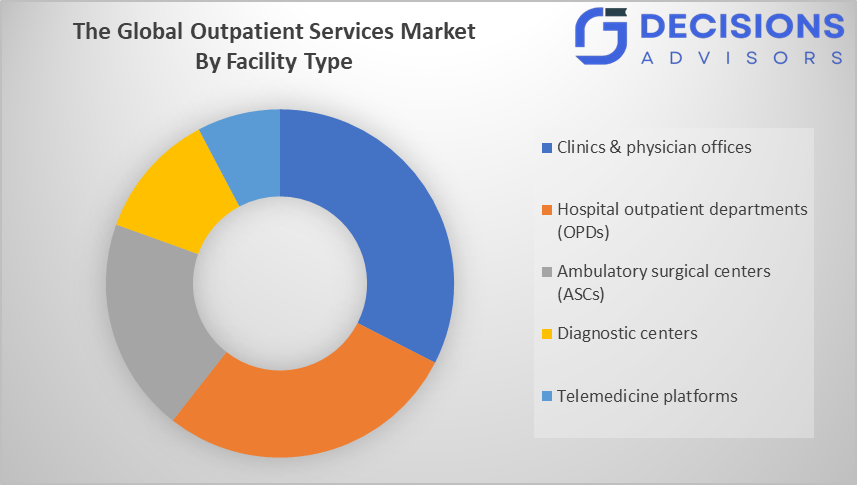
- The clinics & physician offices segment accounted for the largest share in 2025, and is anticipated to grow at a significant CAGR of during the forecast period.
Based on the facility type the outpatient services market is divided into clinics & physician offices, hospital outpatient departments (OPDs), ambulatory surgical centers (ASCs), diagnostic centers, and telemedicine platforms. Among these, the clinics & physician offices segment accounted for the largest share in 2025, and it's anticipated to grow at a significant CAGR during the forecast period. Clinics and physician offices serve as the primary access point for most patients, providing routine consultations, follow-ups, and chronic care management. They are widely available across regions, offer cost-effective and convenient services, and generate high patient volumes due to frequent and ongoing visits.
- The general medicine segment dominated the market in 2025 and is projected to grow at a substantial CAGR during the forecast period.
Based on the end user, the outpatient services market is divided into hospitals, general medicine, cardiology, orthopedics, dermatology, neurology, and gynecology. Among these, the general medicine segment dominated the market in 2025 and is projected to grow at a substantial CAGR during the forecast period. Due to the general medicine covers a broad range of health conditions across all age groups and serves as the first level of diagnosis and treatment. It manages common and chronic illnesses, including infections and lifestyle diseases, requires frequent follow-ups, and acts as a gateway to specialized medical care when necessary.
Strategies to Implement for Growth of the Market in Non-Leading Regions
Growth in non-leading regions can be accelerated through a multi-faceted approach focused on accessibility, affordability, and infrastructure. Strengthening healthcare infrastructure by establishing clinics, diagnostic centers, and ambulatory facilities is essential to meet rising demand. Leveraging telemedicine and digital health solutions can bridge gaps in remote areas, enabling consultations and follow-ups. Promoting primary and preventive care helps reduce disease burden and encourages early treatment. Government support through funding, policies, and public-private partnerships plays a critical role in expanding services. Additionally, training healthcare professionals and adopting task-shifting models can address workforce shortages. Affordable care models and insurance coverage improve service utilization. Strategic collaborations, mobile diagnostic units, and awareness campaigns further enhance reach. Tailoring services to local needs ensure better adoption, ultimately driving sustainable growth in underserved regions.
Regional Segment Analysis of the Outpatient Services Market
- North America (U.S., Canada, Mexico)
- Europe (Germany, France, U.K., Italy, Spain, Rest of Europe)
- Asia-Pacific (China, Japan, India, Rest of APAC)
- South America (Brazil and the Rest of South America)
- The Middle East and Africa (UAE, South Africa, Rest of MEA)
North America is anticipated to hold the largest share of the outpatient services market over the predicted timeframe.
North America is anticipated to hold the largest share of the outpatient services market over the predicted timeframe. The dominance of this region is primarily driven by its highly advanced healthcare infrastructure and widespread availability of specialized outpatient facilities. The region benefits from high healthcare expenditure, strong insurance coverage, and early adoption of advanced medical technologies, including telemedicine and minimally invasive procedures. A growing prevalence of chronic diseases such as diabetes, cardiovascular conditions, and obesity drives frequent outpatient visits. Additionally, there is a strong shift toward cost-effective care, with patients and providers preferring outpatient settings over inpatient hospitalization. Supportive government policies, well-established reimbursement frameworks, and the presence of major healthcare providers further strengthen market growth. High awareness levels and emphasis on preventive care also contribute to increased utilization of outpatient services across the region.
Asia Pacific is expected to grow at a rapid CAGR in the outpatient services market during the forecast period.
Asia Pacific is expected to grow at a rapid CAGR in the outpatient services market during the forecast period. This growth is driven by increasing healthcare demand driven by rising population, urbanization, and growing prevalence of chronic and lifestyle diseases. Expanding healthcare infrastructure, including clinics, diagnostic centers, and ambulatory facilities, supports greater service availability. Rising awareness of preventive care and early diagnosis, combined with growing adoption of telemedicine and digital health solutions, is improving access in both urban and rural areas. Additionally, increasing government investment, favorable healthcare policies, and public-private partnerships are driving market expansion. The region also benefits from a large, underserved patient population seeking cost-effective and convenient outpatient care, making it one of the fastest-growing markets globally for outpatient services.
Europe is the 3rd largest region to grow in the outpatient services market during the region. Europe ranks as the third-largest region in the outpatient services market due to its well-established healthcare systems and high-quality medical infrastructure. The region experiences steady demand for outpatient services driven by an aging population, increasing prevalence of chronic diseases, and a strong focus on preventive care. Widespread health insurance coverage and reimbursement policies make outpatient visits more accessible and affordable for patients. Additionally, Europe has seen growing adoption of advanced technologies, such as telemedicine, electronic health records, and minimally invasive procedures, which enhance service efficiency.
Future Market Trends in Global Outpatient Services Market: -
1. Rapid Adoption of Telemedicine & Digital Healthcare
The market is witnessing a strong shift toward precision medicine, where treatments are tailored based on genetic mutations such as EGFR, ALK, KRAS, and ROS1. The adoption of biomarker testing and next-generation sequencing (NGS) is significantly increasing, enabling clinicians to select highly targeted therapies for improved patient outcomes. Targeted therapies currently account for a major share of the treatment landscape, with dominant market share in therapy segments, reflecting their effectiveness in mutation-specific cases. These therapies are expected to remain a cornerstone of treatment due to their ability to deliver higher efficacy with reduced toxicity compared to chemotherapy.
2. Focus on Preventive and Value?Based Care
The focus on preventive and value-based care is driven by the increasing prevalence of chronic diseases and the need to reduce long-term healthcare costs. Early screenings, regular check-ups, and wellness programs help detect conditions sooner, improving patient outcomes. Payers and providers are incentivized to prioritize proactive care over reactive treatment, while patients benefit from better health management. This shift enhances efficiency, reduces hospitalizations, and supports sustainable growth in outpatient services.
3. Integration of Advanced Diagnostics & Point?of?Care Testing
The integration of advanced diagnostics and point-of-care testing in outpatient services is driven by the demand for faster and more accurate clinical decision-making. Portable diagnostic tools, AI-enabled imaging, and rapid tests allow timely results, reducing reliance on centralized laboratories. This improves patient convenience, supports personalized treatment plans, and enhances overall efficiency in healthcare delivery. Technological innovation and rising patient expectations for quick, reliable diagnostics are key factors accelerating this trend.
Recent Development
In March 2026, U.S. News & World Report released its rankings evaluating over 4,400 ambulatory surgery centers. For the first time, shoulder replacement procedures were included, reflecting their shift to outpatient settings. This development indicated the expansion of advanced surgical care within outpatient services and highlighted growing capabilities in the sector.
In February 2026, In Q4 2025, Tenet Healthcare reported that its ambulatory care segment generated 1.43 billion in revenue, reflecting a 7.2% increase in same-facility revenue. The company described outpatient services as a “bright spot,” indicating strong demand and growth in the sector.
In January 2026, the Consolidated Appropriations Act introduced new documentation requirements for off-campus hospital outpatient departments (HOPDs). Health systems were required to comply or risk financial penalties by 2028. These rules increased administrative burden and compliance costs, impacting outpatient services.
In December 2025, Deloitte reported that 64% of healthcare executives viewed AI as a primary tool for automating workflows. The report highlighted the growing use of “agentic AI” for patient follow-ups and revenue cycle management, improving efficiency and supporting the expansion of outpatient services through better care coordination and operational performance.
How is Recent Developments Helping the Market?
Recent developments are significantly boosting the outpatient services market by enhancing accessibility, efficiency, and patient outcomes. The widespread adoption of telemedicine and digital health platforms allows remote consultations, continuous monitoring, and streamlined follow-ups, especially in underserved regions. Technological advancements in diagnostics, including AI-enabled imaging and point-of-care testing, enable faster, more accurate clinical decisions. Additionally, government initiatives, public-private partnerships, and increased healthcare funding support infrastructure expansion and workforce development. Rising awareness of preventive care and chronic disease management encourages frequent outpatient visits. Collectively, these developments improve service delivery, reduce costs, and drive sustained growth in the global outpatient services market.
Market Segment
This study forecasts revenue at global, regional, and country levels from 2020 to 2035. Decision Advisors has segmented the outpatient services market based on the below-mentioned segments:
Global Outpatient Services Market, By Service Type
- Primary Care Services
- Diagnostic Services
- Minor Surgical Procedures
- Rehabilitation Services
Global Outpatient Services Market, By Facility Type
- Clinics & Physician Offices
- Ambulatory Surgical Centers (ASCs)
- Hospital Outpatient Departments (OPDs)
- Diagnostic Centers
- Telemedicine Platforms
Global Outpatient Services Market, By Application
- Cardiology
- Orthopedics
- Dermatology
- Neurology
- Gynecology
- General Medicine
Global Outpatient Services Market, By Regional Analysis
- North America
- US
- Canada
- Mexico
- Europe
- Germany
- UK
- France
- Italy
- Spain
- Russia
- Rest of Europe
- Asia Pacific
- China
- Japan
- India
- South Korea
- Australia
- Rest of Asia Pacific
- South America
- Brazil
- Argentina
- Rest of South America
- Middle East & Africa
- UAE
- Saudi Arabia
- Qatar
- South Africa
- Rest of the Middle East & Africa
Frequently Asked Questions (FAQ)
Q What role do clinics and physician offices play in the outpatient services market?
A. Clinics and physician offices hold the largest share in the outpatient services market as they act as the primary access point for patients. They provide routine consultations, follow-ups, and chronic disease management. Their wide availability, affordability, and high patient volume contribute significantly to market growth.
Q. Why is the Asia-Pacific region considering the fastest-growing in the outpatient services market?
A. Asia-Pacific is growing rapidly due to increasing population, urbanization, and rising prevalence of chronic diseases. Expanding healthcare infrastructure, growing adoption of telemedicine, and strong government initiatives are improving access to outpatient services, especially in developing countries like India and China.
Q. How do government initiatives support the outpatient services market?
Government initiatives support the market by promoting digital health, expanding primary care infrastructure, and improving access to affordable healthcare. Programs in countries like United Kingdom, United States, and China focus on telemedicine, outpatient infrastructure, and cost-effective care delivery, driving market growth.
Q. What challenges are faced by the outpatient services market?
A. The market faces challenges such as high costs of advanced therapies, limited access to modern diagnostic tools in developing regions, strict regulatory requirements, and potential side effects of treatments. These factors can restrict accessibility and slow down the adoption of outpatient services globally.
Check Licence
Choose the plan that fits you best: Single User, Multi-User, or Enterprise solutions tailored for your needs.
We Have You Covered
- 24/7 Analyst Support
- Clients Across the Globe
- Tailored Insights
- Technology Tracking
- Competitive Intelligence
- Custom Research
- Syndicated Market Studies
- Market Overview
- Market Segmentation
- Growth Drivers
- Market Opportunities
- Regulatory Insights
- Innovation & Sustainability
Report Details
| Scope | Global |
| Pages | 190 |
| Delivery | PDF & Excel via Email |
| Language | English |
| Release | Mar 2026 |
| Access | Download from this page |