
Global Ovarian Cancer Market
 |
Pages:
243
|
Pages:
243
Global Ovarian Cancer Market Size, Share, and COVID-19 Impact Analysis, By Type (Epithelial Ovarian Cancer, Germ Cell Ovarian Cancer, and Stromal Cell Ovarian Cancer), By Treatment Type (Immunotherapy, Chemotherapy, Targeted Therapy, Surgery, and Others), and By Region (North America, Europe, Asia-Pacific, Latin America, Middle East, and Africa), Analysis and Forecast 2025 - 2035
REPORT COVERAGE
Global
Global Ovarian Cancer Market Size Insights Forecasts to 2035
- The Global Ovarian Cancer Market Size Was Estimated at USD 3.25 Billion in 2024
- The Market Size is Expected to Grow at a CAGR of around 7.15% from 2025 to 2035
- The Worldwide Ovarian Cancer Market Size is Expected to Reach USD 6.95 Billion by 2035
- Europe is expected to Grow the fastest during the forecast period.

According to a Research Report Published by Decisions Advisors and Consulting, The Global Ovarian Cancer Market Size was worth around USD 3.25 Billion in 2024 and is predicted to Grow to around USD 6.95 Billion by 2035 with a compound annual growth rate (CAGR) of 7.15% from 2025 to 2035. The expansion of this market segment is notably influenced by the innovations in medical technology, the widespread awareness of early diagnosis, and the growing incidence of ovarian cancer internationally. Moreover, this increase in demand is primarily a result of the substantial infusion of capital into research and development activities, which in turn is opening up fresh avenues for treatment and elevating the standards of healthcare across the world.
Market Overview
The ovarian cancer market refers to the worldwide industry focused on the detection, treatment, and care of ovarian cancer, which includes drugs, therapies, diagnostic tools, and healthcare services. Ovarian cancer is a cancer that starts in the ovaries, i.e., the female reproductive organs that produce eggs and female hormones. Usually, it is caused by the abnormal cells in the ovaries that grow and divide rapidly, forming a tumour. There are different kinds of ovarian cancer, and they may be classified according to the cells from which they are derived. The most common one is epithelial ovarian cancer, which comes from the surface of the ovary. The other, less common types are germ cell tumours and stromal tumours, which develop from the cells that produce eggs and hormones, respectively. The symptoms of ovarian cancer may include abdominal bloating, pelvic or abdominal pain, difficulty eating or feeling full quickly, frequent urination, and changes in bowel habits.
One of the major risk factors leading to the development of the disease is the presence of breast cancer and ovarian cancer in the family history. Also, it has been found that mutations in the BRCA1 and BRCA2 genes are linked to a higher risk.
Ovarian Cancer Research Alliance (OCRA) invested over $10.8 million in scientific research in 2025, as part of a broader $14.5 million commitment to research, patient support, education, and advocacy.
Tilt Biotherapeutics (Tiltbio) has raised $26 million in a Series B round to advance its lead ovarian cancer drug, TILT?123, into Phase II clinical trials for platinum-resistant ovarian cancer.
Report Coverage
This research report categorises the ovarian cancer market based on various segments and regions, forecasts revenue growth, and analyses trends in each submarket. The report analyses the key growth drivers, opportunities, and challenges influencing the ovarian cancer market. Recent market developments and competitive strategies, such as expansion, product launch, development, partnership, merger, and acquisition, have been included to draw the competitive landscape in the market. The report strategically identifies and profiles the key market players and analyses their core competencies in each sub-segment of the ovarian cancer market.
Driving Factors
The market is being propelled by increasing incidences of ovarian cancer, the advent of personalised medicine in cancer treatment, and the implementation of government Initiatives to create awareness, facilitate early detection, and support research. In addition to this, the collaborations between pharmaceutical companies, research institutes, and non-profit organisations are enhancing ovarian cancer therapies. Such partnerships speed up drug development, clinical trials, and awareness activities by pooling resources and expertise. Collaboration thus accelerates the transfer of research to viable treatments and improves the overall market for ovarian cancer therapy. Moreover, the awareness of ovarian cancer is resulting in diagnosis at an early stage, which is a vital factor for improving survival rates. Medical campaigns and advocacy organisations are educating people about the symptoms and risk factors, thus more women are getting medical advice.
The Pershing Square Foundation has launched a $5.25 million Ovarian Cancer Challenge Grant in May 2025, funding seven leading scientists across five premier institutions to address urgent gaps in ovarian cancer detection and treatment.
Restraining Factors
High treatment costs keep ovarian cancer market access limited in low-income regions. Most cases are diagnosed at a late stage, and a complex disease hampers effective outcomes. Break down barriers with innovations and affordable solutions to increase access and care quality.
Market Segmentation
The ovarian cancer market share is classified into type and treatment type.
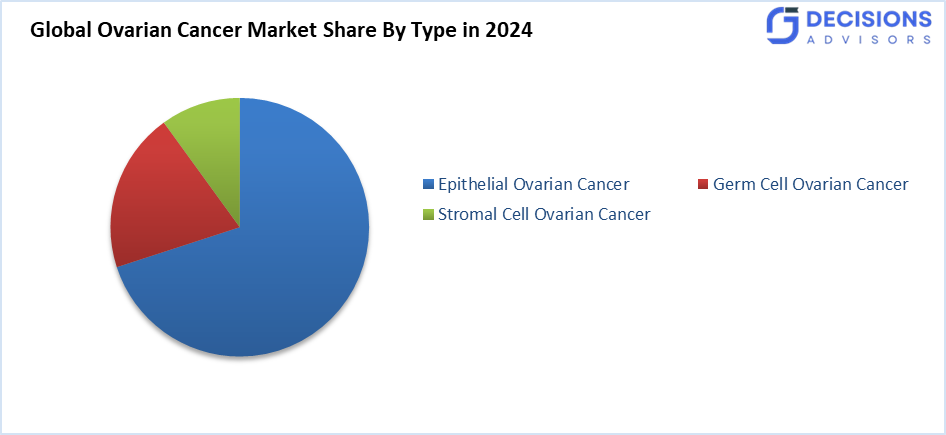
- The epithelial ovarian cancer segment accounted for the largest market share in 2024 and is anticipated to grow at a significant CAGR during the forecast period.
Based on the type, the ovarian cancer market is divided into epithelial ovarian cancer, germ cell ovarian cancer, and stromal cell ovarian cancer. Among these, the epithelial ovarian cancer segment accounted for the largest market share in 2024 and is anticipated to grow at a significant CAGR during the forecast period. Epithelial ovarian cancer is typically diagnosed in women over 60. With the global population becoming older, the incidence of ovarian cancer is on the rise. The chance of ovarian cancer increases dramatically after menopause, so women who have already gone through menopause are at a higher risk of this cancer. On top of that, fatness and bad lifestyle factors, like eating poorly and not exercising, have also been linked to an elevated risk of ovarian cancer.
- The immunotherapy segment accounted for the highest market revenue in 2024 and is projected to grow at a significant CAGR during the forecast period.
Based on the treatment type, the ovarian cancer market is segmented into immunotherapy, chemotherapy, targeted therapy, surgery, and others. Among these, the immunotherapy segment accounted for the highest market revenue in 2024 and is projected to grow at a significant CAGR during the forecast period. Immunotherapy is changing the way we treat cancer, and it is effective in different types of cancer. The great success of immunotherapy in different cancer types has led to a lot of research on whether it can be effective in ovarian cancer as well. Also, immunotherapy exerts its effects on the tumour microenvironment, which consists of immune cells and molecules that aid tumour growth and development.
Regional Segment Analysis of the Ovarian Cancer Market
- North America (U.S., Canada, Mexico)
- Europe (Germany, France, U.K., Italy, Spain, Rest of Europe)
- Asia-Pacific (China, Japan, India, Rest of APAC)
- South America (Brazil and the Rest of South America)
- The Middle East and Africa (UAE, South Africa, Rest of MEA)
North America is anticipated to hold the largest share of the ovarian cancer market over the predicted timeframe.
North America is anticipated to hold the largest share of the ovarian cancer market over the predicted timeframe. The ovarian cancer market in North America is a major contributor to the global ovarian cancer market. The advanced healthcare system, high prevalence of the disease, and extensive research and development activities in the region are the major factors that contribute to this position. In 2023, the region contributed to more than 40% of the total market share globally, with the United States being the leader due to the large number of cancer centres specialised in the treatment and access to the latest therapies. This growth is expected to be driven by supportive government programs, increased spending in cancer research, and the increasing use of personalised medicine. Moreover, the presence of leading pharmaceutical companies and regulatory support will be the key factors in strengthening the region's market prospects.
Europe is expected to grow at a rapid CAGR in the ovarian cancer market during the forecast period. Europe is not far behind and has major contributors in the area of ovarian cancer. Countries like Germany, France, and the United Kingdom have been leading the way in ovarian cancer research and treatment. The growth of the European market is largely a result of growing awareness of ovarian cancer, a strong healthcare system, and government support for cancer research. The region's commitment to early detection and preventive measures is also leading to better patient outcomes and market growth. Additionally, the collaborative research efforts among European countries are, therefore, helping to drive innovation and the development of new treatment modalities.
Competitive Analysis:
The report offers the appropriate analysis of the key organisations/companies involved within the ovarian cancer market, along with a comparative evaluation primarily based on their product offering, business overviews, geographic presence, enterprise strategies, segment market share, and SWOT analysis. The report also provides an elaborate analysis focusing on the current news and developments of the companies, which includes product development, innovations, joint ventures, partnerships, mergers & acquisitions, strategic alliances, and others. This allows for the evaluation of the overall competition within the market.
List of Key Companies
- AbbVie Inc.
- Amgen Inc.
- AstraZeneca
- Bayer AG
- Bristol-Myers Squibb Company
- Clovis Oncology, Inc.
- Eli Lilly and Company
- GlaxoSmithKline plc
- Johnson & Johnson
- Merck & Co., Inc.
- Novartis AG
- Pfizer Inc.
- Roche Holding AG
- Sanofi S.A.
- Others
Key Target Audience
- Market Players
- Investors
- End-users
- Government Authorities
- Consulting and Research Firm
- Venture capitalists
- Value-Added Resellers (VARs)
Recent Development
- In September 2025, MUSC Hollings Cancer Centre launched the AUTOMAIN clinical trial for women with recurrent ovarian cancer, testing repurposed drugs that target autophagy pathways. The new experiment, the second to emerge from this partnership, is intended for women with recurrent ovarian cancer.
- In August 2025, UCLA scientists developed a groundbreaking “off-the-shelf” immunotherapy for ovarian cancer using CAR?NKT cells, which show stronger efficacy and lower cost compared to conventional CAR?T therapies. The new treatment employs a novel platform for off, the, shelf production, thereby enabling a larger patient population to benefit from the treatment at a lower cost, as opposed to the existing personalised immunotherapies, which may cost a few hundred thousand dollars.
Market Segment
This study forecasts revenue at global, regional, and country levels from 2020 to 2035. Decisions Advisors has segmented the ovarian cancer market based on the below-mentioned segments:
Global Ovarian Cancer Market, By Type
- Epithelial Ovarian Cancer
- Germ Cell Ovarian Cancer
- Stromal Cell Ovarian Cancer
Global Ovarian Cancer Market, By Treatment
- Immunotherapy
- Chemotherapy
- Targeted Therapy
- Surgery
- Others
Global Ovarian Cancer Market, By Regional Analysis
- North America
- US
- Canada
- Mexico
- Europe
- Germany
- UK
- France
- Italy
- Spain
- Russia
- Rest of Europe
- Asia Pacific
- China
- Japan
- India
- South Korea
- Australia
- Rest of Asia Pacific
- South America
- Brazil
- Argentina
- Rest of South America
- Middle East & Africa
- UAE
- Saudi Arabia
- Qatar
- South Africa
- Rest of the Middle East & Africa
Frequently Asked Questions (FAQ)
- What is the projected size of the global ovarian cancer market by 2035?
The market is expected to grow from USD 3.25 billion in 2024 to USD 6.95 billion by 2035.
- What is the CAGR for the ovarian cancer market from 2025 to 2035?
The compound annual growth rate (CAGR) is 7.15% during this forecast period.
- Which type of ovarian cancer holds the largest market share?
Epithelial ovarian cancer accounted for the largest share in 2024 and is expected to grow significantly.
- What treatment segment led the market revenue in 2024?
Immunotherapy generated the highest revenue and is projected to expand at a strong CAGR.
- Which region dominates the ovarian cancer market?
North America holds the largest share, driven by advanced healthcare, high prevalence, and R&D investments.
- Which region is expected to grow the fastest?
Europe is anticipated to grow at the fastest CAGR, fueled by awareness, strong healthcare systems, and research collaborations.
- What are the main drivers of market growth?
Key factors include rising ovarian cancer incidence, innovations in personalised medicine, early detection awareness, and funding from governments and organisations.
- Introduction
- Objectives of the Study
- Market Definition
- Research Scope
- Research Methodology and Assumptions
- Executive Summary
- Premium Insights
- Porter’s Five Forces Analysis
- Value Chain Analysis
- Top Investment Pockets
- Market Attractiveness Analysis By Type
- Market Attractiveness Analysis By Treatment Type
- Market Attractiveness Analysis By Region
- Industry Trends
- Market Dynamics
- Market Evaluation
- Drivers
- Widespread awareness of early diagnosis, and the growing incidence of ovarian cancer
- Restraints
- Diagnosed at a late stage, and a complexity during diagnosis
- Opportunities
- Collaboration thus accelerates the transfer of research to viable treatments
- Challenges
- High treatment costs limit in low-income regions
- Global Ovarian Cancer Market Analysis and Projection, By Type
- Segment Overview
- Epithelial Ovarian Cancer
- Germ Cell Ovarian Cancer
- Stromal Cell Ovarian Cancer
- Global Ovarian Cancer Market Analysis and Projection, By Treatment Type
- Segment Overview
- Immunotherapy
- Chemotherapy
- Targeted Therapy
- Surgery
- Others
- Global Ovarian Cancer Market Analysis and Projection, By Regional Analysis
- Segment Overview
- North America
- U.S.
- Canada
- Mexico
- Europe
- Germany
- France
- U.K.
- Italy
- Spain
- Asia-Pacific
- Japan
- China
- India
- South America
- Brazil
- Middle East and Africa
- UAE
- South Africa
- Global Ovarian Cancer Market-Competitive Landscape
- Overview
- Market Share of Key Players in the Ovarian Cancer Market
- Global Company Market Share
- North America Company Market Share
- Europe Company Market Share
- APAC Company Market Share
- Competitive Situations and Trends
- Coverage Launches and Developments
- Partnerships, Collaborations, and Agreements
- Mergers & Acquisitions
- Expansions
- Company Profiles
- AbbVie Inc.
- Business Overview
- Company Snapshot
- Company Market Share Analysis
- Company Coverage Portfolio
- Recent Developments
- SWOT Analysis
- Amgen Inc.
- Business Overview
- Company Snapshot
- Company Market Share Analysis
- Company Coverage Portfolio
- Recent Developments
- SWOT Analysis
- AstraZeneca
- Business Overview
- Company Snapshot
- Company Market Share Analysis
- Company Coverage Portfolio
- Recent Developments
- SWOT Analysis
- Bayer AG
- Business Overview
- Company Snapshot
- Company Market Share Analysis
- Company Coverage Portfolio
- Recent Developments
- SWOT Analysis
- Bristol-Myers Squibb Company
- Business Overview
- Company Snapshot
- Company Market Share Analysis
- Company Coverage Portfolio
- Recent Developments
- SWOT Analysis
- Clovis Oncology, Inc
- Business Overview
- Company Snapshot
- Company Market Share Analysis
- Company Coverage Portfolio
- Recent Developments
- SWOT Analysis
- Eli Lilly and Company
- Business Overview
- Company Snapshot
- Company Market Share Analysis
- Company Coverage Portfolio
- Recent Developments
- SWOT Analysis
- GlaxoSmithKline plc
- Business Overview
- Company Snapshot
- Company Market Share Analysis
- Company Coverage Portfolio
- Recent Developments
- SWOT Analysis
- Johnson & Johnson
- Business Overview
- Company Snapshot
- Company Market Share Analysis
- Company Coverage Portfolio
- Recent Developments
- SWOT Analysis
- Merck & Co., Inc.
- Business Overview
- Company Snapshot
- Company Market Share Analysis
- Company Coverage Portfolio
- Recent Developments
- SWOT Analysis
- Novartis AG
- Business Overview
- Company Snapshot
- Company Market Share Analysis
- Company Coverage Portfolio
- Recent Developments
- SWOT Analysis
- Pfizer Inc.
- Business Overview
- Company Snapshot
- Company Market Share Analysis
- Company Coverage Portfolio
- Recent Developments
- SWOT Analysis
- Roche Holding AG
- Business Overview
- Company Snapshot
- Company Market Share Analysis
- Company Coverage Portfolio
- Recent Developments
- SWOT Analysis
- Sanofi S.A.
- Business Overview
- Company Snapshot
- Company Market Share Analysis
- Company Coverage Portfolio
- Recent Developments
- SWOT Analysis
- Others
- Business Overview
- Company Snapshot
- Company Market Share Analysis
- Company Coverage Portfolio
- Recent Developments
- SWOT Analysis
- AbbVie Inc.
List of Table
- Global Ovarian Cancer Market, By Type, 2024-2035(USD Billion)
- Global Epithelial Ovarian Cancer, Ovarian Cancer Market, By Region, 2024-2035(USD Billion)
- Global Germ Cell Ovarian Cancer, Ovarian Cancer Market, By Region, 2024-2035(USD Billion)
- Global Stromal Cell Ovarian Cancer, Ovarian Cancer Market, By Region, 2024-2035(USD Billion)
- Global Ovarian Cancer Market, By Treatment Type, 2024-2035(USD Billion)
- Global Immunotherapy, Ovarian Cancer Market, By Region, 2024-2035(USD Billion)
- Global Chemotherapy, Ovarian Cancer Market, By Region, 2024-2035(USD Billion)
- Global Targeted Therapy, Ovarian Cancer Market, By Region, 2024-2035(USD Billion)
- Global Surgery, Ovarian Cancer Market, By Region, 2024-2035(USD Billion)
- Global Others, Ovarian Cancer Market, By Region, 2024-2035(USD Billion)
- North America Ovarian Cancer Market, By Type, 2024-2035(USD Billion)
- North America Ovarian Cancer Market, By Treatment Type, 2024-2035(USD Billion)
- U.S. Ovarian Cancer Market, By Type, 2024-2035(USD Billion)
- U.S. Ovarian Cancer Market, By Treatment Type, 2024-2035(USD Billion)
- Canada Ovarian Cancer Market, By Type, 2024-2035(USD Billion)
- Canada Ovarian Cancer Market, By Treatment Type, 2024-2035(USD Billion)
- Mexico Ovarian Cancer Market, By Type, 2024-2035(USD Billion)
- Mexico Ovarian Cancer Market, By Treatment Type, 2024-2035(USD Billion)
- Europe Ovarian Cancer Market, By Type, 2024-2035(USD Billion)
- Europe Ovarian Cancer Market, By Treatment Type, 2024-2035(USD Billion)
- Germany Ovarian Cancer Market, By Type, 2024-2035(USD Billion)
- Germany Ovarian Cancer Market, By Treatment Type, 2024-2035(USD Billion)
- France Ovarian Cancer Market, By Type, 2024-2035(USD Billion)
- France Ovarian Cancer Market, By Treatment Type, 2024-2035(USD Billion)
- U.K. Ovarian Cancer Market, By Type, 2024-2035(USD Billion)
- U.K. Ovarian Cancer Market, By Treatment Type, 2024-2035(USD Billion)
- Italy Ovarian Cancer Market, By Type, 2024-2035(USD Billion)
- Italy Ovarian Cancer Market, By Treatment Type, 2024-2035(USD Billion)
- Spain Ovarian Cancer Market, By Type, 2024-2035(USD Billion)
- Spain Ovarian Cancer Market, By Treatment Type, 2024-2035(USD Billion)
- Asia Pacific Ovarian Cancer Market, By Type, 2024-2035(USD Billion)
- Asia Pacific Ovarian Cancer Market, By Treatment Type, 2024-2035(USD Billion)
- Japan Ovarian Cancer Market, By Type, 2024-2035(USD Billion)
- Japan Ovarian Cancer Market, By Treatment Type, 2024-2035(USD Billion)
- China Ovarian Cancer Market, By Type, 2024-2035(USD Billion)
- China Ovarian Cancer Market, By Treatment Type, 2024-2035(USD Billion)
- India Ovarian Cancer Market, By Type, 2024-2035(USD Billion)
- India Ovarian Cancer Market, By Treatment Type, 2024-2035(USD Billion)
- South America Ovarian Cancer Market, By Type, 2024-2035(USD Billion)
- South America Ovarian Cancer Market, By Treatment Type, 2024-2035(USD Billion)
- Brazil Ovarian Cancer Market, By Type, 2024-2035(USD Billion)
- Brazil Ovarian Cancer Market, By Treatment Type, 2024-2035(USD Billion)
- The Middle East and Africa Ovarian Cancer Market, By Type, 2024-2035(USD Billion)
- The Middle East and Africa Ovarian Cancer Market, By Treatment Type, 2024-2035(USD Billion)
- UAE Ovarian Cancer Market, By Type, 2024-2035(USD Billion)
- UAE Ovarian Cancer Market, By Treatment Type, 2024-2035(USD Billion)
- South Africa Ovarian Cancer Market, By Type, 2024-2035(USD Billion)
- South Africa Ovarian Cancer Market, By Treatment Type, 2024-2035(USD Billion)
List of Figures
- Global Ovarian Cancer Market Segmentation
- Ovarian Cancer Market: Research Methodology
- Market Size Estimation Methodology: Bottom-Up Approach
- Market Size Estimation Methodology: Top-down Approach
- Data Triangulation
- Porter’s Five Forces Analysis
- Value Chain Analysis
- Top investment pocket in the Ovarian Cancer Market
- Top Winning Strategies, 2024-2035
- Top Winning Strategies, By Development, 2024-2035(%)
- Top Winning Strategies, By Company, 2024-2035
- Moderate Bargaining power of Buyers
- Moderate Bargaining power of Suppliers
- Moderate Bargaining power of New Entrants
- Low threat of Substitution
- High Competitive Rivalry
- Top Player Positioning, 2024
- Market Share Analysis, 2024
- Restraint and Drivers: Ovarian Cancer Market
- Ovarian Cancer Market Segmentation, By Type
- Ovarian Cancer Market For Epithelial Ovarian Cancer, By Region, 2024-2035 ($ Billion)
- Ovarian Cancer Market For Germ Cell Ovarian Cancer, By Region, 2024-2035 ($ Billion)
- Ovarian Cancer Market For Stromal Cell Ovarian Cancer, By Region, 2024-2035 ($ Billion)
- Ovarian Cancer Market Segmentation, By Treatment Type
- Ovarian Cancer Market For Immunotherapy, By Region, 2024-2035 ($ Billion)
- Ovarian Cancer Market For Chemotherapy, By Region, 2024-2035 ($ Billion)
- Ovarian Cancer Market For Targeted Therapy, By Region, 2024-2035 ($ Billion)
- Ovarian Cancer Market For Surgery, By Region, 2024-2035 ($ Billion)
- Ovarian Cancer Market For Others, By Region, 2024-2035 ($ Billion)
- AbbVie Inc.: Net Sales, 2024-2035 ($ Billion)
- AbbVie Inc.: Revenue Share, By Segment, 2024 (%)
- AbbVie Inc.: Revenue Share, By Region, 2024 (%)
- Amgen Inc.: Net Sales, 2024-2035 ($ Billion)
- Amgen Inc.: Revenue Share, By Segment, 2024 (%)
- Amgen Inc.: Revenue Share, By Region, 2024 (%)
- AstraZeneca: Net Sales, 2024-2035 ($ Billion)
- AstraZeneca: Revenue Share, By Segment, 2024 (%)
- AstraZeneca: Revenue Share, By Region, 2024 (%)
- Bayer AG: Net Sales, 2024-2035 ($ Billion)
- Bayer AG: Revenue Share, By Segment, 2024 (%)
- Bayer AG: Revenue Share, By Region, 2024 (%)
- Bristol-Myers Squibb Company: Net Sales, 2024-2035 ($ Billion)
- Bristol-Myers Squibb Company: Revenue Share, By Segment, 2024 (%)
- Bristol-Myers Squibb Company: Revenue Share, By Region, 2024 (%)
- Clovis Oncology, Inc: Net Sales, 2024-2035 ($ Billion)
- Clovis Oncology, Inc: Revenue Share, By Segment, 2024 (%)
- Clovis Oncology, Inc: Revenue Share, By Region, 2024 (%)
- Eli Lilly and Company: Net Sales, 2024-2035 ($ Billion)
- Eli Lilly and Company: Revenue Share, By Segment, 2024 (%)
- Eli Lilly and Company: Revenue Share, By Region, 2024 (%)
- GlaxoSmithKline plc: Net Sales, 2024-2035 ($ Billion)
- GlaxoSmithKline plc: Revenue Share, By Segment, 2024 (%)
- GlaxoSmithKline plc: Revenue Share, By Region, 2024 (%)
- Johnson & Johnson.: Net Sales, 2024-2035 ($ Billion)
- Johnson & Johnson.: Revenue Share, By Segment, 2024 (%)
- Johnson & Johnson.: Revenue Share, By Region, 2024 (%)
- Merck & Co., Inc.: Net Sales, 2024-2035 ($ Billion)
- Merck & Co., Inc.: Revenue Share, By Segment, 2024 (%)
- Merck & Co., Inc.: Revenue Share, By Region, 2024 (%)
- Novartis AG: Net Sales, 2024-2035 ($ Billion)
- Novartis AG: Revenue Share, By Segment, 2024 (%)
- Novartis AG: Revenue Share, By Region, 2024 (%)
- Pfizer Inc.: Net Sales, 2024-2035 ($ Billion)
- Pfizer Inc.: Revenue Share, By Segment, 2024 (%)
- Pfizer Inc.: Revenue Share, By Region, 2024 (%)
- Roche Holding AG: Net Sales, 2024-2035 ($ Billion)
- Roche Holding AG: Revenue Share, By Segment, 2024 (%)
- Roche Holding AG: Revenue Share, By Region, 2024 (%)
- Sanofi S.A.: Net Sales, 2024-2035 ($ Billion)
- Sanofi S.A.: Revenue Share, By Segment, 2024 (%)
- Sanofi S.A.: Revenue Share, By Region, 2024 (%)
- Others: Net Sales, 2024-2035 ($ Billion)
- Others: Revenue Share, By Segment, 2024 (%)
- Others: Revenue Share, By Region, 2024 (%)
Check Licence
Choose the plan that fits you best: Single User, Multi-User, or Enterprise solutions tailored for your needs.
We Have You Covered
- 24/7 Analyst Support
- Clients Across the Globe
- Tailored Insights
- Technology Tracking
- Competitive Intelligence
- Custom Research
- Syndicated Market Studies
- Market Overview
- Market Segmentation
- Growth Drivers
- Market Opportunities
- Regulatory Insights
- Innovation & Sustainability
Report Details
| Scope | Global |
| Pages | 243 |
| Delivery | PDF & Excel via Email |
| Language | English |
| Release | Jan 2026 |
| Access | Download from this page |