
Global Paroxysmal Nocturnal Hemoglobinuria Market
 |
Pages:
220
|
Pages:
220
Global Paroxysmal Nocturnal Hemoglobinuria Market Size, Share, and COVID-19 Impact Analysis, By Treatment (Medication, Stem Cell Transplant, and Blood Transfusion), By Drug Administration Route (Intravenous (IV) Administration, and Subcutaneous (SC) Administration) and By Region (North America, Europe, Asia-Pacific, Latin America, Middle East, and Africa), Analysis and Forecast 2025 - 2035.
REPORT COVERAGE
Global
Global Paroxysmal Nocturnal Hemoglobinuria Market Insights Forecasts to 2035
- The Global Paroxysmal Nocturnal Hemoglobinuria Market Size Was valued at USD 5.74 Billion in 2024
- The Global Paroxysmal Nocturnal Hemoglobinuria Market Size is Expected to Grow at a CAGR of around 9.11% from 2025 to 2035
- The Worldwide Paroxysmal Nocturnal Hemoglobinuria Market Size is Expected to Reach USD 14.97 Billion by 2035
- Asia-Pacific is expected to grow the fastest during the forecast period.
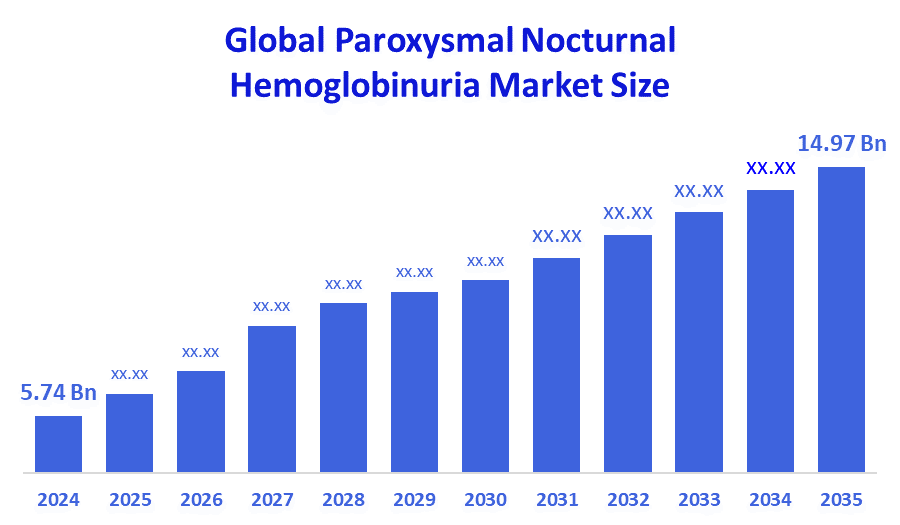
According to a research report published by Decisions Advisors and Consulting, the global paroxysmal nocturnal hemoglobinuria market size was worth around USD 5.74 Billion in 2024 and is predicted to grow to around USD 14.97 Billion by 2035 with a compound annual growth rate (CAGR) of 9.11% from 2025 to 2035. Doctors now identify paroxysmal nocturnal hemoglobinuria (PNH) more frequently because people have become more aware of the condition and diagnostic methods have reached higher accuracy levels.
Market Overview
Paroxysmal Nocturnal Hemoglobinuria (PNH) represents a rare blood disorder which poses a life-threatening risk because it causes premature destruction of red blood cells. The medical condition results in hemolytic anemia and fatigue and blood clots and impaired bone marrow function. Additionally, the paroxysmal nocturnal hemoglobinuria market is currently experiencing notable developments, driven by advancements in treatment options and increased awareness of the disease. The rare blood disorder attracts attention from both healthcare professionals and patients because its main symptom involves red blood cell destruction. The need for new therapies has increased because existing treatments fail to control symptoms and help patients reach better health results. Pharmaceutical companies are actively investing in research and development to create novel treatments, which may lead to enhanced therapeutic options in the near future.
Report Coverage
This research report categorizes the paroxysmal nocturnal hemoglobinuria market based on various segments and regions, forecasts revenue growth, and analyzes trends in each submarket. The report analyses the key growth drivers, opportunities, and challenges influencing the paroxysmal nocturnal hemoglobinuria market. Recent market developments and competitive strategies such as expansion, type launch, development, partnership, merger, and acquisition, have been included to draw the competitive landscape in the market. The report strategically identifies and profiles the key market players and analyses their core competencies in each sub-segment of the paroxysmal nocturnal hemoglobinuria market.
Driving Factors
The recent development of new Paroxysmal Nocturnal Hemoglobinuria treatment methods has created a major impact on the Paroxysmal Nocturnal Hemoglobinuria Market. The introduction of eculizumab and ravulizumab as complement inhibitors has established a new treatment method for PNH patients. The treatment methods have proven successful in decreasing hemolysis while enhancing patients' quality of life which will lead to increased patient demand for these effective treatment methods. The market analysis shows that PNH therapy revenues will exceed several billion dollars by 2030 because healthcare providers now understand the importance of dedicated medical solutions. The ongoing clinical trials and research programs will bring forth new therapies which will enhance PNH treatment possibilities. The Paroxysmal Nocturnal Hemoglobinuria Market grows because treatment methods keep developing through ongoing research efforts.
Restraining Factors
Market Segmentation
The paroxysmal nocturnal hemoglobinuria market share is classified into treatment and drug administration route
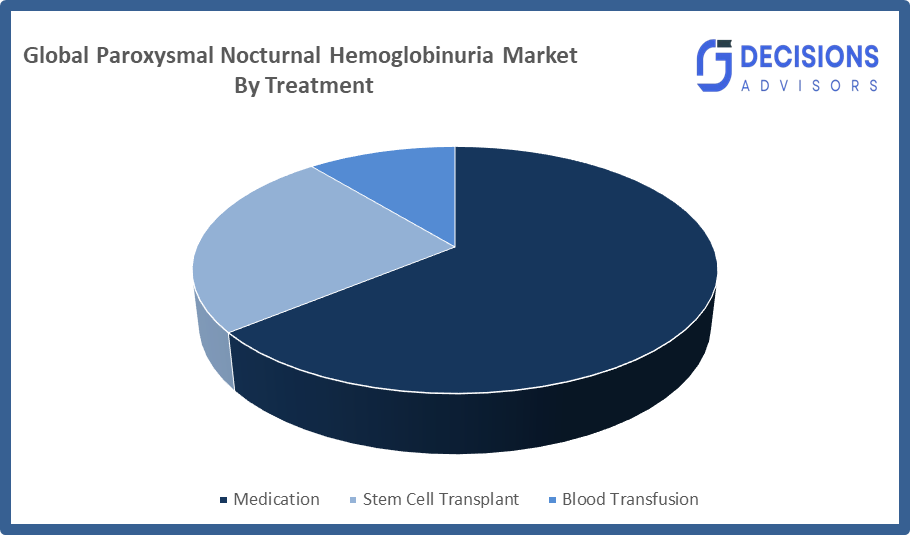
- The medication segment dominated the market in 2024, approximately 65% and is projected to grow at a substantial CAGR during the forecast period.
Based on the treatment, the paroxysmal nocturnal hemoglobinuria market is divided into medication, stem cell transplant, blood transfusion solid. Among these, the medication segment dominated the market in 2024, approximately 65% and is projected to grow at a substantial CAGR during the forecast period. The medication segment leads the PNH market because it has proven effectiveness in controlling hemolysis while preventing medical complications. The combination of oral and injectable treatments provides patients with easy usage options which deliver fast symptom relief and enhance their overall quality of life. The segment maintains its top market position worldwide because of strong clinical guideline support which has led to more doctors using the product while patients and healthcare providers increase their knowledge about it.
- The intravenous (IV) administration segment accounted for the largest share in 2024, approximately 70% and is anticipated to grow at a significant CAGR during the forecast period.
Based on the drug administration route, the paroxysmal nocturnal hemoglobinuria market is divided into intravenous (IV) administration, and subcutaneous (SC) administration. Among these, the intravenous (IV) administration segment accounted for the largest share in 2024, approximately 70% and is anticipated to grow at a significant CAGR during the forecast period. The PNH market leads through its intravenous (IV) administration segment because it provides quick and controlled drug delivery. The system enables doctors to deliver exact drug amounts to patients who obtain instant effects while clinicians maintain close observation of their condition, which results in better medical safety and treatment results. The segment maintains high market share because doctors prefer it and hospitals and clinics widely use it, while its established ability to decrease hemolysis and related medical issues drives its global market expansion.
Regional Segment Analysis of the Paroxysmal Nocturnal Hemoglobinuria Market
- North America (U.S., Canada, Mexico)
- Europe (Germany, France, U.K., Italy, Spain, Rest of Europe)
- Asia-Pacific (China, Japan, India, Rest of APAC)
- South America (Brazil and the Rest of South America)
- The Middle East and Africa (UAE, South Africa, Rest of MEA)
North America is anticipated to hold the largest share of the paroxysmal nocturnal hemoglobinuria market over the predicted timeframe.
North America is anticipated to hold the largest share of the paroxysmal nocturnal hemoglobinuria market over the predicted timeframe. The region experiences high rates of neurological disorders together with chronic pain conditions. The area receives advanced medical facilities which enable the implementation of modern neurostimulation systems. The leading medical device companies make substantial research and development investments which result in new products that improve treatment results. The rising acceptance of neurostimulation therapies by healthcare providers and patients together with reimbursement policies that improve access to advanced treatments drive growth in the PNH treatment market.
Asia-Pacific is expected to grow at a rapid CAGR in the paroxysmal nocturnal hemoglobinuria market during the forecast period. The region's development receives its main drive from rising healthcare expenses together with growing public knowledge about uncommon diseases and improvements in healthcare facilities. The regulatory frameworks of Japan and Australia provide strong support for developing new medical treatments which results in these countries becoming industry leaders. Japan stands out because of its modern medical system and its powerful drug manufacturing sector which includes Takeda Pharmaceutical as a major contributor. The market competition now includes both domestic companies and international firms who compete to obtain market dominance. The rising public knowledge about PNH will increase treatment needs which will create new business expansion possibilities throughout the area.
Competitive Analysis:
The report offers the appropriate analysis of the key organizations/companies involved within the paroxysmal nocturnal hemoglobinuria market, along with a comparative evaluation primarily based on their type of offering, business overviews, geographic presence, enterprise strategies, segment market share, and SWOT analysis. The report also provides an elaborative analysis focusing on the current news and developments of the companies, which includes type development, innovations, joint ventures, partnerships, mergers & acquisitions, strategic alliances, and others. This allows for the evaluation of the overall competition within the market.
List of Key Companies
- Alexion Pharmaceuticals, Inc.
- Apellis Pharmaceuticals
- Novartis AG
- F. Hoffmann-La Roche Ltd
- Genentech, Inc.
- BioCryst Pharmaceuticals, Inc.
- Regeneron Pharmaceuticals Inc.
- Sanofi
- Pfizer Inc.
- Amgen Inc.
- Others
Key Target Audience
- Market Players
- Investors
- End-users
- Government Authorities
- Consulting and Research Firm
- Venture capitalists
- Value-Added Resellers (VARs)
Recent Development
- In June 2025, Novartis announced that APPULSE-PNH, a Phase IIIB study evaluating the efficacy and safety of twice-daily oral monotherapy Fabhalta (iptacopan) in adult patients with paroxysmal nocturnal hemoglobinuria with Hb levels ≥10?g/dL who had switched from anti-C5 therapies (eculizumab or ravulizumab), had shown positive results. After 24 weeks of treatment with Fabhalta, the Hb level had improved on average by 2.01?g/dL, with most patients achieving normal or near-normal levels.
Market Segment
This study forecasts revenue at global, regional, and country levels from 2020 to 2035. Decisions Advisors has segmented the paroxysmal nocturnal hemoglobinuria market based on the below-mentioned segments:
Global Paroxysmal Nocturnal Hemoglobinuria Market, By Treatment
- Medication
- Stem Cell Transplant
- Blood Transfusion
Global Paroxysmal Nocturnal Hemoglobinuria Market, By Drug Administration Route
- Intravenous (IV) Administration
- Subcutaneous (SC) Administration
Global Paroxysmal Nocturnal Hemoglobinuria Market, By Regional Analysis
- North America
- US
- Canada
- Mexico
- Europe
- Germany
- UK
- France
- Italy
- Spain
- Russia
- Rest of Europe
- Asia Pacific
- China
- Japan
- India
- South Korea
- Australia
- Rest of Asia Pacific
- South America
- Brazil
- Argentina
- Rest of South America
- Middle East & Africa
- UAE
- Saudi Arabia
- Qatar
- South Africa
- Rest of the Middle East & Africa
Frequently Asked Questions (FAQ)
Q1: What is Paroxysmal Nocturnal Hemoglobinuria (PNH)?
A: PNH is a rare, life-threatening blood disorder causing premature red blood cell destruction, leading to hemolytic anemia, fatigue, blood clots, and impaired bone marrow function, requiring specialized treatments.
Q2: Which treatment segment dominated the PNH market in 2024?
A: The medication segment dominated the PNH market in 2024, approximately 65%, due to proven effectiveness in controlling hemolysis, oral and injectable options, and strong clinical guideline support.
Q3: Why does intravenous (IV) administration lead the PNH market?
A: IV administration accounted for 70% in 2024 because it ensures precise drug delivery, quick effects, close patient monitoring, better safety, and higher doctor and hospital adoption worldwide.
Q4: Which region holds the largest share of the PNH market?
A: North America holds the largest PNH market share due to advanced medical facilities, high neurological disorder prevalence, strong R&D investments, and supportive reimbursement policies for innovative treatments.
Q5: Why is the Asia-Pacific PNH market expected to grow rapidly?
A: Asia-Pacific growth is driven by rising healthcare spending, better rare disease awareness, improved medical infrastructure, strong regulatory support, and participation from domestic and international pharmaceutical companies.
Check Licence
Choose the plan that fits you best: Single User, Multi-User, or Enterprise solutions tailored for your needs.
We Have You Covered
- 24/7 Analyst Support
- Clients Across the Globe
- Tailored Insights
- Technology Tracking
- Competitive Intelligence
- Custom Research
- Syndicated Market Studies
- Market Overview
- Market Segmentation
- Growth Drivers
- Market Opportunities
- Regulatory Insights
- Innovation & Sustainability
Report Details
| Scope | Global |
| Pages | 220 |
| Delivery | PDF & Excel via Email |
| Language | English |
| Release | Mar 2026 |
| Access | Download from this page |