
Global Patient Engagement Solutions Market
 |
Pages:
240
|
Pages:
240
Global Patient Engagement Solutions Market Size, Share, By Component (Software, Services, and Platforms), By Delivery Mode (On-Premises, Cloud-Based), By End-User (Hospitals, Clinics, Home Care, Others), and By Region (North America, Europe, Asia-Pacific, Latin America, Middle East, and Africa), Analysis and Forecast 2025 ? 2035
REPORT COVERAGE
Global
Market Snapshot
- Market Size (2025): USD 30.5 Billion
- Projected Market Size (2035): USD 94.7 Billion
- Compound Annual Growth Rate (CAGR): 12%
- Largest Regional Market: North America
- Fastest Growing Region: Asia-Pacific
- 3rd Largest Region: Europe
- Base Year: 2025
- Historical Period: 2021–2024
- Forecast Period: 2025–2035
According to Decision Advisors, the Global Patient engagement solutions s Market Size is expected to grow from USD 30.5 billion in 2025 to USD 94.7 billion by 2035, at a CAGR of 12% during the forecast period 2025-2035. Growth of the patient engagement solutions market is primarily driven by increasing adoption of digital health platforms, rising patient awareness, telehealth expansion, and government initiatives promoting patient-centric care. Rising healthcare IT investments and the need to improve patient outcomes are further fuelling the market, alongside initiatives for chronic disease management and remote patient monitoring.
Market Overview/ Introduction
Patient engagement solutions are the digital engines driving this change, defined as a suite of interoperable tools like mobile apps, secure portals, and wearable integrations that empower individuals to actively manage their health data, adhere to treatments, and communicate seamlessly with their care teams. Healthcare is currently undergoing a massive transformation, shifting away from the old doctor-knows-best model toward a collaborative journey where patients are the co-pilots of their own care. In the US, the 21st Century Cures Act is legally breaking the locks on your medical data so you can actually own it. Meanwhile, in India, the Ayushman Bharat Digital Mission has already given nearly 50 crore people a digital health identity, making paperless care a reality for millions for the first time. Especially in the Asia-Pacific, our fastest-growing region. This means a person in a remote village can get the same high-level health coaching as someone in a major city, right through their smartphone.
- Epic Systems Corporation is a leading global patient engagement solutions provider, supported by its widely adopted MyChart platform, which has over 195 million active users and billions of annual patient interactions, strengthening its position in the global patient engagement solutions market through integrated digital health tools and patient-centric engagement capabilities.
- Governments across countries are actively promoting digital healthcare transformation. For instance, India’s Ayushman Bharat Digital Mission (ABDM) is focused on building a unified digital health ecosystem through electronic health records and digital patient platforms, while globally, government initiatives and healthcare IT adoption are key drivers supporting the rapid expansion of patient engagement solutions.
Notable Insights: -
- North America holds the largest regional market share in the global patient engagement solutions market, led by widespread EHR adoption and telehealth integration.
- Asia Pacific is the fastest-growing region in the global patient engagement solutions market.
- By component, the software segment dominates the market, contributing nearly 58–60% of the total revenue share in 2025, due to the widespread use of patient portals, mobile health apps, and telehealth platforms.
- The compound annual growth rate of the global patient engagement solutions market is 12%.
- The market is likely to achieve a valuation of USD 94.7 billion by 2035.
What is role of technology in grooming the market?
Technology plays a pivotal role in the patient engagement solutions market. AI and machine learning improve personalized communication and predict patient behaviour, enhancing adherence and satisfaction. Telehealth platforms facilitate remote consultations, while mobile applications provide appointment scheduling, medication reminders, and access to health records. Data analytics supports population health management, resulting in improvements in patient adherence and outcomes. Blockchain technology is also emerging to secure patient data and maintain privacy compliance.
Market Drivers
The surge in the patient engagement solutions market is primarily fuelled by the transition toward value-based care, where providers are financially incentivised to prioritise patient outcomes over the volume of services. This shift is amplified by the rising prevalence of chronic diseases like diabetes and hypertension, which require the continuous monitoring and proactive management that digital platforms provide. Technological breakthroughs, particularly in Generative AI and Machine Learning, are further accelerating adoption by transforming standard portals into intelligent assistants capable of full-time personalized coaching and automated administrative support. Additionally, the ubiquity of smartphones and wearable devices has created a data-rich environment, allowing real-time health tracking to become a standard expectation for patients. Supported by favourable government regulations and reimbursement policies for remote care, these drivers are collectively moving healthcare toward a more efficient, patient-centric, and digitally integrated model.
Restrain
Despite its rapid growth, the patient engagement solutions market faces significant restraining factors, primarily the high implementation and maintenance costs that can deter smaller healthcare providers. Security remains a top concern, as the sensitive nature of medical data requires strict adherence to HIPAA and GDPR, making platforms vulnerable to costly cyberattacks and regulatory penalties
Competitive Analysis:
The report offers the appropriate analysis of the key organizations/companies involved within the patient engagement solutions market, along with a comparative evaluation primarily based on their product of offering, business overviews, geographic presence, enterprise strategies, segment market share, and SWOT analysis. The report also provides an elaborative analysis focusing on the current news and developments of the companies, which includes product development, innovations, joint ventures, partnerships, mergers & acquisitions, strategic alliances, and others. This allows for the evaluation of the overall competition within the market.
Top Companies in the Global Patient Engagement Solutions Market
- Epic Systems
- Cerner Corporation
- Allscripts Healthcare Solutions
- Athenahealth
- Philips Healthcare
- McKesson Corporation
- Meditech
- eClinicalWorks
- Teladoc Health
- Oracle Health
Government Initiatives
|
Country |
Key Government Initiatives |
|
Initiative: CMS Promoting Interoperability Program Recent Update (July 2025): Launched the Health Tech Ecosystem initiative, securing pledges from 60+ giants (Google, Apple, Epic) to replace paper intake with digital workflows by 2026. |
|
|
US |
Initiative: NSH Digital Transformation Recent Update (2025/26): The NHS 10-Year Health Plan mandates three shifts: hospital to community, analogue to digital, and sickness to prevention. |
|
India |
Initiative: Ayushman Bharat Digital Mission (ABDM). Data: The Digital Health Incentive Scheme (DHIS) offers financial rewards to hospitals and clinics for digitizing records. The market is projected to grow tenfold to $37 billion by 2030. |
Market Segmentation
The patient engagement solutions market share is classified into components, delivery mode, and end users.
- The software segment dominated the market in 2025, accounting for approximately 58–60% of the share during the forecast period.
Based on the component, the patient engagement solutions market is segmented into software, services, and platforms. Among these, the software segment dominated the market in 2025, accounting for approximately 58–60% of the share during the forecast period. The growth of the segment is driven by the widespread adoption of patient portals, mobile health applications, and telehealth platforms. The services segment held around 25–30% share due to increasing demand for implementation, training, and support services, while the platforms segment accounted for nearly 10–15% of the market share.
- Cloud-based platforms are growing at a dominant CAGR, driven by scalability and ease of deployment during the forecast period.
Based on the delivery mode, the patient engagement solutions market is segmented into cloud-based and on-premises solutions. Among these, cloud-based platforms are growing at a dominant CAGR, driven by scalability and ease of deployment during the forecast period. It is because of its scalability, cost-effectiveness, and ease of integration with existing healthcare IT systems. The on-premises segment held a large market share, supported by organizations prioritizing data security, control, and compliance with regulatory requirements.
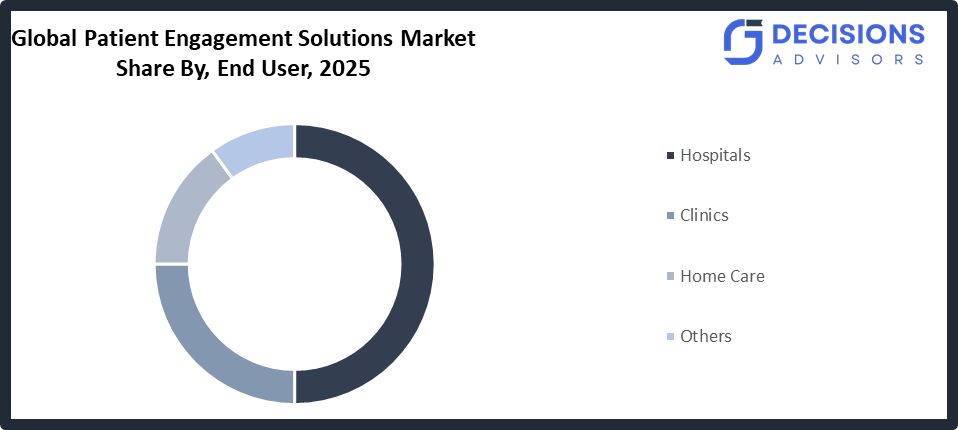
- The hospitals dominated the market in 2025, accounting for approximately 50% of the total share during the forecast timeframe.
Based on the end-user, the patient engagement solutions market is segmented into hospitals, clinics, home care settings, and others. Among these, the hospitals dominated the market in 2025, accounting for approximately 50% of the total share during the forecast timeframe. The growth of the segment is driven by high adoption of EHRs, patient portals, and telehealth platforms. The clinics segment held around 25% share due to increasing digital adoption among small healthcare providers, while home care settings accounted for nearly 15%, supported by the rising demand for remote patient monitoring and home-based care. The other segment contributed approximately 10% of the market share.
What is the Reason of the Region Dominance?
North America dominates the patient engagement solutions market, capturing dominant share, primarily due to its advanced healthcare IT infrastructure and aggressive shift toward value-based care models. This dominance is underpinned by stringent federal mandates like the 21st Century Cures Act, which legally requires interoperability and easy patient access to health data, alongside substantial financial incentives from CMS for digital adoption. The region also benefits from being the innovation hub for industry giants like Oracle (Cerner) and Epic Systems, ensuring that cutting-edge AI and remote monitoring tools are integrated into clinical workflows faster than elsewhere. Furthermore, high healthcare spending representing nearly 18% of U.S. GDP and a tech-savvy population with high smartphone penetration create a fertile environment for the rapid scaling of digital health ecosystems.
Strategies to Implement for Growth of the Market in Non-Leading Regions
To drive growth in non-leading regions like Africa, strategies must pivot toward mobile-first and frugal innovation to overcome infrastructure and affordability gaps. Since these markets often lack high-speed broadband but have high smartphone penetration, success depends on deploying lite applications and omnichannel platforms such as WhatsApp-integrated triage that function on low-bandwidth networks. Growth is further accelerated through Public-Private Partnerships (PPP), aligning digital tools with national digital public infrastructures like India’s Ayushman Bharat Digital Mission (ABDM) to offset high implementation costs. Finally, overcoming digital literacy gaps requires localization, offering multilingual support and hybrid phygital models where digital tools empower, rather than replace, local community health workers to build patient trust in a digital-first journey.
Regional Segment Analysis of the Patient engagement solutions s Market
- North America (U.S., Canada, Mexico)
- Europe (Germany, France, U.K., Italy, Spain, Rest of Europe)
- Asia-Pacific (China, Japan, India, Rest of APAC)
- South America (Brazil and the Rest of South America)
- The Middle East and Africa (UAE, South Africa, Rest of MEA)
North America is anticipated to hold the largest share of the patient engagement solutions market over the predicted timeframe.
North America is anticipated to hold the largest share of the patient engagement solutions market over the predicted timeframe. It is sustained by its pioneering healthcare IT infrastructure and the systemic shift toward value-based care models. This dominance is legally reinforced by the 21st Century Cures Act, which mandates seamless patient data access, and financially supported by CMS reimbursement incentives for digital tools like remote patient monitoring. As the innovation hub for global leaders like Epic Systems and Oracle (Cerner), the region benefits from early access to advanced Generative AI and automated clinical workflows. Furthermore, with U.S. healthcare spending projected to reach $7.7 trillion by 2032, North American providers possess the necessary capital to scale complex engagement ecosystems that empower a tech-savvy patient population.
Asia Pacific is expected to grow at a rapid CAGR in the patient engagement solutions market during the forecast period. The Asia-Pacific region is projected to be the fastest-growing market for patient engagement solutions. It is fueled by a massive digital transformation across emerging economies like India and China. This rapid expansion is underpinned by high smartphone penetration, which has enabled a "mobile-first" approach to healthcare, allowing patients in remote areas to access portals and telehealth services previously unavailable. Government-led initiatives, such as India’s Ayushman Bharat Digital Mission (ABDM) and its Digital Health Incentive Scheme (DHIS), are providing the necessary regulatory framework and financial rewards for hospitals to digitise records. Furthermore, the region's rising chronic disease burden and ageing population are creating an urgent demand for AI-driven remote monitoring tools, leading to a projected regional market valuation with a staggering growth rate that outpaces mature Western markets.
Europe is the 2nd largest region to grow in the patient engagement solutions market during the region. Europe stands as the second-largest market for patient engagement solutions. This strong position is underpinned by the region’s sophisticated healthcare systems and a heavy regulatory emphasis on data privacy and GDPR compliance, which has built high levels of patient trust in digital platforms. Growth is further propelled by national initiatives such as Germany’s DiGA (Digital Health Applications), which allows doctors to prescribe health apps that are fully reimbursed by statutory health insurance. Additionally, the region’s rapidly aging population and the high prevalence of chronic diseases have created an urgent need for the standardized, home-based monitoring tools that European governments are increasingly integrating into their public health frameworks.
Future Market Trends in Global Patient Engagement Solutions Market:
1. Rapid Adoption of AI-Driven Patient Engagement
Artificial intelligence is emerging as a key trend, enabling personalised patient communication, predictive analytics, and automated engagement through chatbots and virtual assistants. These technologies help in improving patient adherence, reducing hospital readmissions, and enhancing care outcomes. Additionally, AI-based messaging and analytics tools are improving engagement rates by enabling real-time and personalised interactions between patients and healthcare providers.
2. Expansion of Telehealth and Remote Patient Monitoring
The increasing adoption of telehealth platforms and remote patient monitoring solutions is significantly transforming patient engagement. The shift toward virtual care has accelerated post-pandemic, with remote monitoring emerging as one of the fastest-growing segments in the market. These solutions enable continuous patient tracking, chronic disease management, and improved accessibility to healthcare services
3. Shift Toward Cloud-Based and Mobile Health Platforms
Cloud-based and web-based patient engagement solutions dominate the market, accounting for the dominant deployments, driven by scalability, cost efficiency, and ease of integration with healthcare systems. Mobile health (mHealth) applications are also gaining traction due to increasing smartphone penetration and demand for on-the-go healthcare access. Cloud platforms reduce operational costs compared to on-premise systems, making them highly attractive for healthcare providers, especially in emerging markets.
Recent Development
In March 2026, healthcare systems and organizations are increasingly adopting remote patient monitoring and home-based care technologies, supported by digital tools and government initiatives. This shift enables continuous patient engagement outside traditional clinical settings and supports personalized, proactive care delivery models.
In September 2025, Oneview Healthcare partnered with Children’s Hospital of Orange County (CHOC) to deploy its MyStay Mobile platform, providing patients and families with real-time access to health education, treatment plans, and communication tools. This initiative reflects the growing demand for mobile-first engagement platforms that improve patient experience and satisfaction
In January 2025, Health Catalyst signed an agreement to acquire Upfront Healthcare Services, a leading patient engagement platform, to enhance personalized patient outreach, care coordination, and data-driven engagement strategies. This acquisition strengthens Health Catalyst’s capabilities in predictive analytics and patient communication, enabling healthcare providers to improve patient adherence and outcomes
How is Recent Developments Helping the Market?
Recent developments are rapidly transforming the patient engagement solutions market from a repository for medical records into an active health management ecosystem. The integration of Generative AI is a primary driver, moving beyond simple portals to provide patients with full time personalized health coaching and automated clinical messaging that feels human-centric. Simultaneously, the surge in Remote Patient Monitoring (RPM) tools allows for the continuous flow of real-time data, enabling providers to intervene before a health issue becomes a crisis. This shift is supported by new regulatory tailwinds, such as updated CMS reimbursement policies, which financially incentivise hospitals to adopt digital tools that improve long-term outcomes. By streamlining administrative tasks like scheduling and intake, these innovations not only reduce provider burnout but also empower patients with the transparency and accessibility needed to take charge of their own care journeys.
Market Segment
This study forecasts revenue at global, regional, and country levels from 2020 to 2035. Decision Advisors has segmented the patient engagement solutions s market based on the below-mentioned segments:
Global Patient Engagement Solutions Market, By Component
- Software
- Services
- Platform
Global Patient Engagement Solutions Market, By Delivery Mode
- On-Premises
- Cloud-Based
Global Patient Engagement Solutions Market, By End-User
- Hospitals
- Clinics
- Home Care
- Others
Global Patient engagement solutions s Market, By Regional Analysis
- North America
- US
- Canada
- Mexico
- Europe
- Germany
- UK
- France
- Italy
- Spain
- Russia
- Rest of Europe
- Asia Pacific
- China
- Japan
- India
- South Korea
- Australia
- Rest of Asia Pacific
- South America
- Brazil
- Argentina
- Rest of South America
- Middle East & Africa
- UAE
- Saudi Arabia
- Qatar
- South Africa
- Rest of the Middle East & Africa
Frequently Asked Questions (FAQ)
Q. How do patient engagement solutions impact hospital readmission rates?
A. Patient engagement solutions significantly reduce hospital readmissions by improving medication adherence, enabling continuous monitoring, and providing timely reminders and follow-ups. Studies indicate that effective engagement platforms can reduce readmission rates by 15–25%, particularly in chronic disease management.
Q. What is the importance of interoperability in patient engagement platforms?
A. Interoperability ensures seamless data exchange between patient engagement tools and electronic health record (EHR) systems. This allows healthcare providers to access comprehensive patient information, improve care coordination, and enhance clinical decision-making.
Q. What role do wearable devices play in patient engagement solutions?
A. Wearable devices such as fitness trackers and remote monitoring tools enhance patient engagement by collecting real-time health data, including heart rate, activity levels, and sleep patterns. This data enables healthcare providers to deliver proactive care and supports early detection of potential health issues.
Q. How are patient engagement solutions improving healthcare accessibility in rural areas?
A. These solutions improve accessibility by enabling teleconsultations, mobile health applications, and remote monitoring, reducing the need for physical hospital visits. This is especially beneficial in rural and underserved areas where healthcare infrastructure is limited.
Check Licence
Choose the plan that fits you best: Single User, Multi-User, or Enterprise solutions tailored for your needs.
We Have You Covered
- 24/7 Analyst Support
- Clients Across the Globe
- Tailored Insights
- Technology Tracking
- Competitive Intelligence
- Custom Research
- Syndicated Market Studies
- Market Overview
- Market Segmentation
- Growth Drivers
- Market Opportunities
- Regulatory Insights
- Innovation & Sustainability
Report Details
| Scope | Global |
| Pages | 240 |
| Delivery | PDF & Excel via Email |
| Language | English |
| Release | Mar 2026 |
| Access | Download from this page |