
Global Pediatric Dental Market
 |
Pages:
257
|
Pages:
257
Global Pediatric Dental Market Size, Share, By Type (Primary, Permanent), By Disease Type (Dental Caries, Enamel Disorders), By Procedure (Pulpotomies, Stainless Steel Crowns (SSCs), Tooth Colored Fillings, Dental Cleaning, and Others), and By Region (North America, Europe, Asia-Pacific, Latin America, Middle East, and Africa), Analysis and Forecast 2025 - 2035
REPORT COVERAGE
Global
Market Snapshot
- Market Size (2025): USD 13.85 Billion
- Projected Market Size (2035): USD 47.2 Billion
- Compound Annual Growth Rate (CAGR): 13.04%
- Largest Regional Market: North America
- Fastest Growing Region: Asia Pacific
- 3rd Largest Region: Europe
- Base Year: 2025
- Historical Period: 2021–2024
- Forecast Period: 2025–2035
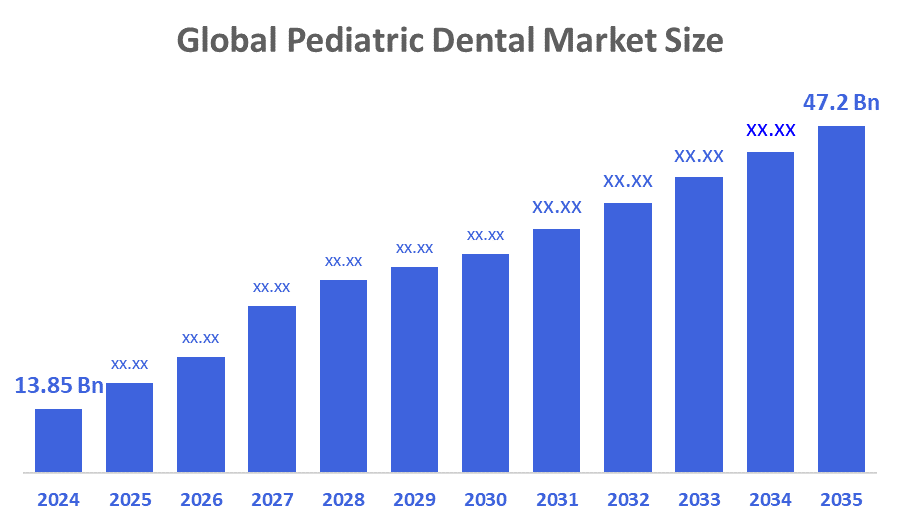
According to Decision Advisors, The Global Pediatric Dental Market Size is expected to Grow from USD 13.85 Billion in 2025 to USD 47.2 Billion by 2035, at a CAGR of 13.04% during the forecast period 2025-2035. Global Pediatric dental market is driven by the rising prevalence of dental caries (cavities), increasing parental awareness of oral health, and rapid advancements in dental technology, such as digital dentistry and clear aligners.
Market Overview/ Introduction
The worldwide pediatric dental market includes products and services designed for the oral health of babies, children, and teenagers. It encompasses preventive care (sealants), restorative materials (crowns), orthodontics, and diagnostic tools, motivated by high rates of dental caries and growing awareness of early oral care. There are technological advancements like the innovation in the painless dentistry and improved, and all the belongings durable restorative materials improve the patient experience and compliances. AI is under investigation for its potential to alleviate dental anxiety via virtual reality (VR) and enhance the precision of diagnoses. Future expansion depends on the incorporation of 3D printing for custom crowns and the application of 3D imaging to expedite treatment and reduce invasiveness. There is also the high demand for innovative products such as child-friendly electric toothbrushes and fluoride toothpaste, which constitute a significant portion of the market.
- The World Health Organization (WHO) is promoting universal health coverage (UHC) for oral health by 2030 through its global strategy and action plan, encouraging countries to integrate oral health services into primary healthcare systems.
- Governments in GCC countries are expanding healthcare insurance systems, increasingly including pediatric dental services such as preventive check-ups and basic treatments.
- Under the Affordable Care Act, pediatric dental care is an Essential Health Benefit, with Medicaid and Children’s Health Insurance Program expanding access, over 90% of U.S. children have coverage, driving strong demand in the pediatric dental market.
- Community oral health outreach programs using mobile dental units provide school-based screenings, fluoride treatments, and basic care for children aged 3–14 years, improving access for underserved populations and driving growth in the pediatric dental market.
Notable Insights: -
- Asia-Pacific holds the largest regional market share approximately 54% in the Pediatric Dental Market.
- Asia Pacific is the fastest growing region in the pediatric dental market.
- By type, the primary segment held a dominant position with 55% in terms of market share in 2025.
- By disease type, dental carries segment is the dominating accounting for over 37% of the global market share in 2025.
- The compound annual growth rate of the pediatric dental market is 13.04%.
- The market is likely to achieve a valuation of USD 47.2 billion by 2035.
What is role of technology in grooming the market?
Technological advancement is playing a transformative role in shaping the pediatric dental market, enabling a shift toward precision-driven, preventive, and accessible care models. The integration of artificial intelligence (AI) is significantly enhancing diagnostic accuracy in detecting early-stage dental conditions and developmental anomalies, thereby improving clinical decision-making and reducing diagnostic variability. Furthermore, the emergence of teledentistry is expanding access to care, with studies indicating comparable diagnostic outcomes to traditional clinical examinations, supporting remote screening and consultation. Advanced digital tools, including intraoral scanners and low-radiation imaging systems, are enhancing procedural efficiency and patient comfort. Additionally, innovations such as 3D-printed restorations and data-driven personalized treatment planning are reducing treatment time and operational costs, thereby improving overall service delivery.
How is Recent Developments Helping the Market?
Recent developments are significantly accelerating the pediatric dental market by improving diagnostics, accessibility, and treatment efficiency. The adoption of AI-driven tools is enhancing early detection of dental caries, which affects nearly 60–90% of children globally, increasing preventive care demand. Digital technologies such as intraoral scanners and low-radiation imaging are improving treatment accuracy and child comfort. Teledentistry is expanding access in underserved regions, while minimally invasive techniques and laser dentistry are boosting patient compliance. Additionally, innovations like 3D-printed restorations and personalized treatment planning are reducing procedure time and costs. With over 90% of children in developed markets having some form of dental coverage, these advancements are driving higher utilization rates, improving outcomes, and supporting sustained growth in the pediatric dental market.
Market Drivers
The pediatric dental market is witnessing sustained expansion, driven by a confluence of structural and demand-side factors. The rising prevalence of dental caries among children, coupled with increasing awareness regarding early oral health intervention, is significantly augmenting service uptake. Government-led initiatives and policy frameworks, including insurance coverage expansions and school-based oral health programs, are enhancing accessibility and affordability. Concurrently, advancements in dental technologies such as minimally invasive procedures, digital diagnostics, and teledentistry are improving treatment outcomes and patient compliance. Demographic trends, particularly the growing pediatric population in emerging economies, further reinforce market potential. Additionally, the proliferation of specialized pediatric dental clinics and increased investments from private healthcare providers are strengthening service infrastructure, thereby catalysing market growth in both developed and developing regions.
Restrain
The pediatric dental market faces restraints due to high treatment costs, limited insurance coverage in developing regions, and unequal access to dental care in rural areas. A shortage of trained pediatric dentists further restricts service availability, while low awareness among parents and dental anxiety in children reduce regular visits, ultimately hindering market growth despite rising disease prevalence.
Competitive Analysis:
The report offers the appropriate analysis of the key organizations/companies involved within the Pediatric Dental market, along with a comparative evaluation primarily based on their product of offering, business overviews, geographic presence, enterprise strategies, segment market share, and SWOT analysis. The report also provides an elaborative analysis focusing on the current news and developments of the companies, which includes product development, innovations, joint ventures, partnerships, mergers & acquisitions, strategic alliances, and others. This allows for the evaluation of the overall competition within the market.
Top Companies in Global Pediatric Dental Market
- Colgate-Palmolive Company
- Procter & Gamble
- Johnson & Johnson
- Unilever
- Dentsply Sirona
- 3M
- Henry Schein Inc.
- Danaher Corporation
- GlaxoSmithKline (GSK)
- Align Technology.
Government Initiatives
|
Country |
Key Government Initiatives |
|
UK |
The UK government provides free NHS dental treatment for children under 18 and those under 19 in full-time education, significantly increasing access to pediatric dental services and driving consistent demand. This government-supported coverage encourages regular check-ups, preventive care, and early treatment among children |
|
US |
In the United States, the American Academy of Pediatric Dentistry (AAPD) promotes the establishment of a dental home by age one to support early diagnosis and preventive care. The organization also advocates for increased federal funding, including over $14 million for pediatric dental training programs, to strengthen the workforce. |
|
Japan |
Japan’s 8020 Campaign, a long-standing national oral health initiative, encourages individuals to retain at least 20 of their natural teeth by the age of 80. The campaign emphasizes the importance of establishing strong oral hygiene habits from early childhood to prevent long-term tooth loss. |
Market Segmentation
The pediatric dental market share is classified into type, disease type, and procedure.
- The primary segment dominated the market in 2025, and is projected to grow at a substantial CAGR of approximately 55% during the forecast period.
Based on the type, the pediatric dental market is divided primary, permanent. Among these, the primary segment dominated the market in 2025, and is projected to grow at a substantial CAGR of approximately 55% during the forecast period. The dominance is because of the high incidence of dental caries (tooth decay) among children aged 3–5, necessitating comprehensive preventive and restorative interventions. This segment is expanding quickly because of the necessity to maintain permanent teeth in older children and adolescents, with an emphasis on orthodontic assessments, early caries treatment, and the preservation of long-term oral health.
- The dental caries segment accounted for the largest share in 2025, and is anticipated to grow at a significant CAGR of approximately 37 % during the forecast period.
Based on the diseases type, the pediatric dental market is divided into dental caries, enamel disorders. Among these, the dental caries segment accounted for the largest share in 2025, and is anticipated to grow at a significant CAGR of approximately 37 % during the forecast period. It is driven by high sugar consumption, poor oral hygiene, and the need for frequent, recurring restorative treatments like fillings and sealants. Early childhood caries (ECC) is exceptionally prevalent, often described as a major, sugar-driven, bacterial-mediated health issue.
- The dental cleaning segment dominated the market in 2025, and is projected to grow at a substantial CAGR during the forecast period.
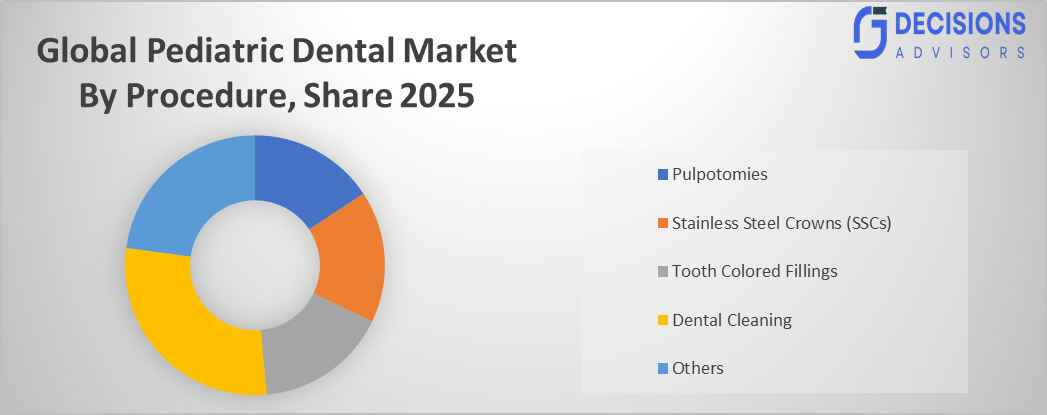
Based on the procedure, the pediatric dental market is divided into pulpotomies, stainless steel crowns (sscs), tooth colored fillings, dental cleaning, and others. Among these, the dental cleaning segment dominated the market in 2025, and is projected to grow at a substantial CAGR during the forecast period. This segment is at the forefront due to the high frequency of preventive care measures, such as plaque removal to avert decay, which is usually advised every 8-16 weeks for patients at high risk. The overall market is propelled by the growth of dental clinics, heightened dental awareness, and a high incidence of caries, with North America at the forefront in usage.
Strategies to Implement for Growth of the Market in Non-Leading Regions
Growth of the pediatric dental market in non-leading regions can be achieved through a combination of improved access, affordability, awareness, and technological adoption. Expanding mobile dental clinics and school-based programs helps reach underserved populations, while strengthening preventive care through fluoride treatments, sealants, and routine checkups reduces long-term disease burden. Increasing parental awareness via education campaigns and digital platforms encourages early dental visits and better oral hygiene practices. Introducing low-cost treatment models, micro-insurance, and government-supported coverage addresses affordability barriers, while workforce development ensures adequate availability of trained pediatric dentists in rural and semi-urban areas. Additionally, leveraging teledentistry and AI-driven diagnostic tools enhances access and efficiency, particularly in remote regions.
Regional Segment Analysis of the Pediatric Dental Market
- North America (U.S., Canada, Mexico)
- Europe (Germany, France, U.K., Italy, Spain, Rest of Europe)
- Asia-Pacific (China, Japan, India, Rest of APAC)
- South America (Brazil and the Rest of South America)
- The Middle East and Africa (UAE, South Africa, Rest of MEA)
North America is anticipated to hold the largest share of the pediatric dental market over the predicted timeframe. This is attributable to its sophisticated and reliable healthcare infrastructure, elevated parental consciousness regarding oral health, and extensive insurance coverage. This sustained market leadership is driven by a high prevalence of pediatric dental issues, an increasing demand for early orthodontic intervention, and a growing number of specialized dentists. Robust insurance policies, particularly in the US, frequently cover preventative and restorative procedures for children, increasing access to care.
For instance, Virtual-first dental care solutions, such as those offered by Dentistry. One, leverage AI and teledentistry to enable remote screenings and consultations; with telehealth adoption rising over 38% post-pandemic, these innovations are improving access and driving pediatric dental market growth.
Asia Pacific is expected to grow at a rapid CAGR in the pediatric dental market during the forecast period. Asia Pacific is expected to witness rapid growth in the pediatric dental market due to favorable demographic and economic dynamics. The region accounts for a significant share of the global pediatric population, particularly in countries like India and China, creating strong demand for dental services. Additionally, improving healthcare infrastructure and rising awareness of pediatric oral health are accelerating service adoption.
For Instance, The June 2025 launch of ORALPEACE Baby Tooth Gel, a fluoride-free, plant-derived, and safe-to-swallow formulation for infants and children, reflects the growing demand for natural, premium pediatric oral care products, particularly in Japan, supporting pediatric dental market expansion.
Europe is the 3rd largest region to grow in the pediatric dental market during the region. Europe’s position as the third-largest region in the pediatric dental market is driven by several interrelated factors. Rising awareness of oral health among parents and caregivers is increasing routine dental visits and preventive care for children. Government initiatives, including school-based dental programs and expanded insurance coverage, are improving access to pediatric dental services. Additionally, higher disposable incomes in Western and Northern European countries enable families to invest in premium oral care products and treatments.
Future Market Trends in Pediatric Dental Market: -
- Minimally Invasive Dentistry & Prevention: A significant change towards stopping decay before it necessitates treatment, employing techniques such as Silver Diamine Fluoride (SDF) to halt cavities without the need for drilling. It is becoming routine and standardized to provide early prevention using fluoride varnish and sealants.
- Aesthetic and Pediatric-Focused Materials: There is an increasing demand for tooth-colored restorative materials (such as composite fillings) over traditional metal options, prioritizing cosmetic outcomes for children.
- Teledentistry and Remote Care: Digital platforms have become essential, enabling virtual consultations, early intervention, and triaging, particularly for young patients experiencing dental anxiety.
Recent Development
- In March 2024, Overjet launched Overjet for Kids, an FDA-cleared AI technology designed to detect, outline, and quantify tooth decay in children aged 4 and above, strengthening early diagnosis and digital innovation within the pediatric dental market.
- In August 2023, Babigans introduced a new range of organic toothpaste and toothbrushes specifically designed for infants. The launch highlights the growing demand for safe, chemical-free oral care products and supports early-stage dental hygiene adoption in the pediatric dental market.
- In June 2023, Procter & Gamble expanded its Oral-B portfolio by introducing baby-friendly toothpaste products tailored for infants and toddlers. This development reflects increasing innovation and brand focus on age-specific oral care solutions within the pediatric dental market.
Market Segment
This study forecasts revenue at global, regional, and country levels from 2020 to 2035. Decision Advisor has segmented the pediatric dental market based on the below-mentioned segments:
Global Pediatric Dental Market, By Type
- Primary
- Permanent
Global Pediatric Dental Market, By Disease Type
- Dental Caries
- Enamel Disorders
Global Pediatric Dental Market, By Procedure
- Pulpotomies
- Stainless Steel Crowns (SSCs)
- Tooth Colored Fillings
- Dental Cleaning
- Others
Global Pediatric Dental Market, By Regional Analysis
- North America
- US
- Canada
- Mexico
- Europe
- Germany
- UK
- France
- Italy
- Spain
- Russia
- Rest of Europe
- Asia Pacific
- China
- Japan
- India
- South Korea
- Australia
- Rest of Asia Pacific
- South America
- Brazil
- Argentina
- Rest of South America
- Middle East & Africa
- UAE
- Saudi Arabia
- Qatar
- South Africa
- Rest of the Middle East & Africa
Frequently Asked Questions (FAQ)
Q. What role do emerging technologies like 3D printing and teledentistry play in expanding access to pediatric dental services in remote regions?
A.3D printing creates precise restorations; teledentistry enables remote consultations and screenings, improving timely access to pediatric dental care in underserved or rural regions.
Q. How do cultural and dietary habits across regions influence the prevalence of dental caries among children?
A.High sugar intake, poor oral hygiene, and regional dietary practices increase caries prevalence, requiring targeted preventive strategies and parental education programs.
Q. Which government policies or insurance schemes have proven most effective in increasing pediatric dental coverage, and how do they vary globally?
A. Programs like Medicaid (US), NHS coverage (UK), and GCC insurance reduce financial barriers, improve access, and promote routine preventive dental care for children.
Q. What are the main challenges in integrating minimally invasive techniques into standard pediatric dental practice?
A. High equipment costs, limited specialist training, low awareness, and inconsistent insurance coverage hinder adoption of minimally invasive procedures like lasers or SDF treatments.
Q. How do organic and plant-based oral care products influence parental purchasing decisions in the pediatric dental segment?
A. Parents prefer safe, natural, and child-friendly products, driving demand for organic toothpastes, gels, and eco-friendly oral care solutions in the pediatric segment.
Check Licence
Choose the plan that fits you best: Single User, Multi-User, or Enterprise solutions tailored for your needs.
We Have You Covered
- 24/7 Analyst Support
- Clients Across the Globe
- Tailored Insights
- Technology Tracking
- Competitive Intelligence
- Custom Research
- Syndicated Market Studies
- Market Overview
- Market Segmentation
- Growth Drivers
- Market Opportunities
- Regulatory Insights
- Innovation & Sustainability
Report Details
| Scope | Global |
| Pages | 257 |
| Delivery | PDF & Excel via Email |
| Language | English |
| Release | Mar 2026 |
| Access | Download from this page |