
Global Pertussis Market
 |
Pages:
245
|
Pages:
245
Global Pertussis Market Size, Share, By Vaccine Type (Whole-cell Pertussis (wP) Vaccines, Acellular Pertussis (aP) Vaccines), By Product Type (DTP (Diphtheria, Tetanus, Pertussis), DTaP (Diphtheria, Tetanus, Acellular Pertussis), Tdap (Tetanus, Diphtheria, Acellular Pertussis ? booster)), By Distribution Channel (Public Sector (Government Immunization Programs), Private Sector (Hospitals, Clinics, Pharmacies)),and By Region (North America, Europe, Asia-Pacific, Latin America, Middle East & Africa), Analysis and Forecast 2025-2035
REPORT COVERAGE
Global
Market Snapshot
- Market Size (2025): USD 4.51 Billion
- Projected Market Size (2035): USD 8.29 Billion
- Compound Annual Growth Rate (CAGR): 6.28%
- Largest Regional Market: North America
- Fastest Growing Region: Asia-Pacific
- 3rd Largest Region: Europe
- Base Year: 2025
- Historical Period: 2021–2024
- Forecast Period: 2026–2035
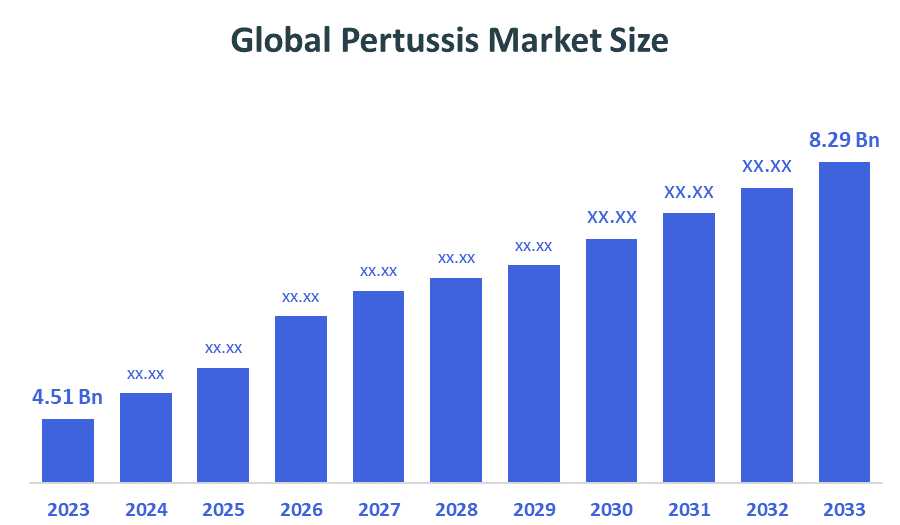
According to Decision Advisors, the Global Pertussis Market Size is expected to grow from USD 4.51 billion in 2024 to USD 8.29 billion by 2035, at a CAGR of 6.28% during the forecast period 2025-2035. The global pertussis market is projected to grow significantly over the next decade, fuelled by rising infection rates, high demand for diagnostic tools, increased vaccination coverage, waning immunity and vaccine shift, improved diagnostic technology, vaccination policies, and market vulnerability.
Market Overview/ Introduction
The global pertussis market refers to all activities involved in the development of vaccines, diagnostic tools, and methods of treatment for pertussis disease prevention and control. Pertussis is a highly contagious bacterial respiratory infection that infects a person when he or she is infected by the bacteria Bordetella pertussis and leads to severe coughing fits that threaten the health of infants and young children. The market experiences continuous development because vaccination rates worldwide increase, together with the establishment of stronger vaccination and disease monitoring systems. The shift toward acellular vaccines has increased the need for booster doses due to waning immunity. The market expansion receives additional support from the growth of diagnostic technologies through PCR, the rising importance of maternal and adolescent vaccination, and increasing public knowledge about disease prevention.
- The Expanded Programme on Immunization highlights the global expansion of vaccination coverage, including pertussis. Growing immunization programs across all age groups boost vaccine demand, improve disease prevention, and strengthen healthcare infrastructure, supporting sustained growth and wider adoption of pertussis-containing vaccines worldwide.
- India’s introduction of the Td vaccine, aligned with World Health Organization recommendations, strengthens adult immunization and booster coverage. It enhances awareness of combination vaccines like DTP, supports lifecycle vaccination strategies, and indirectly boosts demand for pertussis-containing vaccines, contributing to overall market growth and improved disease prevention.
Notable Insights: -
- North America is anticipated to hold the largest share of approximately 41% the pertussis market over the forecast period.
- Asia Pacific is expected to grow at a rapid CAGR of approximately 13.70% in the pertussis market during the forecast period.
- The biologics segment dominated the market in 2025 and is projected to grow to approximately 50% of market share during the forecast period.
- The topical segment accounted for the largest share in 2025, and it's anticipated to grow at a significant CAGR of approximately 7.5% during the forecast period.
- The retail pharmacies segment dominated the market in 2025 and is projected to grow at a substantial CAGR of approximately 7% during the forecast period.
- The compound annual growth rate of the Global Pertussis Market is 6.28%.
- The market is likely to achieve a valuation of USD 8.29 billion by 2035.
What is role of technology in grooming the market?
Technology plays a vital role in shaping the growth of the Pertussis market by enhancing vaccine development, diagnostics, and disease surveillance. Advances in biotechnology have enabled the creation of more effective and safer acellular and next-generation vaccines, including innovative delivery methods such as intranasal formulations. Digital health tools and data analytics support real-time monitoring of outbreaks and improve immunization strategies. Additionally, improved cold-chain logistics and vaccine storage technologies ensure efficient distribution, especially in remote regions. Integration of electronic health records and immunization tracking systems further boosts vaccination coverage, helping governments and healthcare providers implement targeted prevention programs and drive overall market growth.
Market Drivers
The global pertussis market is experiencing strong growth due to the transition from whole-cell to acellular vaccines has resulted in faster waning immunity, thereby increasing the need for booster doses among adolescents and adults. Advancements in Polymerase Chain Reaction (PCR) technology have significantly improved disease detection and reporting rates, enhancing overall monitoring. Additionally, increasing focus on maternal and adolescent vaccination programs, along with rising public awareness about disease prevention, further supports market expansion. Meanwhile, vaccine hesitancy, despite being a challenge, indirectly contributes to the adoption of preventive strategies and increased vaccination efforts globally.
Restrain
The global pertussis market faces restraints due to limited vaccine access in low-income regions, high costs of immunization programs, and logistical challenges in cold-chain distribution. Additionally, vaccine hesitancy, waning immunity over time, and stringent regulatory requirements can hinder widespread adoption and market growth.
Competitive Analysis:
The report offers the appropriate analysis of the key organizations/companies involved within the Global Pertussis Market, along with a comparative evaluation primarily based on their product of offering, business overviews, geographic presence, enterprise strategies, segment market share, and SWOT analysis. The report also provides an elaborative analysis focusing on the current news and developments of the companies, which includes product development, innovations, joint ventures, partnerships, mergers & acquisitions, strategic alliances, and others. This allows for the evaluation of the overall competition within the market.
Top Companies in Global Pertussis Market
- Sanofi Pasteur
- GlaxoSmithKline plc
- Merck & Co., Inc.
- Pfizer Inc.
- AstraZeneca
- Johnson & Johnson
- Novartis AG
- CSL Limited
- Takeda Pharmaceutical Company Limited
- Serum Institute of India Pvt. Ltd.
- Bharat Biotech
- Panacea Biotec Ltd.
Government Initiatives
|
Country |
Key Government Initiatives |
|
UK |
Consensus recommend from the Global Pertussis Initiative highlight the importance of vaccination during pregnancy to protect infants, emphasizing safety and effectiveness. Such global guidance promotes wider adoption of maternal immunization programs, increases vaccine demand, and supports market growth by improving awareness, coverage, and preventive healthcare strategies worldwide |
|
India |
India’s National Vaccination Day highlights the success of the Pulse Polio Programme in eliminating polio. This reinforces public trust in vaccination programs, positively influencing the pertussis market by encouraging higher vaccine acceptance, strengthening immunization infrastructure, and supporting the uptake of routine vaccines including DTP/DTaP. |
|
China |
China’s updated pertussis guidelines recommend a preschool DTaP booster and introduce a fifth DTP dose for 6-year-olds from January 2025. The revised schedule enhances immunization coverage, reflecting global best practices and supporting increased vaccine demand, improved disease control, and positive growth prospects for the pertussis vaccine market. |
Market Segmentation
The pertussis market share is classified into vaccine type, product type, and distribution channel
- The acellular pertussis (aP) vaccines segment dominated the market in 2025 and is anticipated to grow at a significant CAGR of approximately 17.8% during the forecast period.
Based on the vaccine type, the pertussis market is divided into whole-cell pertussis (wP) vaccines, and acellular pertussis (aP) vaccines. Among these, the acellular pertussis (aP) vaccines segment dominated the market in 2025 and is anticipated to grow at a significant CAGR of approximately 17.8% during the forecast period. Due to their superior safety profile and fewer side effects compared to whole-cell vaccines. Their widespread use in developed countries, inclusion in booster immunization schedules, and strong regulatory recommendations drive higher adoption and sustained demand globally.
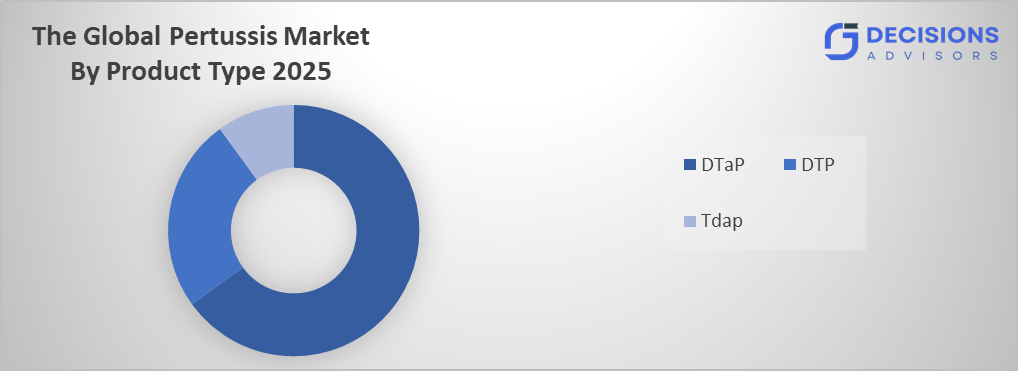
- The DTaP (Diphtheria, Tetanus, Acellular Pertussis) segment accounted for the largest share in 2025 contributing of approximately 48% during the forecast period.
Based on the product type, the pertussis market is divided into topical, injectable, and oral. Among these, the DTaP (Diphtheria, Tetanus, Acellular Pertussis) segment accounted for the largest share in 2025, contributing approximately 48% during the forecast period. Due to its improved safety profile and reduced side effects compared to whole-cell vaccines, increasing parental preference and immunization coverage. Strong government vaccination programs, rising awareness, and inclusion in routine childhood immunization schedules further drive its widespread adoption globally.
- The public sector (Government Immunization Programs) segment dominated the market in 2025 accounting for of approximately 62% of the global pertussis vaccine market during the forecast period.
Based on the distribution channel, the pertussis market is divided into hospital pharmacies, retail pharmacies, and online pharmacies. Among these, the public sector (Government Immunization Programs) segment dominated the market in 2025 accounting for of approximately 62% of the global pertussis vaccine market during the forecast period. The growth of public sector segment is growing due to strong government-led immunization programs, bulk vaccine procurement, and funding support from global health organizations. Expanding vaccination coverage, especially in developing countries, along with mandatory immunization policies and awareness campaigns, continues to drive large-scale adoption.
Strategies to Implement for Growth of the Market in Non-Leading Regions
To drive growth in non-leading regions of the Pertussis market, governments and stakeholders should focus on expanding immunization coverage through national vaccination programs and outreach campaigns. Strengthening healthcare infrastructure and cold-chain logistics is essential to ensure vaccine availability in remote areas. Public awareness initiatives can improve vaccine acceptance and early diagnosis. Partnerships with global organizations such as the World Health Organization can support funding and policy development. Additionally, introducing affordable vaccines, encouraging local manufacturing, and implementing school-based and maternal immunization programs can significantly enhance vaccination rates and drive market growth.
Regional Segment Analysis of the Pertussis Market
- North America (U.S., Canada, Mexico)
- Europe (Germany, France, U.K., Italy, Spain, Rest of Europe)
- Asia-Pacific (China, Japan, India, Rest of APAC)
- South America (Brazil and the Rest of South America)
- The Middle East and Africa (UAE, South Africa, Rest of MEA)
North America is anticipated to hold the largest share of approximately 35% the pertussis market over the forecast period.
North America is anticipated to hold the largest share of approximately 35% the pertussis market over the forecast period. The dominance of this region is primarily driven by the strong vaccination programs, high awareness, and advanced healthcare infrastructure. Support from agencies like the Centers for Disease Control and Prevention ensures high immunization coverage, while continuous surveillance and booster dose recommendations drive sustained demand for vaccines.
Asia Pacific is expected to grow at a rapid CAGR of approximately 8.5% in the pertussis market during the forecast period.
Asia Pacific is expected to grow at a rapid CAGR of approximately 8.5% in the pertussis market during the forecast period. This growth is driven by the growing prevalence of the rising population, increasing incidence of Pertussis, and expanding immunization programs. Improving healthcare infrastructure, growing awareness, and government vaccination initiatives in countries like India and China further support market growth.
Europe is the 3rd largest region to grow in the pertussis market during the period.
Europe is the third largest region in the pertussis market due to well-established immunization programs, strong healthcare infrastructure, and high awareness levels. Countries such as Germany, France, and United Kingdom support growth through routine vaccination schedules, booster dose recommendations, and continuous disease surveillance.
Future Market Trends in Global Pertussis Market: -
1. Development of Next-Generation and Intranasal Vaccines
The development of next-generation and intranasal vaccines is driving growth in the Pertussis market by improving efficacy and ease of administration. Needle-free delivery enhances patient compliance, while ongoing innovation supports better disease prevention, expands vaccination coverage, and strengthens future market potential.
2. Expansion of Immunization Programs and Booster Doses
Expansion of immunization programs and booster doses is driving growth in the Pertussis market by increasing vaccination coverage across all age groups. Enhanced government initiatives, maternal immunization, and routine booster recommendations improve disease prevention, reduce outbreaks, and boost demand for vaccines globally.
3. Rising Focus on Preventive Healthcare and Early Diagnosis
Rising focus on preventive healthcare and early diagnosis is boosting the Pertussis market by encouraging timely vaccination and detection. Improved awareness, screening programs, and surveillance systems help reduce disease spread, enhance patient outcomes, and increase demand for vaccines and diagnostic solutions globally. Global Pertussis.
Recent Development
In March 2026, with seven cases reported in early 2026, exceeding the previous year’s rate, the Guam Department of Public Health and Social Services organized a one-day vaccination clinic. It administered DTaP for children and Tdap for adults, including pregnant women, to control pertussis spread.
In February 2026, Australian whooping cough cases reached their highest level in 35 years, highlighting a significant surge. The disease proved particularly dangerous for babies, though it affected all age groups. Vaccination remained a key line of defence, emphasizing the importance of immunization in controlling outbreaks.
In December 2025, a new intranasal vaccine candidate, BPZE1, demonstrated encouraging results in reducing colonisation by Bordetella pertussis. Findings from a randomized Phase 2b trial at University Hospital Southampton and the University of Oxford confirmed its safety and efficacy in healthy adults aged 18–50 years.
How is Recent Developments Helping the Market?
Recent developments are significantly supporting the growth of the Pertussis market by advancing vaccine innovation and expanding immunization coverage. The development of next-generation vaccines, including intranasal candidates, is improving efficacy and patient compliance. Increased government initiatives and outbreak responses are boosting vaccination campaigns and public awareness. Additionally, regulatory approvals and ongoing clinical trials are strengthening the product pipeline. Organizations such as World Health Organization are promoting global immunization programs, further enhancing market expansion. Technological advancements in vaccine development and increased focus on preventive healthcare are also driving demand, ensuring sustained growth and improved disease control globally.
Market Segment
This study forecasts revenue at global, regional, and country levels from 2020 to 2035. Decision Advisors has segmented the pertussis market based on the below-mentioned segments:
Global Pertussis Market, By Drug Class
- Biologics
- Calcineurin Inhibitors
- PDE-4 Inhibitor
- Corticosteroids
- Others
Global Pertussis Market, By Mode of Administration
- Topical
- Injectable
- Oral
Global Pertussis Market, By Distribution Channel
- Hospital Pharmacies
- Retail Pharmacies
- Online Pharmacies
Global Pertussis Market, By Regional Analysis
- North America
- US
- Canada
- Mexico
- Europe
- Germany
- UK
- France
- Italy
- Spain
- Russia
- Rest of Europe
- Asia Pacific
- China
- Japan
- India
- South Korea
- Australia
- Rest of Asia Pacific
- South America
- Brazil
- Argentina
- Rest of South America
- Middle East & Africa
- UAE
- Saudi Arabia
- Qatar
- South Africa
- Rest of the Middle East & Africa
Frequently Asked Questions (FAQ)
Q How does urbanization impact the growth of the pertussis market?
A. Rapid urbanization increases population density, which can accelerate the spread of Pertussis. This raises the demand for vaccination programs, surveillance systems, and diagnostic tools, thereby supporting market growth, especially in developing economies.
Q. What role do combination vaccines play in the pertussis market?
A. Combination vaccines such as DTaP and Tdap simplify immunization schedules by protecting against multiple diseases in a single dose. This improves patient compliance, reduces healthcare costs, and increases vaccination coverage, thereby boosting overall market demand.
Q. How do global travel and migration influence the pertussis market?
A. Increased international travel and migration contribute to the spread of infectious diseases like pertussis across regions. This drives the need for consistent immunization policies, booster doses, and improved cross-border disease surveillance, positively impacting market expansion.
Q. What is the impact of pediatric healthcare investments on the pertussis market?
A. Rising investments in pediatric healthcare infrastructure enhance access to vaccines and early diagnosis. Improved healthcare facilities, especially in emerging regions, support higher immunization rates and strengthen disease prevention strate
Check Licence
Choose the plan that fits you best: Single User, Multi-User, or Enterprise solutions tailored for your needs.
We Have You Covered
- 24/7 Analyst Support
- Clients Across the Globe
- Tailored Insights
- Technology Tracking
- Competitive Intelligence
- Custom Research
- Syndicated Market Studies
- Market Overview
- Market Segmentation
- Growth Drivers
- Market Opportunities
- Regulatory Insights
- Innovation & Sustainability
Report Details
| Scope | Global |
| Pages | 245 |
| Delivery | PDF & Excel via Email |
| Language | English |
| Release | Apr 2026 |
| Access | Download from this page |