
Global Pharmaceutical Granulators Market
 |
Author:
David J
|
Pages:
210
|
Author:
David J
|
Pages:
210
Global Pharmaceutical Granulators Market Size, Share, By Product Type (Single Pot Granulators, High Shear Granulators, Fluid Bed Granulators, Oscillating Granulators), By Application (Tablets, Capsules, Powders), By End Use (Pharmaceutical Manufacturing Companies, Contract Manufacturing Organizations, Research & Academic Institutes, Nutraceutical & Chemical Industries), and By Region (North America, Europe, Asia-Pacific, Latin America, Middle East & Africa), Analysis and Forecast 2026?2035
CAGR
5.66%
REVENUE 2025
USD Million 4611.78
FORECAST 2035
USD Million 7996.86
REPORT COVERAGE
Global
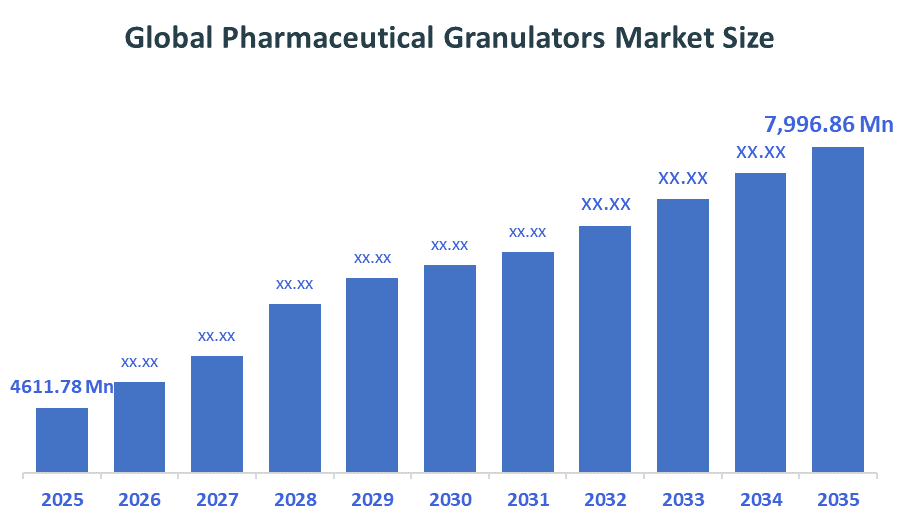
The Global Pharmaceutical Granulators Market Size is forecast to grow from USD 4,611.78 Million in 2025 to approximately USD 7,996.86 Million by 2035. According to Decision Advisors, a detailed research report on the Pharmaceutical granulators market indicates that automation in granulators dominates the market, accounting for approximately 30-35% of the total share globally. Novo Nordisk the market with an estimated 12-15% global market share. The company reported a 2025 revenue of approximately USD 5.4-5.8 Billion, making it one of the most influential forces shaping industry trends and overall market growth.
Market Snapshot
- Global Pharmaceutical Granulators Market Size (2025): USD 4,611.78 Million
- Projected Global Pharmaceutical Granulators Market Size (2035): USD 7,996.86 Million
- Global Pharmaceutical Granulators Market Compound Annual Growth Rate (CAGR): 5.66%
- Largest Regional Market: North America
- Fastest Growing Region: Asia-Pacific
- 2nd Largest Region: Europe
- Base Year: 2025
- Historical Period: 2021–2024
- Forecast Period: 2026–2035
Market Overview/ Introduction
The Global Pharmaceutical Granulators Market refers to the worldwide industry involved in the design, manufacturing, and distribution of equipment used to convert fine powders into uniform granules for solid dosage drug forms. Pharmaceutical granulators are machines that improve powder flowability, compressibility, and content uniformity, enabling efficient production of tablets, capsules, and other oral solid medicines. The market is expected to expand significantly due to increasing demand for high-quality and consistent drug formulations, rising chronic disease prevalence, and growth in generic drug manufacturing. Future opportunities lie in continuous manufacturing systems, automation, and Industry 4.0 integration. Market growth is further driven by pharmaceutical R&D expansion, regulatory compliance requirements (GMP standards), and increasing outsourcing of drug production to CMOs, especially in emerging economies with cost-efficient manufacturing capabilities.
- India’s PLI scheme promotes domestic pharmaceutical manufacturing by offering financial incentives for bulk drugs, APIs, and complex formulations. It encourages investment in advanced production infrastructure, including granulation equipment. The scheme reduces import dependency, strengthens supply chains, and boosts the adoption of modern, high-efficiency manufacturing technologies in pharmaceutical plants.
- The SPI scheme supports MSMEs and pharma clusters through infrastructure upgradation, common facility centers, and technology modernization. It directly improves manufacturing quality and efficiency by encouraging GMP compliance and advanced processing equipment adoption, including granulators used in tablet and capsule production lines.
Notable Insights: -
- North America is anticipated to hold the largest share of approximately 39% in the Pharmaceutical granulators market over the forecast period.
- Asia Pacific is expected to grow at a rapid CAGR of approximately 10% in the Pharmaceutical granulators market during the forecast period.
- The high shear granulators segment dominated the market in 2025, approximately 38%, and is projected to grow at a substantial CAGR during the forecast period.
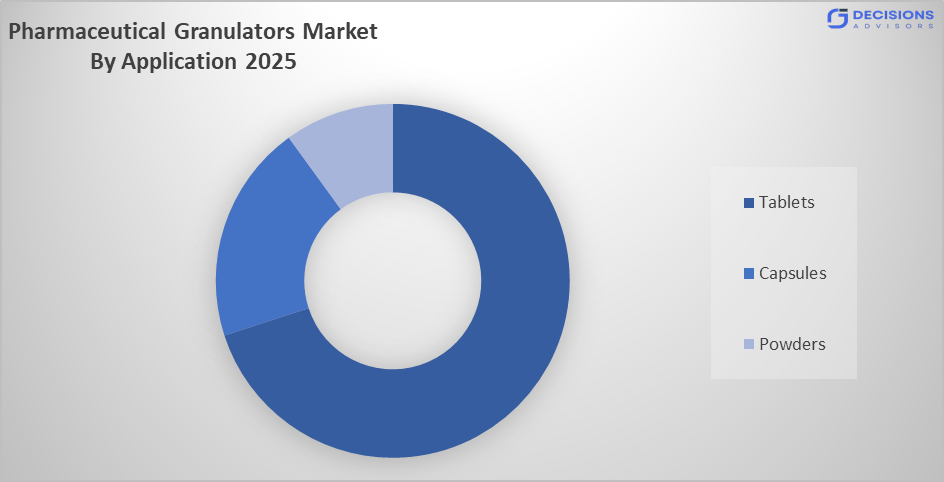
- The tablets segment dominated the market in 2025, approximately 65%, and is projected to grow at a substantial CAGR during the forecast period.
- The pharmaceutical manufacturing companies segment dominated the market in 2025, approximately 55%, and is projected to grow at a substantial CAGR during the forecast period.
- The compound annual growth rate of the Global Pharmaceutical Granulators Market is 5.66%.
- The market is likely to achieve a valuation of USD 7,996.86 Million by 2035.
What is role of technology in grooming the market?
Technology plays a crucial role in shaping the growth of the Global Pharmaceutical Granulators Market by improving efficiency, precision, and scalability in drug manufacturing. Advanced technologies such as automation, Industry 4.0 integration, and continuous manufacturing systems enable real-time monitoring and control of granulation processes, ensuring uniform particle size and consistent drug quality. High-shear, fluid bed, and hybrid granulators now incorporate digital sensors and PLC-based systems for better process optimization. Artificial intelligence and data analytics further enhance predictive maintenance and reduce operational downtime. The adoption of closed-system and contained granulation technologies improves safety and compliance with GMP regulations. Additionally, innovations in energy-efficient and single-pot systems reduce production costs. Overall, technological advancements are transforming pharmaceutical manufacturing into a more streamlined, scalable, and quality-driven process, significantly driving market expansion globally.
Market Drivers
The Global Pharmaceutical Granulators Market is driven by rising demand for solid oral dosage forms such as tablets and capsules, which require efficient granulation for uniformity and stability. Growth in chronic diseases and increasing pharmaceutical production volumes further boost demand for advanced granulation equipment. Strict regulatory requirements like GMP standards encourage manufacturers to adopt high-quality, automated systems. Expansion of generic drug manufacturing and outsourcing to CMOs also supports market growth. Additionally, technological advancements such as automation, continuous processing, and high-efficiency granulators improve productivity and reduce costs, further accelerating adoption across global pharmaceutical manufacturing facilities.
Restrain
The Global Pharmaceutical Granulators Market faces restraints due to high initial equipment and maintenance costs, limiting adoption among small manufacturers. Complex operation and need for skilled workforce also hinder usage. Additionally, stringent regulatory compliance and lengthy validation processes increase production time and operational expenses, slowing market expansion in developing regions.
Competitive Analysis:
The report offers the appropriate analysis of the key organizations/companies involved within the global pharmaceutical granulators market, along with a comparative evaluation primarily based on their product offerings, business overviews, geographic presence, enterprise strategies, segment market share, and SWOT analysis. The report also provides an elaborative analysis focusing on the current news and developments of the companies, which includes product development, innovations, joint ventures, partnerships, mergers & acquisitions, strategic alliances, and others. This allows for the evaluation of the overall competition within the market.
Top Companies in Global Pharmaceutical Granulators Market
- GEA Group Aktiengesellschaft
- Glatt GmbH
- Syntegon Technology GmbH
- Fette Compacting GmbH
- Alexanderwerk AG
- L.B. Bohle Maschinen + Verfahren GmbH
- Freund-Vector Corporation
- Romaco Group
- IMA S.p.A.
- Frewitt S.A.
Government Initiatives
|
Country |
Key Government Initiatives |
|
US |
The U.S. government is strengthening domestic pharmaceutical manufacturing through initiatives like the FDA PreCheck program, which accelerates approvals for new drug production facilities. It promotes GMP-compliant manufacturing, automation adoption, and supply chain resilience. These policies indirectly boost demand for advanced granulation systems used in high-quality tablet and capsule production. |
|
India |
India promotes pharmaceutical manufacturing through the Production Linked Incentive (PLI) scheme, supporting API and formulation production expansion. The government also focuses on GMP compliance, pharmaceutical cluster development, and modernization of manufacturing infrastructure. These initiatives encourage adoption of advanced granulators to enhance efficiency, quality, and global competitiveness of Indian pharma exports. |
|
China |
China supports pharmaceutical industry modernization under national manufacturing strategies like “Made in China 2025.” The government emphasizes automation, high-quality drug production, and advanced manufacturing technologies. This drives the adoption of modern granulation systems in large-scale pharmaceutical plants to improve productivity and strengthen domestic drug self-sufficiency and export capabilities. |
Study on the Supply, Demand, Distribution, and Market Environment of the Pharmaceutical Granulators Market
The Global Pharmaceutical Granulators Market is shaped by a balanced interplay of supply, demand, distribution, and market environment. On the supply side, leading manufacturers such as GEA, Glatt, and Syntegon provide advanced high-shear, fluid bed, and dry granulation systems with strong automation capabilities. Demand is driven by rising production of tablets and capsules, increasing chronic disease prevalence, and expansion of generic drug manufacturing. Distribution occurs through direct sales, specialized equipment distributors, and long-term contracts with pharmaceutical companies and CMOs. The market environment is highly regulated, with strict GMP, FDA, and EMA compliance standards ensuring product quality and safety. Additionally, growing adoption of Industry 4.0, continuous manufacturing, and cost-efficient production technologies is reshaping competitiveness. Emerging economies and outsourcing trends further strengthen global demand and long-term market expansion prospects.
Price Analysis and Consumer Behaviour Analysis
The pricing in the Global Pharmaceutical Granulators Market is highly capital-intensive, with advanced systems such as high-shear, fluid bed, and continuous granulators ranging from moderate to very high costs depending on capacity, automation level, and compliance features. Prices are influenced by regulatory requirements (GMP, FDA), customization needs, and integration of automation and Industry 4.0 technologies. Large-scale pharmaceutical companies prefer premium, fully automated systems despite higher costs due to better efficiency, consistency, and reduced operational downtime. Smaller manufacturers and CMOs show price-sensitive behavior, often opting for semi-automatic or refurbished equipment to control capital expenditure. Consumer behavior is driven by demand for reliability, low maintenance, energy efficiency, and multi-functional capabilities. Increasing outsourcing, expansion of generic drug production, and focus on lifecycle cost optimization are key factors shaping purchasing decisions in this market globally.
Market Segmentation
The Pharmaceutical Granulators Market share is classified into product type, application, and end user.
- The high shear granulators segment dominated the market in 2025, approximately 38%, and is projected to grow at a substantial CAGR during the forecast period.
Based on the product type, the pharmaceutical granulators market is divided into single pot granulators, high shear granulators, fluid bed granulators, and oscillating granulators. Among these, the high shear granulators segment dominated the market in 2025, with approximately 38, and is projected to grow at a substantial CAGR during the forecast period. The growth of the high shear granulators segment is driven by their fast processing speed, uniform granule formation, and wide use in tablet manufacturing. Their ability to handle both wet and dry granulation efficiently makes them highly preferred in large-scale pharmaceutical production, ensuring consistent quality and regulatory compliance.
- The tablets segment dominated the market in 2025, approximately 65%, and is projected to grow at a substantial CAGR during the forecast period.
Based on the application, the pharmaceutical granulators market is divided into tablets, capsules, and powders. Among these, the tablets segment dominated the market in 2025, approximately 65%, and is projected to grow at a substantial CAGR during the forecast period. The tablets segment dominated due to the pharmaceutical granulators market as they represent the most widely produced oral solid dosage form globally. Granulation is essential for tablet compressibility, uniformity, and stability. High demand for cost-effective mass production and patient-friendly dosage forms further strengthens tablet dominance.
- The pharmaceutical manufacturing companies segment dominated the market in 2025, approximately 55%, and is projected to grow at a substantial CAGR during the forecast period.
Based on the end user, the pharmaceutical granulators market is divided into pharmaceutical manufacturing companies, contract manufacturing organizations, research & academic institutes, and nutraceutical & chemical industries. Among these, the pharmaceutical manufacturing companies segment dominated the market in 2025, approximately 55%, and is projected to grow at a substantial CAGR during the forecast period. The growth of the pharmaceutical manufacturing companies segment is due to large-scale drug production requirements. They heavily invest in advanced granulation systems to improve efficiency, product consistency, and regulatory compliance. High-volume tablet and capsule production drives continuous demand for industrial-grade granulators.
Strategies to Implement for Growth of the Market in Non-Leading Regions
To accelerate growth of the Global Pharmaceutical Granulators Market in non-leading regions, companies should adopt targeted expansion strategies focused on affordability, localization, and capacity building. Establishing regional manufacturing units or assembly plants can reduce equipment costs and improve accessibility in emerging markets such as Latin America, Africa, and parts of Southeast Asia. Partnerships with local distributors and CMOs can strengthen distribution networks and after-sales service support. Offering modular, semi-automatic, and cost-effective granulation systems helps address budget constraints of small and mid-sized manufacturers. Training programs and technical workshops can improve operator skills and encourage adoption of advanced technologies. Additionally, government collaborations, favorable financing options, and leasing models can further boost adoption. Tailoring solutions to regional regulatory requirements and promoting energy-efficient, low-maintenance systems will enhance market penetration and long-term sustainable growth in these developing regions.
Regional Segment Analysis of the Pharmaceutical Granulators Market
- North America (U.S., Canada, Mexico)
- Europe (Germany, France, U.K., Italy, Spain, Rest of Europe)
- Asia-Pacific (China, Japan, India, Rest of APAC)
- South America (Brazil and the Rest of South America)
- The Middle East and Africa (UAE, South Africa, Rest of MEA)
North America is anticipated to hold the largest share of approximately 39% the pharmaceutical granulators market over the forecast period.
North America is anticipated to hold the largest share of approximately 39% the pharmaceutical granulators market over the forecast period. The dominance of this region is driven by its advanced pharmaceutical manufacturing infrastructure, strong presence of global drug manufacturers, and high adoption of automated production technologies. The U.S. dominates regional demand, driven by strict FDA regulations, large-scale solid dosage drug production, and continuous investment in advanced manufacturing equipment.
Asia Pacific is expected to grow at a rapid CAGR of approximately 10% in the pharmaceutical granulators market during the forecast period.
Asia Pacific is expected to grow at a rapid CAGR of approximately 10% in the pharmaceutical granulators market during the forecast period. This growth is fueled by rapid expansion of pharmaceutical manufacturing in India, China, and Southeast Asia. Increasing generic drug production, lower manufacturing costs, government support for domestic pharma industries, and rising outsourcing from Western countries are driving strong demand for granulation equipment.
Europe is the 2nd largest region to grow in the pharmaceutical granulators market during the period.
Europe is the second-largest region in the pharmaceutical granulators market, supported by strong pharmaceutical R&D, advanced manufacturing standards, and strict GMP regulations. Countries such as Germany, Switzerland, and the UK lead due to high adoption of automated and precision-based granulation systems in both branded and generic drug production.
Future Market Trends in Global Pharmaceutical Granulators Market: -
1. Automation Expansion
Automation will dominate future granulation systems as pharmaceutical companies shift toward smart manufacturing. Integrated PLC controls, real-time monitoring, and AI-driven process optimization improve batch consistency and reduce human error. Rising demand for GMP compliance and cost efficiency further accelerates adoption of fully automated granulators globally.
2. Continuous Manufacturing Adoption
Continuous granulation is emerging as a key trend due to its ability to deliver uninterrupted production, improved efficiency, and reduced downtime. It ensures consistent product quality and lower operational costs compared to batch processing. Pharmaceutical firms increasingly adopt this approach to meet growing demand for high-volume drug manufacturing.
3. Single-Pot Technology Growth
Single-pot granulators are gaining traction as they combine mixing, granulation, and drying in one system. This reduces contamination risk, equipment footprint, and processing time. Growing demand for compact, high-efficiency, and closed-system manufacturing solutions in sterile and high-potency drug production is driving this trend globally.
Recent Development
- In February 2026, DFE Pharma launched a Continuous Manufacturing platform with Gericke to advance pharmaceutical formulation development. The platform integrated CM-ready excipients, modular feeding and blending systems, and a flexible testing environment at Hyderabad. It enhanced process optimization and supported modern granulation and continuous manufacturing adoption in pharma production.
- In January 2024, GEA Group launched a new high-shear granulator designed to enhance granulation consistency and reduce cycle times in pharmaceutical manufacturing. The innovation improved process efficiency and supported high-quality granule production, strengthening demand for advanced granulation systems in global pharmaceutical manufacturing.
- In March 2023, Frewitt expanded its fluid bed granulator portfolio by introducing an advanced model that improved heat transfer efficiency and ensured better granule size uniformity. The upgrade enhanced drying performance and process consistency, supporting pharmaceutical manufacturers in achieving higher quality standards and optimized granulation operations.
How is Recent Developments Helping the Market?
Recent developments are significantly enhancing the Global Pharmaceutical Granulators Market by improving efficiency, precision, and scalability in drug manufacturing. Innovations such as continuous manufacturing systems, AI-driven process control, and Industry 4.0 integration enable real-time monitoring of granulation parameters, ensuring consistent product quality and reduced batch variability. Advanced high-shear and fluid bed granulators now feature energy-efficient designs and automated cleaning systems, reducing downtime and operational costs. The development of single-pot and hybrid granulation technologies has improved containment and minimized contamination risks, especially for high-potency drugs. Additionally, digital twins and predictive maintenance tools are helping manufacturers optimize equipment performance and reduce failures. Growing adoption of modular and flexible systems is also supporting faster production changes. Overall, these advancements are driving higher productivity, regulatory compliance, and global market expansion across pharmaceutical manufacturing facilities.
Market Segment
This study forecasts revenue at global, regional, and country levels from 2020 to 2035. Decision Advisors has segmented the global pharmaceutical granulators market based on the below-mentioned segments:
Global Pharmaceutical Granulators Market, By Product Type
- Single Pot Granulators
- High Shear Granulators
- Fluid Bed Granulators
- Oscillating Granulators
Global Pharmaceutical Granulators Market, By Application
- Tablets
- Capsules
- Powders
Global Pharmaceutical Granulators Market, By End User
- Pharmaceutical Manufacturing Companies
- Contract Manufacturing Organizations
- Research & Academic Institutes
- Nutraceutical & Chemical Industries
Global Pharmaceutical Granulators Market, By Regional Analysis
- North America
- US
- Canada
- Mexico
- Europe
- Germany
- UK
- France
- Italy
- Spain
- Russia
- Rest of Europe
- Asia Pacific
- China
- Japan
- India
- South Korea
- Australia
- Rest of Asia Pacific
- South America
- Brazil
- Argentina
- Rest of South America
- Middle East & Africa
- UAE
- Saudi Arabia
- Qatar
- South Africa
- Rest of the Middle East & Africa
Frequently Asked Questions (FAQ)
Q. What are the key quality challenges in pharmaceutical granulation processes?
A. Pharmaceutical granulation often faces challenges such as uneven particle distribution, moisture inconsistency, and batch-to-batch variability. These issues can affect tablet hardness, dissolution rate, and drug stability, making process control and advanced automation essential for maintaining consistent product quality.
Q. How does granulation impact drug bioavailability?
A. Granulation improves drug bioavailability by enhancing powder flow, compressibility, and uniform mixing of active ingredients. This ensures consistent dissolution rates in the body, leading to more predictable therapeutic effects and improved patient outcomes, especially in oral solid dosage forms.
Q. What role does sustainability play in modern pharmaceutical granulator design?
A. Sustainability is becoming important as manufacturers focus on reducing energy consumption, waste generation, and solvent usage. Modern granulators are designed with energy-efficient motors, closed-loop systems, and minimal material loss, supporting eco-friendly and cost-efficient pharmaceutical production.
Q. Why are modular granulation systems gaining popularity in pharmaceutical manufacturing?
A. Modular granulation systems are gaining popularity because they offer flexibility, easy scalability, and faster installation. They allow manufacturers to quickly switch between production scales or formulations, making them ideal for contract manufacturing organizations and facilities handling multiple drug types
Check Licence
Choose the plan that fits you best: Single User, Multi-User, or Enterprise solutions tailored for your needs.
We Have You Covered
- 24/7 Analyst Support
- Clients Across the Globe
- Tailored Insights
- Technology Tracking
- Competitive Intelligence
- Custom Research
- Syndicated Market Studies
- Market Overview
- Market Segmentation
- Growth Drivers
- Market Opportunities
- Regulatory Insights
- Innovation & Sustainability
Report Details
| Scope | Global |
| Pages | 210 |
| Delivery | PDF & Excel via Email |
| Language | English |
| Release | May 2026 |
| Access | Download from this page |