
Global Pharmaceutical Robots Market
 |
Author:
Disha B
|
Pages:
245
|
Author:
Disha B
|
Pages:
245
Global Pharmaceutical Robots Market Size, Share, By Type (Automated Dispensing Systems, Robotic Surgery Systems, Robotic Pill Dispensers, Automated Compounding Systems), By Application (Laboratory Automation, Pharmacy Automation, Surgical Robotics, Drug Discovery), By End-User (Pharmaceutical Companies, Research Institutions, Hospitals, Contract Manufacturing Organizations), and By Region (North America, Europe, Asia-Pacific, Latin America, Middle East & Africa), Analysis and Forecast 2026-2035
CAGR
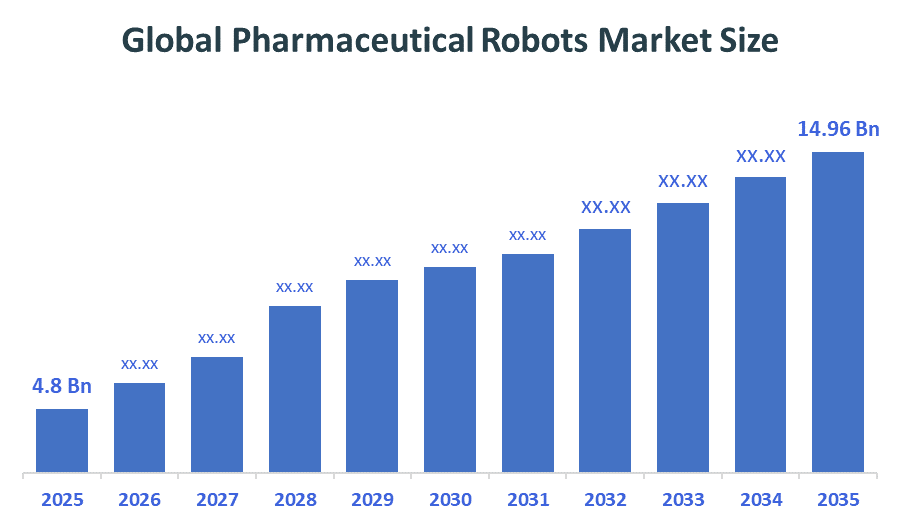
12.04%
REVENUE 2025
USD Billion 4.8
FORECAST 2035
USD Billion 14.96
REPORT COVERAGE
Global
Market Snapshot
- Global Pharmaceutical Robots Market Size (2025): USD 4.8 Billion
- Projected Global Pharmaceutical Robots Market Size (2035): USD 14.96 Billion
- Global Pharmaceutical Robots Market Compound Annual Growth Rate (CAGR): 12.04%
- Largest Regional Market: North America
- Fastest Growing Region: Asia-Pacific
- Market 3rd Largest Region: Europe
- Base Year: 2025
- Historical Period: 2021–2024
- Forecast Period: 2026–2035
Market Overview/ Introduction
The global pharmaceutical robots market refers to the industry that develops and integrates robotic systems that automate drug manufacturing and packaging, and laboratory research and quality control processes. Pharmaceutical robots function as sophisticated machines that execute multiple tasks through their capability to work in clean environments without requiring user input. The market is experiencing strong growth because businesses need automated solutions to meet strict government regulations while maintaining production areas that are free from contamination. AI-driven robotics and biologics manufacturing expansion and emerging market adoption present future business opportunities. The pharmaceutical robots market maintains its global growth because companies face increased labour costs while seeking better operations through new smart manufacturing advancements.
- The European Union promotes robotics and AI adoption across healthcare and pharmaceutical sectors through its coordinated AI strategy. It focuses on increasing investments, supporting R&D, and enabling large-scale deployment of automation technologies. Funding programs like Digital Europe and Horizon Europe accelerate robotic integration.
- India’s government is developing a National Robotics Mission to boost automation in healthcare and pharmaceutical manufacturing. The strategy emphasizes R&D, commercialization, and adoption of robotics across industries, including pharma production and laboratory automation.
Notable Insights: -
- North America is anticipated to hold the largest share of approximately 45% in the pharmaceutical robots market over the forecast period.
- Asia Pacific is expected to grow at a rapid CAGR of approximately 9.5% in the pharmaceutical robots’ market during the forecast period.
- The automated dispensing systems segment dominated the market in 2025, approximately 55 %, and is projected to grow at a substantial CAGR during the forecast period.
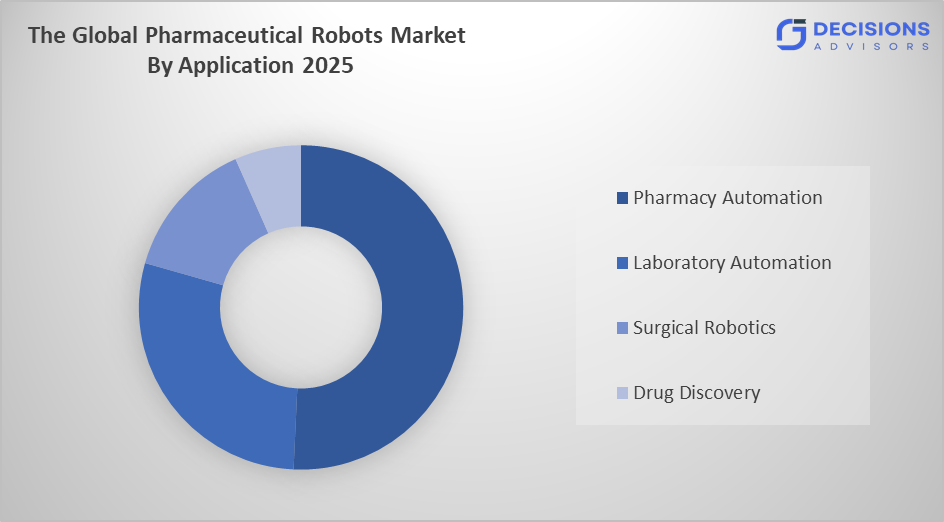
- The pharmacy automation segment dominated the market in 2025, approximately 40%, and is projected to grow at a substantial CAGR during the forecast period.
- The pharmaceutical companies segment dominated the market in 2025, approximately 45%, and is projected to grow at a substantial CAGR during the forecast period.
- The compound annual growth rate of the Global Pharmaceutical Robots Market is 12.04%.
- The market is likely to achieve a valuation of USD 14.96Billion by 2035.
What is role of technology in grooming the market?
Technology plays a vital role in shaping and advancing the global pharmaceutical robots market by enhancing precision, efficiency, and scalability across operations. Integration of artificial intelligence and machine learning enables robots to perform complex tasks such as drug discovery, high-throughput screening, and real-time quality inspection with minimal human intervention. Advanced vision systems and sensors improve accuracy in packaging and inspection processes, ensuring compliance with strict regulatory standards. Robotics combined with Industry 4.0 technologies, including IoT and data analytics, allows predictive maintenance, process optimization, and seamless connectivity across manufacturing units. Additionally, innovations in collaborative robots (cobots) enhance flexibility and safety in human-machine interactions. Automation in sterile environments reduces contamination risks, while continuous advancements in software and control systems are driving productivity, cost efficiency, and overall market growth globally.
Market Drivers
The pharmaceutical robots market exists as an automated solution that pharmaceutical manufacturers require to achieve their strict contamination control and sterility standards. Companies now need to control their production expenses, which drives them to adopt robotic systems that improve their operational performance and investment returns. Robots deliver high accuracy and uniform performance when they execute fragile operations like vial filling and device assembly, which reduces the possibility of mistakes. The system handles dangerous and physically demanding tasks through its ability to execute multiple repetitive tasks, which boosts worker protection and helps solve staffing problems. The increasing demand for advanced robotic systems develops from the rising production of complex biologics because AI integration creates systems for predictive maintenance and real-time monitoring and decreases operational downtime.
Restrain
The global pharmaceutical robots market faces restraints such as high initial investment costs, complex system integration, and stringent regulatory compliance requirements. Limited technical expertise in developing regions and concerns over workforce displacement also hinder adoption. Additionally, maintenance costs and potential operational disruptions can challenge widespread implementation across small and mid-sized pharmaceutical companies.
Competitive Analysis:
The report offers the appropriate analysis of the key organizations/companies involved within the global pharmaceutical robots market, along with a comparative evaluation primarily based on their product offerings, business overviews, geographic presence, enterprise strategies, segment market share, and SWOT analysis. The report also provides an elaborative analysis focusing on the current news and developments of the companies, which includes product development, innovations, joint ventures, partnerships, mergers & acquisitions, strategic alliances, and others. This allows for the evaluation of the overall competition within the market.
Top Companies in Global Pharmaceutical Robots Market
- ABB Ltd.
- FANUC Corporation
- KUKA AG
- Yaskawa Electric Corporation
- Kawasaki Heavy Industries Ltd.
- Mitsubishi Electric Corporation
- Denso Corporation
- Seiko Epson Corporation
- Stäubli International AG
- Universal Robots A/S
- Marchesini Group S.p.A.
- Shibuya Corporation
- GEA Group AG
Government Initiatives
|
Country |
Key Government Initiatives |
|
US |
The U.S. government supports healthcare robotics through regulatory frameworks led by the U.S. Food and Drug Administration, which oversees AI-enabled medical devices and robotic systems. Federal programs such as the National AI Initiative Act promote R&D in robotics and automation across healthcare and pharmaceutical manufacturing. Additionally, public-private collaborations and NIH funding programs are advancing robotic-assisted drug discovery, laboratory automation, and precision medicine applications. |
|
Europe |
The European Commission has implemented the AI Act (effective August 2024) to regulate high-risk AI systems including healthcare robots, ensuring safety, transparency, and compliance. Alongside this, the European Health Data Space (EHDS) (2025) facilitates access to large-scale health data for AI-driven pharmaceutical research and robotic automation. These policies accelerate innovation in robotic drug development, diagnostics, and hospital automation. |
|
India |
The Government of India is promoting robotics in healthcare and pharmaceuticals through the National Strategy on Robotics (MeitY), which prioritizes healthcare automation, R&D funding, and robotics manufacturing ecosystems. Additionally, the IndiaAI Mission (launched March 2024) supports AI-driven healthcare technologies including robotic diagnostics and automation platforms. These initiatives aim to position India as a global robotics hub by 2030 and enhance pharmaceutical manufacturing efficiency. |
Study on the Supply, Demand, Distribution, and Market Environment of the Pharmaceutical Robots Market
The global pharmaceutical robots market operates within a structured supply–demand ecosystem driven by increasing automation needs in drug manufacturing, laboratory research, and packaging. Supply is influenced by robot manufacturers, component suppliers, and technology providers, while demand is fueled by pharmaceutical companies seeking efficiency, precision, and regulatory compliance. Distribution typically occurs through direct sales, system integrators, and specialized automation providers. The market environment is shaped by stringent regulatory standards, high capital investment, and rapid adoption of Industry 4.0 technologies. Key raw materials include metals such as aluminum and steel, electronic components like sensors and semiconductors, and advanced software systems for control and analytics. Supply chain disruptions in electronics and components can impact production, while growing global demand for automation continues to strengthen market expansion and technological advancement.
Price Analysis and Consumer Behaviour Analysis
The global pharmaceutical robots market is characterized by relatively high initial investment costs due to advanced technologies, integration complexity, and compliance with stringent regulatory standards. Pricing varies based on robot type, functionality, and level of automation, with collaborative robots offering more cost-effective and flexible solutions compared to traditional systems. Despite high upfront costs, long-term benefits such as reduced labor expenses, improved efficiency, and minimized errors drive adoption. From a consumer behavior perspective, pharmaceutical companies prioritize reliability, precision, and regulatory compliance when adopting robotic systems. Demand is largely driven by the need for automation in drug manufacturing, laboratory operations, and packaging. Increasing pressure to enhance productivity, ensure consistent quality, and address skilled labor shortages is encouraging companies to invest in robotics, supporting steady market growth globally.
Market Segmentation
The Pharmaceutical Robots Market share is classified into type, application, and end-user.
- The automated dispensing systems segment dominated the market in 2025, approximately 55%, and is projected to grow at a substantial CAGR during the forecast period.
Based on the type, the pharmaceutical robots market is divided into automated dispensing systems, robotic surgery systems, robotic pill dispensers, and automated compounding systems. Among these, the automated dispensing systems segment dominated the market in 2025, approximately 55%, and is projected to grow at a substantial CAGR during the forecast period. The growth of the automated dispensing systems segment is growing due to its critical role in reducing medication errors, improving patient safety, and streamlining pharmacy operations. Automated dispensing systems enhance efficiency through real-time tracking, secure storage, and faster drug distribution. Growing demand for cost reduction, regulatory compliance, and high patient volumes further drives adoption, making it the most dominant segment in the market.
- The pharmacy automation segment dominated the market in 2025, approximately 40%, and is projected to grow at a substantial CAGR during the forecast period.
Based on the application, the pharmaceutical robots market is divided into laboratory automation, pharmacy automation, surgical robotics, and drug discovery. Among these, the pharmacy automation segment dominated the market in 2025, approximately 40%, and is projected to grow at a substantial CAGR during the forecast period. The pharmacy automation segment dominated due to the widespread adoption of robotic systems in hospitals and retail pharmacies for medication dispensing, packaging, and inventory management. Pharmacy automation improves accuracy, reduces human errors, and enhances workflow efficiency. Increasing prescription volumes, need for patient safety, and demand for cost-effective operations are key factors driving its strong market dominance globally.
- The pharmaceutical companies’ drugs segment dominated the market in 2025, approximately 45%, and is projected to grow at a substantial CAGR during the forecast period.
Based on the end-user, the pharmaceutical robots market is divided into pharmaceutical companies, research institutions, hospitals, and contract manufacturing organizations. Among these, the pharmaceutical companies segment dominated the market in 2025, approximately 45%, and is projected to grow at a substantial CAGR during the forecast period. The growth of the pharmaceutical companies’ segment is growing due to the extensive use of robotics in drug manufacturing, packaging, and quality control processes. Pharmaceutical companies invest heavily in automation to ensure precision, regulatory compliance, and high production efficiency. Increasing demand for biologics, rising R&D activities, and the need to reduce operational costs further drive the adoption of robotic systems in this segment.
Strategies to Implement for Growth of the Market in Non-Leading Regions
To drive growth in non-leading regions, companies in the global pharmaceutical robots’ market should focus on cost-effective and scalable automation solutions tailored to local needs. Establishing partnerships with regional pharmaceutical manufacturers and governments can support technology adoption and infrastructure development. Investing in training programs and technical skill development is essential to address workforce limitations and ensure smooth integration of robotic systems. Additionally, offering flexible financing models, such as leasing or robotics-as-a-service (RaaS), can lower initial investment barriers. Expanding local manufacturing and distribution networks can reduce costs and improve accessibility. Companies should also align with regional regulatory frameworks and promote awareness of automation benefits, such as improved efficiency, quality, and compliance, to accelerate adoption and long-term market growth.
Regional Segment Analysis of the Pharmaceutical Robots Market
- North America (U.S., Canada, Mexico)
- Europe (Germany, France, U.K., Italy, Spain, Rest of Europe)
- Asia-Pacific (China, Japan, India, Rest of APAC)
- South America (Brazil and the Rest of South America)
- The Middle East and Africa (UAE, South Africa, Rest of MEA)
North America is anticipated to hold the largest share of approximately 45% the pharmaceutical robots market over the forecast period.
North America is anticipated to hold the largest share of approximately 45% the pharmaceutical robots market over the forecast period. The dominance of this region is primarily driven by the advanced healthcare infrastructure, strong presence of leading pharmaceutical companies, and early adoption of automation technologies. High R&D investments, supportive regulatory frameworks, and increasing demand for precision and efficiency in drug manufacturing further drive the widespread integration of robotic systems across the region.
Asia Pacific is expected to grow at a rapid CAGR of approximately 9.5% in the pharmaceutical robots’ market during the forecast period.
Asia Pacific is expected to grow at a rapid CAGR of approximately 9.5% in the pharmaceutical robots’ market during the forecast period. This growth is driven by the expanding pharmaceutical manufacturing in countries like China and India, rising healthcare investments, and increasing adoption of automation. Favorable government initiatives, growing demand for cost-efficient production, and the presence of contract manufacturing organizations further accelerate the integration of robotic technologies across the region.
Europe is the 3rd largest region to grow in the pharmaceutical robots’ market during the period.
Europe is the third-largest region in the Global Pharmaceutical Robots Market due to its well-established pharmaceutical industry, particularly in countries such as Germany, France, and the United Kingdom. Growth is supported by increasing automation in drug manufacturing, strict regulatory standards, and rising investments in advanced robotics to enhance precision, efficiency, and compliance across pharmaceutical operations.
Future Market Trends in Global Pharmaceutical Robots Market: -
1. Integration of AI and Smart Robotics
The future of the pharmaceutical robots’ market will be strongly driven by the integration of artificial intelligence and machine learning. These technologies enable real-time decision-making, predictive maintenance, and enhanced precision in drug manufacturing and research. AI-powered robots improve efficiency, reduce errors, and accelerate drug discovery processes.
2. Rising Adoption of Collaborative Robots (Cobots)
Collaborative robots are expected to gain significant traction due to their flexibility and ability to work alongside humans safely. Cobots enhance productivity in packaging, inspection, and laboratory operations while reducing labour dependency. Their cost-effectiveness and adaptability make them ideal for modern pharmaceutical manufacturing environments.
3. Expansion of Automation in Drug Manufacturing and Packaging
Automation will continue to expand across pharmaceutical production, especially in drug packaging, quality control, and sterile manufacturing. Robots ensure high-speed, contamination-free operations and regulatory compliance. Increasing demand for efficiency, consistency, and large-scale production is pushing companies to adopt robotic automation extensively.
Recent Development
- In July 2025, Merck Group launched the AAW (Automated Assay Workstation). This Opentrons-powered lab automation platform enables plug-and-play robotic workflows for pharmaceutical and biotech labs, automating routine experiments and accelerating drug discovery processes.
- In June 2025, Seiko Epson Corporation announced development and planned launch of a cleanroom collaborative robot for pharmaceutical and life sciences automation. The robot is designed for sterile environments, improving precision and compliance in drug manufacturing and laboratory operations.
- In December 2024, Universal Robots introduced new pharmaceutical-focused robotic solutions and showcased applications during a global pharma robotics event. These collaborative robots (cobots) are increasingly used in drug manufacturing, packaging, and lab automation.
- In October 2024, Dash Bio launched an AI-driven robotic laboratory platform aimed at automating clinical sample testing and accelerating pharmaceutical R&D timelines using robotics and AI integration.
How is Recent Developments Helping the Market?
Recent developments are significantly accelerating the growth of the global pharmaceutical robots’ market by enhancing efficiency, precision, and scalability in drug manufacturing and laboratory processes. Advanced robotic systems integrated with artificial intelligence and machine learning are enabling automated drug discovery, high-throughput screening, and accurate formulation handling. Collaborative robots (cobots) are improving flexibility in production lines while ensuring safety and reducing human intervention. Innovations in aseptic robotic systems support sterile manufacturing, which is critical for biologics and vaccines. Additionally, the adoption of robotics in packaging, inspection, and quality control ensures compliance with stringent regulatory standards. Growing investments in smart manufacturing and Industry 4.0 technologies are further optimizing operations, reducing errors, and lowering production costs, thereby driving widespread adoption across pharmaceutical companies worldwide.
Market Segment
This study forecasts revenue at global, regional, and country levels from 2020 to 2035. Decision Advisors has segmented the pharmaceutical robots market based on the below-mentioned segments:
Global Pharmaceutical Robots Market, By Type
- Automated Dispensing Systems
- Robotic Surgery Systems
- Robotic Pill Dispensers
- Automated Compounding Systems
Global Pharmaceutical Robots Market, By Application
- Laboratory Automation
- Pharmacy Automation
- Surgical Robotics
- Drug Discovery
Global Pharmaceutical Robots Market, By End-User
- Pharmaceutical Companies
- Research Institutions
- Hospitals
- Contract Manufacturing Organizations
Global Pharmaceutical Robots Market, By Regional Analysis
- North America
- US
- Canada
- Mexico
- Europe
- Germany
- UK
- France
- Italy
- Spain
- Russia
- Rest of Europe
- Asia Pacific
- China
- Japan
- India
- South Korea
- Australia
- Rest of Asia Pacific
- South America
- Brazil
- Argentina
- Rest of South America
- Middle East & Africa
- UAE
- Saudi Arabia
- Qatar
- South Africa
- Rest of the Middle East & Africa
Frequently Asked Questions (FAQ)
Q How are pharmaceutical robots improving regulatory compliance in drug manufacturing?
A. Pharmaceutical robots enhance regulatory compliance by ensuring consistent and error-free operations in highly controlled environments. They minimize human intervention, reducing contamination risks and ensuring adherence to Good Manufacturing Practices (GMP). Automated documentation, real-time monitoring, and traceability features help companies meet strict regulatory requirements while maintaining high-quality production standards across global markets.
Q. What role do pharmaceutical robots play in biologics and vaccine production?
A. Pharmaceutical robots are crucial in biologics and vaccine production due to their ability to handle complex, sensitive processes in sterile environments. They enable precise liquid handling, aseptic filling, and contamination-free manufacturing. This is especially important for biologics, which require strict temperature control and accuracy. Robots also accelerate production speed, supporting large-scale vaccine manufacturing during global health emergencies.
Q. How is the adoption of robotics transforming pharmaceutical supply chain operations?
A. Robotics is transforming pharmaceutical supply chains by improving inventory management, packaging, and distribution efficiency. Automated systems streamline warehouse operations, reduce manual errors, and enhance tracking through real-time data integration. This leads to faster order fulfillment, reduced operational costs, and improved supply chain transparency, ensuring timely delivery of medicines globally.
Q. What challenges do small and mid-sized pharmaceutical companies face in adopting robotic systems?
A. Small and mid-sized pharmaceutical companies often face challenges such as high upfront investment costs, limited access to advanced technology, and lack of skilled workforce for system integration and maintenance. Additionally, complex regulatory requirements and concerns about return on investment can slow adoption. However, emerging solutions like robotics-as-a-service (RaaS) are helping overcome these barriers.
Check Licence
Choose the plan that fits you best: Single User, Multi-User, or Enterprise solutions tailored for your needs.
We Have You Covered
- 24/7 Analyst Support
- Clients Across the Globe
- Tailored Insights
- Technology Tracking
- Competitive Intelligence
- Custom Research
- Syndicated Market Studies
- Market Overview
- Market Segmentation
- Growth Drivers
- Market Opportunities
- Regulatory Insights
- Innovation & Sustainability
Report Details
| Scope | Global |
| Pages | 245 |
| Delivery | PDF & Excel via Email |
| Language | English |
| Release | Apr 2026 |
| Access | Download from this page |