
Global Pharmaceutical Waste Management Market
 |
Author:
David J
|
Pages:
245
|
Author:
David J
|
Pages:
245
Global Pharmaceutical Waste Management Market Size, Share, By Type (Hazardous Waste, Non-Hazardous Waste), By Service (Collection, Transportation, Treatment & Disposal, Recycling), By End-User (Hospitals, Pharmaceutical Companies, Laboratories, Clinics), and By Region (North America, Europe, Asia-Pacific, Latin America, Middle East & Africa), Analysis and Forecast 2026-2035
CAGR
1.38%
REVENUE 2025
USD Billion 2.58
FORECAST 2035
USD Billion 6.46
REPORT COVERAGE
Global
Market Snapshot
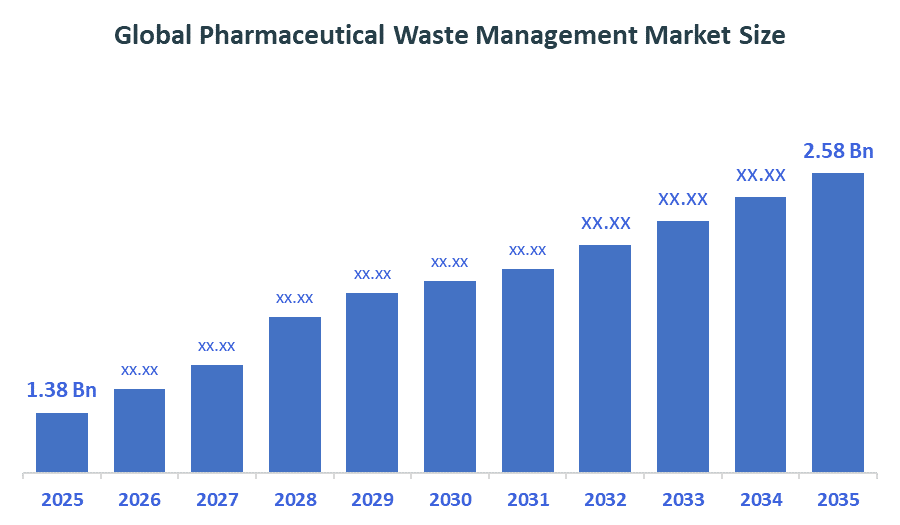
- Global Pharmaceutical Waste Management Market Size (2025): USD 1.38 Billion
- Projected Global Pharmaceutical Waste Management Market Size (2035): USD 2.58 Billion
- Global Pharmaceutical Waste Management Market Compound Annual Growth Rate (CAGR): 6.46%
- Largest Regional Market: North America
- Fastest Growing Region: Asia-Pacific
- Market 3rd Largest Region: Europe
- Base Year: 2025
- Historical Period: 2021–2024
- Forecast Period: 2026–2035
Market Overview/ Introduction
The global pharmaceutical waste management market refers to the industry responsible for the collection, transportation, treatment, disposal of waste generated from pharmaceutical products, healthcare activities, including expired drugs, contaminated materials, hazardous chemical by-products. Environmental regulations are becoming stricter while pharmaceutical consumption is increasing, and organizations seek sustainable disposal methods, which result in significant market growth. The healthcare and pharmaceutical industries require regulatory waste management systems because their current pharmaceutical waste disposal methods cause severe environmental damage and health risks. The market is expanding because government agencies and educational institutions have become more conscious of the existing situation. The market will experience future growth because waste treatment technologies are advancing, and organizations are implementing circular economy methods and developing waste-to-energy systems, which will enhance operational efficiency and decrease environmental effects while reshaping the entire industry.
- The Basel Convention on the Control of Trans boundary Movements of Hazardous Wastes and Their Disposal is the most important global treaty regulating pharmaceutical waste classified as hazardous. It controls cross-border movement, promotes environmentally sound disposal, and reduces hazardous waste generation worldwide. Many pharmaceutical and medical wastes fall under its scope, making it a key global governance framework.
- The World Health Organization provides global guidance and technical frameworks for safe handling, segregation, treatment, and disposal of pharmaceutical and healthcare waste. These guidelines support national governments in developing safe waste systems and reducing environmental and health risks.
Notable Insights: -
- North America is anticipated to hold the largest share of approximately 40% in the pharmaceutical waste management market over the forecast period.
- Asia Pacific is expected to grow at a rapid CAGR of approximately 9 % in the pharmaceutical waste management market during the forecast period.
- The hazardous waste segment dominated the market in 2025, approximately 60 %, and is projected to grow at a substantial CAGR during the forecast period.
- The treatment & disposal segment dominated the market in 2025, approximately 45%, and is projected to grow at a substantial CAGR during the forecast period.
- The hospitals segment dominated the market in 2025, approximately 42%, and is projected to grow at a substantial CAGR during the forecast period.
- The compound annual growth rate of the Global Pharmaceutical Waste Management Market is 6.46%.
- The market is likely to achieve a valuation of USD 2.58Billion by 2035.
What is role of technology in grooming the market?
Technology plays a crucial role in grooming the pharmaceutical waste management market by enhancing efficiency, safety, and regulatory compliance. Advanced treatment technologies such as high-temperature incineration, autoclaving, and chemical disinfection enable effective disposal of hazardous waste while minimizing environmental impact. Digital solutions, including real-time tracking systems, barcode scanning, and cloud-based platforms, improve transparency, monitoring, and documentation, ensuring strict adherence to regulations. Automation in waste segregation and handling reduces human error and operational risks. Additionally, innovations like waste-to-energy conversion and recycling technologies help optimize resource utilization and lower disposal costs. Data analytics and IoT-based systems further support predictive planning and efficient logistics. Overall, technological advancements are driving sustainable practices, improving operational performance, and accelerating the adoption of pharmaceutical waste management services across healthcare and pharmaceutical industries.
Market Drivers
The pharmaceutical waste management market experiences growth because drug consumption and healthcare activities lead to greater amounts of pharmaceutical waste. Environmental regulations require companies to implement waste disposal methods that meet legal requirements. Consumers are becoming more aware of the environmental and health hazards that result from incorrect waste disposal, which speeds up the process of adopting proper disposal methods. The growth of pharmaceutical manufacturing and biologics production creates intricate waste materials that need special treatment processes. The market development receives a boost from both technological progress and sustainability programs.
Restrain
The market faces challenges such as high operational and treatment costs, complex regulatory compliance, and a lack of proper waste segregation practices in developing regions. Limited infrastructure and awareness can hinder effective waste management. Additionally, logistical challenges in the collection and transportation of hazardous waste impact efficiency.
Competitive Analysis:
The report offers the appropriate analysis of the key organizations/companies involved within the global pharmaceutical waste management market, along with a comparative evaluation primarily based on their product offerings, business overviews, geographic presence, enterprise strategies, segment market share, and SWOT analysis. The report also provides an elaborative analysis focusing on the current news and developments of the companies, which includes product development, innovations, joint ventures, partnerships, mergers & acquisitions, strategic alliances, and others. This allows for the evaluation of the overall competition within the market.
Top Companies in Global Pharmaceutical Waste Management Market
- Stericycle, Inc.
- Waste Management, Inc.
- Clean Harbors, Inc.
- Veolia Environnement S.A.
- Suez Environnement S.A.
- Daniels Health
- Sharps Compliance, Inc.
- BioMedical Waste Solutions, LLC
- Republic Services, Inc.
- Covanta Holding Corporation
- US Ecology, Inc.
- Remondis Medison GmbH
Government Initiatives
|
Country |
Key Government Initiatives |
|
US |
The U.S. Environmental Protection Agency (EPA) regulates pharmaceutical waste under the Resource Conservation and Recovery Act (RCRA) Hazardous Waste Pharmaceuticals Rule (2019), ensuring safe segregation and disposal in healthcare facilities. The Drug Enforcement Administration (DEA) National Prescription Drug Take Back Program promotes safe disposal of unused medicines to prevent misuse. The FDA “Flush List” Guidance also supports controlled disposal of high-risk drugs. |
|
Europe |
The European Union enforces pharmaceutical waste management through the EU Waste Framework Directive (2008/98/EC), promoting safe handling and extended producer responsibility. The European Green Deal and EU Pharmaceutical Strategy for Europe (2020) strengthen sustainability and safe disposal practices. Member states also implement national take-back and EPR schemes for unused medicines. |
|
India |
India regulates pharmaceutical and healthcare waste under the Biomedical Waste Management Rules (2016, amended) issued by the Ministry of Environment, Forest and Climate Change (MoEFCC). The Central Pollution Control Board (CPCB) provides guidelines for the segregation, treatment, and disposal of biomedical and pharmaceutical waste. Hospitals must follow strict segregation and disposal protocols via authorized treatment facilities. |
Study on the Supply, Demand, Distribution, and Market Environment of the Pharmaceutical Waste Management Market
The pharmaceutical waste management market is shaped by a complex interplay of supply, demand, distribution, and market environment factors. Supply is driven by specialized service providers offering collection, treatment, and disposal solutions using technologies such as incineration and autoclaving. Demand is increasing due to rising pharmaceutical production, healthcare expansion, and strict environmental regulations requiring safe disposal of hazardous waste. Distribution networks involve coordinated logistics, including waste collection, transportation, and centralized processing facilities, ensuring compliance and efficiency. The market environment is influenced by regulatory frameworks, sustainability initiatives, and growing awareness of environmental risks. Raw materials primarily include pharmaceutical by-products, expired drugs, contaminated packaging, and chemical residues, which require careful segregation and handling. Advancements in recycling and waste-to-energy technologies are further optimizing resource utilization, reducing environmental impact, and supporting sustainable market growth globally.
Price Analysis and Consumer Behaviour Analysis
Price analysis in the pharmaceutical waste management market is influenced by factors such as treatment technology, regulatory compliance costs, transportation, and disposal methods. Advanced solutions like incineration, autoclaving, and waste-to-energy systems often involve higher initial investments but reduce long-term operational costs through efficiency and sustainability. Pricing also varies based on waste type (hazardous vs. non-hazardous) and service customization. Increasing regulatory pressure and environmental standards are pushing service providers to adopt premium pricing strategies while offering value-added services such as digital tracking and compliance reporting, which enhance overall cost efficiency for clients. Consumer behavior in this market is primarily driven by regulatory compliance, environmental awareness, and safety concerns. Healthcare providers and pharmaceutical companies prefer reliable, certified service providers that ensure safe disposal and transparency. There is a growing shift toward sustainable and eco-friendly waste management solutions, influenced by corporate social responsibility goals. Additionally, consumers increasingly value integrated services, including real-time tracking and documentation, which simplify compliance and auditing processes.
Market Segmentation
The Pharmaceutical Waste Management Market share is classified into type, application, and end-user.
- The hazardous waste segment dominated the market in 2025, approximately 60%, and is projected to grow at a substantial CAGR during the forecast period.
Based on the type, the pharmaceutical waste management market is divided into hazardous waste, and non-hazardous waste. Among these, the hazardous waste segment dominated the market in 2025, approximately 60%, and is projected to grow at a substantial CAGR during the forecast period. The growth of the hazardous waste segment is growing due to the increasing generation of toxic and chemically active pharmaceutical by-products requiring strict regulatory handling. Stringent environmental laws, higher risk to human health, and the need for specialized treatment technologies significantly drive demand, ensuring its leading share and strong growth.
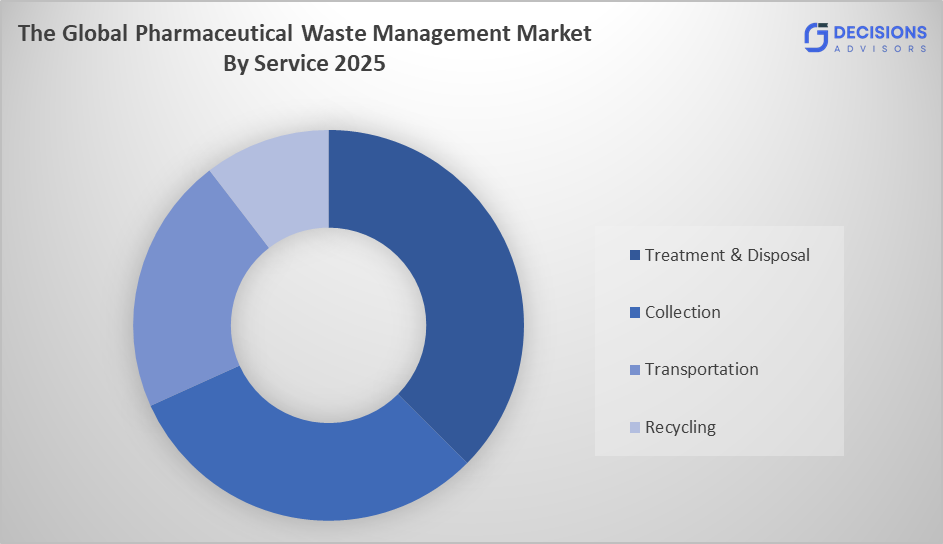
- The treatment & disposal segment dominated the market in 2025, approximately 45%, and is projected to grow at a substantial CAGR during the forecast period.
Based on the service, the pharmaceutical waste management market is divided into collection, transportation, treatment & disposal, and recycling. Among these, the treatment & disposal segment dominated the market in 2025, approximately 45%, and is projected to grow at a substantial CAGR during the forecast period. The treatment & disposal segment dominated due to the stringent environmental regulations, increasing generation of hazardous pharmaceutical waste, and rising healthcare and pharmaceutical production. Growing demand for safe, compliant disposal methods such as incineration and chemical treatment, along with outsourcing trends, strengthens its market leadership position.
- The hospitals drugs segment dominated the market in 2025, approximately 42%, and is projected to grow at a substantial CAGR during the forecast period.
Based on the end-user, the pharmaceutical waste management market is divided into hospitals, pharmaceutical companies, laboratories, and clinics. Among these, the hospitals segment dominated the market in 2025, approximately 42%, and is projected to grow at a substantial CAGR during the forecast period. The growth of the hospitals segment is growing due to the high volume of drug consumption in hospitals, continuous generation of expired and unused medicines, and strict regulatory compliance requirements for safe disposal. Increasing hospital admissions, expansion of healthcare infrastructure, and growing awareness about environmental safety further drive the segment’s strong market share and steady growth.
Strategies to Implement for Growth of the Market in Non-Leading Regions
To drive growth in non-leading or emerging regions, companies should focus on strengthening regulatory frameworks and aligning with global compliance standards. Many developing markets face fragmented or weak regulations, so collaborating with governments to establish clear policies and guidelines can significantly boost adoption of pharmaceutical waste management services. Investing in infrastructure development is another critical strategy. Building efficient waste collection, segregation, and treatment facilities—especially through public-private partnerships helps overcome the lack of proper disposal systems in these regions and creates long-term market opportunities. Adoption of cost-effective and scalable technologies is essential, as high treatment costs often limit market penetration. Companies should introduce modular and affordable solutions tailored to local needs, ensuring accessibility for smaller healthcare facilities. Raising awareness and providing training programs for healthcare professionals and stakeholders can improve proper waste disposal practices and increase demand for compliant services. In many emerging economies, limited awareness remains a key barrier to market growth.
Regional Segment Analysis of the Pharmaceutical Waste Management Market
- North America (U.S., Canada, Mexico)
- Europe (Germany, France, U.K., Italy, Spain, Rest of Europe)
- Asia-Pacific (China, Japan, India, Rest of APAC)
- South America (Brazil and the Rest of South America)
- The Middle East and Africa (UAE, South Africa, Rest of MEA)
North America is anticipated to hold the largest share of approximately 40% the pharmaceutical waste management market over the forecast period.
North America is anticipated to hold the largest share of approximately 40% the pharmaceutical waste management market over the forecast period. The dominance of this region is primarily driven by its advanced healthcare infrastructure, strict environmental regulations, and strong compliance frameworks. High pharmaceutical consumption, widespread hospital networks, and well-established waste treatment technologies further strengthen the region’s leading position and support sustained market growth.
Asia Pacific is expected to grow at a rapid CAGR of approximately 9% in the pharmaceutical waste management market during the forecast period.
Asia Pacific is expected to grow at a rapid CAGR of approximately 9% in the pharmaceutical waste management market during the forecast period. This growth is driven by the expanding healthcare infrastructure, rising pharmaceutical production, and increasing environmental awareness. Rapid urbanization, growing hospital networks, and strengthening government regulations for proper waste disposal further drive market expansion across emerging economies in the region.
Europe is the 3rd largest region to grow in the pharmaceutical waste management market during the period.
Europe ranks as the third-largest region in the pharmaceutical waste management market due to its well-established healthcare systems, strict environmental and waste disposal regulations, and strong focus on sustainability. Increasing pharmaceutical consumption, rising hospital waste generation, and growing adoption of advanced treatment technologies further support steady market growth across the region.
Future Market Trends in Global Pharmaceutical Waste Management Market: -
1. Integration of AI and Smart Robotics
The future of the pharmaceutical waste management market will be strongly driven by the integration of artificial intelligence and machine learning. These technologies enable real-time decision-making, predictive maintenance, and enhanced precision in drug manufacturing and research. AI-powered robots improve efficiency, reduce errors, and accelerate drug discovery processes.
2. Rising Adoption of Collaborative Robots (Cobots)
Collaborative robots are expected to gain significant traction due to their flexibility and ability to work alongside humans safely. Cobots enhance productivity in packaging, inspection, and laboratory operations while reducing labour dependency. Their cost-effectiveness and adaptability make them ideal for modern pharmaceutical manufacturing environments.
3. Expansion of Automation in Drug Manufacturing and Packaging
Automation will continue to expand across pharmaceutical production, especially in drug packaging, quality control, and sterile manufacturing. Robots ensure high-speed, contamination-free operations and regulatory compliance. Increasing demand for efficiency, consistency, and large-scale production is pushing companies to adopt robotic automation extensively.
Recent Development
- In January 2026, Remedi announced its 2026 landfill diversion target, aiming to divert 1.2 million pounds of regulated medical waste through recycling-enabled processing systems, supporting circular economy and sustainability goals in healthcare waste management.
- In December 2025, the pharmaceutical waste management market witnessed strong trends in the integration of digital tracking and eco-friendly disposal systems. This included increasing adoption of compliance tracking platforms, expansion of advanced incineration and chemical treatment technologies, and growing collaboration between hospitals and specialized waste management companies to improve sustainability and regulatory compliance.
- In June 2025, Daniels Healthcare launched a sustainable SHARPSGUARD eco 24L sharps container, contributing to healthcare and pharmaceutical waste management systems.
- In June 2025, Veolia expanded its hazardous waste treatment facilities in Europe, strengthening capacity for industrial, medical, and pharmaceutical waste streams as part of its broader environmental services growth strategy.
How is Recent Developments Helping the Market?
Recent developments are significantly enhancing the pharmaceutical waste management market by improving operational efficiency, safety standards, and environmental sustainability. Advanced technologies such as automated waste segregation, high-temperature incineration, and chemical treatment systems enable more effective handling of hazardous pharmaceutical waste while minimizing ecological risks. The integration of digital tracking and monitoring systems ensures regulatory compliance, improves transparency, and reduces the chances of improper disposal. Additionally, increased investments in infrastructure, including centralized treatment facilities and waste-to-energy solutions, are streamlining waste processing and lowering overall operational costs. These innovations not only support strict environmental and healthcare regulations but also encourage broader adoption across hospitals, laboratories, and pharmaceutical manufacturers. As awareness of sustainable waste practices grows, these advancements are playing a crucial role in shaping a safer and more efficient pharmaceutical waste management ecosystem globally.
Market Segment
This study forecasts revenue at global, regional, and country levels from 2020 to 2035. Decision Advisors has segmented the Pharmaceutical Waste Management Market based on the below-mentioned segments:
Global Pharmaceutical Waste Management Market, By Type
- Hazardous Waste
- Non-Hazardous Waste
Global Pharmaceutical Waste Management Market, By Service
- Collection
- Transportation
- Treatment & Disposal
- Recycling
Global Pharmaceutical Waste Management Market, By End-User
- Hospitals
- Pharmaceutical Companies
- Laboratories
- Clinics
Global Pharmaceutical Waste Management Market, By Regional Analysis
- North America
- US
- Canada
- Mexico
- Europe
- Germany
- UK
- France
- Italy
- Spain
- Russia
- Rest of Europe
- Asia Pacific
- China
- Japan
- India
- South Korea
- Australia
- Rest of Asia Pacific
- South America
- Brazil
- Argentina
- Rest of South America
- Middle East & Africa
- UAE
- Saudi Arabia
- Qatar
- South Africa
- Rest of the Middle East & Africa
Frequently Asked Questions (FAQ)
Q What are the key challenges in ensuring safe pharmaceutical waste disposal in developing countries?
A. Developing countries face challenges such as weak regulatory enforcement, limited waste treatment infrastructure, low awareness among healthcare providers, and high costs of advanced disposal technologies. These factors often lead to improper segregation and unsafe disposal practices, increasing environmental and health risks.
Q. How does pharmaceutical waste management contribute to environmental protection?
A. It reduces contamination of soil, water, and air by ensuring safe disposal of toxic drug residues and chemical by-products. Proper treatment methods such as incineration and chemical neutralization prevent hazardous substances from entering ecosystems, thereby protecting biodiversity and reducing long-term ecological damage.
Q. What role do hospitals play in the pharmaceutical waste management ecosystem?
A. Hospitals are primary generators of pharmaceutical and medical waste due to high drug usage and patient care activities. They are responsible for proper segregation, storage, and disposal of expired medicines, contaminated materials, and sharps, often through authorized waste management service providers.
Q. Why is outsourcing pharmaceutical waste management services increasing globally?
A. Outsourcing is rising because specialized service providers offer cost-efficient, regulatory-compliant, and technologically advanced disposal solutions. It helps healthcare facilities reduce operational burden, ensure safety compliance, and focus on core medical services while experts manage hazardous waste treatment and logistics.
Check Licence
Choose the plan that fits you best: Single User, Multi-User, or Enterprise solutions tailored for your needs.
We Have You Covered
- 24/7 Analyst Support
- Clients Across the Globe
- Tailored Insights
- Technology Tracking
- Competitive Intelligence
- Custom Research
- Syndicated Market Studies
- Market Overview
- Market Segmentation
- Growth Drivers
- Market Opportunities
- Regulatory Insights
- Innovation & Sustainability
Report Details
| Scope | Global |
| Pages | 245 |
| Delivery | PDF & Excel via Email |
| Language | English |
| Release | Apr 2026 |
| Access | Download from this page |