
Global Photodetectors Cells Quantum Dots Market
 |
Author:
Achal E
|
Pages:
210
|
Author:
Achal E
|
Pages:
210
Global Photodetectors Cells Quantum Dots Market Size, Share, By Product Type (Photodiodes, Phototransistors, Photoconductors, and Quantum Dot Solar Cells) By Material Type (Cadmium-based Quantum Dots, Cadmium-free Quantum Dots, and Other Nanomaterials) By Application (Consumer Electronics, Healthcare and Medical Devices, Automotive, Aerospace and Defence, and Energy and Utilities) By Region (North America, Europe, Asia-Pacific, Latin America, Middle East, and Africa), Analysis and Forecast 2026-2035
CAGR
8.1%
REVENUE 2025
USD Million 1795.28
FORECAST 2035
USD Million 3910.15
REPORT COVERAGE
Global
Market Snapshot
- Market Size (2025): USD 1795.28 Million
- Projected Market Size (2035): USD 3910.15 Million
- Compound Annual Growth Rate (CAGR): 8.1%
- Largest Regional Market: North America
- Fastest Growing Region: Asia-Pacific
- 3rd Largest Region: Europe
- Base Year: 2025
- Historical Period: 2021–2024
- Forecast Period: 2026–2035
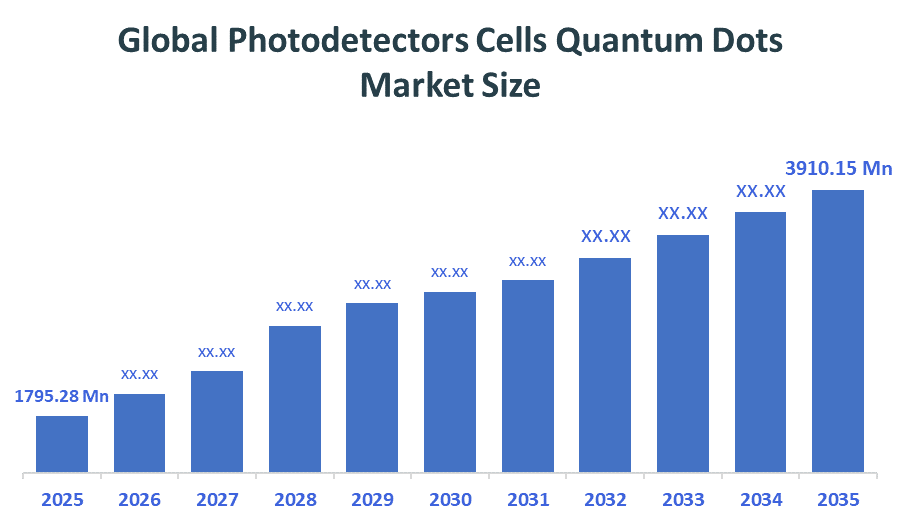
According to Decision Advisors, the Global Photodetectors Cells Quantum Dots Market Size is expected to grow from USD 1795.28 million in 2025 to USD 3910.15 million by 2035, with a CAGR of 8.1% during the forecast period from 2026 to 2035. The market for the industry is also expected to grow significantly with the development and integration of next-generation technologies in the field of optical sensing. The growth in the market has been attributed to the demand for high-sensitivity imaging and the adoption of quantum dot technology in high-performance sensing devices. Innovations in the field of material science have also played a significant role in the development and growth of the industry. Advanced photodetectors with high light absorption capabilities and a wide range of detected wavelengths have become essential in the development of electronic devices.
Market Overview/ Introduction
The growing focus on guaranteeing efficiency in high-resolution imaging and sensitive optical detection, especially in modern electronics and healthcare, is a primary driver for the global photodetectors cells quantum dots market. The term photodetectors cells refer to advanced semiconductor devices that utilise quantum dots, nanoscale crystals with size-tunable light absorption properties, to convert photons into electrical signals with extreme precision. From their theoretical beginnings, these cells have evolved into highly sophisticated components characterised by high quantum efficiency, low noise levels, and the ability to detect a broad spectral range from ultraviolet to near-infrared. Photodetectors cells play a crucial role in ensuring increased performance in complex technical settings, where engineers and researchers use this technology to achieve superior sensitivity and faster response times compared to traditional silicon-based sensors. The increasing emphasis placed on miniaturisation and spectral tunability has led to the integration of quantum dot-based cells that offer greater adaptability in challenging environments, such as night vision, deep-tissue medical imaging, and satellite communications.
- North America contributes more than 35% of global revenue, driven by heavy R&D investment in aerospace, defence, and biotechnology, alongside a concentrated presence of leading semiconductor innovators and quantum research facilities.
- Consumer electronics and imaging applications dominate the market, accounting for over 50% share, as quantum dot sensors are increasingly integrated into smartphone cameras, wearable health monitors, and high-end thermal imaging devices.
- The growing need for sustainable energy sources and better diagnostics, spanning from photovoltaics to early cancer detection, is boosting the demand for high-efficiency sensing materials, thereby fuelling the rapid adoption of quantum dot photodetectors.
Notable Insights: -
- North America leads the global photodetectors cells quantum dots market, contributing approximately 35% of total revenue in 2025. This dominance is supported by heavy R&D investment in aerospace, defence, and high-performance computing.
- The Asia-Pacific region is expected to register the fastest growth, with a projected CAGR of nearly 12% during the forecast period. This surge is driven by the rapid expansion of electronics manufacturing hubs in China, South Korea, and India,
- By application, consumer electronics and imaging sensors hold the dominant position, accounting for over 50% of the market share. The widespread integration of quantum dot-based sensors into mobile cameras, wearable health monitors, and facial recognition systems has solidified this segment's lead in the industry.
- By material type, cadmium-free quantum dots represent the fastest-growing segment, with an expected growth rate exceeding 21%. As global environmental regulations become more stringent, industries are rapidly shifting toward sustainable materials like Indium Phosphide and Perovskite to develop eco-friendly sensing solutions.
- The global photodetectors cells quantum dots market is expanding at a Compound Annual Growth Rate (CAGR) of 8.1% through 2035. This steady growth reflects a significant industry-wide transition toward miniaturised, high-sensitivity optical components that offer superior spectral tenability compared to traditional silicon technologies.
What is the role of technology in shaping the market?
Technology is significantly impacting the photodetectors cells market as it is enhancing the sensitivity, response time, and precision of photodetectors cells. The sensing unit is not an ordinary silicon-based unit; it is a highly integrated unit with quantum dots that can be used with highly efficient absorption technology while being compatible with high-resolution imaging technology. It is in this way that engineers/scientists have been able to simplify the process of data acquisition while reducing interference in the process while being accurate in the process while functioning in different spectrums of light, ranging from ultraviolet to infrared.
How are Recent Developments Helping the Market?
Recent trends like constant material innovations, the inclusion of digital manufacturing technologies, and the development of perovskite-based quantum technologies are driving the photodetectors cells quantum dots market. The manufacturers of photodetectors cells quantum dots are introducing new cells with programmable sensitivity, thermal stability, and quantum efficiency. The recent trend of using high-fidelity machine vision systems and autonomous technologies is creating the need for the integration of photodetectors cells quantum dots with AI-based diagnostic technologies.
Market Drivers
The global photodetectors cells quantum dots market is expanding as technology providers are investing in advanced technology for improving image resolution. The latest quantum dot cell technology is highly preferred for its ability to integrate various features into a single device, including its ability to absorb across a wide range of light, convert light quickly, and have ultra-low levels of noise. North America has dominated the photodetectors cells and quantum dots market in recent years and is expected to have a significant market share in 2025 due to its high adoption rate for technologically advanced defence equipment and research facilities for semiconductors. In addition, the increasing trend of miniaturized electronic devices among consumers is driving the demand for advanced technology for improving the functionality and user experience of photography and facial recognition features. In recent years, the increasing trend towards sustainable manufacturing practices and eco-friendly electronic products has driven manufacturers to upgrade their technology with advanced features, including cadmium-free quantum dots.
Restraints
The photodetectors cells quantum dots market is limited by the high cost of advanced synthesis and clean room fabrication, which is beyond the means of smaller technology firms and start-ups. Additional costs incurred due to the encapsulation and protection requirements add to the cost burden.
Competitive Analysis:
The report offers the appropriate analysis of the key organisations/companies involved within the photodetectors cells quantum dots market, along with a comparative evaluation primarily based on their product offerings, business overviews, geographic presence, enterprise strategies, segment market share, and SWOT analysis. The report also provides an elaborate analysis focusing on the current news and developments of the companies, which includes product development, innovations, joint ventures, partnerships, mergers & acquisitions, strategic alliances, and others. This allows for the evaluation of the overall competition within the market.
Top 10 Companies in the Photodetectors Cells Quantum Dots Market
- Nanosys Inc.
- Nanoco Group plc
- Merck KGaA
- Samsung Display Co., Ltd.
- LG Display Co., Ltd.
- BOE Technology Group Co., Ltd.
- QD Laser Inc.
- Ocean NanoTech LLC
- NNCrystal US Corporation
- UbiQD Inc.
Government Initiatives
|
Country |
Key Government Initiatives |
|
US |
In the United States, high-performance sensing and quantum materials are supported through the CHIPS and Science Act, which authorises over USD 52 billion to boost domestic semiconductor research and manufacturing. The government also promotes quantum dot innovation through the National Quantum Initiative (NQI), and specialised Department of Energy (DOE) programs focused on advanced photonics and energy-efficient light-harvesting cells. |
|
China |
In China, quantum technology is a central pillar of the 14th and upcoming 15th Five-Year Plans, which prioritise self-reliance in high-tech sectors. The government has established a national venture capital guidance fund mobilising over 1 trillion yuan (approximately USD 138 billion) to accelerate the transition of quantum dot sensors from laboratory research to large-scale industrial and consumer electronics applications. |
|
European Union |
In the European Union, the Quantum Technologies Flagship is a long-term initiative with a budget of at least EUR 1 billion aimed at placing Europe at the forefront of the second quantum revolution. This program, supported by Horizon Europe, specifically funds projects in quantum sensing and metrology, encouraging the development of on-chip integrated photonics and high-sensitivity image sensors for medical and industrial use. |
Study on the Supply, Demand, Distribution, and Market Environment
The photodetectors cells quantum dots market is affected by the interplay of supply, demand, distribution, and the general market environment. In terms of supply, the focus of manufacturers has been on developing technologically advanced and cost-effective quantum dot sensing units for the changing needs of semiconductor and optoelectronics professionals. In terms of demand, the photodetectors cells quantum dots market has seen growth due to the increasing incorporation of high-resolution sensors in electronic devices, the increasing occurrence of machine vision in automation technology, and the increasing recognition of the potential of quantum dots for spectral tunability. In terms of distribution, the photodetectors cells quantum dots market has seen a combination of direct industrial sales, semiconductor distributors, and nanotechnology platforms, which have enhanced the accessibility of the product in both developed and developing research centres.
Price Analysis and Consumer Behaviour Analysis
Pricing in the photodetectors cells quantum dots market differs depending on the materials used in the product. The advanced sensing cells with cadmium-free technology and broad-spectrum infrared integration tend to be more expensive compared to the standard colloidal quantum dots. The main consumer behaviours in the photodetectors cells quantum dots market are determined by several key elements such as quantum efficiency, thermal stability, ease of integration into existing CMOS systems, and technical support services. Industrial professionals and hardware engineers in the market tend to prefer the product depending on the long-term reliability of the product and the signal-to-noise ratios compared to the cost of the product.
Market Segmentation
The photodetectors cells quantum dots market share is classified into product type, material type, and application.
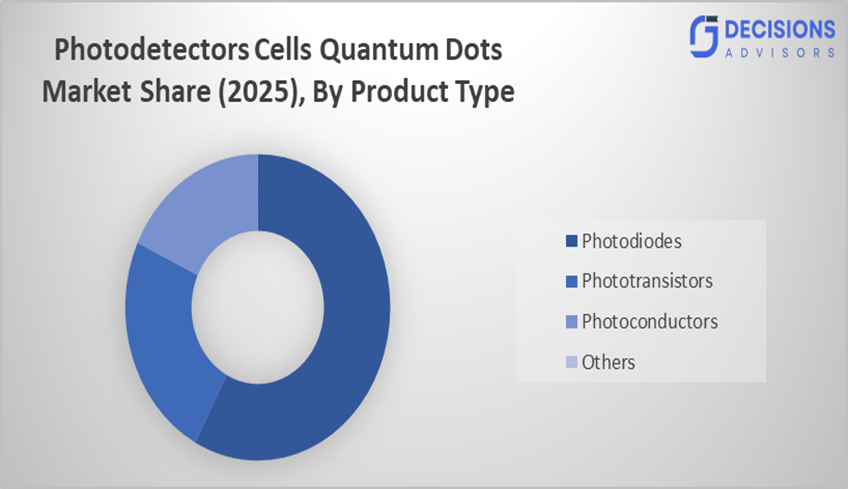
By product type, photodiodes dominate the global photodetectors cells quantum dots market, accounting for approximately 48% of the total market share in 2025.
Based on the product type, the photodetectors cells quantum dots market is segmented into photodiodes, phototransistors, photoconductors, and quantum dot solar cells. photodiodes dominate the global photodetectors cells quantum dots market, accounting for approximately 48% of the total market share in 2025. The photodiode segment dominated the market in 2024 and is expected to grow at a steady CAGR of around 7.8% during the forecast period. This dominance is mainly attributed to their widespread use in optical communication and high-speed imaging due to integrated features, operational efficiency, and suitability for a wide range of light-sensing procedures.
By material type, cadmium-based quantum dots hold the largest share, contributing approximately 47% of the market in 2025.
Based on material type, the photodetectors cells quantum dots market is segmented into cadmium-based quantum dots, cadmium-free quantum dots, and other nanomaterials. By material type, cadmium-based quantum dots hold the largest share, contributing approximately 47% of the market in 2025. The cadmium-based segment dominates due to its superior quantum yield, reliability, and established manufacturing processes compared to early-stage alternatives. These materials provide higher colour purity and better integration with conventional semiconductor platforms. Therefore, they are highly favoured in the present high-performance sensor application. Cadmium-free materials are predicted to experience the maximum growth rate because of the increasingly stringent environmental regulations.
By application, consumer electronics account for the largest share, representing over 52% of the global market in 2025.
Based on application, the market is categorised into consumer electronics, healthcare and medical devices, automotive, aerospace and defence, and energy and utilities. By application, consumer electronics account for the largest share, representing over 52% of the global market in 2025. Consumer electronics lead the market as these products use a large number of cameras, ambient light detectors, and facial recognition systems requiring highly sensitive photodetectors. The rising number of smart devices across the world and the rising demand from consumers for high-definition camera capabilities in mobile devices and biometric security systems are fuelling the growth of the consumer electronics segment.
Strategies to Implement for Growth of the Market in Non-Leading Regions
The development of the photodetectors cells quantum dots market in non-leading regions can be enhanced by employing measures that promote these products’ affordability and technical as well as infrastructural viability. One of the most effective measures is promoting cost-effective sensing units targeting small-scale electronics manufacturers and research institutions with limited budgets. Enhancing research and development grants as well as government-backed semiconductor funding schemes can also promote the development and use of quantum dot technology in non-leading high-tech development centers. Moreover, investing in nanotechnology education as well as specialized engineering training is vital for ensuring that technical staff can efficiently integrate these advanced cells into local electronics hardware designs. Enhancing global semiconductor partnerships as well as digital supply chains can promote availability in remote and developing industrial regions.
Regional Segment Analysis of the Photodetectors Cells Quantum Dots Market
- North America (U.S., Canada, Mexico)
- Europe (Germany, France, U.K., Italy, Spain, Rest of Europe)
- Asia-Pacific (China, Japan, India, South Korea, Rest of APAC)
- Latin America (Brazil and the Rest of Latin America)
- The Middle East and Africa (UAE, South Africa, Rest of MEA)
North America is expected to hold the largest share of the photodetectors cells quantum dots market during the forecast period. The region accounts for approximately 35% of the global revenue share, supported by a highly advanced technological infrastructure and strong adoption of quantum-integrated sensing equipment in the defence and aerospace sectors. The United States contributes the majority of this regional revenue due to high research and development expenditure in nanotechnology, which exceeds several billion dollars annually, along with a large number of well-equipped semiconductor fabrication facilities. The continuous upgrade of optical sensors, focus on high-speed data transmission, and early adoption of quantum dot infrared solutions are further driving the demand for modern photodetectors across the region.
Asia-Pacific is projected to be the fastest-growing region in the photodetectors cells quantum dots market over the forecast period. The region is expected to grow at a CAGR of approximately 12% while accounting for approximately 30% of the global market share. This growth is driven by improving electronics manufacturing infrastructure, rising demand for next-generation consumer gadgets, and a rapidly expanding network of semiconductor assembly plants in countries such as China, South Korea, and India. Increasing investments in 5G telecommunications, government high-tech initiatives, and a massive consumer base for smartphones are also contributing to higher demand for advanced and miniaturised photodetectors, particularly in major industrial corridors.
Europe is anticipated to hold the third-largest share in the photodetectors cells quantum dots market, contributing approximately 22% of the global market share. The region maintains a strong position due to well-established automotive and medical imaging industries and consistent investment in photonics research. Countries such as Germany, France, and the United Kingdom play a key role due to high awareness of sustainable technology and the implementation of strict environmental regulations favouring cadmium-free quantum dots.
Future Market Trends in the Global Photodetectors Cells Quantum Dots Market
- Increasing Adoption of Digitally Integrated and Smart Sensing Units
A clear transition is evident from traditional silicon-based sensor technologies to digitally integrated quantum dot-based photodetectors with built-in spectral sensitivity, programmability in the response function, and seamless connectivity to AI-based processing units. These advanced cells enhance data acquisition speed and can improve imaging resolution by around 30% in low-light conditions.
- Rising Demand for Miniature and High-Resolution SWIR Imaging
New high-tech industries in the present day are increasingly focusing on miniaturization and high-accuracy Short-Wave Infrared (SWIR) detection, thus creating the need for quantum dot photodetectors with ultra-small pixel pitches and broadband absorption. These small detectors minimize device size and enable the integration of smartphones and wearable electronics, in addition to improving night vision capabilities.
- Expansion of High-Tech Manufacturing in Emerging Markets
The photodetectors cells quantum dots market has observed significant growth in developing countries such as Asia-Pacific and Latin America due to the enhancement in infrastructure facilities for semiconductors and the rising awareness of next-generation optoelectronics. The rapid expansion of electronics assembly plants, along with government high-tech initiatives.
Recent Developments
- In July 2024, Nanoco Technologies launched a new 300mm wafer device facility at its Runcorn headquarters. This facility allows the company to coat quantum dot layers directly onto silicon wafers in-house, accelerating the prototyping cycle and significantly reducing the time required for performance feedback.
- In April 2024, Quantum Solutions introduced the SWIR, a quantum dot-based image sensor for robotics and machine vision. The sensor features a broad spectral range of 400 to 1700 nm and a compact 5 μm pixel pitch, enabling high-resolution imaging through obstructions like smoke or atmospheric haze.
- In January 2024, Samsung Semiconductor enhanced its optical sensing portfolio by integrating next-generation quantum dot colour conversion technology into its latest imaging processors. This advancement improves clinical and industrial diagnostic accuracy by around 15%, providing sharper details and better colour fidelity for high-end medical and consumer cameras.
- In June 2023, UbiQD signed a high-volume supply agreement with First Solar to scale production of cadmium-free quantum dots to over 100 metric tons annually. This technology is designed to more than double the bifacial quantum efficiency at specific wavelengths, boosting the energy yield of utility-scale solar panels.
Market Segmentation
This study forecasts revenue at global, regional, and country levels from 2020 to 2035. The photodetectors cells quantum dots market is segmented based on the following categories:
Global Photodetectors Cells Quantum Dots Market, By Product Type
- Photodiodes
- Phototransistors
- Photoconductors
- Quantum Dot Solar Cells
Global Photodetectors Cells Quantum Dots Market, By Material Type
- Cadmium-based Quantum Dots
- Cadmium-free Quantum Dots
- Other Nanomaterials
Global Photodetectors Cells Quantum Dots Market, By Application
- Consumer Electronics
- Healthcare and Medical Devices
- Automotive
- Aerospace and Defence
- Energy and Utilities
Global Photodetectors Cells Quantum Dots Market, By Regional Analysis
- North America
- United States
- Canada
- Mexico
- Europe
- Germany
- United Kingdom
- France
- Italy
- Spain
- Russia
- Rest of Europe
- Asia Pacific
- China
- Japan
- India
- South Korea
- Australia
- Rest of Asia Pacific
- Latin America
- Brazil
- Argentina
- Rest of Latin America
- Middle East & Africa
- United Arab Emirates
- Saudi Arabia
- Qatar
- South Africa
- Rest of Middle East & Africa
Frequently Asked Questions (FAQ)
What are photodetectors cells, quantum dots, and why are they important?
Photodetectors cells, quantum dots are highly advanced semiconductor devices used for converting light into electric signals precisely. These are extremely important for our modern technology as they can absorb light precisely and are highly sensitive. This has led to many breakthroughs in high-definition imaging, night vision, and solar power harvesting.
What factors are driving the growth of the photodetectors cells quantum dots market?
The market is growing due to increased demand for high-performance sensors for smartphones, the development of autonomous vehicle navigation systems, and infrared sensing in medical diagnostics. Furthermore, there is an increased need for sustainable cadmium-free materials, as well as massive investments by governments in quantum technologies.
Which product type dominates the photodetectors cells quantum dots market?
Photodiodes currently hold the largest market share. Their dominance is due to their widespread application in optical fibre communications, smoke detectors, and digital cameras, where they provide reliable, high-speed conversion of light into current.
Which region leads the photodetectors cells quantum dots market?
North America holds the highest market share due to its well-developed semiconductor industry, high defence spending on sensing technology, and the presence of world-class research institutions. However, the Asia-Pacific region is growing at the highest rate due to its massive electronics industry and high rate of industrial automation.
Who are the key end users of these quantum dot cells?
The primary end users include consumer electronics manufacturers, aerospace and defense organizations, automotive companies specializing in LiDAR technology, and healthcare organizations using advanced bio-imaging technologies. The largest end-user segment is the consumer electronics industry due to the need for improved camera sensors and biometric security.
- Introduction
- Objectives of the Study
- Market Definition
- Research Scope
- Research Methodology and Assumptions
- Executive Summary
- Premium Insights
- Porter’s Five Forces Analysis
- Value Chain Analysis
- Top Investment Pockets
- Market Attractiveness Analysis By Product Type
- Market Attractiveness Analysis By Material Type
- Market Attractiveness Analysis By Application
- Market Attractiveness Analysis By Region
- Industry Trends
- Market Dynamics
- Market Evaluation
- Drivers
- Increasing demand for high-sensitivity and efficient photodetection technologies
- Restraints
- Complex fabrication processes and high production costs of quantum dot-based devices
- Opportunities
- Growing investment in advanced nanotechnology and optoelectronic research
- Challenges
5.5.1. Stability issues and material toxicity concerns in quantum dot applications
- Global Photodetectors Cells Quantum Dots Market Analysis and Projection, By Product Type
- Segment Overview
- Photodiodes
- Phototransistors
- Photoconductors
- Quantum Dot Solar Cells
- Global Photodetectors Cells Quantum Dots Market Analysis and Projection, By Material Type
- Segment Overview
- Cadmium-based Quantum Dots
- Cadmium-free Quantum Dots
- Other Nanomaterials
- <<Sub2_se4>>
- <<Sub2_se5>>
- Global Photodetectors Cells Quantum Dots Market Analysis and Projection, By Application
- Segment Overview
- Consumer Electronics
- Healthcare and Medical Devices
- Automotive
- Aerospace and Defence
- Energy and Utilities
- Global Photodetectors Cells Quantum Dots Market Analysis and Projection, By Regional Analysis
- Segment Overview
- North America
- U.S.
- Canada
- Mexico
- Europe
- Germany
- France
- U.K.
- Italy
- Spain
- Asia-Pacific
- Japan
- China
- India
- South America
- Brazil
- Middle East and Africa
- UAE
- South Africa
- Global Photodetectors Cells Quantum Dots Market-Competitive Landscape
- Overview
- Market Share of Key Players in the Photodetectors Cells Quantum Dots Market
- Global Company Market Share
- North America Company Market Share
- Europe Company Market Share
- APAC Company Market Share
- Competitive Situations and Trends
- Coverage Launches and Developments
- Partnerships, Collaborations, and Agreements
- Mergers & Acquisitions
- Expansions
- Company Profiles
- Nanosys Inc.
- Business Overview
- Company Snapshot
- Company Market Share Analysis
- Company Coverage Portfolio
- Recent Developments
- SWOT Analysis
- Nanoco Group plc
- Business Overview
- Company Snapshot
- Company Market Share Analysis
- Company Coverage Portfolio
- Recent Developments
- SWOT Analysis
- Merck KGaA
- Business Overview
- Company Snapshot
- Company Market Share Analysis
- Company Coverage Portfolio
- Recent Developments
- SWOT Analysis
- Samsung Display Co., Ltd.
- Business Overview
- Company Snapshot
- Company Market Share Analysis
- Company Coverage Portfolio
- Recent Developments
- SWOT Analysis
- LG Display Co., Ltd.
- Business Overview
- Company Snapshot
- Company Market Share Analysis
- Company Coverage Portfolio
- Recent Developments
- SWOT Analysis
- BOE Technology Group Co., Ltd.
- Business Overview
- Company Snapshot
- Company Market Share Analysis
- Company Coverage Portfolio
- Recent Developments
- SWOT Analysis
- QD Laser Inc.
- Business Overview
- Company Snapshot
- Company Market Share Analysis
- Company Coverage Portfolio
- Recent Developments
- SWOT Analysis
- Ocean NanoTech LLC
- Business Overview
- Company Snapshot
- Company Market Share Analysis
- Company Coverage Portfolio
- Recent Developments
- SWOT Analysis
- NNCrystal US Corporation
- Business Overview
- Company Snapshot
- Company Market Share Analysis
- Company Coverage Portfolio
- Recent Developments
- SWOT Analysis
- UbiQD Inc.
- Business Overview
- Company Snapshot
- Company Market Share Analysis
- Company Coverage Portfolio
- Recent Developments
- SWOT Analysis
- Nanosys Inc.
List of Table
- Global Photodetectors Cells Quantum Dots Market, By Product Type, 2024-2035(USD Billion)
- Global Photodiodes, Photodetectors Cells Quantum Dots Market, By Region, 2024-2035(USD Billion)
- Global Phototransistors, Photodetectors Cells Quantum Dots Market, By Region, 2024-2035(USD Billion)
- Global Photoconductors, Photodetectors Cells Quantum Dots Market, By Region, 2024-2035(USD Billion)
- Global Quantum Dot Solar Cells, Photodetectors Cells Quantum Dots Market, By Region, 2024-2035(USD Billion)
- Global Photodetectors Cells Quantum Dots Market, By Material Type, 2024-2035(USD Billion)
- Global Cadmium-based Quantum Dots, Photodetectors Cells Quantum Dots Market, By Region, 2024-2035(USD Billion)
- Global Cadmium-free Quantum Dots, Photodetectors Cells Quantum Dots Market, By Region, 2024-2035(USD Billion)
- Global Other Nanomaterials, Photodetectors Cells Quantum Dots Market, By Region, 2024-2035(USD Billion)
- Global Photodetectors Cells Quantum Dots Market, By Application, 2024-2035(USD Billion)
- Global Consumer Electronics, Photodetectors Cells Quantum Dots Market, By Region, 2024-2035(USD Billion)
- Global Healthcare and Medical Devices, Photodetectors Cells Quantum Dots Market, By Region, 2024-2035(USD Billion)
- Global Automotive, Photodetectors Cells Quantum Dots Market, By Region, 2024-2035(USD Billion)
- Global Aerospace and Defence, Photodetectors Cells Quantum Dots Market, By Region, 2024-2035(USD Billion)
- Global Energy and Utilities, Photodetectors Cells Quantum Dots Market, By Region, 2024-2035(USD Billion)
- North America Photodetectors Cells Quantum Dots Market, By Product Type, 2024-2035(USD Billion)
- North America Photodetectors Cells Quantum Dots Market, By Material Type, 2024-2035(USD Billion)
- North America Photodetectors Cells Quantum Dots Market, By Application, 2024-2035(USD Billion)
- U.S. Photodetectors Cells Quantum Dots Market, By Product Type, 2024-2035(USD Billion)
- U.S. Photodetectors Cells Quantum Dots Market, By Material Type, 2024-2035(USD Billion)
- U.S. Photodetectors Cells Quantum Dots Market, By Application, 2024-2035(USD Billion)
- Canada Photodetectors Cells Quantum Dots Market, By Product Type, 2024-2035(USD Billion)
- Canada Photodetectors Cells Quantum Dots Market, By Material Type, 2024-2035(USD Billion)
- Canada Photodetectors Cells Quantum Dots Market, By Application, 2024-2035(USD Billion)
- Mexico Photodetectors Cells Quantum Dots Market, By Product Type, 2024-2035(USD Billion)
- Mexico Photodetectors Cells Quantum Dots Market, By Material Type, 2024-2035(USD Billion)
- Mexico Photodetectors Cells Quantum Dots Market, By Application, 2024-2035(USD Billion)
- Europe Photodetectors Cells Quantum Dots Market, By Product Type, 2024-2035(USD Billion)
- Europe Photodetectors Cells Quantum Dots Market, By Material Type, 2024-2035(USD Billion)
- Europe Photodetectors Cells Quantum Dots Market, By Application, 2024-2035(USD Billion)
- Germany Photodetectors Cells Quantum Dots Market, By Product Type, 2024-2035(USD Billion)
- Germany Photodetectors Cells Quantum Dots Market, By Material Type, 2024-2035(USD Billion)
- Germany Photodetectors Cells Quantum Dots Market, By Application, 2024-2035(USD Billion)
- France Photodetectors Cells Quantum Dots Market, By Product Type, 2024-2035(USD Billion)
- France Photodetectors Cells Quantum Dots Market, By Material Type, 2024-2035(USD Billion)
- France Photodetectors Cells Quantum Dots Market, By Application, 2024-2035(USD Billion)
- U.K. Photodetectors Cells Quantum Dots Market, By Product Type, 2024-2035(USD Billion)
- U.K. Photodetectors Cells Quantum Dots Market, By Material Type, 2024-2035(USD Billion)
- U.K. Photodetectors Cells Quantum Dots Market, By Application, 2024-2035(USD Billion)
- Italy Photodetectors Cells Quantum Dots Market, By Product Type, 2024-2035(USD Billion)
- Italy Photodetectors Cells Quantum Dots Market, By Material Type, 2024-2035(USD Billion)
- Italy Photodetectors Cells Quantum Dots Market, By Application, 2024-2035(USD Billion)
- Spain Photodetectors Cells Quantum Dots Market, By Product Type, 2024-2035(USD Billion)
- Spain Photodetectors Cells Quantum Dots Market, By Material Type, 2024-2035(USD Billion)
- Spain Photodetectors Cells Quantum Dots Market, By Application, 2024-2035(USD Billion)
- Asia Pacific Photodetectors Cells Quantum Dots Market, By Product Type, 2024-2035(USD Billion)
- Asia Pacific Photodetectors Cells Quantum Dots Market, By Material Type, 2024-2035(USD Billion)
- Asia Pacific Photodetectors Cells Quantum Dots Market, By Application, 2024-2035(USD Billion)
- Japan Photodetectors Cells Quantum Dots Market, By Product Type, 2024-2035(USD Billion)
- Japan Photodetectors Cells Quantum Dots Market, By Material Type, 2024-2035(USD Billion)
- Japan Photodetectors Cells Quantum Dots Market, By Application, 2024-2035(USD Billion)
- China Photodetectors Cells Quantum Dots Market, By Product Type, 2024-2035(USD Billion)
- China Photodetectors Cells Quantum Dots Market, By Material Type, 2024-2035(USD Billion)
- China Photodetectors Cells Quantum Dots Market, By Application, 2024-2035(USD Billion)
- India Photodetectors Cells Quantum Dots Market, By Product Type, 2024-2035(USD Billion)
- India Photodetectors Cells Quantum Dots Market, By Material Type, 2024-2035(USD Billion)
- India Photodetectors Cells Quantum Dots Market, By Application, 2024-2035(USD Billion)
- South America Photodetectors Cells Quantum Dots Market, By Product Type, 2024-2035(USD Billion)
- South America Photodetectors Cells Quantum Dots Market, By Material Type, 2024-2035(USD Billion)
- South America Photodetectors Cells Quantum Dots Market, By Application, 2024-2035(USD Billion)
- Brazil Photodetectors Cells Quantum Dots Market, By Product Type, 2024-2035(USD Billion)
- Brazil Photodetectors Cells Quantum Dots Market, By Material Type, 2024-2035(USD Billion)
- Brazil Photodetectors Cells Quantum Dots Market, By Application, 2024-2035(USD Billion)
- The Middle East and Africa Photodetectors Cells Quantum Dots Market, By Product Type, 2024-2035(USD Billion)
- The Middle East and Africa Photodetectors Cells Quantum Dots Market, By Material Type, 2024-2035(USD Billion)
- The Middle East and Africa Photodetectors Cells Quantum Dots Market, By Application, 2024-2035(USD Billion)
- UAE Photodetectors Cells Quantum Dots Market, By Product Type, 2024-2035(USD Billion)
- UAE Photodetectors Cells Quantum Dots Market, By Material Type, 2024-2035(USD Billion)
- UAE Photodetectors Cells Quantum Dots Market, By Application, 2024-2035(USD Billion)
- South Africa Photodetectors Cells Quantum Dots Market, By Product Type, 2024-2035(USD Billion)
- South Africa Photodetectors Cells Quantum Dots Market, By Material Type, 2024-2035(USD Billion)
- South Africa Photodetectors Cells Quantum Dots Market, By Application, 2024-2035(USD Billion)
List of Figures
- Global Photodetectors Cells Quantum Dots Market Segmentation
- Photodetectors Cells Quantum Dots Market: Research Methodology
- Market Size Estimation Methodology: Bottom-Up Approach
- Market Size Estimation Methodology: Top-down Approach
- Data Triangulation
- Porter’s Five Forces Analysis
- Value Chain Analysis
- Top investment pocket in the Photodetectors Cells Quantum Dots Market
- Top Winning Strategies, 2024-2035
- Top Winning Strategies, By Development, 2024-2035(%)
- Top Winning Strategies, By Company, 2024-2035
- Moderate Bargaining power of Buyers
- Moderate Bargaining power of Suppliers
- Moderate Bargaining power of New Entrants
- Low threat of Substitution
- High Competitive Rivalry
- Top Player Positioning, 2024
- Market Share Analysis, 2024
- Restraint and Drivers: Photodetectors Cells Quantum Dots Market
- Photodetectors Cells Quantum Dots Market Segmentation, By Product Type
- Photodetectors Cells Quantum Dots Market For Photodiodes, By Region, 2024-2035 ($ Billion)
- Photodetectors Cells Quantum Dots Market For Phototransistors, By Region, 2024-2035 ($ Billion)
- Photodetectors Cells Quantum Dots Market For Photoconductors, By Region, 2024-2035 ($ Billion)
- Photodetectors Cells Quantum Dots Market For Quantum Dot Solar Cells, By Region, 2024-2035 ($ Billion)
- Photodetectors Cells Quantum Dots Market Segmentation, By Material Type
- Photodetectors Cells Quantum Dots Market For Cadmium-based Quantum Dots, By Region, 2024-2035 ($ Billion)
- Photodetectors Cells Quantum Dots Market For Cadmium-free Quantum Dots, By Region, 2024-2035 ($ Billion)
- Photodetectors Cells Quantum Dots Market For Other Nanomaterials, By Region, 2024-2035 ($ Billion)
- Photodetectors Cells Quantum Dots Market Segmentation, By Application
- Photodetectors Cells Quantum Dots Market For Consumer Electronics, By Region, 2024-2035 ($ Billion)
- Photodetectors Cells Quantum Dots Market For Healthcare and Medical Devices, By Region, 2024-2035 ($ Billion)
- Photodetectors Cells Quantum Dots Market For Automotive, By Region, 2024-2035 ($ Billion)
- Photodetectors Cells Quantum Dots Market For Aerospace and Defence, By Region, 2024-2035 ($ Billion)
- Photodetectors Cells Quantum Dots Market For Energy and Utilities, By Region, 2024-2035 ($ Billion)
- Nanosys Inc.: Net Sales, 2024-2035 ($ Billion)
- Nanosys Inc.: Revenue Share, By Segment, 2024 (%)
- Nanosys Inc.: Revenue Share, By Region, 2024 (%)
- Nanoco Group plc: Net Sales, 2024-2035 ($ Billion)
- Nanoco Group plc: Revenue Share, By Segment, 2024 (%)
- Nanoco Group plc: Revenue Share, By Region, 2024 (%)
- Merck KGaA: Net Sales, 2024-2035 ($ Billion)
- Merck KGaA: Revenue Share, By Segment, 2024 (%)
- Merck KGaA: Revenue Share, By Region, 2024 (%)
- Samsung Display Co., Ltd.: Net Sales, 2024-2035 ($ Billion)
- Samsung Display Co., Ltd.: Revenue Share, By Segment, 2024 (%)
- Samsung Display Co., Ltd.: Revenue Share, By Region, 2024 (%)
- LG Display Co., Ltd.: Net Sales, 2024-2035 ($ Billion)
- LG Display Co., Ltd.: Revenue Share, By Segment, 2024 (%)
- LG Display Co., Ltd.: Revenue Share, By Region, 2024 (%)
- BOE Technology Group Co., Ltd.: Net Sales, 2024-2035 ($ Billion)
- BOE Technology Group Co., Ltd.: Revenue Share, By Segment, 2024 (%)
- BOE Technology Group Co., Ltd.: Revenue Share, By Region, 2024 (%)
- QD Laser Inc.: Net Sales, 2024-2035 ($ Billion)
- QD Laser Inc.: Revenue Share, By Segment, 2024 (%)
- QD Laser Inc.: Revenue Share, By Region, 2024 (%)
- Ocean NanoTech LLC: Net Sales, 2024-2035 ($ Billion)
- Ocean NanoTech LLC: Revenue Share, By Segment, 2024 (%)
- Ocean NanoTech LLC: Revenue Share, By Region, 2024 (%)
- NNCrystal US Corporation.: Net Sales, 2024-2035 ($ Billion)
- NNCrystal US Corporation.: Revenue Share, By Segment, 2024 (%)
- NNCrystal US Corporation.: Revenue Share, By Region, 2024 (%)
- UbiQD Inc.: Net Sales, 2024-2035 ($ Billion)
- UbiQD Inc.: Revenue Share, By Segment, 2024 (%)
- UbiQD Inc.: Revenue Share, By Region, 2024 (%)
Check Licence
Choose the plan that fits you best: Single User, Multi-User, or Enterprise solutions tailored for your needs.
We Have You Covered
- 24/7 Analyst Support
- Clients Across the Globe
- Tailored Insights
- Technology Tracking
- Competitive Intelligence
- Custom Research
- Syndicated Market Studies
- Market Overview
- Market Segmentation
- Growth Drivers
- Market Opportunities
- Regulatory Insights
- Innovation & Sustainability
Report Details
| Scope | Global |
| Pages | 210 |
| Delivery | PDF & Excel via Email |
| Language | English |
| Release | Apr 2026 |
| Access | Download from this page |