
Global Planar Light wave Circuit Splitter Market
 |
Author:
Achal E
|
Pages:
245
|
Author:
Achal E
|
Pages:
245
Global Planar light wave circuit splitter Market Size, Share, By Application (Data centers, Telecommunications, and Broadband), By Type (Unequal Splitter, Balanced Splitter, and Star Coupler), By Material (Glass, Silicon and Plastic), By Configuration (Integrated, and Standalone) and By Region (North America, Europe, Asia-Pacific, Latin America, Middle East, and Africa), Analysis and Forecast 2026-2035
CAGR
8.2%
REVENUE 2025
USD Billion 1.57
FORECAST 2035
USD Billion 3.44
REPORT COVERAGE
Global
Market Snapshot
- Market Size (2025): USD 1.565 Billion
- Projected Market Size (2035): USD 3.441 Billion
- Compound Annual Growth Rate (CAGR): 8.2%
- Largest Regional Market: Asia Pacific
- Fastest Growing Region: North America
- 3rd Largest Region: Europe
- Base Year: 2025
- Historical Period: 2021–2024
- Forecast Period: 2026–2035
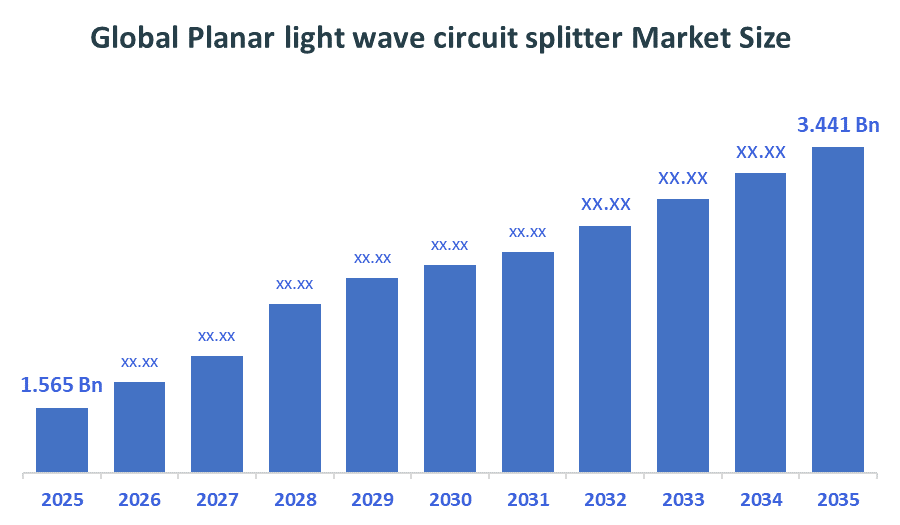
According to Decision Advisors, the Global Planar light wave circuit splitter Market Size is expected to grow from USD 1.565 Billion in 2025 to USD 3.441 Billion by 2035, at a CAGR of 8.2% during the forecast period 2026-2035. Global Planar light wave circuit splitter market is expected to experience substantial growth over the forecast period due to the rapid expansion of fibre optic communication networks, increasing deployment of FTTH and FTTx infrastructure, rising demand for high-speed internet and data transmission, growing adoption of 5G technology, and continuous advancements in optical networking solutions.
Market Overview/ Introduction
Planar light wave circuit splitter market refers to the global industry involved in the design, manufacturing, and distribution of PLC splitters, which are passive optical devices used in fibre optic communication networks. A Planar Lightwave Circuit (PLC) Splitter is a passive optical device used in fibre optic communication systems to split a single optical signal into multiple output signals evenly. The market is increasing due to an increase in fibre optic networks, the desire for high-speed internet, the increasing use of FTTH and 5G technologies and the growth in data centres and cloud services around the world. Moreover, there is a global need for efficient (and low-loss) signal distribution and scalable telecommunication infrastructure increases demand as well. The market innovation in optical fiber connectors has several significant participants, including Broadex Technologies, Browave Corporation, Prysmian, Senko Advanced Components, Corning, NTT Electronics, and Shanghai Sun Telecom. Although barriers to entry consist primarily of established competitors and the cost of raw materials, the overall outlook for the industry as a whole appears to be optimistic due primarily to global digital transformation.
- April 2026, India’s BharatNet Programme is expanding digital infrastructure by connecting Gram Panchayats with optical fiber and FTTH services, making over 2.18 lakh villages service-ready for high-speed broadband and digital governance implementation.
- New Delhi, February 2026: The government has disbursed ?28,748 crore under PLI schemes across 14 sectors, including electronics and pharmaceuticals, to boost domestic manufacturing and strengthen India’s industrial growth.
- March 2026, India launched the Make in India initiative to boost manufacturing, investment, and innovation. The program supports domestic production of fiber optic components like Planar Lightwave Circuit (PLC) splitters, strengthening telecom infrastructure and exports.
Notable Insights: -
- Asia-Pacific holds the largest regional market share approximately 45% in the global Planar light wave circuit splitter market.
- North America is the fastest growing region market share approximately 28% in the global Planar light wave circuit splitter market.
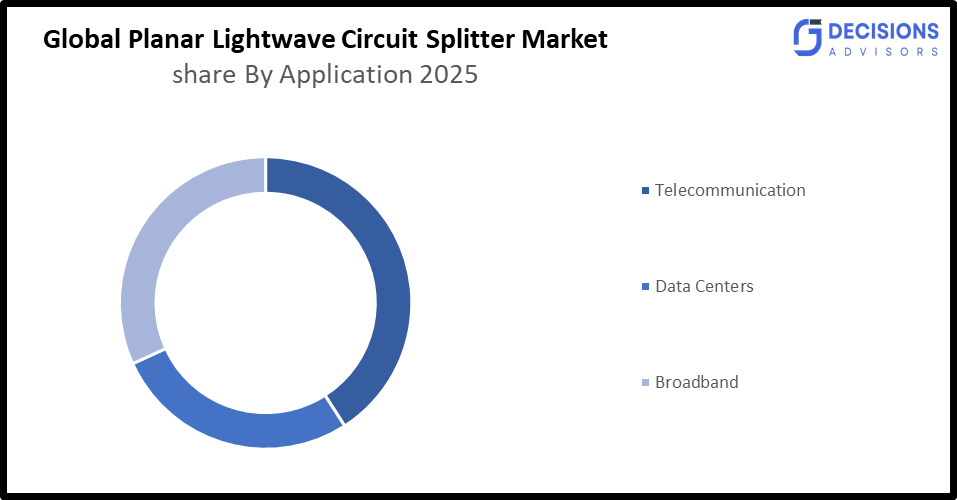
- By Application, the telecommunications segment held a dominant position with 34% in terms of market share in 2025.
- By Type, balanced splitter segment is the dominating accounting for over 60% of the global market share in 2025.
- By Material, Glass segment is the dominating accounting for market is approximately 62%.
- By Configuration, Integrated segment held a dominant position market is approximately 65%.
- The market is likely to achieve a valuation of USD 3.441 Billion by 2035.
What is role of technology in grooming the market?
Technology is significantly driving the PLC splitter market, improving efficiency and scalability in fibre networks. Advanced photonic integration enables low loss (<0.3 dB) and uniform signal distribution. High-density designs support split ratios up to 1×64, widely used in FTTH deployments. With global fibre broadband connections exceeding 1.5 billion and 5G expansion growing at over 12% annually, demand for reliable optical components like PLC splitters is rapidly increasing, enhancing overall network performance and adoption.
How is Recent Developments Helping the Market?
Recent developments are accelerating the Planar Lightwave Circuit (PLC) splitter market through innovations in high-density designs, low-loss materials, and advanced manufacturing. Modern PLC splitters now support up to 1×64 and 1×128 configurations with insertion loss below 0.3–0.5 dB, improving network efficiency. The rapid expansion of FTTH connections, surpassing 1.5 billion globally, and 5G deployment growing at over 12% CAGR are increasing demand. Additionally, integration with cloud data centres and smart city infrastructure is further boosting adoption worldwide.
Market Drivers
The world-wide PLC (planar light wave circuit) market has continued a steady march to the top with a compound annual growth rate of around 8% – 9%, as the total market has been estimated to grow from an estimated US$1.4 billion in 2024-2025 to close to US$2.9 billion by 2032. Asia-Pacific is the major growth area of the worldwide PLC splitter market being a dominant region accounting for approximately 40% of the overall PLC splitter market - led by the immense growth of fibre optic networks in China, India and Japan. In addition, the growth of the worldwide PLC splitter market is being driven by FTTH and FTTx network buildouts, including the buildout of 5G networks, and the increase in demand for high-speed internet services worldwide. The continuing expansion of data centres, the increase in cloud computing and "smart city" programs are also expected to create additional demand for efficient optical communication solutions.
Restrain
The PLC splitter market faces restraints due to high initial installation and deployment costs, complex manufacturing processes, and challenges in integrating with existing network infrastructure. Additionally, price competition, limited awareness in developing regions, and the availability of alternative technologies like FBT splitters may hinder market growth to some extent.
Competitive Analysis:
The report offers the appropriate analysis of the key organizations/companies involved within the Planar light wave circuit splitter market, along with a comparative evaluation primarily based on their type of offering, business overviews, geographic presence, enterprise strategies, segment market share, and SWOT analysis. The report also provides an elaborative analysis focusing on the current news and developments of the companies, which includes type development, innovations, joint ventures, partnerships, mergers & acquisitions, strategic alliances, and others. This allows for the evaluation of the overall competition within the market.
Top Companies in Global Planar light wave circuit splitter Market
- NTT Electronics
- Senko Advanced Components
- Corning Incorporated
- Broadex Technologies
- Furukawa Electric Co., Ltd.
- Fujikura Ltd.
- Prysmian Group
- Accelink Technologies Co., Ltd.
- Amphenol Telect, Inc.
- OZ Optics Limited
- Browave Corporation
- T&S Communications Co., Ltd.
Government Initiatives
|
Country |
Key Government Initiatives |
|
India |
January 2026: India’s Ministry of Electronics and Information Technology approved 22 additional proposals under the ECMS, attracting ?41,863 crore investment, projected production of ?2.58 lakh crore, and creating 33,791 direct jobs, boosting electronics manufacturing growth. |
|
US |
October 2025: The NTIA eased BABA compliance via revised guidance and self-certification. Companies like Cisco, Corning, and Nokia began certifying U.S. manufacturing, accelerating broadband projects and reducing regulatory uncertainty for BEAD applicants nationwide. |
|
Sweden |
National Broadband Goals (2020-2023): Strategic goals targeting 95% of households to have access to 100 Mbit/s, with complete coverage by 2023, driving FTTH and PLC splitter deployment. |
Study on the Supply, Demand, Distribution, and Market Environment of Energy Management Systems Market
The Planar Light wave Circuit (PLC) splitter market ecosystem is shaped by strong supply chains, rising demand, and evolving distribution channels. Suppliers include fiber optic component manufacturers providing PLC splitters for telecom and broadband networks. Demand is driven by increasing FTTH deployments, 5G expansion, and growing data consumption globally. Distribution occurs through direct sales, telecom equipment vendors, and partnerships with network integrators. Cloud-based and data center applications further strengthen demand. The market environment is influenced by government digital initiatives, infrastructure investments, and technological advancements in photonics. However, factors such as pricing pressure, integration complexity, and competition from alternative technologies impact market dynamics while driving continuous innovation and efficiency improvements.
Price Analysis and Consumer Behaviour Analysis
The price of Planar Lightwave Circuit (PLC) splitters depends on split ratio, design, and performance, with high-density models (1×32, 1×64) costing more. However, large-scale production is gradually reducing prices. From a consumer behaviour perspective, telecom operators and ISPs prioritize performance, reliability, and low insertion loss over cost. Buyers also prefer scalable, compact solutions compatible with existing infrastructure. Increasing demand for FTTH and 5G networks is driving preference for high-quality, cost-efficient, and durable optical components in modern communication systems.
Market Segmentation
The Planar light wave circuit splitter market share is classified into application, type, material, and configuration
- The telecommunications segment dominated the market in 2025, and is projected to grow at a substantial CAGR of approximately 34% during the forecast period.
Based on the application, the planar light wave circuit splitter market is divided into data centres, telecommunications, and broadband. Among these, the telecommunications segment dominated the market in 2025, the telecommunications segment led by telecommunications, holding around 30–34% share, driven by FTTH and 5G expansion. Broadband applications account for 26–29%, supported by rising internet penetration. Data centres contribute 16–29%, growing rapidly due to cloud computing, hyperscale infrastructure, and increasing global data traffic demand.
- The balanced splitter segment accounted for the largest share in 2024, and is anticipated to grow at a significant CAGR of approximately 60% during the forecast period.
Based on the type, the planar light wave circuit splitter market is divided into unequal splitter, balanced splitter, star coupler. Among these, the balanced splitter segment dominates the PLC splitter market, accounting for approximately 55–60% share, due to its ability to provide uniform signal distribution with low insertion loss. Unequal splitters hold around 20–25%, used in customized applications, while star couplers account for 15–20%. Balanced splitters lead due to widespread use in FTTH and PON networks requiring equal signal output.
- The glass segment dominated the market in 2024, and is projected to grow at a substantial CAGR of approximately 62% during the forecast period.
Based on the material, the planar light wave circuit splitter market is divided into glass, silicon and plastic. Among these, the glass segment dominates the PLC splitter market, accounting for approximately 60–65% share, due to its low insertion loss, high reliability, and stability in optical transmission. Silicon holds around 20–25%, while plastic accounts for 10–15%. Glass leads as it ensures superior performance and durability in telecom and FTTH applications.
- The integrated segment dominated the market in 2024, and is projected to grow at a substantial CAGR of approximately 65% during the forecast period.
Based on the configuration, the planar light wave circuit splitter market is divided into integrated, standalone. Among these, the integrated segment dominates the PLC splitter market, accounting for approximately 60–65% share, due to its compact design, scalability, and seamless integration with optical networks. Standalone splitters hold around 35–40%. Integrated solutions lead as they support high-density deployments, reduce installation space, and improve efficiency in FTTH, 5G, and data center applications.
Strategies to Implement for Growth of the Market in Non-Leading Regions
To drive growth of the PLC splitter market in non-leading regions, companies should focus on offering cost-effective and scalable solutions tailored to local needs. Expanding local manufacturing and forming partnerships with telecom providers and governments can reduce costs and improve market reach. Supporting FTTH and broadband infrastructure development, especially in rural areas, will increase adoption. Aligning with government digital initiatives and policies can further accelerate growth. Additionally, providing technical training and after-sales support helps overcome skill gaps. Raising awareness about product benefits and adopting flexible pricing or business models can encourage faster adoption in emerging markets.
Regional Segment Analysis of the Planar light wave circuit splitter Market
- North America (U.S., Canada, Mexico)
- Europe (Germany, France, U.K., Italy, Spain, Rest of Europe)
- Asia-Pacific (China, Japan, India, Rest of APAC)
- South America (Brazil and the Rest of South America)
- The Middle East and Africa (UAE, South Africa, Rest of MEA)
Asia Pacific is anticipated to hold the largest share of the Planar light wave circuit splitter market over the predicted timeframe.
Asia Pacific dominates the PLC splitter market with approximately 40–45% share and is growing at a CAGR of 9–11%. Growth is driven by rapid FTTH expansion, rising 5G deployment, and increasing internet penetration in China, India, and Japan. Government digital initiatives and strong manufacturing capabilities further support demand. Additionally, large-scale broadband projects and cost-effective production make Asia Pacific the fastest-growing and leading regional market globally.
North America is expected to grow at a rapid CAGR in the Planar light wave circuit splitter market during the forecast period. North America is expected to grow at a CAGR of around 7–9% in the PLC splitter market, holding approximately 25–30% market share. Growth is driven by advanced telecom infrastructure, rapid 5G deployment, and strong FTTH expansion across the United States and Canada. Increasing investments in data centres, cloud services, and government-backed broadband programs are further accelerating demand for high-performance optical components in the region.
Europe is the 3rd largest region to grow in the Planar light wave circuit splitter market during the region. Europe is the third-largest region in the Planar Light wave Circuit (PLC) splitter market, accounting for approximately 20–25% share and growing at a CAGR of around 6–8%. Growth is driven by increasing fiber optic deployment, FTTH expansion, and strict data regulations in countries like Germany, United Kingdom, and France. Rising demand for high-speed connectivity, digital transformation initiatives, and strong government support for broadband infrastructure further contribute to steady market growth.
Future Market Trends in Global Planar light wave circuit splitter Market:
1. High?Density & Miniaturized Designs
Future PLC splitter trends include compact, high?density modules (e.g., up to 1×128). Miniaturization reduces space and costs while supporting larger port counts required for FTTH, 5G, and data center networks. Such designs improve scalability, enhance performance, and meet growing demand for efficient optical distribution in constrained environments.
2. Integration with Next?Gen Optical Networks
PLC splitters are evolving to integrate seamlessly with advanced networks like NG?PON2 and coherent optics, enabling faster data rates and better reliability. This enhances interoperability, supports diverse applications, and ensures optimal performance across telecom, broadband, and enterprise infrastructures.
3. Smart City & IoT Connectivity
As smart city projects expand, PLC splitters become essential for robust fiber backbone infrastructure. They support IoT applications, sensor networks, and broadband utilities, enabling real?time data exchange, improving urban services, and enhancing digital inclusion in emerging markets.
Recent Development
- In March 2026, Prysmian Group launched its Sirocco high?density microduct cables to support increased fiber counts, enabling efficient deployment of PLC splitters and enhancing the planar lightwave circuit splitter market by facilitating scalable, high?capacity optical access networks.
- In December, 2025, Nokia and du deployed the first 5G Advanced autonomous network slicing solution, enabling intent-based, premium services for business-critical operations, live events, broadcasting, gaming, XR, and AI applications, marking a major milestone in 5G technology evolution.
- In May 2024, EXFO partnered with Corning to co-develop high-density PLC splitter modules for next-generation PON and FTTH networks, strengthening the planar light wave circuit splitter market by supporting advanced optical access and improved network efficiency.
- In October 2023, TE Connectivity acquired AFC Technology, enhancing its optical?component offerings to support expanded telecom infrastructure, including planar light wave circuit splitter solutions for emerging markets.
Market Segment
This study forecasts revenue at global, regional, and country levels from 2020 to 2035. Decision Advisors has segmented the Planar light wave circuit splitter market based on the below-mentioned segments:
Global Planar light wave circuit splitter Market, By Application
- Data centres
- Telecommunications
- Broadband
Global Planar light wave circuit splitter Market, By Type
- Unequal Splitter
- Balanced Splitter
- Star Coupler
Global Planar light wave circuit splitter Market, By Material
- Glass
- Silicon
- Plastic
Global Planar light wave circuit splitter Market, By Configuration
- Integrated
- Standalone
Global Planar light wave circuit splitter Market, By Regional Analysis
- North America
- US
- Canada
- Mexico
- Europe
- Germany
- UK
- France
- Italy
- Spain
- Russia
- Rest of Europe
- Asia Pacific
- China
- Japan
- India
- South Korea
- Australia
- Rest of Asia Pacific
- South America
- Brazil
- Argentina
- Rest of South America
- Middle East & Africa
- UAE
- Saudi Arabia
- Qatar
- South Africa
- Rest of the Middle East & Africa
Frequently Asked Questions (FAQ)
Q1: How is environmental sustainability influencing the PLC splitter market?
A: Increasing focus on sustainability is driving manufacturers to develop low-energy, recyclable PLC splitters and micro duct systems. Companies are adopting eco-friendly materials, reducing carbon footprint during production, and designing compact, energy-efficient optical components for greener network deployments.
Q2: What role do emerging technologies like AI and IoT play in PLC splitter deployment?
A: AI and IoT enable predictive network management, optimizing fiber allocation and splitter performance. Smart sensors and AI-driven analytics help detect faults early, manage traffic loads, and improve reliability of optical networks where PLC splitters are deployed, especially in smart cities.
Q3: How is the aftermarket or maintenance segment evolving for PLC splitters?
A: As PLC splitter networks expand, aftermarket services like monitoring, replacement, and refurbishment are becoming critical. Providers now offer warranty extensions, rapid replacement programs, and remote diagnostic services to reduce downtime and extend equipment life.
Q4: Are there any cybersecurity concerns related to PLC splitter networks?
A: While PLC splitters are passive devices, the networks they support especially FTTH, 5G, and data centres—require secure optical transmission. Network operators are focusing on encryption and physical security to prevent tapping and ensure data integrity.
Q5: How are small and medium enterprises (SMEs) influencing PLC splitter demand?
A: SMEs adopting fibre-optic networks for office connectivity, cloud applications, and IoT deployments are boosting demand for cost-effective, small-form-factor PLC splitters. Flexible, modular splitter designs allow scalable solutions for smaller organizations without large telecom budgets.
Check Licence
Choose the plan that fits you best: Single User, Multi-User, or Enterprise solutions tailored for your needs.
We Have You Covered
- 24/7 Analyst Support
- Clients Across the Globe
- Tailored Insights
- Technology Tracking
- Competitive Intelligence
- Custom Research
- Syndicated Market Studies
- Market Overview
- Market Segmentation
- Growth Drivers
- Market Opportunities
- Regulatory Insights
- Innovation & Sustainability
Report Details
| Scope | Global |
| Pages | 245 |
| Delivery | PDF & Excel via Email |
| Language | English |
| Release | Apr 2026 |
| Access | Download from this page |