
Global Plasma Lighting Market
 |
Author:
Achal E
|
Pages:
195
|
Author:
Achal E
|
Pages:
195
Global Plasma Lighting Market Size, Share, By Wattage (300W, 700W, 1,000W), By Distribution Channel (Retail, and Commercial), By Application (Sports and Entertainment, Roadways, Streets and Tunnels, Industrial Horticulture, Others) and By Region (North America, Europe, Asia-Pacific, Latin America, Middle East, and Africa), Analysis and Forecast 2026-2035.
CAGR
9.33%
REVENUE 2025
USD Billion 0.45
FORECAST 2035
USD Billion 1.1
REPORT COVERAGE
Global
Market Snapshot
- Market Size (2025): USD 0.45 Billion
- Projected Market Size (2035): USD 1.098 Billion
- Compound Annual Growth Rate (CAGR): 9.33%
- Largest Regional Market: North America
- Fastest Growing Region: Asia Pacific
- 3rd Largest Region: Europe
- Base Year: 2025
- Historical Period: 2021–2024
- Forecast Period: 2026–2035
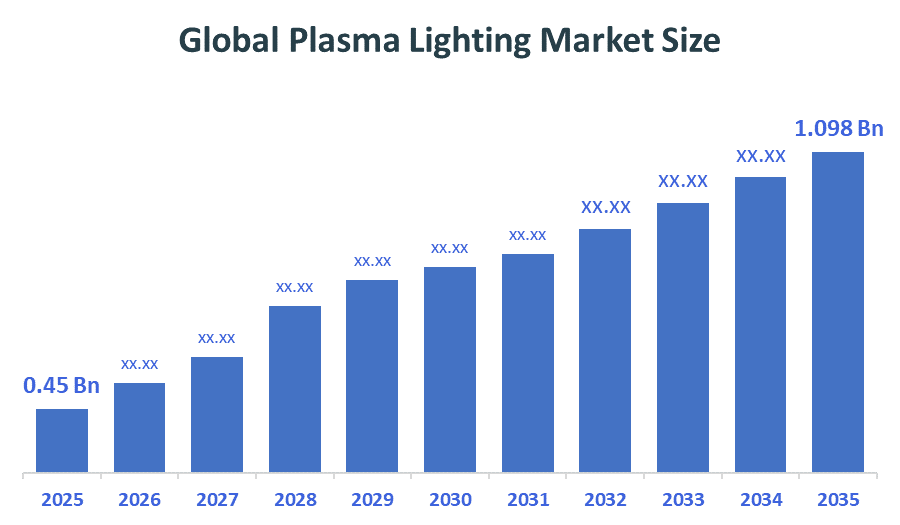
According to Decision Advisors, the global plasma lighting market size is expected to grow from USD 0.45 billion in 2024 to USD 1.098 billion by 2035, at a CAGR of 9.33% during the forecast period 2026-2035. Global plasma lighting market is projected to grow significantly due to sports arenas, warehouses, roadways need more intense lighting and urban infrastructure projects are increasing and companies such as GE Lighting and Nichia continue to develop new technologies.
Market Overview/ Introduction
The Global Plasma Lighting Market refers to the global industry involved in the manufacture and distribute lighting systems which operate through ionized gas plasma technology to produce high-intensity light solutions for industrial facilities sports arenas street lighting systems and horticultural settings. The rising need for bright lighting solutions which stadiums and highways and warehouses and horticulture farms require has created upward market momentum for the global plasma lighting market. Plasma lamps can deliver luminous efficacy of around 90–120 lumens per watt and provide a colour rendering index (CRI) above 90 which makes them appropriate for use in precision lighting applications. The recent advancements in technology develop microwave-driven plasma systems along with compact plasma lamps which achieve better light distribution and consume 20 to 30 % less energy than traditional high-intensity discharge lamps. Companies such as Ceravision Lighting Limited, Seoul Semiconductor are investing in advanced lighting solutions to support sustainable infrastructure and industrial lighting modernization worldwide.
- Regulations restricting mercury-based lamps, including the EU RoHS Directive, are accelerating the shift toward alternative lighting technologies such as plasma lighting in Europe and Gulf countries.
- Japan is increasing investments in plasma-based and advanced lighting technologies to support energy-efficient and smart infrastructure, strengthening its role in the Asia-Pacific lighting market and contributing to regional growth in specialized illumination systems.
- Canada provides utility and provincial incentives to support energy-efficient greenhouse lighting upgrades, encouraging licensed growers to adopt advanced lighting systems and achieve measurable electricity savings in controlled-environment agriculture.
Notable Insights: -
- Asia Pacific is the fastest growing region market share approximately 27% in the global plasma lighting market
- North America holds the largest regional market share approximately 40% in the global plasma lighting market
- By Wattage, the 700Wsegment held a dominant position approximately 44% in terms of market share in 2025.
- By distribution Channel, Sprays segment is the dominating accounting for approximately 46% of the global market share in 2025.
- The compound annual growth rate of the global Plasma Lighting Market is 9.33%.
- The market is likely to achieve a valuation of USD 1.098 Billion by 2035.
What is role of technology in grooming the market?
The plasma lighting market is experiencing technological advancement which enables higher power output through digital management systems and compatibility with intelligent building networks. Modern plasma lamps can produce light output exceeding 20,000–50,000 lumens which makes them suitable for illumination in large venues, industrial complexes and highway systems. The deployment of IoT-based lighting management systems enables organizations to achieve 15-25% efficiency improvements through real-time system monitoring and automatic light adjustment and energy consumption management. The development of solid-state RF drivers together with compact plasma chambers leads to smaller systems which offer better operational performance. Seoul Semiconductor and Ushio Inc. are conducting research on hybrid lighting systems which use plasma light output and digital lighting control technology.
Market Drivers
The global plasma lighting market demonstrates steady growth because commercial and industrial sectors together with specialized markets demand high-efficiency permanent high-intensity lighting solutions. Plasma lighting systems serve multiple applications which include sports stadiums and horticulture and street lighting and large industrial facilities because they deliver greater lumen output and extended product life which typically exceeds 50,000 hours and improved energy efficiency compared to conventional lighting systems. The global plasma lighting market is expanding because demand for energy-efficient lighting products that provide extended service and high brightness for commercial and industrial and specialized uses continues to rise.
Restrain
The global Plasma Lighting Market faces restraints due to high initial installation costs, complex system design, and competition from rapidly advancing LED lighting technologies. The market for plasma lighting systems faces adoption challenges because people do not know about the technology and the systems need special infrastructure for installation. The operational performance of plasma lighting systems depends on their need for advanced cooling systems and RF drivers, which creates operational difficulties and maintenance expenses that result in reduced market entry into cost-sensitive commercial and residential lighting markets.
Competitive Analysis:
The report offers the appropriate analysis of the key organizations/companies involved within the plasma lighting market, along with a comparative evaluation primarily based on their product of offering, business overviews, geographic presence, enterprise strategies, segment market share, and SWOT analysis. The report also provides an elaborative analysis focusing on the current news and developments of the companies, which includes product development, innovations, joint ventures, partnerships, mergers & acquisitions, strategic alliances, and more. This allows for the evaluation of the overall competition within the market.
Top Companies in Global Plasma Lighting Market
- Gavita International B.V.
- Ceravision Limited
- Hive Lighting Inc.
- Pure Plasma Lighting Inc.
- KA Shui International Holdings
- Green De Corp
- Solaronix SA
- BIRNS Inc.
- Saturn Overseas Trading LLC
- Ushio Inc
Government Initiatives
|
Country |
Key Government Initiatives |
|
Europe |
National subsidies covering 30–40% of horticulture lighting upgrades and funding from Horizon Europe support energy-efficient grow lighting, while plasma-based cultivation studies report up to 40% faster crop growth in controlled greenhouse environments. |
|
US |
In the United States, the DesignLights Consortium released Horticultural Lighting V4.0 in 2025, raising Photosynthetic Photon Efficacy (PPE) thresholds and supporting utility rebates for high-efficiency horticultural lighting systems. |
|
India |
India’s UJALA Scheme and Street Lighting National Programme remain LED-focused, distributing 36.87 crore bulbs and 1.34 crore streetlights by early 2025; plasma lighting may qualify for niche high-mast or tunnel projects meeting performance specifications. |
Study on the Supply, Demand, Distribution, and Market Environment of Plasma Lighting Market
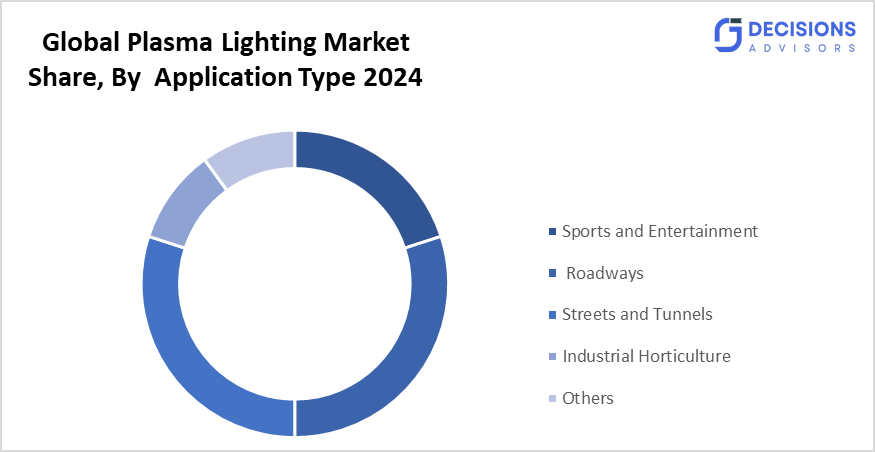
The worldwide plasma lighting industry shows equal growth through its production capacity and technological requirements and its changing methods of distribution. The market for supply distribution shows more than half of its total components which includes electrodeless lamps through the specialized manufacturers who make electrodeless plasma lamps and RF drivers and high-power luminaires. The market distribution operates mainly through direct sales channels which account for approximately 64% of the market and through system integrators who provide services to industrial customers. Demand is strongest in roadway lighting which held over 34% application share while horticulture applications are expanding at over 6% annual growth which indicates a shifting market environment toward controlled-environment agriculture and specialized lighting solutions.
Price Analysis and Consumer Behaviour Analysis
The plasma lighting market shows three different price levels which result from differences in wattage, system design and application requirements. High-intensity plasma luminaires typically range between USD 400 and USD 1,200 per unit, while specialized horticulture plasma grow lights can reach USD 1,500–2,000 due to full-spectrum output and advanced RF drivers. The installation and control systems together contribute an additional 15 to 25% of total project expenses. The equipment requirements of industrial facilities sports arenas and greenhouse operators better match their high durability and spectrum performance and extended equipment lifespan than lower starting costs. The research shows that more than 60% of commercial customers prefer lighting systems which last more than 50,000 hours, while about 45% of custom ers view energy savings as their main buying consideration, which demonstrates the strong market need for efficient high-intensity lighting products.
Market Segmentation
The plasma lighting market share is classified into wattage, distribution channel, and application
- The 700W segment dominated the market in 2024, and is projected to grow at a substantial CAGR of approximately 44% during the forecast period.
Based on the wattage, the plasma lighting market is divided into 300W, 700W, 1,000W. Among these, the 700W segment dominated the market in 2024, and is projected to grow at a substantial CAGR of approximately 44% during the forecast period. The 700W segment maintained its lead in the plasma lighting market during 2024 due to it delivers superior light output together with energy savings which makes it ideal for use in stadiums, warehouses and horticultural operations. The system achieves high user adoption rates because it offers multiple applications while its operational expenses remain lower than those of 1,000W systems.
- The commercial segment accounted for the largest share in 2024, and is anticipated to grow at a significant CAGR of approximately 5.3% during the forecast period.
Based on the distribution channel, the plasma lighting market is divided into retail, and commercial. Among these, the commercial segment accounted for the largest share in 2024, and is anticipated to grow at a significant CAGR of approximately 5.3% during the forecast period. The commercial segment achieved its largest market share throughout 2024 due to various industrial facilities, stadiums, greenhouse operations and infrastructure projects brought strong demand. Commercial buyers who purchase large installations make up more than 60% of the total equipment installations because they need high-intensity lighting systems which they acquire through bulk purchases and permanent energy-efficient system upgrades.
- The roadways, streets and tunnels segment dominated the market in 2024, and is projected to grow at a substantial CAGR approximately 5.4% during the forecast period.
Based on the application, the plasma lighting market is divided into sports and entertainment, roadways, streets and tunnels, industrial horticulture, others. Among these, the roadways, streets and tunnels, segment dominated the market in 2024, and is projected to grow at a substantial CAGR approximately 5.4% during the forecast period. The commercial segment achieved its largest market share throughout 2024 because various industrial facilities, stadiums, greenhouse operations and infrastructure projects brought strong demand. Commercial buyers who purchase large installations make up more than 60% of the total equipment installations due to they need high-intensity lighting systems which they acquire through bulk purchases and permanent energy-efficient system upgrade.
Strategies to Implement for Growth of the Market in Non-Leading Regions
The plasma lighting market needs expansion in non-leading regions through strategic partnerships, pilot projects and localized manufacturing efforts. The implementation of subsidy-backed pilot installations in high-value sectors will demonstrate energy savings that range from 15 to 25% compared to traditional HID lamps. The expansion of training programs will help installers and maintenance teams to overcome operational challenges. Smart-city projects in developing economies will emerge as the primary force which drives the adoption of outdoor lighting solutions that will reach USD 2.1 billion by 2030. The introduction of modular plasma systems which have lower initial costs of USD 600 to 800 will enable small-to-medium commercial buyers to enter the market and achieve market penetration.
Regional Segment Analysis of the Plasma Lighting Market
- North America (U.S., Canada, Mexico)
- Europe (Germany, France, U.K., Italy, Spain, Rest of Europe)
- Asia-Pacific (China, Japan, India, Rest of APAC)
- South America (Brazil and the Rest of South America)
- The Middle East and Africa (UAE, South Africa, Rest of MEA)
North America is anticipated to hold the largest share approximately 40% of the Plasma Lighting Marketover the predicted timeframe.
North America is the largest market for plasma lighting due to it controls approximately 40% of the worldwide market. The worldwide plasma lighting market received a valuation between USD 460 million and USD 470 million in 2024 which is expected to increase to a value between USD 780 million and USD 800 million by 2034 with a compound annual growth rate of approximately 5%. The United States dominates the regional market with nearly 75% of North America’s revenue, followed by Canada with about 15–18% share. Major companies such as GE Lighting and Cree drive innovation through advanced lighting technologies. The regional market expansion receives support from three factors which include strong industrial adoption and government energy-efficiency incentives and established supply chains.
Asia Pacific is expected to grow at a rapid CAGR approximately 27% in the plasma lighting market during the forecast period.
The plasma lighting market in Asia-Pacific shows fast growth which represents approximately 27% of the worldwide market. The regional market will expand at a compound annual growth rate between 6% and 7% until 2034 due to the ongoing urban development and industrial growth and the building of new infrastructure facilities. China holds the top position in the regional market because it accounts for approximately 40% to 45% of Asia-Pacific demand while Japan and South Korea follow with their respective shares of about 20% and 10 to 12%. The government funds which support smart city initiatives and energy-saving lighting initiatives and sustainable building projects are driving the current trend of technology adoption. The main companies in the industry including Seoul Semiconductor and Nichia drive technological progress while they make their products available for various commercial and industrial and public lighting uses.
Europe is the 3rd largest region to grow in the plasma lighting market during the region.
Europe represents the third-largest market for plasma lighting, which accounts for approximately 29% of the worldwide market. The regional market is anticipated to expand at a compound annual growth rate of 4 to 5% until 2034 due to essential energy-efficiency standards and environmental sustainability regulations. Germany leads the regional demand with about 25% of Europe’s market, followed by France around 18% and the United Kingdom 15–16%. Major companies in the industry, including Philips, Osram and Ceravision Lighting Limited, are creating new technological advancements. The European Union energy regulations together with smart infrastructure development are promoting the use of plasma lighting systems with high energy efficiency in both industrial and public sector applications.
Future Market Trends in Global Plasma Lighting Market: -
- Hybrid and Smart Integration
Plasma lighting systems will increasingly integrate with IoT and smart control platforms, enabling real?time energy optimization; smart lighting adoption in infrastructure is projected to grow at a CAGR of 18% through 2032, which will create market prospects for plasma systems in urban areas and highway networks and stadium facilities. The system achieves operational efficiency improvements through its ability to connect with traffic sensors and environmental monitoring systems while delivering energy savings of 25% during extensive system deployments.
- Horticulture Adoption Expansion
Plasma and LEP grow lights have gained popularity for use in greenhouses and vertical farms and high-value crop cultivation because they deliver full-spectrum light with a color rendering index above 90 and provide uniform light distribution. The horticulture lighting market will expand at a compound annual growth rate between 6 and 7% which will drive revenue growth to USD 2.3 billion by 2034. The pilot studies conducted in Switzerland and the Netherlands demonstrated that their combination of improvements led to plant growth rates which exceeded 40% and energy savings which reached 20% when compared to traditional HID systems. The existence of government subsidies, which finance 30 to 40% of project costs, serves as a motivation for companies to adopt this solution across various nations.
- Infrastructure Modernization
The public illumination and road system upgrades in emerging economies will reach a total investment of more than USD 2.1 billion by 2030. Plasma luminaires serve as the optimal solution for highway, tunnel, and high-mast applications because they provide a lifespan exceeding 50,000 to 60,000 hours and deliver a luminous output range of 20,000 to 50,000 lumens. The plasma lighting system has been integrated into energy-efficient urban infrastructure projects in Asia-Pacific and Middle East smart-city initiatives, which resulted in maintenance and electricity cost reductions that reached 30% when compared to traditional HID systems.
Recent Development
- In September 2025: Gavita International B.V. completed a management buyout and became independent again while retaining its leadership team, expanding its focus on sustainable horticultural lighting solutions including high-performance plasma/LEP grow lights.
- In July 2025: Ushio Inc. acquired ams OSRAM’s industrial and entertainment lamp business for about 114 million, strengthening high-intensity discharge and specialty plasma-related lighting applications.
- In June 2025: MIRAI-LABO launched hybrid solar-EV smart streetlights in Japan, highlighting resilient lighting infrastructure trends, while plasma-related R&D, including funding for UK Atomic Energy Authority technologies, may improve plasma lighting durability.
- In April 2025: Tark Thermal Solutions introduced UltraTEC UTX thermoelectric coolers designed for 100–300 W projection-class luminaires, improving thermal management and reliability of high-power lighting systems including plasma and specialty projection lamps.
How is Recent Developments Helping the Market?
The global plasma lighting market witness’s substantial growth due to recent advancements creates better performance standards and wider usage options. The development of electrodeless plasma lamp systems and RF-driven plasma lamp systems enables the production of 90-120 lm/W luminous output while extending their operational life to more than 60000 hours which results in a 25-30% decrease in total ownership expenses. The organization expands its operational capacity through management buyouts which include Gavita's upcoming 2025 acquisition of its own business and through acquisitions which include Ushio Inc.'s acquisition of ams OSRAM's industrial lamp division for 114 million. The implementation of DLC Horticultural Lighting V4.0 and the European and GCC mercury lamp phase-out regulations create increased market requirements. The commercial adoption of pilot horticulture trials which achieve 40% faster growth provides strong evidence for greenhouse and smart infrastructure adoption.
Market Segment
This study forecasts revenue at global, regional, and country levels from 2020 to 2035. Decision Advisors has segmented the plasma lighting market based on the below-mentioned segments:
Global Plasma Lighting Market, By Wattage
- 300W
- 700W
- 1,000W
Global Plasma Lighting Market, By Distribution Channel
- Retail
- Commercial
Global Plasma Lighting Market, By Application
- Sports and Entertainment
- Roadways
- Streets and Tunnels
- Industrial Horticulture
- Others
Global Plasma Lighting Market, By Regional Analysis
- Asia Pacific
- US
- Canada
- Mexico
- Europe
- Germany
- UK
- France
- Italy
- Spain
- Russia
- Rest of Europe
- Asia Pacific
- China
- Japan
- India
- South Korea
- Australia
- Rest of Asia Pacific
- South America
- Brazil
- Argentina
- Rest of South America
- Middle East & Africa
- UAE
- Saudi Arabia
- Qatar
- South Africa
- Rest of the Middle East & Africa
Frequently Asked Questions (FAQ)
Q1: What is plasma lighting and how does it differ from traditional lighting?
A: Plasma lighting systems generate high-intensity light through plasma technology which uses ionized gas to achieve luminous efficacy ratings between 90 and 120 lumens per watt and a color rendering index higher than 90. The system provides extended operational life between 50000 and 60000 hours which maintains consistent light output for industrial and horticultural and large outdoor use.
Q2: Which regions are driving the growth of the plasma lighting market?
A: North America dominates the market with approximately 40% of total sales because industrial companies use plasma lighting and governments provide financial support while Asia-Pacific markets grow at the fastest rate with twenty-seven percent of total market share because urban areas develop smart-city initiatives and build new infrastructure.
Q3: What are the main applications of plasma lighting?
A: Plasma lighting systems find use in various locations which include 34% of their installation base and sports stadiums and industrial sites and horticultural production areas. Horticulture lighting adoption is growing at a CAGR of 6–7% due to energy-efficient, full-spectrum light benefits.
Q4: How are recent technological advancements impacting the market?
A: Technological progress made by the industry improves market performance through two developed technologies which include electrodeless and RF-driven plasma lamps and their compact modules and IoT smart control systems that deliver 15 to 25% efficiency gains while extending product life beyond 60000 hours and cutting operating expenses by 25 to 30 %.
Q5: Who are the leading companies in the global plasma lighting market?
A: The global plasma lighting market features Gavita International B.V., Ceravision Limited, Ushio Inc., Hive Lighting Inc., Seoul Semiconductor, and Pure Plasma Lighting Inc. as its main market competitors who develop new products while they expand their business operations.
- Introduction
- Objectives of the Study
- Market Definition
- Research Scope
- Research Methodology and Assumptions
- Executive Summary
- Premium Insights
- Porter’s Five Forces Analysis
- Value Chain Analysis
- Top Investment Pockets
- Market Attractiveness Analysis By Wattage
- Market Attractiveness Analysis By Distribution Channel
- Market Attractiveness Analysis By Application
- Market Attractiveness Analysis By Region
- Industry Trends
- Market Dynamics
- Market Evaluation
- Drivers
- Increase in health consciousness
- Restraints
- Strict adherence to regulations required for sugar substitute products
- Opportunities
- Increased investment in R&D activities by manufacturers
- Challenges
5.5.1. Product labeling and claims issues
- Global Plasma Lighting Market Analysis and Projection, By Wattage
- Segment Overview
- 300W
- 700W
- 1,000W
- Global Plasma Lighting Market Analysis and Projection, By Distribution Channel
- Segment Overview
- Retail
- Commercial
- Global Plasma Lighting Market Analysis and Projection, By Application
- Segment Overview
- Sports and Entertainment
- Roadways
- Streets and Tunnels
- Industrial Horticulture
- Others
- Global Plasma Lighting Market Analysis and Projection, By Regional Analysis
- Segment Overview
- North America
- U.S.
- Canada
- Mexico
- Europe
- Germany
- France
- U.K.
- Italy
- Spain
- Asia-Pacific
- Japan
- China
- India
- South America
- Brazil
- Middle East and Africa
- UAE
- South Africa
- Global Plasma Lighting Market-Competitive Landscape
- Overview
- Market Share of Key Players in the Plasma Lighting Market
- Global Company Market Share
- North America Company Market Share
- Europe Company Market Share
- APAC Company Market Share
- Competitive Situations and Trends
- Coverage Launches and Developments
- Partnerships, Collaborations, and Agreements
- Mergers & Acquisitions
- Expansions
- Company Profiles
- Gavita International B.V.
- Business Overview
- Company Snapshot
- Company Market Share Analysis
- Company Coverage Portfolio
- Recent Developments
- SWOT Analysis
- Ceravision Limited
- Business Overview
- Company Snapshot
- Company Market Share Analysis
- Company Coverage Portfolio
- Recent Developments
- SWOT Analysis
- Hive Lighting Inc.
- Business Overview
- Company Snapshot
- Company Market Share Analysis
- Company Coverage Portfolio
- Recent Developments
- SWOT Analysis
- Pure Plasma Lighting Inc.
- Business Overview
- Company Snapshot
- Company Market Share Analysis
- Company Coverage Portfolio
- Recent Developments
- SWOT Analysis
- KA Shui International Holdings
- Business Overview
- Company Snapshot
- Company Market Share Analysis
- Company Coverage Portfolio
- Recent Developments
- SWOT Analysis
- Green De Corp
- Business Overview
- Company Snapshot
- Company Market Share Analysis
- Company Coverage Portfolio
- Recent Developments
- SWOT Analysis
- Solaronix SA
- Business Overview
- Company Snapshot
- Company Market Share Analysis
- Company Coverage Portfolio
- Recent Developments
- SWOT Analysis
- BIRNS Inc.
- Business Overview
- Company Snapshot
- Company Market Share Analysis
- Company Coverage Portfolio
- Recent Developments
- SWOT Analysis
- Saturn Overseas Trading LLC
- Business Overview
- Company Snapshot
- Company Market Share Analysis
- Company Coverage Portfolio
- Recent Developments
- SWOT Analysis
- Ushio Inc
- Business Overview
- Company Snapshot
- Company Market Share Analysis
- Company Coverage Portfolio
- Recent Developments
- SWOT Analysis
- Gavita International B.V.
List of Table
- Global Plasma Lighting Market, By Wattage, 2024-2035(USD Billion)
- Global 300W, Plasma Lighting Market, By Region, 2024-2035(USD Billion)
- Global 700W, Plasma Lighting Market, By Region, 2024-2035(USD Billion)
- Global 1,000W, Plasma Lighting Market, By Region, 2024-2035(USD Billion)
- Global Plasma Lighting Market, By Distribution Channel, 2024-2035(USD Billion)
- Global Retail, Plasma Lighting Market, By Region, 2024-2035(USD Billion)
- Global Commercial, Plasma Lighting Market, By Region, 2024-2035(USD Billion)
- Global Plasma Lighting Market, By Application, 2024-2035(USD Billion)
- Global Sports and Entertainment, Plasma Lighting Market, By Region, 2024-2035(USD Billion)
- Global Roadways, Plasma Lighting Market, By Region, 2024-2035(USD Billion)
- Global Streets and Tunnels, Plasma Lighting Market, By Region, 2024-2035(USD Billion)
- Global Industrial Horticulture, Plasma Lighting Market, By Region, 2024-2035(USD Billion)
- Global Others, Plasma Lighting Market, By Region, 2024-2035(USD Billion)
- North America Plasma Lighting Market, By Wattage, 2024-2035(USD Billion)
- North America Plasma Lighting Market, By Distribution Channel, 2024-2035(USD Billion)
- North America Plasma Lighting Market, By Application, 2024-2035(USD Billion)
- U.S. Plasma Lighting Market, By Wattage, 2024-2035(USD Billion)
- U.S. Plasma Lighting Market, By Distribution Channel, 2024-2035(USD Billion)
- U.S. Plasma Lighting Market, By Application, 2024-2035(USD Billion)
- Canada Plasma Lighting Market, By Wattage, 2024-2035(USD Billion)
- Canada Plasma Lighting Market, By Distribution Channel, 2024-2035(USD Billion)
- Canada Plasma Lighting Market, By Application, 2024-2035(USD Billion)
- Mexico Plasma Lighting Market, By Wattage, 2024-2035(USD Billion)
- Mexico Plasma Lighting Market, By Distribution Channel, 2024-2035(USD Billion)
- Mexico Plasma Lighting Market, By Application, 2024-2035(USD Billion)
- Europe Plasma Lighting Market, By Wattage, 2024-2035(USD Billion)
- Europe Plasma Lighting Market, By Distribution Channel, 2024-2035(USD Billion)
- Europe Plasma Lighting Market, By Application, 2024-2035(USD Billion)
- Germany Plasma Lighting Market, By Wattage, 2024-2035(USD Billion)
- Germany Plasma Lighting Market, By Distribution Channel, 2024-2035(USD Billion)
- Germany Plasma Lighting Market, By Application, 2024-2035(USD Billion)
- France Plasma Lighting Market, By Wattage, 2024-2035(USD Billion)
- France Plasma Lighting Market, By Distribution Channel, 2024-2035(USD Billion)
- France Plasma Lighting Market, By Application, 2024-2035(USD Billion)
- U.K. Plasma Lighting Market, By Wattage, 2024-2035(USD Billion)
- U.K. Plasma Lighting Market, By Distribution Channel, 2024-2035(USD Billion)
- U.K. Plasma Lighting Market, By Application, 2024-2035(USD Billion)
- Italy Plasma Lighting Market, By Wattage, 2024-2035(USD Billion)
- Italy Plasma Lighting Market, By Distribution Channel, 2024-2035(USD Billion)
- Italy Plasma Lighting Market, By Application, 2024-2035(USD Billion)
- Spain Plasma Lighting Market, By Wattage, 2024-2035(USD Billion)
- Spain Plasma Lighting Market, By Distribution Channel, 2024-2035(USD Billion)
- Spain Plasma Lighting Market, By Application, 2024-2035(USD Billion)
- Asia Pacific Plasma Lighting Market, By Wattage, 2024-2035(USD Billion)
- Asia Pacific Plasma Lighting Market, By Distribution Channel, 2024-2035(USD Billion)
- Asia Pacific Plasma Lighting Market, By Application, 2024-2035(USD Billion)
- Japan Plasma Lighting Market, By Wattage, 2024-2035(USD Billion)
- Japan Plasma Lighting Market, By Distribution Channel, 2024-2035(USD Billion)
- Japan Plasma Lighting Market, By Application, 2024-2035(USD Billion)
- China Plasma Lighting Market, By Wattage, 2024-2035(USD Billion)
- China Plasma Lighting Market, By Distribution Channel, 2024-2035(USD Billion)
- China Plasma Lighting Market, By Application, 2024-2035(USD Billion)
- India Plasma Lighting Market, By Wattage, 2024-2035(USD Billion)
- India Plasma Lighting Market, By Distribution Channel, 2024-2035(USD Billion)
- India Plasma Lighting Market, By Application, 2024-2035(USD Billion)
- South America Plasma Lighting Market, By Wattage, 2024-2035(USD Billion)
- South America Plasma Lighting Market, By Distribution Channel, 2024-2035(USD Billion)
- South America Plasma Lighting Market, By Application, 2024-2035(USD Billion)
- Brazil Plasma Lighting Market, By Wattage, 2024-2035(USD Billion)
- Brazil Plasma Lighting Market, By Distribution Channel, 2024-2035(USD Billion)
- Brazil Plasma Lighting Market, By Application, 2024-2035(USD Billion)
- The Middle East and Africa Plasma Lighting Market, By Wattage, 2024-2035(USD Billion)
- The Middle East and Africa Plasma Lighting Market, By Distribution Channel, 2024-2035(USD Billion)
- The Middle East and Africa Plasma Lighting Market, By Application, 2024-2035(USD Billion)
- UAE Plasma Lighting Market, By Wattage, 2024-2035(USD Billion)
- UAE Plasma Lighting Market, By Distribution Channel, 2024-2035(USD Billion)
- UAE Plasma Lighting Market, By Application, 2024-2035(USD Billion)
- South Africa Plasma Lighting Market, By Wattage, 2024-2035(USD Billion)
- South Africa Plasma Lighting Market, By Distribution Channel, 2024-2035(USD Billion)
- South Africa Plasma Lighting Market, By Application, 2024-2035(USD Billion)
List of Figures
- Global Plasma Lighting Market Segmentation
- Plasma Lighting Market: Research Methodology
- Market Size Estimation Methodology: Bottom-Up Approach
- Market Size Estimation Methodology: Top-down Approach
- Data Triangulation
- Porter’s Five Forces Analysis
- Value Chain Analysis
- Top investment pocket in the Plasma Lighting Market
- Top Winning Strategies, 2024-2035
- Top Winning Strategies, By Development, 2024-2035(%)
- Top Winning Strategies, By Company, 2024-2035
- Moderate Bargaining power of Buyers
- Moderate Bargaining power of Suppliers
- Moderate Bargaining power of New Entrants
- Low threat of Substitution
- High Competitive Rivalry
- Top Player Positioning, 2024
- Market Share Analysis, 2024
- Restraint and Drivers: Plasma Lighting Market
- Plasma Lighting Market Segmentation, By Wattage
- Plasma Lighting Market For 300W, By Region, 2024-2035 ($ Billion)
- Plasma Lighting Market For 700W, By Region, 2024-2035 ($ Billion)
- Plasma Lighting Market For 1,000W, By Region, 2024-2035 ($ Billion)
- Plasma Lighting Market Segmentation, By Distribution Channel
- Plasma Lighting Market For Retail, By Region, 2024-2035 ($ Billion)
- Plasma Lighting Market For Commercial, By Region, 2024-2035 ($ Billion)
- Plasma Lighting Market Segmentation, By Application
- Plasma Lighting Market For Sports and Entertainment, By Region, 2024-2035 ($ Billion)
- Plasma Lighting Market For Roadways, By Region, 2024-2035 ($ Billion)
- Plasma Lighting Market For Streets and Tunnels, By Region, 2024-2035 ($ Billion)
- Plasma Lighting Market For Industrial Horticulture, By Region, 2024-2035 ($ Billion)
- Plasma Lighting Market For Others, By Region, 2024-2035 ($ Billion)
- Gavita International B.V.: Net Sales, 2024-2035 ($ Billion)
- Gavita International B.V.: Revenue Share, By Segment, 2024 (%)
- Gavita International B.V.: Revenue Share, By Region, 2024 (%)
- Ceravision Limited: Net Sales, 2024-2035 ($ Billion)
- Ceravision Limited: Revenue Share, By Segment, 2024 (%)
- Ceravision Limited: Revenue Share, By Region, 2024 (%)
- Hive Lighting Inc.: Net Sales, 2024-2035 ($ Billion)
- Hive Lighting Inc.: Revenue Share, By Segment, 2024 (%)
- Hive Lighting Inc.: Revenue Share, By Region, 2024 (%)
- Pure Plasma Lighting Inc.: Net Sales, 2024-2035 ($ Billion)
- Pure Plasma Lighting Inc.: Revenue Share, By Segment, 2024 (%)
- Pure Plasma Lighting Inc.: Revenue Share, By Region, 2024 (%)
- KA Shui International Holdings: Net Sales, 2024-2035 ($ Billion)
- KA Shui International Holdings: Revenue Share, By Segment, 2024 (%)
- KA Shui International Holdings: Revenue Share, By Region, 2024 (%)
- Green De Corp: Net Sales, 2024-2035 ($ Billion)
- Green De Corp: Revenue Share, By Segment, 2024 (%)
- Green De Corp: Revenue Share, By Region, 2024 (%)
- Solaronix SA: Net Sales, 2024-2035 ($ Billion)
- Solaronix SA: Revenue Share, By Segment, 2024 (%)
- Solaronix SA: Revenue Share, By Region, 2024 (%)
- BIRNS Inc.: Net Sales, 2024-2035 ($ Billion)
- BIRNS Inc.: Revenue Share, By Segment, 2024 (%)
- BIRNS Inc.: Revenue Share, By Region, 2024 (%)
- Saturn Overseas Trading LLC.: Net Sales, 2024-2035 ($ Billion)
- Saturn Overseas Trading LLC.: Revenue Share, By Segment, 2024 (%)
- Saturn Overseas Trading LLC.: Revenue Share, By Region, 2024 (%)
- Ushio Inc: Net Sales, 2024-2035 ($ Billion)
- Ushio Inc: Revenue Share, By Segment, 2024 (%)
- Ushio Inc: Revenue Share, By Region, 2024 (%)
Check Licence
Choose the plan that fits you best: Single User, Multi-User, or Enterprise solutions tailored for your needs.
We Have You Covered
- 24/7 Analyst Support
- Clients Across the Globe
- Tailored Insights
- Technology Tracking
- Competitive Intelligence
- Custom Research
- Syndicated Market Studies
- Market Overview
- Market Segmentation
- Growth Drivers
- Market Opportunities
- Regulatory Insights
- Innovation & Sustainability
Report Details
| Scope | Global |
| Pages | 195 |
| Delivery | PDF & Excel via Email |
| Language | English |
| Release | Apr 2026 |
| Access | Download from this page |