
Plastic Packaging Film Market
 |
Author:
Aditya G
|
Pages:
200
|
Author:
Aditya G
|
Pages:
200
Global Plastic Packaging Film Market Size, Share, By Type (Polyethylene, Polypropylene, Polyvinyl Chloride, Polyester, and Nylon), By Application (Food Packaging, Medical Packaging, Industrial Packaging, Agricultural Packaging, and Retail Packaging), By Thickness (Below 10 Micron, 10 to 30 Micron, 31 to 50 Micron, 51 to 100 Micron, and Above 100 Micron), By End Use (Food and Beverage, Healthcare, Consumer Goods, Electronics, and Agriculture), and By Region (North America, Europe, Asia-Pacific, South America, Middle East & Africa), Analysis and Forecast 2026-2035
CAGR
4.64%
REVENUE 2025
USD Billion 57.35
FORECAST 2035
USD Billion 90.04
REPORT COVERAGE
Country
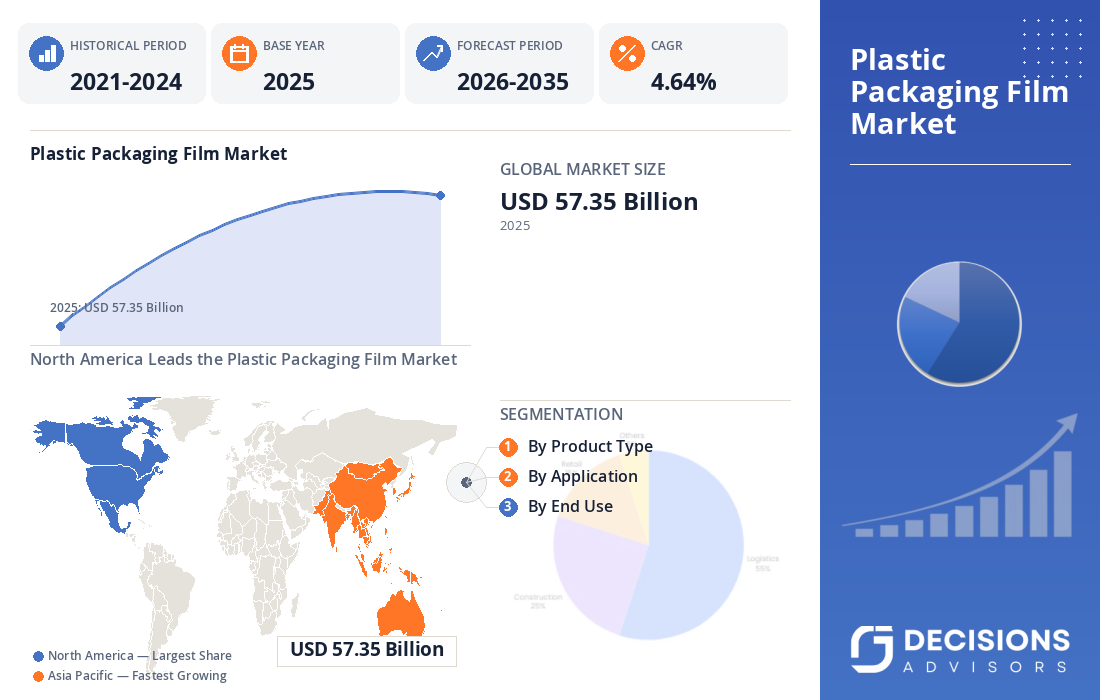
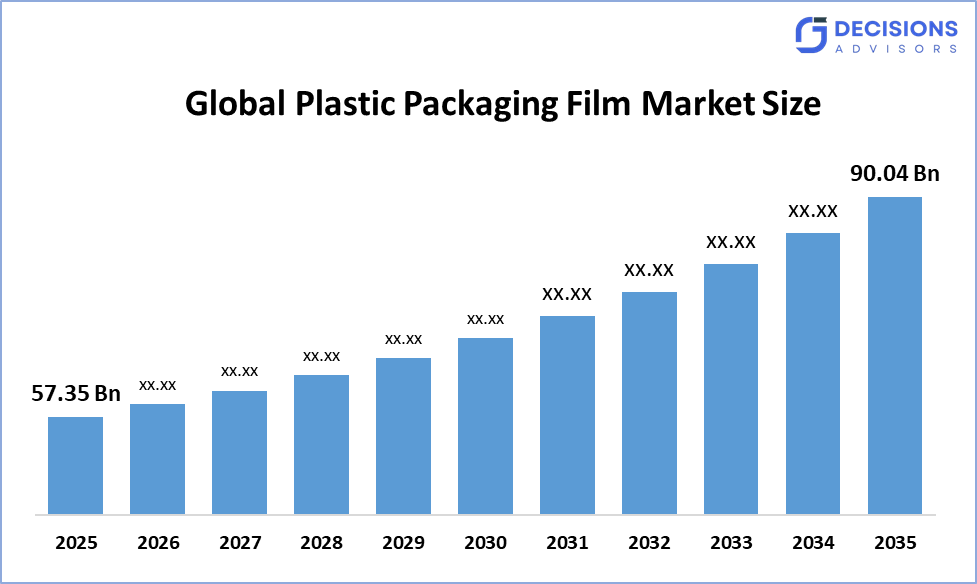
The Global Plastic Packaging Film Market Size is projected to grow from approximately USD 57.35 Billion in 2025 and is expected to reach approximately USD 90.04 Billion by 2035, expanding at a CAGR of 4.64% during the forecast period. The market is experiencing steady growth due to increasing demand for lightweight packaging, rising consumption of packaged food and beverages, expansion of pharmaceutical and healthcare packaging, growth of e-commerce, and increasing demand for flexible and high-barrier packaging solutions. Plastic packaging films provide flexibility, durability, moisture resistance, transparency, sealability, and cost efficiency, making them widely used across food, healthcare, consumer goods, agriculture, electronics, and industrial applications.
Market Snapshot
- Global Plastic Packaging Film Market Size (2025): USD 57.35 Billion
- Projected Market Size (2035): USD 90.04 Billion
- Global Market CAGR (2026–2035): 4.64%
- Largest Regional Market: North America
- 2nd Largest Region: Asia-Pacific
- Fastest Growing Region: Asia-Pacific
- Base Year: 2025
- Historical Period: 2021–2024
- Forecast Period: 2026–2035
Market Overview/ Introduction
The Global Plastic Packaging Film Market encompasses thin, flexible plastic materials used to protect, wrap, contain, seal, and extend the shelf life of a wide range of products. Plastic packaging films are manufactured from materials such as polyethylene, polypropylene, polyvinyl chloride, polyester, and nylon. They are widely used in food packaging, medical packaging, industrial packaging, agricultural packaging, retail packaging, consumer goods, and electronics. The market is undergoing significant transformation due to increasing demand for lightweight, convenient, durable, and cost-effective packaging. Plastic films provide strong barrier properties against moisture, oxygen, contaminants, and physical damage, making them particularly valuable for packaged food, pharmaceuticals, personal care products, and other sensitive goods. Increasing consumption of packaged and convenience foods, expansion of organized retail, and the growth of e-commerce are further supporting demand.
The U.S. governments across major economies are introducing policies related to plastic waste reduction, recycling, extended producer responsibility, and sustainable packaging, encouraging manufacturers to develop recyclable and resource-efficient film products.
- Several Asia-Pacific countries continue investing in flexible packaging production, food-processing infrastructure, pharmaceutical manufacturing, and modern retail networks.
Notable Insights: -
- North America is anticipated to maintain a leading position in the Global Plastic Packaging Film Market due to strong demand from food, healthcare, consumer goods, and retail industries and the presence of established packaging manufacturers.
- Asia-Pacific is expected to witness strong growth during the forecast period as urbanization, packaged food consumption, pharmaceutical production, e-commerce, and consumer spending continue to expand.
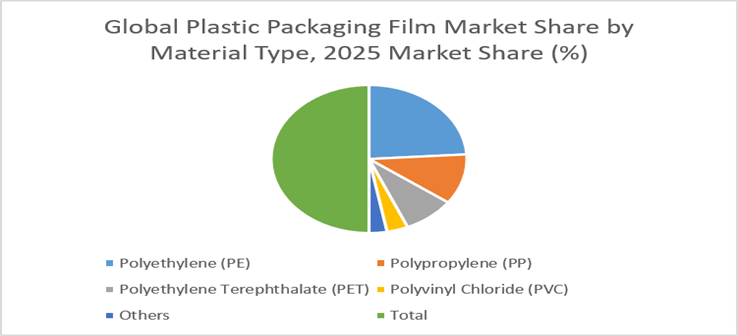
- Polyethylene is expected to remain a dominant material segment because of its flexibility, moisture resistance, sealability, and extensive use in food, retail, and industrial packaging.
- Food Packaging represents the largest application segment because plastic films provide protection, extended shelf life, lightweight packaging, and convenient sealing for food products.
- 10 to 30 Micron and 31 to 50 Micron films remain widely used across food, consumer goods, retail, and industrial applications because they provide a balance between material efficiency, strength, and barrier performance.
Market Drivers
The Global Plastic Packaging Film Market is primarily driven by increasing demand for packaged and convenience foods worldwide. Changing lifestyles, urbanization, rising disposable incomes, and growing consumption of ready-to-eat, frozen, processed, and packaged food products are increasing the need for flexible plastic film packaging. The expansion of pharmaceutical and healthcare industries is another important growth driver. Plastic films are used in medical packaging, pharmaceutical wrapping, sachets, pouches, blister-related structures, and protective packaging because of their barrier and hygiene properties. The rapid growth of e-commerce is also increasing demand for lightweight protective packaging films.
Restrain
The Global Plastic Packaging Film Market faces challenges including increasing environmental concerns associated with plastic waste, stringent regulations on single-use plastics, fluctuating polymer prices, recycling limitations, and the high cost of developing sustainable film technologies. Manufacturers face increasing pressure to reduce plastic consumption while maintaining mechanical strength, barrier properties, printability, and sealability.
Competitive Analysis:
The report offers the appropriate analysis of the key organizations/companies involved within the Global Global Plastic Packaging Film Market, along with a comparative evaluation primarily based on their product offerings, business overviews, geographic presence, enterprise strategies, segment market share, and SWOT analysis. The report also provides an elaborative analysis focusing on the current news and developments of the companies, which includes product development, innovations, joint ventures, partnerships, mergers & acquisitions, strategic alliances, and others. This allows for the evaluation of the overall competition within the market.
Top Companies in the Global Plastic Packaging Film Market
- Amcor plc
- Sealed Air Corporation
- Berry Global Inc.
- Mondi Group plc
- Constantia Flexibles
- DuPont
- BASF SE
- SABIC
- UFlex Limited
- Jindal Poly Films Limited
Government Initiatives
|
Country |
Key Government Initiatives |
|
Us |
Federal and state-level policies increasingly support plastic waste reduction, recycling infrastructure, sustainable packaging, recycled-content adoption, and improvements in packaging material efficiency. |
|
Germany |
Government initiatives emphasize packaging waste reduction, recycling, circular-economy practices, extended producer responsibility, and increased use of recyclable packaging materials. |
|
China |
Government policies increasingly focus on plastic pollution reduction, recycling infrastructure, sustainable packaging, and development of a circular economy for plastic materials. |
Market Segmentation
The Global Plastic Packaging Film Market share is classified into type, application, thickness, end use, and region.
The Polyethylene Segment Dominated the Market
Based on type, the market is divided into Polyethylene, Polypropylene, Polyvinyl Chloride, Polyester, and Nylon. Among these, Polyethylene dominates the market due to its flexibility, excellent moisture resistance, sealability, durability, and cost effectiveness. Polyethylene films are widely used in food packaging, retail bags, agricultural applications, industrial packaging, and flexible packaging structures.
- The Food Packaging Segment Accounted for the Largest Share
Based on application, the market is divided into Food Packaging, Medical Packaging, Industrial Packaging, Agricultural Packaging, and Retail Packaging. Among these, the Food Packaging segment accounted for the largest share in 2025 due to the widespread use of plastic films for snacks, bakery products, frozen foods, meat, dairy products, fresh produce, confectionery, and ready-to-eat meals.
- The 10 to 30 Micron Segment Accounted for a Significant Share
Based on thickness, the market is divided into Below 10 Micron, 10 to 30 Micron, 31 to 50 Micron, 51 to 100 Micron, and Above 100 Micron. The 10 to 30 Micron segment represents a significant share because films within this thickness range offer a balance between lightweight construction, strength, flexibility, barrier protection, and material efficiency.
Regional Segment Analysis of the Global Plastic Packaging Film Market
- North America (U.S., Canada, Mexico)
- Europe (Germany, U.K., France, Italy, Spain, Netherlands, Rest of Europe)
- Asia-Pacific (China, Japan, India, Australia, South Korea, Rest of Asia-Pacific)
- South America (Brazil, Argentina, Rest of South America)
- Middle East & Africa (UAE, Saudi Arabia, South Africa, Rest of MEA)
North America is anticipated to hold the largest share of the Global Plastic Packaging Film Market during the forecast period, supported by established food-processing, healthcare, consumer goods, retail, and packaging industries.
The United States represents a major market because of its large packaged food industry, extensive pharmaceutical and healthcare sector, established retail network, and strong demand for flexible packaging films. Growing adoption of recyclable film structures and investments in advanced packaging technologies are also supporting market development.
Asia-Pacific is expected to remain one of the fastest-growing regional markets due to rapid urbanization, increasing disposable incomes, expanding food-processing industries, rising pharmaceutical production, e-commerce growth, and increasing demand for lightweight packaging.
The United States represents a major market because of its large domestic tourism industry, extensive hotel network, business travel activity, vacation-rental ecosystem, and high digital booking penetration.
Europe is expected to experience steady growth due to increasing demand for recyclable packaging
strict environmental regulations, circular-economy initiatives, and continued innovation in sustainable plastic films.
Future Market Trends in Global Plastic Packaging Film Market: -
-
- Expansion of Recyclable Mono-Material Films
Plastic packaging manufacturers are increasingly developing mono-material polyethylene and polypropylene film structures that can improve recyclability while maintaining required barrier and mechanical properties. The shift toward recyclable packaging is expected to remain a major trend throughout the forecast period.
-
- Growth of High-Barrier Packaging Films
High-barrier films are expected to gain increasing adoption in food, pharmaceutical, and healthcare applications because they provide improved protection against oxygen, moisture, light, and contaminants. These properties can help extend product shelf life and reduce food and pharmaceutical waste.
-
- Development of Lightweight and Downgauged Films
Manufacturers are increasingly reducing film thickness while maintaining strength and packaging performance. Downgauging helps reduce raw-material consumption, packaging weight, transportation costs, and overall material usage.
-
- Increasing Adoption of Sustainable and Bio-Based Films
Growing environmental awareness and regulatory pressure are encouraging manufacturers to develop recycled-content, bio-based, compostable, and lower-impact film solutions. Sustainable materials are expected to become increasingly important in food, retail, personal care, and consumer goods packaging.
Recent Development
- In February 2024, Amcor completed its combination with Berry Global, creating a significantly expanded packaging platform with broader flexible and rigid packaging capabilities.
- In July 2024, Recent packaging-film market developments increasingly emphasize recyclable mono-material films, downgauging, high-barrier structures, and sustainable packaging technologies as manufacturers respond to environmental regulations and brand-owner sustainability targets.
- In November 2024, Amcor, Sealed Air, Berry Global, and Mondi continue to focus on high-performance, recyclable, lightweight, and barrier film technologies for food, healthcare, consumer goods, and industrial applications.
Market Segment
This study forecasts revenue at global, regional, and country levels from 2026 to 2035. Decision Advisors has segmented the Global Plastic Packaging Film Market based on the below-mentioned segments:
Global Plastic Packaging Film Market, By Product Type
- Polyethylene
- Polypropylene
- Polyvinyl Chloride
- Polyester
- Nylon
- Others
Global Plastic Packaging Film Market, By Application
- Food Packaging
- Medical Packaging
- Industrial Packaging
- Agricultural Packaging
- Retail Packaging
- Others
Global Plastic Packaging Film Market, By End Use
- Food and Beverage
- Healthcare
- Consumer Goods
- Electronics
- Agriculture
- Others
Global Plastic Packaging Film Market, By Regional Analysis
- North America
- US
- Canada
- Mexico
- Europe
- Germany
- UK
- France
- Italy
- Spain
- Russia
- Rest of Europe
- Asia Pacific
- China
- Japan
- India
- South Korea
- Australia
- Rest of Asia Pacific
- South America
- Brazil
- Argentina
- Rest of South America
- Middle East & Africa
- UAE
- Saudi Arabia
- Qatar
- South Africa
- Rest of the Middle East & Africa
Frequently Asked Questions (FAQ)
Q. Why are plastic packaging films important for packaging applications?
A. Plastic packaging films provide lightweight, flexible, durable, and cost-effective packaging solutions while offering protection against moisture, oxygen, contaminants, and physical damage. They are widely used across food, healthcare, retail, industrial, and agricultural applications.
Q. Why is polyethylene widely used in plastic packaging films?
A. Polyethylene offers excellent flexibility, moisture resistance, sealability, durability, and cost efficiency, making it suitable for food packaging, retail packaging, industrial films, agricultural applications, and flexible packaging.
Q. What role do plastic films play in food packaging?
A. Plastic films help protect food products from moisture, oxygen, contamination, and physical damage while supporting extended shelf life, convenient handling, lightweight packaging, and efficient transportation.
Q. How are technological advancements influencing the Plastic Packaging Film Market?
A. Advancements in extrusion, multilayer structures, high-barrier coatings, film orientation, downgauging, recyclable mono-material designs, recycled-content materials, and bio-based polymers are improving packaging performance while supporting sustainability and material efficiency.
Check Licence
Choose the plan that fits you best: Single User, Multi-User, or Enterprise solutions tailored for your needs.
We Have You Covered
- 24/7 Analyst Support
- Clients Across the Globe
- Tailored Insights
- Technology Tracking
- Competitive Intelligence
- Custom Research
- Syndicated Market Studies
- Market Overview
- Market Segmentation
- Growth Drivers
- Market Opportunities
- Regulatory Insights
- Innovation & Sustainability
Report Details
| Scope | Country |
| Pages | 200 |
| Delivery | PDF & Excel via Email |
| Language | English |
| Release | Aug 2026 |
| Access | Download from this page |