
Global Pod Taxi Market
 |
Author:
Atul K
|
Pages:
245
|
Author:
Atul K
|
Pages:
245
Global Pod Taxi Market Size, Share By Type (Cloud-Based, Web-Based), By Application (Airports, City Centers, Business Industrial Parks, Shopping Centers, Theme Parks Resorts, Others) By Propulsion (Electric Vehicles, Fuel Cell Vehicles, Hybrid Vehicles) and By Region (North America, Europe, Asia-Pacific, Latin America, Middle East & Africa), Analysis and Forecast 2026-2035
CAGR
18.1%
REVENUE 2025
USD Billion 17.19
FORECAST 2035
USD Billion 90.76
REPORT COVERAGE
Global
Market Snapshot
- Global Pod Taxi Market Size (2025): USD 17.19 Billion
- Projected Global Pod Taxi Market Size (2035): USD 90.76 Billion
- Global Pod Taxi Market Compound Annual Growth Rate (CAGR): 18.1%
- Largest Regional Market: North America
- 2nd Largest Region: Europe
- Fastest Growing Region: Asia-Pacific
- Base Year: 2025
- Historical Period: 2021–2024
- Market Forecast Period: 2026–2035
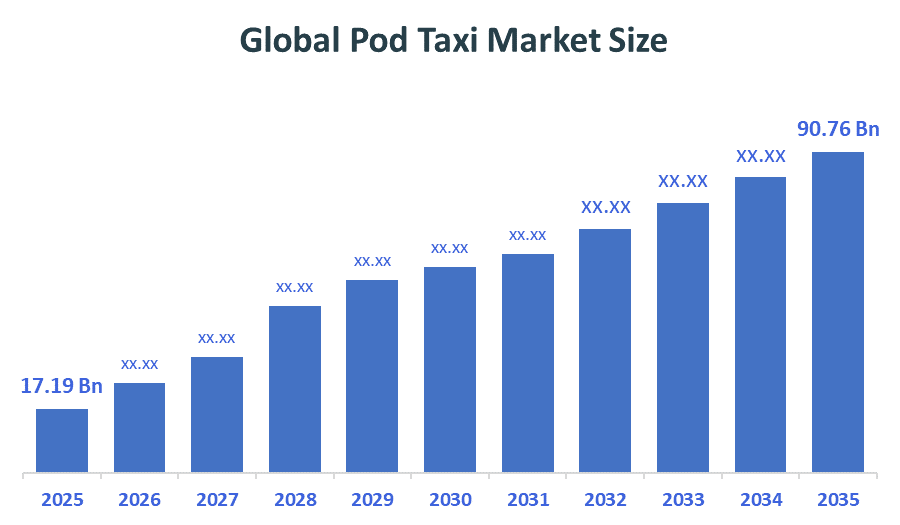
According to Decision Advisors, the Global Pod Taxi Market Size is expected to grow from USD 17.19 Billion in 2025 to USD 90.76 Billion by 2035, at a CAGR of 18.1% during the forecast period 2026-2035. The Global Pod Taxi Market is projected to grow steadily, driven by increasing investments in smart city infrastructure, rising demand for sustainable urban mobility, and advancements in autonomous transportation technologies.
Market Overview/ Introduction
The Global Pod Taxi Market refers to the development, deployment, and operation of automated, driverless vehicles operating on dedicated guideways, commonly known as Personal Rapid Transit (PRT) systems. The systems operate to deliver urban transportation services that allow users to travel between specific points without requiring extensive operator control. The market experiences continuous expansion because rising urban traffic challenges and the need for effective last-mile solutions and worldwide adoption of self-driving electric vehicles create urgent market requirements. Smart mobility solutions the world over now see broader acceptance between developed nations and developing nations. Various governments in India, European countries and the United Arab Emirates promote pod taxi systems through their smart city initiatives and urban transport improvement programs, and sustainability goals which aim to decrease carbon emissions and traffic congestion. The implementation of pod taxi systems results in several advantages, including reduced traffic congestion and emissions, efficient energy use, automated systems that safeguard users, and on-demand travel options that let passengers avoid interruptions. The market is set to grow because smart city systems will gain more AI traffic control systems, and development funds will increase in both the Asia-Pacific and Middle Eastern regions.
Notable Insights: -
- North America is anticipated to hold approximately 25% share of the global pod taxi market over the predicted timeframe.
- Europe is expected to grow at a rapid CAGR in the pod taxi market by holding approximately 33% of the share during the forecast period.
- By type, the cloud-based segment dominated the market and holds approximately 63% share in 2025 and is projected to grow at a substantial CAGR during the forecast period.
- By application, the airports segment dominated the market and holds approximately 44% share in 2025 and is projected to grow at a substantial CAGR during the forecast period.
- The compound annual growth rate of the Global Pod Taxi Market is 18.1%.
- The market is likely to achieve a valuation of USD 90.76 Billion by 2035.
What is the role of technology in grooming the market?
Technology plays a central role in shaping the Global Pod Taxi Market through advancements in autonomous driving, artificial intelligence, and real-time traffic management systems. Integration of Internet of Things enables continuous monitoring, predictive maintenance, and system optimization. Electric propulsion systems enhance energy efficiency and sustainability, while smart sensors improve safety and navigation accuracy. Digital twin technology supports simulation and performance analysis. Additionally, advanced communication networks and cloud-based platforms enable seamless operations, scalability, and integration with broader smart city ecosystems, accelerating deployment and improving overall system reliability and passenger experience.
Market Drivers
The Global Pod Taxi Market expands because urban congestion and ineffective public transport systems create challenges for millions of daily commuters major cities worldwide. Over the past decade cities have moved towards smart mobility solutions through their automatic transit systems, which received funding increases between 25-30 % across their major urban areas. The pod taxi system delivers a revolutionary solution which enables users to travel without interruptions while achieving a 40% decrease in travel time through its continuous service. The increasing demand for transportation systems in Asia-Pacific and European regions results from population growth which requires both sustainable development and efficient transportation systems and modern intelligent transportation solutions.
Restrain
The market faces challenges such as high initial infrastructure costs, including dedicated guideway construction and advanced control systems, which can limit large-scale adoption. Regulatory uncertainties, land acquisition issues, and integration complexities with existing transport networks also hinder deployment. Additionally, limited public awareness and concerns regarding safety, scalability, and return on investment may slow adoption, particularly in developing economies.
Competitive Analysis:
The report offers the appropriate analysis of the key organizations/companies involved within the global pod taxi market, along with a comparative evaluation primarily based on their product of offering, business overviews, geographic presence, enterprise strategies, segment market share, and SWOT analysis. The report also provides an elaborative analysis focusing on the current news and developments of the companies, which includes product development, innovations, joint ventures, partnerships, mergers & acquisitions, strategic alliances, and others. This allows for the evaluation of the overall competition within the market.
Top Companies in the Global Pod Taxi Market
- ULTra PRT
- 2getthere
- SkyTran
- Vectus Ltd.
- Mister Co. Ltd.
- Beamways AB
- POMA Group
- Siemens Mobility
- General Atomics
- JPods
Government Initiatives
|
Country |
Key Government Initiatives |
|
UK |
The UK government announced £36.5?million ($26?million) funding to support self-driving taxis and drone technologies, directly promoting autonomous mobility solutions, including pod taxis. |
|
Japan |
Japan aims to deploy Level?4 autonomous transportation services in over 100 municipalities by 2027, supporting the development and adoption of pod taxis in urban and regional transport systems. |
|
Europe |
Initiatives such as DTLF, NAPCORE, and the C-Roads Platform are centralizing digital, connected, and cooperative mobility, providing essential infrastructure for autonomous transport solutions, including pod taxis. |
Study on the Supply, Demand, Distribution, and Market Environment of the Pod Taxi Market
The pod taxi market demonstrates a growing ecosystem driven by increasing demand for efficient urban mobility and last-mile connectivity. Demand is fuelled by rising urban population density, with over 55% of the global population living in cities, creating pressure on existing transport systems. Supply is led by technology providers focusing on autonomous navigation, electric propulsion, and lightweight infrastructure systems. Distribution is primarily project-based, involving government contracts, public-private partnerships (PPP), and smart city developments. Increasing investments in infrastructure and digital transport networks are strengthening the overall market environment, particularly in emerging economies.
Market Segmentation
The Pod Taxi Market share is classified into type, application and propulsion.
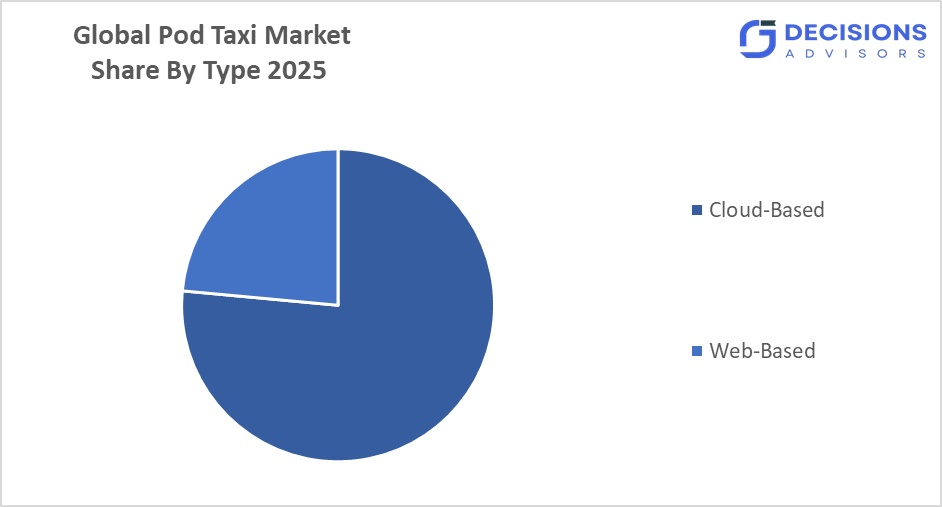
- The cloud-based segment dominated the market and holds approximately 63% share in 2025 and is projected to grow at a substantial CAGR during the forecast period.
Based on the type, the pod taxi market is divided into cloud-based, web based. Among these, the cloud-based segment dominated the market and holds approximately 63% share in 2025 and is projected to grow at a substantial CAGR during the forecast period. This dominance is due to their scalability, real-time data processing, remote monitoring, and integration with smart city infrastructure. These systems enable efficient fleet management, predictive maintenance, and centralized control.
- The airports segment accounted for the largest share of approximately 44% in 2025 and is anticipated to grow at a significant CAGR during the forecast period.
Based on the application, the pod taxi market is divided into airports, city centers, business industrial parks, shopping centers, theme parks resorts, others. Among these, the airports segment accounted for the largest share of approximately 44% in 2025 and is anticipated to grow at a significant CAGR during the forecast period. This growth is due to high demand for efficient passenger transit, baggage handling connectivity, and reduced walking distances. City centers are also witnessing strong growth driven by congestion reduction needs, while business parks and theme parks are adopting pod taxis for controlled, high-density mobility environments.
- The electric vehicles segment accounted for the largest share of approximately 70% in 2025 and is anticipated to grow at a significant CAGR during the forecast period.
Based on the propulsion, the pod taxi market is divided into electric vehicles, fuel cell vehicles, hybrid vehicles. Among these, the electric vehicles segment accounted for the largest share of approximately 70% in 2025 and is anticipated to grow at a significant CAGR during the forecast period. This is primarily due to the high global prevalence of urolithiasis and increasing number of minimally invasive procedures such as ureteroscopy and lithotripsy, where stents are routinely used. The ureteral obstruction segment also contributes significantly, particularly in cases related to malignancies and strictures.
Strategies to Implement for Growth of the Market in Non-Leading Regions
Expansion in non-leading regions of the global pod taxi market requires strategic investment in cost-efficient infrastructure and adoption of Public-Private Partnership (PPP) models to reduce financial burden on governments. Integration with existing urban transport systems is essential to ensure seamless mobility. Governments in regions such as Asia-Pacific and Africa should promote awareness of smart mobility benefits while offering incentives to attract private players. Additionally, capacity building through training programs for planners and engineers will enhance deployment efficiency, while regulatory support and pilot projects can accelerate adoption and build public confidence in automated transit systems.
Regional Segment Analysis of the Pod Taxi Market
- North America (U.S., Canada, Mexico)?
- Europe (Germany, France, U.K., Italy, Spain, Rest of Europe)
- Asia-Pacific (China, Japan, India, Rest of APAC)
- South America (Brazil and the Rest of South America)?
- The Middle East and Africa (UAE, South Africa, Rest of MEA)
North America is anticipated to hold approximately 25% share of the global pod taxi market over the predicted timeframe.
North America is anticipated to hold approximately 25% share of the global pod taxi market over the predicted timeframe. The region’s growth is driven by advanced urban mobility infrastructure, increasing adoption of autonomous transport technologies, and strong investments in smart city projects. The United States leads the market due to high R&D spending, presence of key technology providers, and pilot deployments in airports and urban corridors. Additionally, supportive regulatory frameworks, focus on reducing traffic congestion, and rising demand for sustainable transport solutions are further contributing to steady market expansion across North America.
Europe is expected to grow at a rapid CAGR in the pod taxi market by holding approximately 33% of the share during the forecast period
Europe is expected to grow at a rapid CAGR in the pod taxi market by holding approximately 33% of the share during the forecast period. The region’s growth is driven by early adoption of Personal Rapid Transit systems, strong government support for sustainable mobility, and well-established urban infrastructure. Countries such as United Kingdom, Germany, and France are leading due to investments in smart city projects and autonomous transport technologies. Additionally, increasing focus on reducing carbon emissions and traffic congestion is accelerating deployment, making Europe a key regional market.
Asia Pacific is the fastest-growing region in the pod taxi market during the period, holding approximately 31% share.
Asia Pacific is the fastest-growing region in the pod taxi market during the period, holding approximately 31% share. Growth is driven by rapid urbanization, rising population density, and increasing investments in smart city infrastructure across countries such as China, India, and Japan. Government initiatives supporting autonomous mobility, along with the need to reduce traffic congestion and emissions, are accelerating adoption. Additionally, expanding urban transport networks and public-private partnerships are strengthening market development across Asia-Pacific.
Future Market Trends in Global Pod Taxi Market: -
-
- Integration of Autonomous Driving Technologies
The adoption of advanced autonomous systems, including Level 4 and Level 5 automation, is transforming pod taxi operations by eliminating the need for human drivers. These technologies enhance safety, optimize routing, and reduce operational costs. Improved sensors, AI algorithms, and real-time decision-making systems are enabling reliable, efficient, and scalable automated transit solutions globally.
-
- Shift Toward Smart Mobility & MaaS (Mobility-as-a-Service)
Pod taxis are increasingly integrated into smart mobility ecosystems through Mobility-as-a-Service platforms, allowing users to plan, book, and pay for multimodal transport via a single interface. This integration improves convenience, reduces travel time, and enhances urban transport efficiency, supporting seamless connectivity between pod taxis, metros, buses, and other transport modes.
-
- Advancements in Battery & Energy Efficiency
Continuous advancements in battery technology are significantly improving the performance and efficiency of pod taxi systems. Enhanced energy density, faster charging capabilities, and longer lifecycle batteries reduce operational costs and increase vehicle uptime. These improvements support zero-emission goals, making pod taxis a sustainable solution aligned with global environmental and clean energy initiatives.
Recent Development
- In April?2026, Baidu launched its Apollo Go fully driverless ride-hailing service in Dubai, deploying autonomous vehicles for commercial use, directly contributing to the growth of the global pod taxi market.
- In April 2026, Verne, co-founded by Mate Rimac in Croatia, launched fully autonomous electric pods without steering wheels or pedals, designed for high-comfort, affordable ride-hailing, directly targeting the pod taxi market
- In March?2026, WeRide and Grab launched Singapore’s first autonomous public ride service, offering connected, driverless vehicles for shared mobility, directly contributing to the global pod taxi market.
- In January 2026, 20 Chinese cities launched pilot programs for intelligent, connected robotaxis, with projections of 300,000 driverless cabs by 2030, supporting the growth of the pod taxi market
How is Recent Developments Helping the Market?
Recent developments are significantly enhancing the efficiency, scalability, and commercial viability of the Global Pod Taxi Market. Advancements in autonomous driving, artificial intelligence, and energy-efficient electric propulsion systems are improving operational reliability and passenger safety. Innovations in lightweight infrastructure and modular guideways are reducing deployment costs and construction time. Additionally, government-backed pilot projects and smart city initiatives in regions such as Asia-Pacific and Middle East are increasing public acceptance and investor confidence. These developments are accelerating the transition from pilot phases to large-scale commercial deployment, strengthening long-term market growth potential.
Market Segment
This study forecasts revenue at global, regional, and country levels from 2020 to 2035. Decision Advisors has segmented the Global Pod Taxi Market based on the below-mentioned segments:
Global Pod Taxi Market, By Type
- Cloud-Based
- Web-Based
Global Pod Taxi Market, By Application
- Airports
- City Centers
- Business Industrial Parks
- Shopping Centers
- Theme Parks Resorts
- Others
Global Pod Taxi Market, By Propulsion
- Electric Vehicles
- Fuel Cell Vehicles
- Hybrid Vehicles
Global Pod Taxi Market, By Regional Analysis
- North America
- US
- Canada
- Mexico
- Europe
- Germany
- UK
- France
- Italy
- Spain
- Russia
- Rest of Europe
- Asia Pacific
- China
- Japan
- India
- South Korea
- Australia
- Rest of Asia Pacific
- South America
- Brazil
- Argentina
- Rest of South America
- Middle East & Africa
- UAE
- Saudi Arabia
- Qatar
- South Africa
- Rest of the Middle East & Africa
Frequently Asked Questions (FAQ)
Q. How do pod taxi systems handle peak-hour passenger demand?
Pod taxi systems use dynamic routing algorithms and real-time demand forecasting to increase vehicle frequency during peak hours. Additional pods are automatically deployed, and routes are optimized to minimize wait times, ensuring efficient passenger flow without overcrowding typical of conventional public transport.
Q. What is the typical implementation timeline for a pod taxi project?
Implementation timelines vary based on project scale, regulatory approvals, and infrastructure complexity, but most systems take approximately 2–5 years from planning to full operation, including feasibility studies, construction, testing, and commissioning phases.
Q. How do pod taxis compare with metro systems in terms of cost and flexibility?
Pod taxis generally require lower infrastructure investment per km compared to metro systems and offer greater route flexibility. They are particularly effective for short-distance, last-mile connectivity, whereas metros are more suitable for high-capacity, long-distance urban transit.
Q. Can pod taxi systems operate in extreme weather conditions?
Yes, modern pod taxi systems are designed to operate in diverse weather conditions, including rain, heat, and moderate snow. Advanced sensor technologies and weather-resistant infrastructure enable consistent performance, although extreme conditions may require operational adjustments for safety.
Check Licence
Choose the plan that fits you best: Single User, Multi-User, or Enterprise solutions tailored for your needs.
We Have You Covered
- 24/7 Analyst Support
- Clients Across the Globe
- Tailored Insights
- Technology Tracking
- Competitive Intelligence
- Custom Research
- Syndicated Market Studies
- Market Overview
- Market Segmentation
- Growth Drivers
- Market Opportunities
- Regulatory Insights
- Innovation & Sustainability
Report Details
| Scope | Global |
| Pages | 245 |
| Delivery | PDF & Excel via Email |
| Language | English |
| Release | Apr 2026 |
| Access | Download from this page |