
Global Polyvinyl Chloride (PVC) Market
 |
Author:
Aditya G
|
Pages:
200
|
Author:
Aditya G
|
Pages:
200
Global Polyvinyl Chloride (PVC) Market Size, Share By Product Type (Rigid PVC, Flexible PVC, and More), By Application (Pipes and Fittings, Bottles, and More), By End-User Industry (Building and Construction, Packaging, and More), and By Region (North America, Europe, Asia-Pacific, Latin America, Middle East & Africa), Analysis and Forecast 2026-2035
CAGR
3.61%
REVENUE 2025
USD Billion 83.45
FORECAST 2035
USD Billion 118.96
REPORT COVERAGE
Global
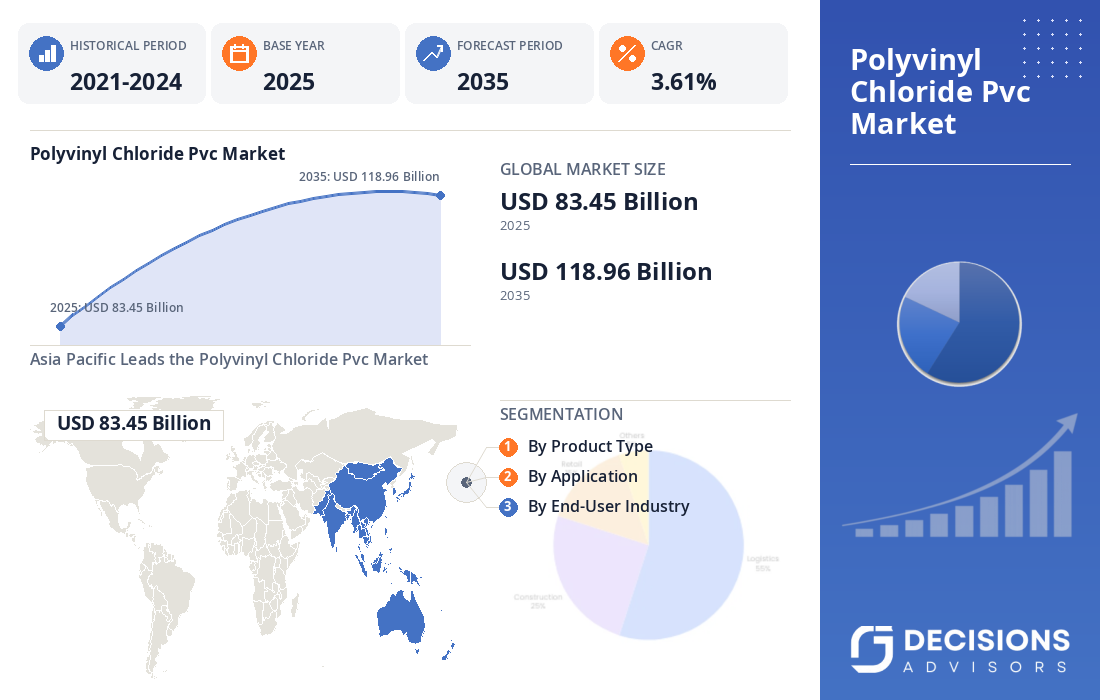
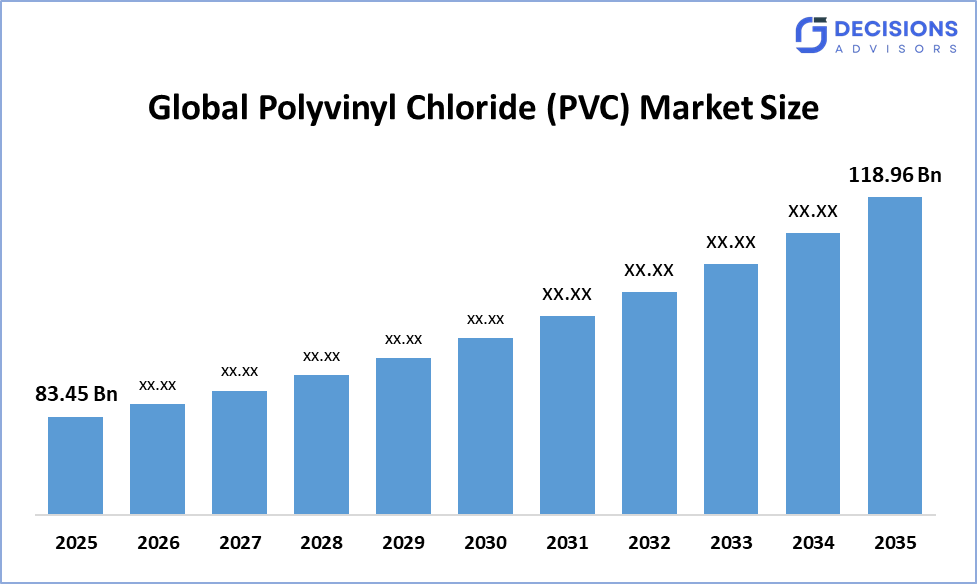
The Global Polyvinyl Chloride (PVC) Market Size is predicted to grow from USD 83.45 Billion in 2025 and is likely to reach around USD 118.96 Billion by 2035 with a CAGR of 3.61%. According to Decision Advisors, the analysis of the market through an elaborate research report shows that the sustainable production of PVC is the prevailing trend within the Global Polyvinyl Chloride (PVC) Market, occupying about 42% of the total market share globally. INEOS tops the market and earns a yearly revenue of around USD 61 billion with about 8.5% global market share.
Market Snapshot
- Global Polyvinyl Chloride (PVC) Market Size (2025): USD 83.45 Billion
- Projected Global Polyvinyl Chloride (PVC) Market Size (2035): USD 118.96 Billion
- Global Polyvinyl Chloride (PVC) Market Compound Annual Growth Rate (CAGR): 3.61%
- Largest Regional Market: Asia Pacific
- 2nd Largest Region: North America
- Fastest Growing Region: Asia Pacific
- Base Year: 2025
- Historical Period: 2021-2024
- Market Forecast Period: 2026-2035
Market Overview/ Introduction
The Global Polyvinyl Chloride (PVC) Market includes all production, processing, distribution, and consumption of PVC, which is a highly adaptable thermoplastic material that is widely used in construction, electrical and electronic industry, healthcare, automotive, packaging, and consumer goods sectors. Plastic waste management schemes, recycling facilities, and circular economy policies, which are aimed at responsible production and recycling of PVC, have been adopted by governments around the world. The latest trends in the Global PVC Market involve improvements in PVC recycling technologies, higher usage of recycled materials in the production process, sustainable additives, and lower environmental impact of PVC manufacturing. Moreover, recent developments in the market are providing support for sustainability and circularity of PVC value chains. Expansion of the market is due to urbanization, infrastructure development, growing construction activity, high demand for durable pipes and fittings, electrical applications, and healthcare sector requirements.
- The U.S. Infrastructure Investment and Jobs Act allocates billions for modernizing water distribution networks. This federal funding significantly accelerates municipal procurement of durable rigid PVC piping systems.
- The Indian government restricted low-priced imports of suspension-grade PVC resin for six months. This move aims to stabilize domestic manufacturing prices and protect local pipe producers.
Notable Insights: -
- Asia Pacific is anticipated to hold approximately 56% share of the Global Polyvinyl Chloride (PVC) Market over the predicted timeframe.
- Middle East & Africa is expected to grow at a rapid CAGR in the Global Polyvinyl Chloride (PVC) Market by holding approximately 5% of the share during the forecast period.
- By product type, the Rigid PVC, segment dominated the market and holds approximately 58% share in 2025 and is projected to grow at a substantial CAGR during the forecast period.
- By application, the Pipes and Fittings segment dominated the market and holds approximately 52% share in 2025 and is projected to grow at a substantial CAGR during the forecast period.
- The compound annual growth rate of the Global Polyvinyl Chloride (PVC) Market is 3.61%.
- The market is likely to achieve a valuation of USD 118.96 Billion by 2035.
Market Drivers
The Global Polyvinyl Chloride (PVC) Market grows due to the increasing demand for PVC pipes and fittings used in residential, commercial, and infrastructural buildings. Urbanization and industrialization lead to the growing demand for strong, lightweight, and economical building materials. Increased expenditure on water supply and wastewater systems and infrastructure further contributes to the rising consumption of PVC. Rising demand from the electrical and electronics industry due to PVC’s superior electrical properties and durability further drives the market growth. The increasing demand for flexible PVC in the form of packaging, medical devices, flooring, and automotive components leads to the expansion of the global market. The automotive industry increasingly uses lightweight PVC materials for its interiors, wiring, and other components. Also, the corrosion resistance, versatility, recyclability, and economical manufacturing costs of PVC make manufacturers opt for this material over others.
Restrain
Environmental concerns, stringent regulations, and fluctuating raw material prices, which raise production costs, are obstacles facing the global polyvinyl chloride (PVC) market. Because of worries about emissions and compounds based on chlorine, PVC manufacture and disposal are restricted by tight environmental rules.
Competitive Analysis:
The report offers the appropriate analysis of the key organizations/companies involved within the Global Polyvinyl Chloride (PVC) Market along with a comparative evaluation primarily based on their product offerings, business overviews, geographic presence, enterprise strategies, segment market share, and SWOT analysis. The report also provides an elaborative analysis focusing on the current news and developments of the companies, which includes product development, innovations, joint ventures, partnerships, mergers & acquisitions, strategic alliances, and others. This allows for the evaluation of the overall competition within the market.
Top Companies in the Global Polyvinyl Chloride (PVC) Market
- Shin-Etsu Chemical
- Formosa Plastics
- Inovyn (INEOS)
- Westlake Chemical
- Shintech
- Xinjiang Zhongtai Chemical
- Qingdao Haiwan Group
- OxyVinyls
- Reliance Industries
- Kem One
Government Initiatives
|
Country |
Key Government Initiatives |
|
India |
The massive Jal Jeevan Mission pushes rural tap water connections across the country, driving astronomical domestic demand for durable PVC piping and fittings. |
|
China |
Ongoing government-backed municipal smart-city projects and state-funded agricultural irrigation expansions systematically mandate massive consumption of rigid PVC window profiles, conduits, and drainage networks. |
|
United States |
The EPA has initiated formal risk evaluations under the Toxic Substances Control Act (TSCA) for vinyl chloride monomer, tightening safety boundaries around domestic PVC resin production. |
Market Segmentation
The Global Polyvinyl Chloride (PVC) Market share is classified into Product Type, Application and End-User Industry
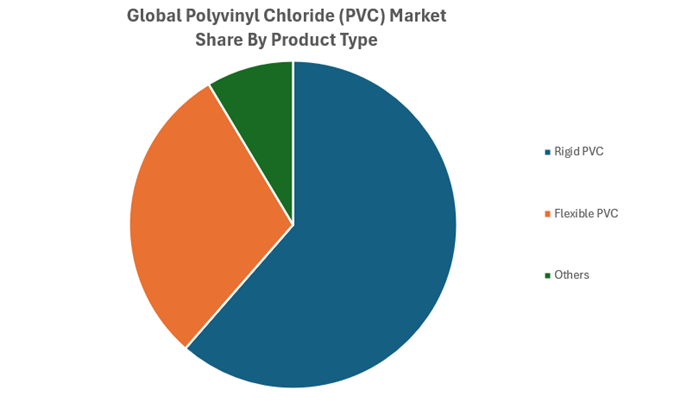
- The Rigid PVC segment dominated the market and holds approximately 58% share in 2025 and is projected to grow at a substantial CAGR during the forecast period.
Based on the product type, the Global Polyvinyl Chloride (PVC) Market is segmented into Rigid PVC, Flexible PVC, and Others. Out of these segments, Rigid PVC Segment leads the market and constitutes around 58% of market share in 2025. The growth is mainly driven by its strength, toughness, corrosion-resistant nature, and cost-effectiveness. Rigid PVC finds wide application in pipes and fittings, construction profiles, doors, windows, and industries. Increasing infrastructure developments and urbanization, along with investment in water supply and wastewater projects, boost the consumption of rigid PVC.
- The Pipes & Fittings segment accounted for the largest share of approximately 52% in 2025 and is anticipated to grow at a significant CAGR during the forecast period.
Based on the application, the Global Polyvinyl Chloride (PVC) Market includes Pipes & Fittings, Bottles, and other segments. Out of these three segments, the Pipes & Fittings segment occupied the highest market share, accounting for about 52% of the market share in 2025. The reason behind such high market share is the rise in infrastructure development, urbanization, and need for robust water distribution & wastewater management systems. The advantages of using PVC pipes include being highly resistant to corrosion, light in weight, cost-effective, and easy to install.
- The Building and Construction segment accounted for the largest share of approximately 60% in 2025 and is anticipated to grow at a significant CAGR during the forecast period.
Based on end-user industry, the Global Polyvinyl Chloride (PVC) Market comprises six types: Building and Construction, Packaging, Automotive, Electrical and Electronics, Healthcare, and Others. Out of all these segments, the Building and Construction Segment leads the market and accounts for about 60% of the market share in 2025. This is because PVC has been largely used in pipes, fittings, flooring, roofing membranes, doors, and windows. The increase in urbanization, development of infrastructure, and construction activities around the globe is adding fuel to its demand.
Regional Segment Analysis of the Global Polyvinyl Chloride (PVC) Market
- Asia-Pacific (China, India, Japan, South Korea, and Rest of Asia-Pacific)?
- North America (United States and Canada)
- Europe (Germany, Italy, France, United Kingdom, and Rest of Europe)
- Latin America (Brazil, Mexico, Argentina, and Rest of Latin America)?
- The Middle East and Africa (Saudi Arabia, UAE, South Africa, Turkey, and Rest of MEA)
Asia Pacific is anticipated to hold approximately 56% share of the Global Polyvinyl Chloride (PVC) Market over the predicted timeframe.
The Asia Pacific segment represents around 56% of the Global Polyvinyl Chloride (PVC) Market due to the factors such as fast urbanization, large-scale construction and development of infrastructure projects and robust demand from various industries such as packaging, automotive, electrical and healthcare industries. Countries such as China, India, Japan and South Korea are among the prominent producers and consumers of PVC in the region. The presence of a strong manufacturing base, well-established chemical supply chain and a large domestic demand are some of the favorable factors influencing the growth of the market in this region. The growing investments in water treatment and management systems, residential building construction and industrial infrastructure are some of the factors promoting market growth in this region.
Middle East & Africa is expected to grow at a rapid CAGR in the Global Polyvinyl Chloride (PVC) Market, holding approximately 5% of the share during the forecast period
The Middle East & Africa segment contributes about 5% to the global Polyvinyl Chloride (PVC) market, aided by increasing urbanization, infrastructure development, construction, and investment in water treatment facilities. Some of the leading players from this region include Saudi Arabia, the UAE, and others in the GCC region. These countries have been investing heavily in infrastructure and diversification projects, which have helped boost the demand for PVC. Increasing use of PVC in pipes and fittings, electrical wires, flooring, window frames, packaging, and medical applications is likely to drive growth in this segment.
North America is the fastest-growing region in the Global Polyvinyl Chloride (PVC) Market during the period, holding approximately 19.2% share.
The North America region is contributing about 19.2% of the Global Polyvinyl Chloride (PVC) Market through infrastructure upgradation, construction of houses and buildings, and growing demand for durable pipes. USA leads the regional market, while Canada and Mexico are trailing behind. Investments in water and wastewater infrastructure are helping boost the demand for PVC. Moreover, the presence of a strong chemical industry and downstream processing plants in the region is another reason why it holds such a large market share. Various applications of PVC include pipes and fittings, electrical wires, flooring, packaging, medical devices, and automotive components.
Future Market Trends in Global Polyvinyl Chloride (PVC) Market: -
-
- Rising Demand for Sustainable PVC Solutions
Environmental issues have become the main concern for the PVC industry, which has shifted its focus to manufacturing using sustainable processes that are recyclable, bio-based, and reduce emissions. Companies in the PVC industry are working on circular economy and recycling projects that will lead to the development of green PVC products.
-
- Expansion of PVC Recycling and Circular Economy
PVC recovery is becoming feasible through improvements in mechanical and chemical recycling technologies to enable the reuse of the material used for construction, packaging, cars, and electrical purposes. Recycled PVC is being used more frequently in manufacturing new products to minimize waste production and cut back on use of raw materials.
-
- Growth in Infrastructure and Construction Applications
An increasing demand for PVC is expected with growing construction activities for homes, offices, and infrastructures. PVC pipes, fittings, windows, floorings, roofings, and other applications of PVC have properties such as strength, resistance to corrosion, and economic benefits. Urbanization and modernization projects will create opportunities to produce PVC in the coming future.
-
- Increasing Use of High-Performance PVC Products
There is a trend towards the development of new PVC compounds that exhibit increased durability, flexibility, fire resistance, weathering and chemical resistance. Such superior properties have made PVC compounds useful in making automotive parts, health care products, electrical products, packaging and industrial machinery. The demand for durable but lightweight and economical material has led to such developments.
Recent Development
- In August 2024, Reliance Industries presented a comprehensive multi-year plan to grow its integrated PVC manufacturing facilities, specifically focusing on infrastructure and construction end-uses in the Asia-Pacific area
- In January 2025, the value-added tax (VAT) export rebate for PVC was eliminated, according to China's Ministry of Finance. To reduce overcapacity, this strategic change compelled Chinese manufacturers to reorganize regional pricing strategies and move away from aggressive international exports
- In May 2026, Innovations in integrating common compound stabilizers with digital tracers and intelligent sorting were emphasized in a significant scholarly review on PVC modification and industrial recycling. This made it possible for facilities to efficiently separate rigid and flexible PVC during high-throughput recycling
Market Segment
This study forecasts revenue at global, regional, and country levels from 2020 to 2035. Decision Advisors has segmented the Global Polyvinyl Chloride (PVC) Market based on the below-mentioned segments:
Global Polyvinyl Chloride (PVC) Market, By Product Type
- Rigid PVC
- Flexible PVC
- More
Global Polyvinyl Chloride (PVC) Market, By Application
- Pipes and Fittings
- Bottles
- More
Global Polyvinyl Chloride (PVC) Market, By End-User Industry
- Building and Construction
- Packaging
- More
Global Polyvinyl Chloride (PVC) Market, By Regional Analysis
- Asia-Pacific
- China
- India
- Japan
- South Korea
- Rest of Asia-Pacific
- North America
- United States
- Canada
- Europe
- Germany
- Italy
- France
- United Kingdom
- Rest of Europe
- Latin America
- Brazil
- Mexico
- Argentina
- Rest of Latin America
- Middle East & Africa
- Saudi Arabia
- UAE
- South Africa
- Turkey
- Rest of MEA
Frequently Asked Questions (FAQ)
Q. What factors are driving the growth of the Global Polyvinyl Chloride (PVC) Market?
A. The global PVC market is expanding due to rising building activity, infrastructure development, urbanization, and rising demand for pipes, fittings, packaging, electrical cables, and automotive components.
Q. Why is PVC widely preferred over alternative materials?
A. PVC is ideal for a wide range of applications due to its exceptional durability, corrosion resistance, lightweight qualities, adaptability, affordability, and low maintenance needs.
Q. What role does PVC play in the construction industry?
A. Because of its longevity and resistance to corrosion and moisture, PVC is widely used in pipes, fittings, floors, roofing membranes, windows, doors, and other building items.
Q. How is sustainability influencing PVC market development?
A. Manufacturers are investing in PVC recycling, sustainable production methods, circular economy principles, and enhanced recovery technologies because of growing environmental concerns.
Check Licence
Choose the plan that fits you best: Single User, Multi-User, or Enterprise solutions tailored for your needs.
We Have You Covered
- 24/7 Analyst Support
- Clients Across the Globe
- Tailored Insights
- Technology Tracking
- Competitive Intelligence
- Custom Research
- Syndicated Market Studies
- Market Overview
- Market Segmentation
- Growth Drivers
- Market Opportunities
- Regulatory Insights
- Innovation & Sustainability
Report Details
| Scope | Global |
| Pages | 200 |
| Delivery | PDF & Excel via Email |
| Language | English |
| Release | Sep 2026 |
| Access | Download from this page |