
Global Porcine Vaccine Market
 |
Author:
David J
|
Pages:
210
|
Author:
David J
|
Pages:
210
Global Porcine Vaccine Market Size, Share by Product Type (Inactivated Vaccines, Live Attenuated Vaccines, Recombinant Vaccines, DNA Vaccines), By Route of Administration (Intramuscular Injection, Oral, Intranasal), By Disease Type (Porcine Reproductive and Respiratory Syndrome (PRRS), Swine Influenza, Classical Swine Fever, Porcine Circovirus, Others), By End User (Livestock Farms, Veterinary Clinics, Research Institutes) and By Region (North America, Europe, Asia-Pacific, Latin America, Middle East & Africa), Analysis and Forecast 2026?2035
CAGR
7.61%
REVENUE 2025
USD Billion 1.21
FORECAST 2035
USD Billion 2.52
REPORT COVERAGE
Global
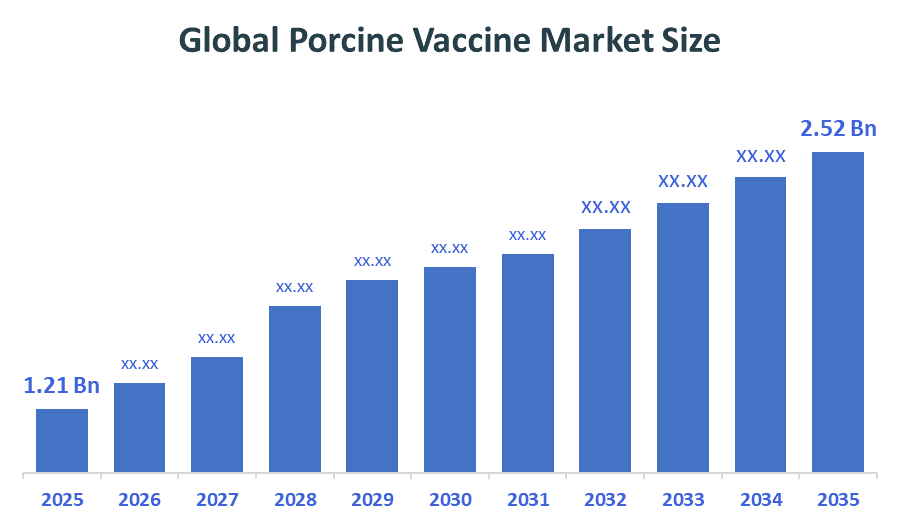
The Global Porcine Vaccine Market Size is foreseen to grow from USD 1.21 Billion in 2025 and is govern to reach around USD 2.52 Billion by 2035. According to Decision Advisors, a detailed research report on the Global Porcine Vaccine Market is boosted by shift toward disease prevention over treatment, accounting for nearly upto the 25-35% share of the total share worldwide. Zoetis Inc. is the prime player in the market with approximately USD 1.23- 3.21 billion in annual turnover and a 40-45% market share, positioning it as the primary driver of the global porcine vaccine market.
Market Snapshot
- Global Porcine Vaccine Market Size (2025): USD 1.21 Billion
- Projected Global Porcine Vaccine Market Size (2035): USD 2.52 Billion
- Global Porcine Vaccine Market Compound Annual Growth Rate (CAGR): 7.61%
- Largest Regional Market: North America
- Fastest Growing Region: Asia Pacific
- 2nd Largest Region: Europe
- Base Year: 2025
- Historical Period: 2021–2024
- Forecast Period: 2026–2035
Market Overview/ Introduction
The global porcine vaccine market is essentially the preventative healthcare wing for the world's pig farming industry. Think of these vaccines as the first line of defense, they use harmless pieces of a virus to train a pig's immune system to fight off devastating illnesses like PRRS or PCV without the animal ever getting sick. This market is buzzing right now because of a global push to stop using antibiotics as a just-in-case measure. Instead, farmers are turning to vaccines to keep herds healthy from the start. Right now, industry giants like Zoetis and Merck are pouring money into smart tech. The market is seeing a shift toward needle-free injections (using air pressure instead of steel) and customised mRNA vaccines that can be designed in just a few months to stop a local outbreak in its tracks. Because people in places like China and India are eating more pork than ever, the industry is expected to grow steadily about 6% to 9% each year, potentially doubling in size. It’s a move away from treating the sick toward staying healthy, which is better for the animals and the people who eventually eat the food.
Notable Insights: -
- North America is anticipated to hold the largest share, approximately 38% of the global porcine vaccine market over the predicted timeframe.
- Asia Pacific is expected to grow at the fastest CAGR in the global porcine vaccine market during the forecast period.
- By product type, the live attenuated vaccines segment dominated the market in 2025 with approximately 45% share, and is projected to grow at a substantial CAGR during the forecast period.
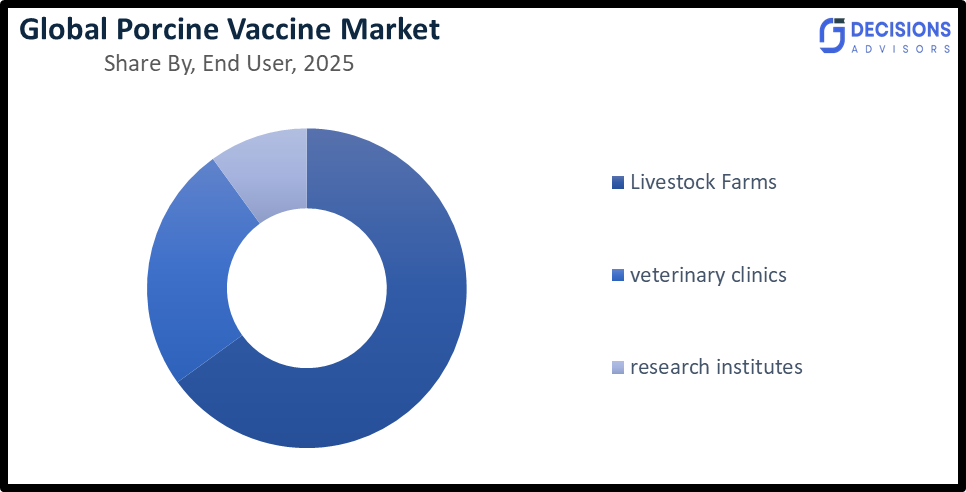
- By end user, the livestock farms segment dominated the market in 2025 with approximately 70% share, and is projected to grow at a substantial CAGR during the forecast period.
- The compound annual growth rate of the global porcine vaccine market is 7.61%.
- The market is likely to achieve a valuation of USD 2.52 Billion by 2035.
What is the role of technology in grooming the market?
Technology plays a crucial role in shaping the porcine vaccine market by enabling the development of advanced vaccines such as recombinant, DNA, and mRNA-based formulations that offer higher efficacy and faster immune response. Digital livestock monitoring systems and data analytics help farmers track disease outbreaks and optimise vaccination schedules, improving herd health management. Additionally, innovations in cold chain logistics and vaccine delivery methods ensure better storage, distribution, and effectiveness, ultimately driving higher adoption and market growth.
Market Drivers
The market drivers are a perfect storm of doing better for both the animals and the industry. First, there’s a massive global shift toward ditching antibiotics. Instead of using medicine as a safety net to prevent sickness, farmers are now using vaccines to build up natural immunity from day one. This isn't just about rules, it’s about the fact that people everywhere are eating more pork, and they want it to be cleaner and healthier. On top of that, nobody wants to see a farm lose half its herd to a sudden outbreak. New tech is making it much easier to stay ahead of these diseases we're talking about, needle-free shots that are way less stressful for the pigs and custom vaccines that scientists can program in just a few weeks to fight a new virus. Essentially, the market is growing because farming is moving away from reacting to problems and toward a prevention first mindset that's smarter, faster, and more humane.
Restrain
The porcine vaccine market faces restraints due to high costs associated with advanced vaccine development and storage requirements, particularly cold chain logistics. Limited awareness among small-scale farmers and inadequate veterinary infrastructure in developing regions can hinder adoption.
Competitive Analysis:
The report offers the appropriate analysis of the key organizations/companies involved within the global porcine vaccine market, along with a comparative evaluation primarily based on their product of offering, business overviews, geographic presence, enterprise strategies, segment market share, and SWOT analysis. The report also provides an elaborative analysis focusing on the current news and developments of the companies, which includes product development, innovations, joint ventures, partnerships, mergers & acquisitions, strategic alliances, and others. This allows for the evaluation of the overall competition within the market.
Top Companies in the Global Porcine Vaccine Market
- Zoetis Inc.
- Boehringer Ingelheim
- Merck & Co. Inc. (MSD)
- Elanco Animal Health
- Ceva Santé Animale
- HIPRA
- Vetoquinol S.A.
- Virbac
- Bimeda Animal Health
- Phibro Animal Health Corporation
Government Initiatives
|
Country |
Key Government Initiatives |
|
Japan |
Animal Husbandry Infrastructure Development Fund (AHIDF): The government has allocated over ?29,110 crore up to 2025-26, which includes incentivising the establishment of veterinary vaccine and drug manufacturing facilities. |
|
UK |
The Vaccine Group received funding from Innovate UK and Defra (around £1 million) for a vaccine targeting Streptococcus suis, aiming to reduce antibiotic use in the pig industry. |
|
US |
The U.S. Department of Agriculture (USDA), through its National Institute of Food and Agriculture (NIFA), announced a $21.7 million investment to support research on livestock diseases, including swine diseases such as African Swine Fever (ASF) and PRRS, boosting porcine vaccine development. |
Study on the Supply, Demand, Distribution, and Market Environment of the Global Porcine Vaccine Market
The global porcine vaccine market reflects a strong balance between supply, demand, distribution, and market environment. Supply is driven by major veterinary pharmaceutical companies with advanced manufacturing and R&D capabilities, ensuring consistent vaccine availability. Demand is fueled by rising swine disease outbreaks and increasing pork consumption worldwide. Distribution is supported through veterinary networks, livestock farms, and government vaccination programs, especially in developing regions. The overall market environment is influenced by regulatory frameworks, biosecurity measures, and growing awareness of animal health, which collectively support steady market growth.
Price Analysis and Consumer Behaviour Analysis
Price analysis in the porcine vaccine market shows that vaccine costs vary significantly by type and region, with advanced vaccines such as recombinant vaccines typically priced 20–30% higher than conventional inactivated vaccines due to higher R&D and production costs. From a consumer behaviour perspective, studies indicate that over 65% of commercial swine producers prioritise vaccine efficacy and disease coverage over price, as disease outbreaks like PRRS can cause substantial economic losses. However, small-scale farmers remain price-sensitive and often opt for lower-cost vaccination programs, balancing affordability with basic disease protection.
Market Segmentation
The Global Porcine Vaccine Market share is classified into product type, route of administration, disease type, and end user.
- The live attenuated vaccines segment dominated the market in 2025 with approximately 45% share, and is projected to grow at a substantial CAGR during the forecast period.
Based on the product type, the global porcine vaccine market is divided into inactivated vaccines, live attenuated vaccines, recombinant vaccines, and DNA vaccines. Among these, the live attenuated vaccines segment dominated the market in 2025 with approximately 45% share, owing to their ability to provide strong and long-lasting immune responses at relatively lower costs. For instance, live vaccines are widely used for diseases such as Classical Swine Fever and PRRS due to their high effectiveness in large-scale swine farms. Additionally, recent developments such as the launch of next-generation PRRS live vaccines in 2024 have improved safety profiles and boosted adoption. Recombinant vaccines are expected to witness faster growth due to ongoing R&D advancements.
- The intramuscular injection segment accounted for the largest share in 2025 with approximately 60%, and is anticipated to grow at a significant CAGR during the forecast period.
Based on the route of administration, the global porcine vaccine market is divided into intramuscular injection, oral, and intranasal. Among these, the intramuscular injection segment accounted for the largest share in 2025 with approximately 60%, driven by its reliability, precise dosing, and widespread use in commercial swine production. For example, most porcine vaccines such as PRRS and swine influenza are administered via intramuscular route to ensure effective immune response. Moreover, recent innovations in needle-free injection systems (introduced in 2023–2024) are further enhancing efficiency and reducing stress in animals, supporting segment growth. Oral and intranasal routes are gaining traction for ease of administration.
- The PRRS (Porcine Reproductive and Respiratory Syndrome) segment dominated the market in 2025 with approximately 35% share, and is projected to grow at a substantial CAGR during the forecast period.
Based on the disease type, the global porcine vaccine market is divided into PRRS, swine influenza, classical swine fever, porcine circovirus, and others. Among these, the PRRS segment dominated the market in 2025 with approximately 35% share, owing to its significant economic impact on the swine industry globally. For instance, PRRS leads to reproductive failure and respiratory issues, resulting in major productivity losses in pig farms. Additionally, recent developments such as ongoing ASF and PRRS vaccine research collaborations in 2024–2025 are accelerating innovation and demand for advanced vaccines. Other diseases like porcine circovirus also hold notable shares due to high prevalence.
- The livestock farms segment dominated the market in 2025 with approximately 70% share, and is projected to grow at a substantial CAGR during the forecast period.
Based on the end user, the global porcine vaccine market is divided into livestock farms, veterinary clinics, and research institutes. Among these, the livestock farms segment dominated the market in 2025 with approximately 70% share, due to the large-scale vaccination requirements in commercial pig farming operations. For instance, commercial farms routinely vaccinate herds to prevent disease outbreaks and maintain productivity. Furthermore, recent government-supported vaccination programs and farm-level disease control initiatives in countries like China and India (2023–2025) are strengthening vaccine adoption. Veterinary clinics and research institutes contribute smaller shares but are important for diagnostics and innovation.
Strategies to Implement for Growth of the Market in Non-Leading Regions
To drive growth in non-leading regions, companies should focus on improving awareness through farmer education programs, expanding affordable vaccine options, and strengthening rural distribution networks. Collaborating with governments and local veterinary bodies can significantly boost adoption. For example, in India, government-supported livestock vaccination programs under the National Livestock Mission have increased vaccine accessibility in rural areas, encouraging small-scale farmers to adopt preventive healthcare practices. Such initiatives, combined with partnerships and infrastructure development, can accelerate market penetration in emerging regions.
Regional Segment Analysis of the Global Porcine Vaccine Market
- North America (U.S., Canada, Mexico)
- Europe (Germany, France, U.K., Italy, Spain, Rest of Europe)
- Asia-Pacific (China, Japan, India, Rest of APAC)
- South America (Brazil and the Rest of South America)
- The Middle East and Africa (UAE, South Africa, Rest of MEA)
North America is anticipated to hold the largest share, approximately 38% of the global porcine vaccine market over the predicted timeframe.
North America is anticipated to hold the largest share, approximately 38% of the global porcine vaccine market over the predicted timeframe. The region dominates due to its advanced livestock infrastructure and strong adoption of vaccination programs, particularly in the United States and Canada, where commercial farms maintain over 90% vaccination coverage. Additionally, the U.S. alone has over 70 million pigs, supporting large-scale vaccine demand. A key recent development includes Zoetis investing USD 120 million in a biologics manufacturing facility (2024–2027) to expand vaccine production capacity by nearly 30%, highlighting strong industry growth. Strict regulations on antibiotic use are also pushing farmers toward vaccination-based disease prevention, further strengthening market dominance.
Asia Pacific is expected to grow at the fastest CAGR in the global porcine vaccine market during the forecast period.
Asia Pacific is expected to grow at the fastest CAGR in the global porcine vaccine market during the forecast period, with growth rates exceeding 14% CAGR in some estimates. The region has the largest pig population globally, with over 380 million pigs, including more than 200 million in China alone, creating massive demand for vaccines. Growth is driven by increasing pork consumption, frequent disease outbreaks like African Swine Fever (ASF), and expanding commercial farming. A real-world example is Vietnam’s government program targeting approximately 80% vaccination coverage of breeding herds by 2026, which is significantly boosting adoption. Additionally, rising investments in modern farming and government subsidies are accelerating market expansion across countries like China and India.
Europe is the third largest region in the Global Porcine Vaccine Market during the forecast period.
Europe is the third largest region in the Global Porcine Vaccine Market during the forecast period, holding around 24% market share, supported by a pig population exceeding 150 million animals across key countries. The region benefits from strict animal welfare regulations and high vaccination coverage, with farms typically administering 5–7 vaccines per production cycle. Countries like Germany, Spain, and Denmark lead due to their strong pork export industries. A recent development includes the European Union’s continued enforcement of animal health laws promoting preventive vaccination and biosecurity measures, which is driving consistent demand for porcine vaccines. Additionally, increasing focus on antibiotic reduction strategies is further supporting vaccine adoption.
Future Market Trends in the Global Porcine Vaccine Market: -
1. Rapid Growth Driven by Disease Outbreaks & Food Security
The market is expected to grow significantly, reaching around USD 4.73 billion by 2031 at a CAGR of 11.21%, driven by rising outbreaks like African Swine Fever (ASF) and PRRS. Notably, ASF alone affected over 1.7 million pigs globally (2022–2024), increasing the urgent need for effective vaccination.
2. Shift Toward Advanced & Recombinant Vaccine Technologies
There is a strong shift from traditional vaccines to recombinant, DNA-based, and multivalent vaccines, which are growing at over 14% CAGR in some segments. These technologies improve efficacy, reduce doses, and provide protection against multiple diseases, making them highly preferred in modern large-scale pig farming.
3. Expansion in Emerging Markets with Government Support
Asia-Pacific is the fastest-growing region with approximately 14% CAGR, supported by government vaccination programs and rising pork demand. Countries like China and Vietnam are investing in mass immunisation and biosecurity, accelerating vaccine adoption in developing regions
Recent Development
In December 2025, Merck Animal Health announced the launch of its new CIRCUMVENT CL vaccine for pigs, designed to protect against Porcine Circovirus (PCV) types 2a & 2d and Lawsonia intracellularis. The ready-to-use vaccine requires no mixing, helping simplify vaccination processes and reduce handling errors on farms. It is suitable for pigs aged three weeks and older and offers a targeted solution for herds that do not require mycoplasma vaccination, strengthening herd health management and improving operational efficiency.
In June 2025, A new development highlighted by Pig Progress shows how digital technology is transforming porcine vaccination practices. MSD Animal Health introduced Swine Protect & Connect, which integrates needle-free intradermal vaccination (IDAL) with individual pig identification systems (LeeO).
In May 2025, MSD Animal Health announced the development of Swine Protect & Connect, an integrated system created through collaboration with veterinarians and pig producers to enhance vaccination and herd management.
March 2022, Boehringer Ingelheim launched ReproCyc ParvoFLEX, a new porcine parvovirus (PPV) vaccine designed to prevent reproductive failure in pigs
In May 2021, Zoetis launched a new porcine circovirus (PCV2) vaccine, CircoMax Myco, aimed at improving protection against evolving swine diseases. The vaccine is unique as it includes two PCV2 genotypes (a & b), offering broader coverage compared to traditional single-genotype vaccines.
How are recent developments helping the Market?
Recent developments are significantly accelerating the growth of the porcine vaccine market by improving vaccine effectiveness, delivery, and regulatory support. For instance, in 2025, Zoetis received a conditional U.S. license for a Porcine Epidemic Diarrhoea (PED) vaccine, expanding protection against deadly piglet diseases, while Merck Animal Health introduced dual-protection intradermal vaccines that protect against multiple infections in a single dose. Additionally, innovations like needle-free vaccination systems and digital tracking are enhancing herd-level monitoring and efficiency. On a global level, the adoption of the first international African Swine Fever (ASF) vaccine standards in 2025 is helping countries speed up approval and deployment processes, addressing a disease responsible for over 2 million pig losses since 2022. These advancements collectively improve disease control, boost farmer confidence, and drive market expansion.
Market Segment
This study forecasts revenue at global, regional, and country levels from 2020 to 2035. Decision Advisors has segmented the global porcine vaccine market based on the below-mentioned segments:
Global Porcine Vaccine Market, By Product Type
- Inactivated Vaccines
- Live Attenuated Vaccines
- Recombinant Vaccines
- DNA Vaccines
Global Porcine Vaccine Market, By Route of Administration
- Intramuscular Injection
- Oral
- Intranasal
Global Porcine Vaccine Market, By disease Type
- Porcine Reproductive and Respiratory Syndrome (PRRS)
- Swine Influenza
- Classical Swine Fever
- Porcine Circovirus
- Others
Global Porcine Vaccine Market, By End User
- Livestock Farms
- Veterinary Clinics
- Research Institutes
Global Porcine Vaccine Market, By Regional Analysis
- North America
- US
- Canada
- Mexico
- Europe
- Germany
- UK
- France
- Italy
- Spain
- Russia
- Rest of Europe
- Asia Pacific
- China
- Japan
- India
- South Korea
- Australia
- Rest of Asia Pacific
- South America
- Brazil
- Argentina
- Rest of South America
- Middle East & Africa
- UAE
- Saudi Arabia
- Qatar
- South Africa
- Rest of the Middle East & Africa
Frequently Asked Questions (FAQ)
Q1. What is the typical vaccination schedule for pigs in commercial farms?
A. Vaccination schedules vary by region and disease risk but generally include early-life immunization followed by booster doses during growth and breeding stages.
Q2. Can porcine vaccines be used during disease outbreaks or only for prevention?
A. Most vaccines are preventive, but in some cases (like PRRS), emergency vaccination strategies may be used to control outbreaks under veterinary guidance.
Q3. How do environmental factors impact vaccine effectiveness in pigs?
A. Factors such as temperature, farm hygiene, stress, and nutrition can influence immune response and overall vaccine effectiveness.
Q4. Are there any risks of vaccine resistance or reduced efficacy over time?
A. Yes, viral mutations and improper vaccination practices can reduce effectiveness, which is why continuous monitoring and updated vaccines are important.
Q5. What role do veterinarians play in optimising porcine vaccination programs?
A. Veterinarians design customised vaccination plans, monitor herd health, and ensure proper storage and administration to maximise vaccine efficiency.
Check Licence
Choose the plan that fits you best: Single User, Multi-User, or Enterprise solutions tailored for your needs.
We Have You Covered
- 24/7 Analyst Support
- Clients Across the Globe
- Tailored Insights
- Technology Tracking
- Competitive Intelligence
- Custom Research
- Syndicated Market Studies
- Market Overview
- Market Segmentation
- Growth Drivers
- Market Opportunities
- Regulatory Insights
- Innovation & Sustainability
Report Details
| Scope | Global |
| Pages | 210 |
| Delivery | PDF & Excel via Email |
| Language | English |
| Release | Apr 2026 |
| Access | Download from this page |