
Global Post-Traumatic Stress Disorder (PTSD) Market
 |
Author:
David J
|
Pages:
240
|
Author:
David J
|
Pages:
240
Global Post-Traumatic Stress Disorder (PTSD) Market Size, Share, and COVID-19 Impact Analysis, By Drug Class (Antidepressants, Antipsychotics, Anti-anxiety, and Others), By Age Group (Adult, Geriatrics, and Pediatrics), and By Region (North America, Europe, Asia-Pacific, Latin America, Middle East, and Africa), Analysis and Forecast 2025-2035
CAGR
4.35%
REVENUE 2024
USD Billion 13.75
FORECAST 2035
USD Billion 21.97
REPORT COVERAGE
Global
Global Post-Traumatic Stress Disorder (PTSD) Market Insights Forecasts to 2035
- The Global Post-Traumatic Stress Disorder (PTSD) Market Size Was Estimated at USD 13.75 Billion in 2024
- The Market Size is Expected to Grow at a CAGR of around 4.35% from 2025 to 2035
- The Worldwide Post-Traumatic Stress Disorder (PTSD) Market Size is Expected to Reach USD 21.97 Billion by 2035
- North America is expected to grow the fastest during the forecast period.
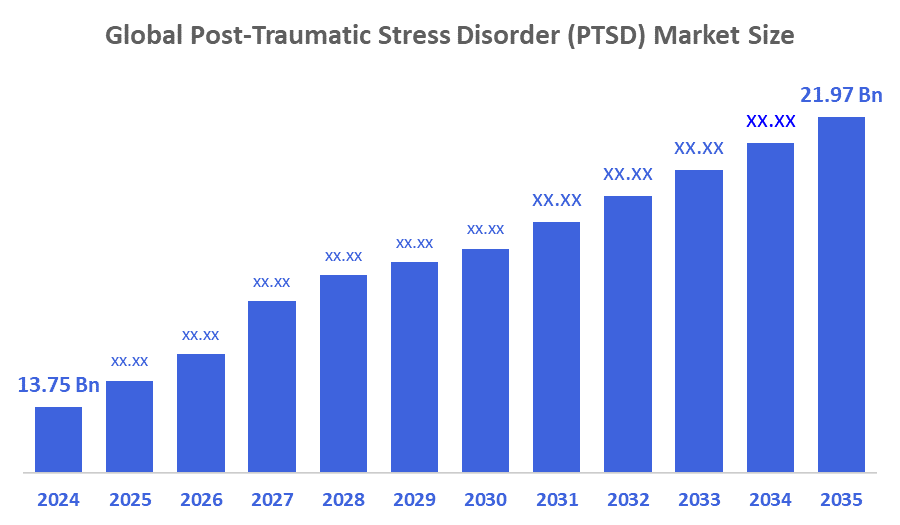
According to a research report published by Decisions Advisors and Consulting, the global post-traumatic stress disorder (PTSD) market size was worth around USD 13.75 billion in 2024 and is predicted to grow to around USD 21.97 billion by 2035 with a compound annual growth rate (CAGR) of 4.35% from 2025 to 2035. Post traumatic stress disorder (PTSD) treatment market is growing at a moderate pace owing to increased awareness of mental health disorders, greater identification of cases, and the development of new therapeutic options. Further, continuous funding in brain studies, as well as the breakthrough therapies, facilitates the availability of treatments, thus they are gradually being developed and becoming more affordable worldwide.
Market Overview
The post-traumatic stress disorder (PTSD) market includes developing, manufacturing, and distributing therapies, both pharmacological and non-pharmacological, designed to manage or alleviate PTSD symptoms such as anxiety, depression, flashbacks, and sleep disturbances. It encompasses drugs, psychotherapy services, and digital health solutions delivered through hospital pharmacies, retail outlets, and online platforms. Examples of such events include a natural disaster, a serious accident, a terrorist act, war/combat, or rape, or the person has been threatened with death, sexual violence, or serious injury. Individuals suffering from PTSD have memories filled with disturbing thoughts and feelings associated with the trauma that continue for a very long time, even after the traumatic event. They might experience flashbacks or have nightmares when they think about the traumatic event; they might feel sad, scared, or angry or even become detached or estranged from others. Those who have PTSD might try to avoid places or people that remind them of the trauma and might have extremely strong negative reactions even to something as normal as a sudden loud sound or an unwanted touch.
The University of Idaho will receive two significant multi-institutional grants from the U.S. Department of Defence (DoD) to support machine learning research aimed at improving PTSD diagnosis and bolstering support networks for military families under stress during deployment cycles. The two multi-site initiatives have a combined budget of over $6 million, of which $1.33 million is used to support U of I research.
In January 2025, HOPE Therapeutics, Inc. and NRx Pharmaceuticals, Inc. announced a $27 million funding agreement to support the acquisition of HOPE Clinics and expand pharmaceutical operations. The deal includes a $25 million Series A investment in HOPE Therapeutics and $2 million in NRx equity purchases.
Report Coverage
This research report categorises the post-traumatic stress disorder (PTSD) market based on various segments and regions, forecasts revenue growth, and analyzes trends in each submarket. The report analyses the key growth drivers, opportunities, and challenges influencing the post-traumatic stress disorder (PTSD) market. Recent market developments and competitive strategies, such as expansion, product launch, development, partnership, merger, and acquisition, have been included to draw the competitive landscape in the market. The report strategically identifies and profiles the key market players and analyzes their core competencies in each sub-segment of the post-traumatic stress disorder (PTSD) market.
Driving Factors
Raising understanding about psychological states and the necessity for treatment of such conditions is one of the main reasons behind the surge in demand for PTSD. Introduction of novel and ground-breaking therapies and technologies for the treatment of PTSD, such as virtual reality therapy, is supporting the expansion of the PTSD market. The increasing inclination towards personalised medicine and targeted therapies is fostering the creation of new PTSD treatments that accommodate the specific needs of the patients. Moreover, globally key market players are stepping up their mental health programs to which they provide their support, and these initiatives are propelling the growth of the PTSD market. For instance, to enhance the living standards of PTSD sufferers, governments are channelling funds into mental health research and treatment programs.
Collaborative care models have been shown to significantly reduce disparities in mental health treatment, particularly among racial and ethnic minority groups, by integrating mental health services into primary care and using team-based approaches to improve access, quality, and outcomes.
Restraining Factors
One major barrier to personalised medicine in the post-traumatic stress disorder treatment industry is the absence of reliable biomarkers to detect PTSD and predict how well a patient will respond to therapies. Customising biologically based therapy is challenging because there are no trustworthy biomarkers for PTSD. Moreover, the lack of biomarkers means that medical professionals are compelled to employ traditional diagnostic techniques (such as questionnaires or interviews) and clinical judgment, which do not account for the molecular causes of PTSD.
Market Segmentation
The post-traumatic stress disorder (PTSD) market share is classified into drug class and age group.
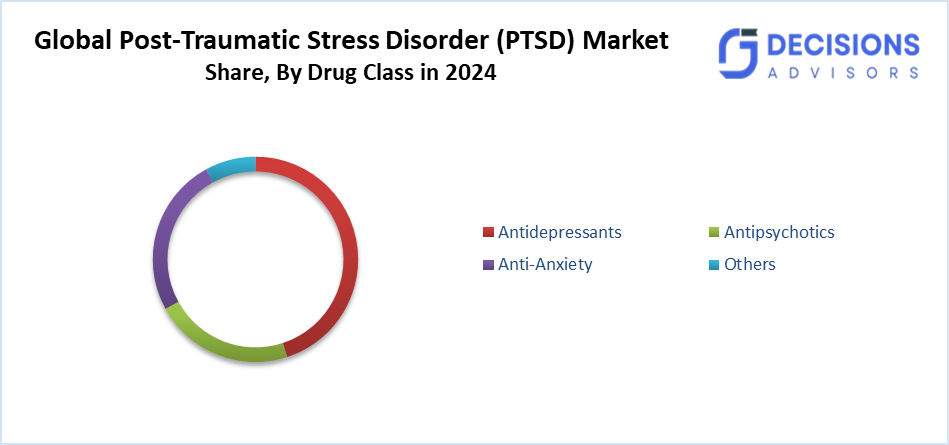
- The antidepressants segment accounted for the largest market share in 2024 and is anticipated to grow at a remarkable CAGR during the forecast period.
Based on the drug class, the post-traumatic stress disorder (PTSD) market is divided into antidepressants, antipsychotics, anti-anxiety, and others. Among these, the antidepressants segment accounted for the largest market share in 2024 and is anticipated to grow at a remarkable CAGR during the forecast period. Antidepressant medications, especially selective serotonin reuptake inhibitors (SSRIs) and serotonin-norepinephrine reuptake inhibitors (SNRIs), are frequently given for post-traumatic stress disorder (PTSD) because they effectively reduce basic symptoms such as anxiety, despair, and intrusive thoughts. They aid in the brain's neurotransmitter balance, which can lessen symptoms and enhance general mood and function. Major psychiatric and mental health organisations' clinical guidelines and recommendations also endorse this class of drugs.
- The adult segment dominated the market in 2024 and is projected to grow at a substantial CAGR during the forecast period.
Based on the age group, the post-traumatic stress disorder (PTSD) market is segmented into adult, geriatric, and pediatric. Among these, the adult segment dominated the market in 2024 and is projected to grow at a substantial CAGR during the forecast period. Adult PTSD diagnosis and recognition have improved as a result of increased awareness and comprehension of the disorder. Media attention, educational programs, and campaigns by mental health organisations have all contributed to de-stigmatising PTSD and motivating people to get professional assistance. More adults are being diagnosed with and treated for PTSD as awareness rises, which increases demand for therapeutic solutions and propels market expansion.
Regional Segment Analysis of the Post-Traumatic Stress Disorder (PTSD) Market
- North America (U.S., Canada, Mexico)
- Europe (Germany, France, U.K., Italy, Spain, Rest of Europe)
- Asia-Pacific (China, Japan, India, Rest of APAC)
- South America (Brazil and the Rest of South America)
- The Middle East and Africa (UAE, South Africa, Rest of MEA)
Asia Pacific is anticipated to hold the largest share of the post-traumatic stress disorder (PTSD) market over the predicted timeframe.
Asia Pacific is anticipated to hold the largest share of the post-traumatic stress disorder (PTSD) market over the predicted timeframe. The regional market is growing due to increasing public acceptance of mental health, a greater investment in healthcare, and improved access to digital therapy. Positive impact on the mental health market comes from numerous government-funded initiatives in mental health and mental health integrated into the primary health care systems in the countries of India, China, Japan and South Korea. Mobile platforms for therapy are also increasing the presence and access to mental health services in these regions. The growth in the prevalence of PTSD caused by social stressors, urban trauma and natural disasters has resulted in the demand for effective therapy options. As domestic pharmaceutical companies begin investing in the development of psychotropic drugs and international companies collaborate with healthcare providers, the Asia-Pacific region will continue to experience sustained growth.
North America is expected to grow at a rapid CAGR in the post-traumatic stress disorder (PTSD) market during the forecast period. The North American region is leading in the PTSD industry due to several factors. Among these factors are the presence of mental health initiatives, supported by the federal government, and innovative research into pharmaceutical products that can be used to treat PTSD. The United States has a large number of veterans, many of whom have PTSD, and the U.S. Department of Veterans Affairs (VA) and the National Institute of Mental Health (NIMH) are advancing the cause of PTSD through extensive programs to increase research, diagnosis, and treatment of veterans suffering from PTSD. Canada's public health campaigns, aimed at raising awareness of PTSD and decreasing public perceptions of PTSD as it pertains to first responders and other healthcare workers, are contributing to the increasing market opportunities.
In June 2022, the Government of Canada announced a $28.2 million investment to expand mental health support for trauma and post?traumatic stress disorder (PTSD), particularly targeting frontline and essential workers most affected by the pandemic.
Competitive Analysis:
The report offers the appropriate analysis of the key organizations/companies involved within the post-traumatic stress disorder (PTSD) market, along with a comparative evaluation primarily based on their product offering, business overviews, geographic presence, enterprise strategies, segment market share, and SWOT analysis. The report also provides an elaborative analysis focusing on the current news and developments of the companies, which includes product development, innovations, joint ventures, partnerships, mergers & acquisitions, strategic alliances, and others. This allows for the evaluation of the overall competition within the market.
List of Key Companies
- AstraZeneca Plc
- Aurobindo Pharma Limited
- Bionomics
- Camber Pharmaceuticals, Inc.
- Eli Lilly and Company
- GSK plc
- H. Lundbeck A/S
- Jazz Pharmaceuticals plc
- Johnson & Johnson Services, Inc.
- Lupin Pharmaceuticals, Inc.
- Merck & Co., Inc.
- Novartis AG
- Otsuka Pharmaceutical Co., Ltd.
- Pfizer, Inc.
- Others
Key Target Audience
- Market Players
- Investors
- End-users
- Government Authorities
- Consulting and Research Firm
- Venture capitalists
- Value-Added Resellers (VARs)
Recent Development
- In January 2026, the Israel Defence Forces (IDF) announced a “medical revolution,” unveiling AI-assisted PTSD treatment and drone-based whole blood delivery systems designed to save lives and modernise battlefield medicine. The IDF Medical Corps has been involved in a full-fledged revolution during and after the utilisation of whole blood, artificial intelligence, and, shortly, drone delivery of whole blood, which might potentially save thousands of lives.
- In October 2025, Silo Pharma announced that key milestones in its PTSD drug development program and launched a new digital assets treasury initiative. The company is preparing to file an FDA Investigational New Drug (IND) application for its lead candidate SPC-15, while also expanding its cryptocurrency holdings.
- In February 2025, the U.S. Defence Health Agency (DHA) announced the launch of the Military and Veterans PTSD Adaptive Platform Clinical Trial (MPACT), a Phase II study designed to evaluate multiple drug therapies for post-traumatic stress disorder (PTSD) in active-duty soldiers and veterans.
Market Segment
This study forecasts revenue at global, regional, and country levels from 2020 to 2035. Decisions Advisors has segmented the post-traumatic stress disorder (PTSD) market based on the below-mentioned segments:
Global Post-Traumatic Stress Disorder (PTSD) Market, By Drug Class
- Antidepressants
- Antipsychotics
- Anti-anxiety
- Others
Global Post-Traumatic Stress Disorder (PTSD) Market, By Age Group
- Adult
- Geriatrics
- Pediatrics
Global Post-Traumatic Stress Disorder (PTSD) Market, By Regional Analysis
- North America
- US
- Canada
- Mexico
- Europe
- Germany
- UK
- France
- Italy
- Spain
- Russia
- Rest of Europe
- Asia Pacific
- China
- Japan
- India
- South Korea
- Australia
- Rest of Asia Pacific
- South America
- Brazil
- Argentina
- Rest of South America
- Middle East & Africa
- UAE
- Saudi Arabia
- Qatar
- South Africa
- Rest of the Middle East & Africa
Frequently Asked Questions (FAQ)
- What is the current size of the global PTSD market?
The market was valued at USD 13.75 million in 2024.
- What is the projected market size by 2035?
It is expected to reach USD 21.97 million by 2035.
- What is the CAGR for the PTSD market from 2025 to 2035?
The market is projected to grow at a CAGR of 4.35%.
- Which region is expected to grow the fastest?
North America is expected to grow at the fastest rate during the forecast period.
- Which drug class holds the largest market share?
Antidepressants accounted for the largest share in 2024 and are expected to grow significantly.
- Which age group dominates the market?
The adult segment dominated in 2024 and is projected to grow at a substantial CAGR.
- What are the main market segments?
The market is segmented by drug class (antidepressants, antipsychotics, anti-anxiety, others) and age group (adults, geriatrics, paediatrics).
- What drives growth in the Asia-Pacific region?
Growth comes from rising mental health awareness, government initiatives, and increased access to digital therapies.
Check Licence
Choose the plan that fits you best: Single User, Multi-User, or Enterprise solutions tailored for your needs.
We Have You Covered
- 24/7 Analyst Support
- Clients Across the Globe
- Tailored Insights
- Technology Tracking
- Competitive Intelligence
- Custom Research
- Syndicated Market Studies
- Market Overview
- Market Segmentation
- Growth Drivers
- Market Opportunities
- Regulatory Insights
- Innovation & Sustainability
Report Details
| Scope | Global |
| Pages | 240 |
| Delivery | PDF & Excel via Email |
| Language | English |
| Release | Jan 2026 |
| Access | Download from this page |