
Global Postoperative Pain Market
 |
Pages:
230
|
Pages:
230
Global Postoperative Pain Market Size, Share, and COVID-19 Impact Analysis, By Drug Class (Opioids {(Natural opioids, Semi-synthetic opioids, Synthetic opioids)}, NSAIDs [(Non-selective COX inhibitors, and COX-2 selective inhibitors (coxibs)], Local Anesthetic, and Acetaminophen), By Route of Administration (Injectable, Oral, Topical, Transdermal, and Others), By End Use (Hospital Pharmacies, Retail Pharmacies, Clinics, and Others), and By Region (North America, Europe, Asia-Pacific, Latin America, Middle East, and Africa), Analysis and Forecast 2025-2035
REPORT COVERAGE
Global
Global Postoperative Pain Market Size Insights Forecasts to 2035
- The Global Postoperative Pain Market Size Was Estimated at USD 2.85 Billion in 2024
- The Market Size is Expected to Grow at a CAGR of around 5.87 % from 2025 to 2035
- The Worldwide Postoperative Pain Market Size is Expected to Reach USD 5.34 Billion by 2035
- North America is expected to grow the fastest during the forecast period.
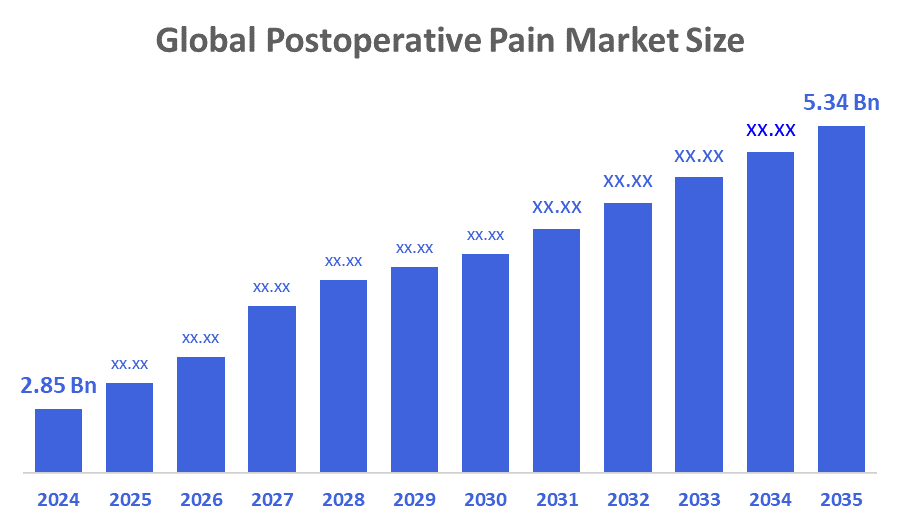
According to a research report published by Decisions Advisors and Consulting, The Global Postoperative Pain Market Size Was Worth Around USD 2.85 Billion In 2024 And Is Predicted To Grow To Around USD 5.34 Billion By 2035 With A Compound Annual Growth Rate (CAGR) Of 5.87 % From 2025 To 2035. The postoperative pain treatment market is expected to grow due to the increasing demand for pain relief medications and devices. The rising number of surgeries among cancer patients across the globe is a major factor that is contributing to the growth of the market. Moreover, the recovery process of the older patient pool is slower, which is increasing the demand for postoperative pain relief treatments.
Market Overview
Postoperative pain is the pain that a patient feels after surgery. This pain can be of varying intensity and duration, depending on the type of surgery that has been performed. There are various types of postoperative pain, and these include acute pain, chronic pain, phantom pain, and incisional pain. Acute pain is the type of pain that is felt immediately after surgery, and this pain usually lasts for a few days to a couple of weeks. This pain is usually caused by the incisions that have been made during surgery, as well as the healing process. The management of this type of pain usually involves the use of a combination of medications, physical therapy, and relaxation methods. The medications that can be used include over-the-counter pain medications, such as ibuprofen, and prescription pain medications. Narcotics can also be used to relieve this type of pain. In addition to medications, physical therapy can also be used to manage this type of pain, while relaxation methods, such as deep breathing or meditation, can be used to relieve stress and tension that may be caused by pain.
Synaptrix, a medical device company based in Atlanta, received $10 million in Series A funding to further develop its NOVABLOC™ system, a drug-free pain management solution for postoperative pain that targets opioid dependence. The investment was led by Hatteras Venture Partners, with contributions from Rex Health Ventures (the venture capital arm of UNC Health), Avanos Medical, and Portal Innovations. The company states that the current state of pain management is often ineffective, either providing temporary pain relief or contributing to opioid use, which has a high risk of long-term dependency.
Report Coverage
This research report categorizes the postoperative pain market based on various segments and regions, forecasts revenue growth, and analyzes trends in each submarket. The report analyses the key growth drivers, opportunities, and challenges influencing the Postoperative Pain market. Recent market developments and competitive strategies, such as expansion, product launch, development, partnership, merger, and acquisition, have been included to draw the competitive landscape in the market. The report strategically identifies and profiles the key market players and analyzes their core competencies in each sub-segment of the postoperative pain market.
Driving Factors
The rising incidence of chronic diseases, the rising number of surgical procedures, and the rising incidence of accidental injuries are the major factors driving the global postoperative pain market. Apart from this, the growing awareness of palliative care and the increasing demand for innovative and advanced pain-relieving medications are also having a positive impact on the market. Moreover, the rising popularity of orally ingested medications, driven by their various associated benefits such as non-invasiveness, ease of use, and self-administration, is also fueling market growth. Further, the key players are also concentrating on the development of extended-release non-opioid medications and abuse-deterrent opioid medications for postoperative pain relief. Also, the development of innovative products and techniques, such as nerve blocks and pumps that release pain medications directly to the surgical site, is also creating a positive impact on the market growth. Moreover, the rising investments in R&D activities for the development of high-quality postoperative pain management solutions due to the rising demand for effective pain management with minimum side effects are expected to drive the global postoperative pain market.
The National Institutes of Health (NIH) awarded $2.7 million (R18 grant) to the University of Connecticut (UConn) and a multidisciplinary team. Their project focuses on developing implantable drug?delivery films designed to relieve pain after surgery.
Restraining Factors
Factors that restrict the market include opioid-related risks of dependency, regulatory issues, limited reimbursement rates, drug side effects, and the slow acceptance of non-opioid therapies. The high cost of treatment and disparities in the regional healthcare infrastructure are additional factors that restrict the market.
Market Segmentation
The postoperative pain market share is classified into drug class, route of administration, and end user.
- The opioids segment accounted for the largest share in 2024 and is anticipated to grow at a significant CAGR during the forecast period.
Based on the drug class, the postoperative pain market is divided into opioids (natural opioids, semi-synthetic opioids, synthetic opioids), NSAIDs (non-selective COX inhibitors, and cox-2 selective inhibitors (COXIBS)], local anaesthetics, and acetaminophen. Among these, the opioids segment accounted for the largest share in 2024 and is anticipated to grow at a significant CAGR during the forecast period. As per the NIH, opioids are widely used for the treatment of moderate to severe post-operative pain. In research studies and trials, opioid medications are known to be effective in the treatment of postoperative pain and can help patients achieve their objectives.
For instance, Pacira BioSciences entered into a partnership with LG Chem to expand access to its flagship opioid pain therapy, EXPAREL (bupivacaine liposome injectable suspension), across select Asia?Pacific markets.
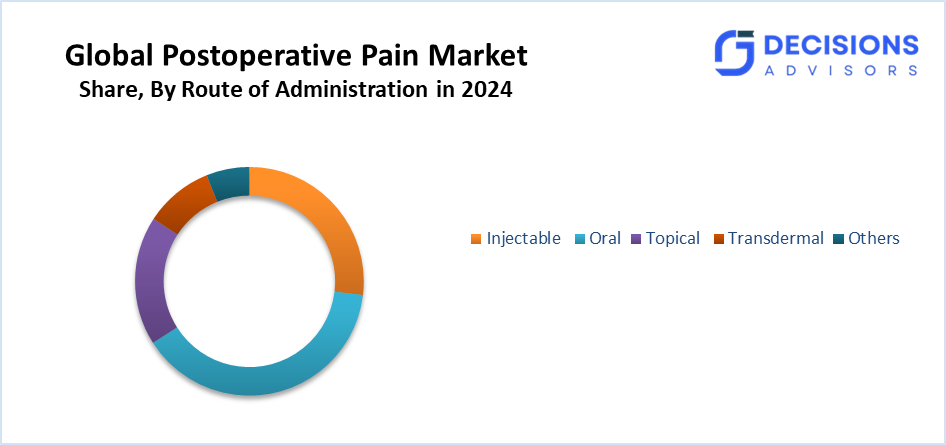
- The oral segment accounted for the largest share in 2024 and is anticipated to grow at a significant CAGR during the forecast period.
Based on the route of administration, the postoperative pain market is segmented into injectable, oral, topical, transdermal, and others. Among these, the oral segment accounted for the largest share in 2024 and is anticipated to grow at a significant CAGR during the forecast period. The convenience and acceptance of oral administration among patients, especially the elderly, are factors that contribute to the larger share of the market in the postoperative pain market.
For instance, the FDA approved Vertex Pharmaceuticals’ suzetrigine (brand name JOURNAVX) as a first?in?class non?opioid oral pain signal inhibitor for adults with moderate?to?severe acute pain.
- The hospital pharmacies segment accounted for the highest market revenue in 2024 and is anticipated to grow at a significant CAGR during the forecast period.
Based on the end use, the postoperative pain market is segmented into hospital pharmacies, retail pharmacies, clinics, and others. Among these, the hospital pharmacies segment accounted for the highest market revenue in 2024 and is anticipated to grow at a significant CAGR during the forecast period. The necessity for a complete pain control infrastructure, including patient-controlled analgesia (PCA) devices, which account for technology-based income, and the rising volume of inpatient surgical procedures.
Regional Segment Analysis of the Postoperative Pain Market
- North America (U.S., Canada, Mexico)
- Europe (Germany, France, U.K., Italy, Spain, Rest of Europe)
- Asia-Pacific (China, Japan, India, Rest of APAC)
- South America (Brazil and the Rest of South America)
- The Middle East and Africa (UAE, South Africa, Rest of MEA)
Asia Pacific is anticipated to hold the largest share of the postoperative pain market over the predicted timeframe.
Asia Pacific is anticipated to hold the largest share of the postoperative pain market over the predicted timeframe. The management of postoperative pain is an increasingly prominent issue in the Asia-Pacific (APAC) region, where the demand for surgery is increasing with the ageing population and better access to healthcare. The latest guidelines emphasise the role of multimodal analgesia, using opioids, NSAIDs, acetaminophen, and local anaesthetics together to decrease opioid use. The new extended-release local anaesthetics, with durations of up to 72 hours, are changing this by providing sustained relief. In the APAC region, collaborations such as the Pacira-LG Chem partnership to distribute EXPAREL® are indicative of a strong market demand for safer and more opioid-sparing pain management options.
There was an announcement that a $57.5M Series D round of funding was obtained, along with venture debt financing from HSBC to further the development of ATX101, our ultra-sustained, non-opioid analgesic product candidate for post-surgical pain. This investment will help us move forward with the ongoing Phase 2b registration study assessing the administration of ATX101 in patients undergoing total knee replacement surgery. Further, it's conducting a Phase I/II study of ATX101 in Japan - has recently extended its license agreement to include S. Korea.
North America is expected to grow at a rapid CAGR in the postoperative pain market during the forecast period. The USA is expected to command a significant market share in the market for postoperative pain in North America by 2025. The adoption of opioid treatment is expected to reduce the prevalence of the opioid epidemic, which is increasing in prevalence in North America, especially in the United States. For example, over 33 million opioid drugs were prescribed and administered to patients in the United States in 2020. Additionally, it is expected that the adoption of postoperative pain medications would increase in this region because of the robust drug pipeline with effective medications pending FDA approval. Patients' perception has improved in the United States because of improved adherence to pain treatment recommendations.
Competitive Analysis:
The report offers the appropriate analysis of the key organizations/companies involved within the postoperative pain market, along with a comparative evaluation primarily based on their product offering, business overviews, geographic presence, enterprise strategies, segment market share, and SWOT analysis. The report also provides an elaborative analysis focusing on the current news and developments of the companies, which includes product development, innovations, joint ventures, partnerships, mergers & acquisitions, strategic alliances, and others. This allows for the evaluation of the overall competition within the market.
List of Key Companies
- Allergan plc
- Egalet Corporation
- Endo International plc
- GlaxoSmithKline Plc.
- Janssen Pharmaceuticals, Inc.
- Mylan N.V
- Novartis AG
- Pacira Pharmaceuticals Inc.
- Pfizer Inc.
- Purdue Pharma L.P
- Teva Pharmaceutical Industries Ltd.
- Others
Key Target Audience
- Market Players
- Investors
- End-users
- Government Authorities
- Consulting and Research Firm
- Venture capitalists
- Value-Added Resellers (VARs)
Recent Development
- In May 2025, Researchers at the University of Arizona Health Sciences recently uncovered a novel mechanism to ease postoperative pain in women. It found that pituitary prolactin, a hormone elevated by preoperative stress and naturally higher in females, excites nociceptors (pain-sensing nerve cells) and worsens pain after surgery. This discovery could lead to new therapies that lower the need for opioids in women following surgery, addressing a critical gap in postoperative care.
- In April 2024, AtriCure, Inc. announced the launch of the cryoSPHERE+ cryoablation probe for postoperative pain management. The device is part of the company’s cryoICE platform and received FDA 510(k) clearance for temporarily blocking pain by ablating peripheral nerves in adults and intercostal nerves in adolescents.
Market Segment
This study forecasts revenue at global, regional, and country levels from 2020 to 2035. Decisions Advisors has segmented the postoperative pain market based on the below-mentioned segments:
Global Postoperative Pain Market, By Drug Class
- Opioids
- Natural opioids
- Semi-synthetic opioids
- Synthetic opioids
- NSAIDs
- Non-selective COX inhibitors
- COX-2 selective inhibitors (COXIBS)
- Local Anaesthetic
- Acetaminophen
Global Postoperative Pain Market, By Route of Administration
- Injectable
- Oral
- Topical
- Transdermal
- Others
Global Postoperative Pain Market, By End Use
- Hospital Pharmacies
- Retail Pharmacies
- Clinics
- Others
Global Postoperative Pain Market, By Regional Analysis
- North America
- US
- Canada
- Mexico
- Europe
- Germany
- UK
- France
- Italy
- Spain
- Russia
- Rest of Europe
- Asia Pacific
- China
- Japan
- India
- South Korea
- Australia
- Rest of Asia Pacific
- South America
- Brazil
- Argentina
- Rest of South America
- Middle East & Africa
- UAE
- Saudi Arabia
- Qatar
- South Africa
- Rest of the Middle East & Africa
Frequently Asked Questions (FAQ)
1. How is Enhanced Recovery After Surgery (ERAS) influencing the postoperative pain market?
ERAS protocols emphasise multimodal analgesia, minimal opioid use, and faster patient mobilisation. Their growing adoption across hospitals is increasing demand for non-opioid drugs, regional anaesthesia techniques, and long-acting local anaesthetics.
2. What role do biosimilars and generics play in market competition?
The increasing availability of generic opioids and NSAIDs is intensifying price competition. Biosimilar formulations of anaesthetic agents may further reduce treatment costs, impacting revenue growth but improving accessibility.
3. How are wearable pain management devices shaping future treatment approaches?
Wearable neurostimulation devices and portable infusion pumps are emerging as alternatives to systemic medications. These technologies allow targeted pain relief with fewer systemic side effects, particularly in outpatient surgical settings.
4. What impact do ambulatory surgery centres (ASCs) have on the market?
The global shift toward same-day discharge surgeries is increasing demand for fast-acting, long-lasting oral and local anaesthetic formulations that enable early recovery and home-based pain management.
5. How are artificial intelligence and predictive analytics being used in postoperative pain management?
AI tools are being developed to predict individual pain scores and opioid requirements based on patient history, surgical type, and genetic markers, enabling personalised dosing strategies and reducing overprescription risks.
6. What is the economic burden of poorly managed postoperative pain?
Inadequate pain control can lead to longer hospital stays, higher readmission rates, delayed rehabilitation, and increased healthcare costs. This economic burden is driving healthcare systems to adopt more effective and standardised pain management protocols.
7. How are regulatory reforms targeting opioid stewardship affecting market dynamics?
Governments worldwide are implementing stricter opioid prescribing guidelines, prescription monitoring programs, and risk evaluation strategies. These reforms are accelerating the shift toward non-opioid and device-based pain management solutions.
Check Licence
Choose the plan that fits you best: Single User, Multi-User, or Enterprise solutions tailored for your needs.
We Have You Covered
- 24/7 Analyst Support
- Clients Across the Globe
- Tailored Insights
- Technology Tracking
- Competitive Intelligence
- Custom Research
- Syndicated Market Studies
- Market Overview
- Market Segmentation
- Growth Drivers
- Market Opportunities
- Regulatory Insights
- Innovation & Sustainability
Report Details
| Scope | Global |
| Pages | 230 |
| Delivery | PDF & Excel via Email |
| Language | English |
| Release | Feb 2026 |
| Access | Download from this page |