
Global Programmable Stage Lighting Market
 |
Author:
Shruti G
|
Pages:
210
|
Author:
Shruti G
|
Pages:
210
Global Programmable Stage Lighting Market Size, Share, By Light Type (LED Stage Lighting, Moving Head Lights, Wash Lights, Effect Lights, Control Systems) By Application (Concerts, Theater Productions, Corporate Events, Nightclubs, Festivals) By Technology (Wired Control Systems, Wireless Technology, Wi-Fi, Bluetooth) By End User (Event Organizers, Production Companies, Rental Service Providers, Permanent Installations (Theatres, Studios)), and By Region (North America, Europe, Asia-Pacific, Latin America, Middle East, and Africa), Analysis and Forecast 2026 ? 2035.
CAGR
5.01%
REVENUE 2025
USD Billion 5.93
FORECAST 2035
USD Billion 10.15
REPORT COVERAGE
Global
Market Snapshot
- Market Size (2025): USD 5.93 billion
- Projected Market Size (2035): USD 10.15 Billion
- Compound Annual Growth Rate (CAGR): 5.01%
- Largest Regional Market: North America
- Fastest Growing Region: Europe
- 3rd Largest Region: Asia-Pacific
- Base Year: 2025
- Historical Period: 2021–2024
- Forecast Period: 2026–2035
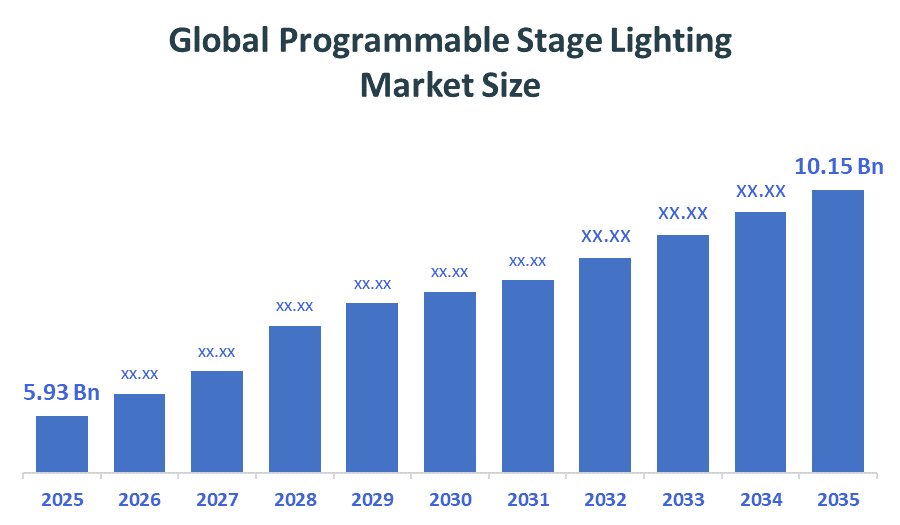
According to Decision Advisors, the Global Programmable Stage Lighting Market Size is expected to grow from USD 5.93 billion in 2025 to USD 10.15 billion by 2035, at a CAGR of 5.01% during the forecast period 2026-2035. The global programmable stage lighting systems is expanding quickly because of the live entertainment events like concerts and music festivals and corporate events are increasing. The need for programmable stage lighting systems will grow, these factors will drive demand in the market. The implementation of energy-efficient solutions such as LED technology results in decreased expenses and improved lighting performance for users. The development of artificial intelligence together with Internet of things technologies enables the implementation of real-time lighting control systems that generate dynamic lighting effects.
Market Overview/ Introduction
The global programmable stage lighting market includes lighting systems that digitally controlled which use advanced wireless technologies and protocols to produce automated visual effects that operate in synchronization. The solutions find application in concerts and theatres and corporate events and nightlife venues because they enhance audience engagement and enable precise scene transitions and create immersive environments and improve operational efficiency and flexibility and energy optimization in modern event production ecosystems. The market experiences innovation through high-efficiency LED designs and wireless control systems and sensor-based automation technologies which improve performance while consuming less energy. The market shows expansion potential through immersive event spaces and smart venues that utilize IoT technology and through development of small-scale modular lighting systems. The new developments enable quick system implementation while decreasing operational expenses and providing customizable solutions which establish intelligent lighting as a fundamental element for advanced entertainment systems.
- In New Delhi the government-backed cultural schemes in India are boosting programmable stage lighting demand, with public investments in performing arts infrastructure rising by 12-15%, accelerating adoption of advanced LED lighting across theatres and event venues globally.
- EU Ecodesign mandates are accelerating LED adoption, with Europe’s lighting investments exceeding USD 34-40 billion annually, rising by 10-14%, driving gradual transition in programmable stage lighting despite special-purpose exemptions.
- In Paris, Mar 31, 2026, France-backed innovation in stage technology is advancing, as Naostage’s AI-driven K SYSTEM supported by Bpifrance (€1 million funding)-drives 8-12% rise in smart lighting investments, accelerating programmable stage lighting adoption globally.
Notable Insights: -
- North America holds the largest regional market share, approximately 37.9% in the global programmable stage lighting market.
- North America is the fastest growing region in the global programmable stage lighting market, because of the three factors which include strong entertainment demand and advanced technology adoption and high investment levels.
- By light type, the LED Stage Lighting segment held a dominant position with 68.8% in terms of market share in 2025.
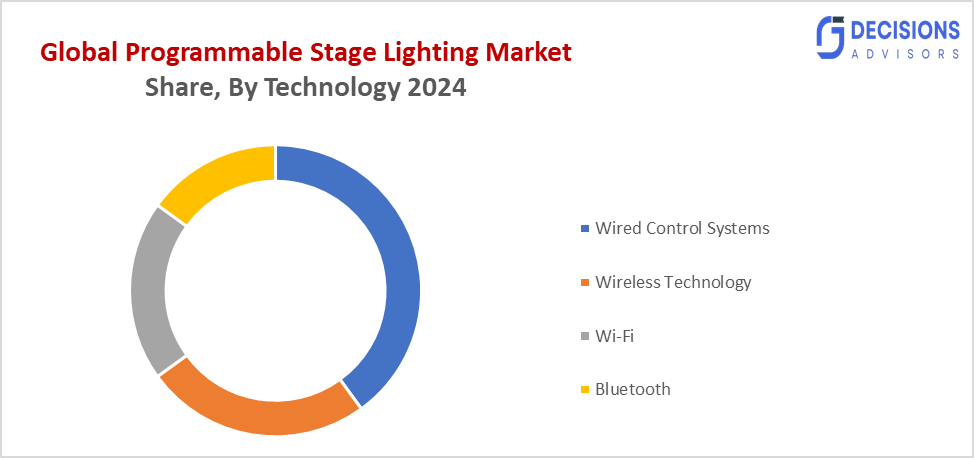
- By Technology, Wired Control Systems segment is the dominating accounting for over 52.6% of the global market share in 2025.
- The compound annual growth rate of the global programmable stage lighting market is 5.01%.
- The market is likely to achieve a valuation of USD 10.15 billion by 2035.
What is role of technology in grooming the market?
The global programmable stage lighting market experiences changes through the technological advancements which increase operational efficiency while enabling innovative artistic workflows. The market shows rapid growth because more than 75% of customers now use LED lighting which reduces energy use by 60-70% while providing better color accuracy and longer product life. AI and IoT-powered control systems enable organizations to achieve automatic operations which allow staff to operate systems from remote locations while delivering synchronized lighting patterns that increase productivity by 20-30%. The combination of DMX protocols and wireless technologies provides simpler methods to establish difficult lighting systems in extensive performance spaces. The software-based visualization tools give designers the ability to create complex lighting sequences which help them save both time and expenses during the setup process.
How is Recent Developments Helping the Market?
Recent developments in the global programmable stage lighting market show that the industry is moving forward with intelligent systems which focus on achieving better operational efficiency. The AI-powered lighting solutions now provide the ability to match musical elements and performer movements in real time, which enhances the value of immersive performances. The introduction of next-generation RGBW LED engines and laser-based lighting systems is providing better brightness control and improved color fidelity. The sustainability requirements are driving the transition from traditional halogen lights to LED lights which achieve energy savings of up to 75-85%. The use of modern control consoles that have built-in data analysis features simplifies pre-visualization processes while reducing rehearsal time and improving production efficiency.
Market Drivers
The global programmable stage lighting market is experiencing strong growth because of rapid technological progress and changing patterns in entertainment. The U.S. Department of Energy supports continuous improvements in LED efficiency which allow users to achieve energy savings of up to 75% while decreasing their operational costs and improving their lighting results. The combination of AI and machine learning with wireless control systems enables automatic systems to generate accurate lighting effects which result in better production efficiency. The construction of new theatres and multipurpose venues drives higher demand because urban areas continue to develop while their infrastructure expands. The EU's Ecodesign framework and other sustainability mandates drive LED adoption because they require companies to meet environmental standards while they develop new immersive programmable lighting technologies.
Restrain
The global programmable stage lighting market faces structural restraints stemming from high capital intensity and cost pressures. In the advanced programmable systems can cost up to 3-5 times more than conventional lighting which limits their use in markets that have price sensitivity. The volatility in raw material prices, particularly aluminium and steel which account for 40-60% of production costs creates manufacturing constraints that reduce their profit margins. The specialized technical skills needed for programming and system integration create obstacles for people to use emerging technologies in developing countries. The existence of affordable traditional lighting options makes it harder for advanced intelligent lighting systems to enter markets because they face increased competition from these cheaper alternatives.
Competitive Analysis:
The report offers the appropriate analysis of the key organizations/companies involved within the spirits market, along with a comparative evaluation primarily based on their product of offering, business overviews, geographic presence, enterprise strategies, segment market share, and SWOT analysis. The report also provides an elaborative analysis focusing on the current news and developments of the companies, which includes product development, innovations, joint ventures, partnerships, mergers & acquisitions, strategic alliances, and others. This allows for the evaluation of the overall competition within the market.
Top Companies in Global Programmable Stage Lighting Market
- Signify N.V.
- ams-OSRAM AG
- Chauvet & Sons Inc.
- Electronic Theatre Controls
- ROBE Lighting s.r.o.
- Martin Professional
- Claypaky
- GLP German Light Products
- Elation Professional
- ADJ Products LLC
- Ayrton
- SGM Light
Government Initiatives
|
Country |
Key Government Initiatives |
|
India |
Government-led smart city initiatives, including India’s Smart Cities Mission, are accelerating deployment of IoT-enabled LED lighting and centralized control systems, indirectly fostering technological innovation and adoption in the global programmable stage lighting market through advanced automation and intelligent lighting ecosystems. |
|
US |
Government initiatives led by the U.S. Department of Energy are accelerating adoption of advanced LED and automated lighting systems, directly driving technological innovation and demand in the global programmable stage lighting market through enhanced efficiency and intelligent control solutions. |
|
China |
Government-backed subsidies and green city initiatives in China are accelerating adoption of LED and intelligent lighting systems, fostering energy efficiency and automation, while indirectly driving innovation, cost optimization, and demand growth in the global programmable stage lighting market. |
Market Segmentation
The Programmable Stage Lighting Market share is classified into light type, application, technology, and end user
- The LED stage lighting segment dominated the market in 2024 and is projected to grow at a substantial CAGR of approximately 80.2% during the forecast period.
Based on the light type, the programmable stage lighting market is divided into LED stage lighting, moving head lights, wash lights, effect lights, control systems. Among these, the LED Stage Lighting segment dominated the market in 2024 and is projected to grow at a substantial CAGR of approximately 80.2% during the forecast period. It is because of its higher energy efficiency through 50-75% power savings and its extended product life which resulted in lower maintenance expenses. LED technology delivers three main benefits which include precise color reproduction and adaptable light management and digital control system compatibility. The combination of sustainability requirements and audience demand for high-quality visual experiences during concerts and events has driven the market to adopt LED-based lighting solutions at an accelerated pace.
- The wired control systems segment accounted for the largest share in 2024 and is anticipated to grow at a significant CAGR of approximately 77.9% during the forecast period.
Based on the technology, the programmable stage lighting market is divided into super wired control systems, wireless technology, Wi-Fi, Bluetooth. Among these, The Wired Control Systems segment accounted for the largest share in 2024 and is anticipated to grow at a significant CAGR of approximately 77.9% during the forecast period. It is dominating because the reliable system, low latency and stable signal transmission capabilities meet essential requirements for conducting large-scale live events.
- The concerts segment dominated the market in 2024, and is projected to grow at a substantial CAGR during the forecast period.
Based on the application, the programmable stage lighting market is divided into concerts, theater productions, corporate events, nightclubs, festivals. Among these, the concerts segment dominated the market in 2024 and is projected to grow at a substantial CAGR during the forecast period. The expansion of live events to larger sizes together with the increased need for immersive visual experiences and the production of high-quality content through extensive financial backing have led to this situation. The rising number of worldwide music festivals together with their international tours has created a need for advanced programmable lighting systems which continues to drive strong growth in that particular market segment.
Strategies to Implement for Growth of the Market in Non-Leading Regions
Growth in non-leading regions of the programmable stage lighting market companies need to implement three strategies which include cost optimization and localization efforts and technology diffusion initiatives. The market demands that manufacturers create cost-effective LED systems which include modular components to support budget-conscious customers who need rental and leasing options to minimize their initial expenses. The establishment of stronger ties with local event organizers and cultural institutions will help to increase adoption rates. The organization needs to establish training programs which will help employees develop their technical skills because they lack essential expertise. The organization can improve accessibility by promoting wireless solutions which enable easy installation of lighting systems. The government will drive market growth through its collaboration with smart city projects and cultural infrastructure initiatives which will enable the market to expand at a steady pace.
Regional Segment Analysis of the Programmable Stage Lighting Market
- North America (U.S., Canada, Mexico)
- Europe (Germany, France, U.K., Italy, Spain, Rest of Europe)
- Asia-Pacific (China, Japan, India, Rest of APAC)
- South America (Brazil and the Rest of South America)
- The Middle East and Africa (UAE, South Africa, Rest of MEA)
North America is anticipated to hold the largest share of the programmable stage lighting market over the predicted timeframe. North America is anticipated to hold the largest share of the global programmable stage lighting market, accounting for approximately 37% of total revenue over the forecast period. The region maintains its market leadership because of its fully developed entertainment industry together with its high-budget events and its numerous major production companies. The region maintains its position as the top market for advanced programmable lighting systems because of its ongoing technological progress together with its constant worldwide touring activities and its established equipment rental network.
Europe is expected to grow at a rapid CAGR in the programmable stage lighting market during the forecast period. The European market will experience fast growth because it accounts for approximately 27% of the global programmable stage lighting market which proves its strength through institutional backing of its cultural institutions and creative economic sectors. The public funding across performing arts and cross-border cultural collaborations is sustaining continuous demand for technologically advanced lighting systems. Europe currently accelerates its modernization process through two primary vectors which include digital transformation for live productions and smart venue technology implementation.
Asia-Pacific is the 3rd largest region to grow in the programmable stage lighting market during the region. The Asia-Pacific region stands as the third biggest area global for the programmable stage lighting market since it holds approximately 22.9% market share which grows through its developing mid-tier entertainment industry. The region experiences growth because private investments increase for event production while commercial venues multiply and local music and cultural events become more common. The Asia-Pacific market shows high demand because new cities in the region start using contemporary event technology which they had not used before. The region establishes itself as a major global market driver because its cost-effective adoption methods which include rental services and flexible lighting systems become more widely used.
Future Market Trends in Global Programmable Stage Lighting Market: -
- AI-Driven Lighting Automation
The enabling predictive and adaptive lighting systems that react to audience dynamics and performer motions, artificial intelligence has the potential to completely transform stage lighting. This would greatly increase production efficiency and provide immersive audience experiences by lowering manual involvement, increasing precision, and enabling real-time customisation.
- Expansion of Wireless Ecosystems
The need for quick and flexible deployment in touring and temporary settings is driving the shift to wireless lighting control solutions. Cloud-based control systems and wireless DMX will enable smooth remote operation in a variety of event scenarios, lessen reliance on infrastructure, and shorten installation times.
- Rise of Immersive Experience Technologies
The use of synchronized lighting with AR/VR, projection mapping, and interactive effects is being pushed by the growing emphasis on experiential entertainment. In order to create multisensory settings and turn live events into incredibly captivating, technologically advanced experiences, programmable lighting will be essential.
Recent Development
- In April 2026, the global Programmable Stage Lighting Market is advancing in the United States and Germany, where AI-driven systems improve energy efficiency by up to 30% and enhance color accuracy by 20%, meeting broadcast standards and regulatory requirements in live venues.
- In March 2026, the global Programmable Stage Lighting Market is advancing as LED-based intelligent fixtures replace traditional lighting, offering up to 80% energy savings, longer lifespans, reduced heat output, and enhanced creative flexibility for large-scale events.
- In July 2025, In Deqing, Zhejiang, China, Absen and Versatile launched a massive LED virtual stage, influencing the global Programmable Stage Lighting Market by integrating display-based illumination with advanced programmable lighting systems.
- In November 2025, Brompton Technology’s Tessera LED processors power Oscar At The Crown in London, transforming a basement into an immersive dystopian stage, highlighting innovative trends driving The global Programmable Stage Lighting Market.
Market Segment
This study forecasts revenue at global, regional, and country levels from 2020 to 2035. Decision Advisor has segmented the programmable stage lighting market based on the below-mentioned segments:
Global Programmable Stage Lighting Market, By light Type
- LED Stage Lighting
- Moving Head Lights
- Wash Lights
- Effect Lights
- Control Systems
Global Programmable Stage Lighting Market, By Application
- Concerts
- Theater Productions
- Corporate Events
- Nightclubs
- Festivals
Global Programmable Stage Lighting Market, By Technology
- Wired Control Systems
- Wireless Technology
- Wi-Fi
- Bluetooth
Global Programmable Stage Lighting Market, End User
- Event Organizers
- Production Companies
- Rental Service Providers
- Permanent Installations (Theatres, Studios)
Global Programmable Stage Lighting Market, By Regional Analysis
- North America
- US
- Canada
- Mexico
- Europe
- Germany
- UK
- France
- Italy
- Spain
- Russia
- Rest of Europe
- Asia Pacific
- China
- Japan
- India
- South Korea
- Australia
- Rest of Asia Pacific
- South America
- Brazil
- Argentina
- Rest of South America
- Middle East & Africa
- UAE
- Saudi Arabia
- Qatar
- South Africa
- Rest of the Middle East & Africa
Frequently Asked Questions (FAQ)
Q. In what ways is sustainability influencing procurement decisions?
A. Sustainability considerations are playing a central role in purchasing strategies, with end users favoring energy-efficient LED systems over traditional lighting. Regulatory pressures and carbon reduction goals are accelerating this transition. Lower power consumption, reduced heat output, and extended lifecycle benefits are making sustainable lighting solutions economically viable.
Q. How are rental and service-based business models impacting market expansion?
A. The rise of rental and leasing models is lowering entry barriers for small and mid-sized event organizers. These models provide access to advanced lighting systems without heavy upfront investment, enabling wider adoption. Service providers are also offering integrated solutions, including installation and technical support, enhancing overall market penetration.
Q. What role do software and visualization tools play in modern lighting design?
A. The advanced software platforms are enabling pre-visualization and simulation of lighting setups before actual deployment. This reduces trial-and-error during rehearsals and minimizes operational costs. Designers can experiment with multiple configurations digitally, improving efficiency and ensuring seamless execution during live performances.
Q. What long-term structural changes are expected in the industry?
A. The industry is expected to evolve toward fully integrated, intelligent lighting ecosystems combining AI, IoT, and immersive technologies. Increased interoperability, cloud-based controls, and data-driven insights will redefine operational standards. This transformation will position programmable lighting as a critical component of next-generation entertainment infrastructure.
- Introduction
- Objectives of the Study
- Market Definition
- Research Scope
- Research Methodology and Assumptions
- Executive Summary
- Premium Insights
- Porter’s Five Forces Analysis
- Value Chain Analysis
- Top Investment Pockets
- Market Attractiveness Analysis By Light Type
- Market Attractiveness Analysis By Application
- Market Attractiveness Analysis By Technology
- Market Attractiveness Analysis By End User
- Market Attractiveness Analysis By Region
- Industry Trends
- Market Dynamics
- Market Evaluation
- Drivers
- Increase in concerts, music festvals
- Restraints
- Fluctuating raw material cost
- Opportunities
- Emerging opportunities lie in AI-driven lighting automation
- Challenges
- High initial setup cost
- Global Programmable Stage Lighting Market Analysis and Projection, By Light Type
- Segment Overview
- LED Stage Lighting
- Moving Head Lights
- Wash Lights
- Effect Lights
- Control Systems
- Global Programmable Stage Lighting Market Analysis and Projection, By Application
- Segment Overview
- Concerts
- Theater Productions
- Corporate Events
- Nightclubs
- Festivals
- Global Programmable Stage Lighting Market Analysis and Projection, By Technology
- Segment Overview
- Wired Control Systems
- Wireless Technology
- Wi-Fi
- Bluetooth
- Global Programmable Stage Lighting Market Analysis and Projection, By End User
- Segment Overview
- Event Organizers
- Production Companies
- Rental Service Providers
- Permanent Installations
- Global Programmable Stage Lighting Market Analysis and Projection, By Regional Analysis
- Segment Overview
- North America
- U.S.
- Canada
- Mexico
- Europe
- Germany
- France
- U.K.
- Italy
- Spain
- Asia-Pacific
- Japan
- China
- India
- South America
- Brazil
- Middle East and Africa
- UAE
- South Africa
- Global Programmable Stage Lighting Market-Competitive Landscape
- Overview
- Market Share of Key Players in the Programmable Stage Lighting Market
- Global Company Market Share
- North America Company Market Share
- Europe Company Market Share
- APAC Company Market Share
- Competitive Situations and Trends
- Coverage Launches and Developments
- Partnerships, Collaborations, and Agreements
- Mergers & Acquisitions
- Expansions
- Company Profiles
- Signify N.V.
- Business Overview
- Company Snapshot
- Company Market Share Analysis
- Company Coverage Portfolio
- Recent Developments
- SWOT Analysis
- ams-OSRAM AG
- Business Overview
- Company Snapshot
- Company Market Share Analysis
- Company Coverage Portfolio
- Recent Developments
- SWOT Analysis
- Chauvet & Sons Inc.
- Business Overview
- Company Snapshot
- Company Market Share Analysis
- Company Coverage Portfolio
- Recent Developments
- SWOT Analysis
- Electronic Theatre Controls
- Business Overview
- Company Snapshot
- Company Market Share Analysis
- Company Coverage Portfolio
- Recent Developments
- SWOT Analysis
- ROBE Lighting s.r.o.
- Business Overview
- Company Snapshot
- Company Market Share Analysis
- Company Coverage Portfolio
- Recent Developments
- SWOT Analysis
- Martin Professional
- Business Overview
- Company Snapshot
- Company Market Share Analysis
- Company Coverage Portfolio
- Recent Developments
- SWOT Analysis
- Claypaky
- Business Overview
- Company Snapshot
- Company Market Share Analysis
- Company Coverage Portfolio
- Recent Developments
- SWOT Analysis
- GLP German Light Products
- Business Overview
- Company Snapshot
- Company Market Share Analysis
- Company Coverage Portfolio
- Recent Developments
- SWOT Analysis
- Elation Professional
- Business Overview
- Company Snapshot
- Company Market Share Analysis
- Company Coverage Portfolio
- Recent Developments
- SWOT Analysis
- ADJ Products LLC
- Business Overview
- Company Snapshot
- Company Market Share Analysis
- Company Coverage Portfolio
- Recent Developments
- SWOT Analysis
- Ayrton
- Business Overview
- Company Snapshot
- Company Market Share Analysis
- Company Coverage Portfolio
- Recent Developments
- SWOT Analysis
- SGM Light
- Business Overview
- Company Snapshot
- Company Market Share Analysis
- Company Coverage Portfolio
- Recent Developments
- SWOT Analysis
- Signify N.V.
List of Table
- Global Programmable Stage Lighting Market, By Light Type, 2024-2035(USD Billion)
- Global LED Stage Lighting, Programmable Stage Lighting Market, By Region, 2024-2035(USD Billion)
- Global Moving Head Lights, Programmable Stage Lighting Market, By Region, 2024-2035(USD Billion)
- Global Wash Lights, Programmable Stage Lighting Market, By Region, 2024-2035(USD Billion)
- Global Effect Lights, Programmable Stage Lighting Market, By Region, 2024-2035(USD Billion)
- Global Control Systems, Programmable Stage Lighting Market, By Region, 2024-2035(USD Billion)
- Global Programmable Stage Lighting Market, By Application, 2024-2035(USD Billion)
- Global Concerts, Programmable Stage Lighting Market, By Region, 2024-2035(USD Billion)
- Global Theater Productions, Programmable Stage Lighting Market, By Region, 2024-2035(USD Billion)
- Global Corporate Events, Programmable Stage Lighting Market, By Region, 2024-2035(USD Billion)
- Global Nightclubs, Programmable Stage Lighting Market, By Region, 2024-2035(USD Billion)
- Global Festivals, Programmable Stage Lighting Market, By Region, 2024-2035(USD Billion)
- Global Programmable Stage Lighting Market, By Technology, 2024-2035(USD Billion)
- Global Wired Control Systems, Programmable Stage Lighting Market, By Region, 2024-2035(USD Billion)
- Global Wireless Technology, Programmable Stage Lighting Market, By Region, 2024-2035(USD Billion)
- Global Wi-Fi, Programmable Stage Lighting Market, By Region, 2024-2035(USD Billion)
- Global Bluetooth, Programmable Stage Lighting Market, By Region, 2024-2035(USD Billion)
- Global Programmable Stage Lighting Market, By End User, 2024-2035(USD Billion)
- Global Event Organizers, Programmable Stage Lighting Market, By Region, 2024-2035(USD Billion)
- Global Production Companies, Programmable Stage Lighting Market, By Region, 2024-2035(USD Billion)
- Global Rental Service Providers, Programmable Stage Lighting Market, By Region, 2024-2035(USD Billion)
- Global Permanent Installations, Programmable Stage Lighting Market, By Region, 2024-2035(USD Billion)
- North America Programmable Stage Lighting Market, By Light Type, 2024-2035(USD Billion)
- North America Programmable Stage Lighting Market, By Application, 2024-2035(USD Billion)
- North America Programmable Stage Lighting Market, By Technology, 2024-2035(USD Billion)
- North America Programmable Stage Lighting Market, By End User, 2024-2035(USD Billion)
- U.S. Programmable Stage Lighting Market, By Light Type, 2024-2035(USD Billion)
- U.S. Programmable Stage Lighting Market, By Application, 2024-2035(USD Billion)
- U.S. Programmable Stage Lighting Market, By Technology, 2024-2035(USD Billion)
- U.S. Programmable Stage Lighting Market, By End User, 2024-2035(USD Billion)
- Canada Programmable Stage Lighting Market, By Light Type, 2024-2035(USD Billion)
- Canada Programmable Stage Lighting Market, By Application, 2024-2035(USD Billion)
- Canada Programmable Stage Lighting Market, By Technology, 2024-2035(USD Billion)
- Canada Programmable Stage Lighting Market, By End User, 2024-2035(USD Billion)
- Mexico Programmable Stage Lighting Market, By Light Type, 2024-2035(USD Billion)
- Mexico Programmable Stage Lighting Market, By Application, 2024-2035(USD Billion)
- Mexico Programmable Stage Lighting Market, By Technology, 2024-2035(USD Billion)
- Mexico Programmable Stage Lighting Market, By End User, 2024-2035(USD Billion)
- Europe Programmable Stage Lighting Market, By Light Type, 2024-2035(USD Billion)
- Europe Programmable Stage Lighting Market, By Application, 2024-2035(USD Billion)
- Europe Programmable Stage Lighting Market, By Technology, 2024-2035(USD Billion)
- Europe Programmable Stage Lighting Market, By End User, 2024-2035(USD Billion)
- Germany Programmable Stage Lighting Market, By Light Type, 2024-2035(USD Billion)
- Germany Programmable Stage Lighting Market, By Application, 2024-2035(USD Billion)
- Germany Programmable Stage Lighting Market, By Technology, 2024-2035(USD Billion)
- Germany Programmable Stage Lighting Market, By End User, 2024-2035(USD Billion)
- France Programmable Stage Lighting Market, By Light Type, 2024-2035(USD Billion)
- France Programmable Stage Lighting Market, By Application, 2024-2035(USD Billion)
- France Programmable Stage Lighting Market, By Technology, 2024-2035(USD Billion)
- France Programmable Stage Lighting Market, By End User, 2024-2035(USD Billion)
- U.K. Programmable Stage Lighting Market, By Light Type, 2024-2035(USD Billion)
- U.K. Programmable Stage Lighting Market, By Application, 2024-2035(USD Billion)
- U.K. Programmable Stage Lighting Market, By Technology, 2024-2035(USD Billion)
- U.K. Programmable Stage Lighting Market, By End User, 2024-2035(USD Billion)
- Italy Programmable Stage Lighting Market, By Light Type, 2024-2035(USD Billion)
- Italy Programmable Stage Lighting Market, By Application, 2024-2035(USD Billion)
- Italy Programmable Stage Lighting Market, By Technology, 2024-2035(USD Billion)
- Italy Programmable Stage Lighting Market, By End User, 2024-2035(USD Billion)
- Spain Programmable Stage Lighting Market, By Light Type, 2024-2035(USD Billion)
- Spain Programmable Stage Lighting Market, By Application, 2024-2035(USD Billion)
- Spain Programmable Stage Lighting Market, By Technology, 2024-2035(USD Billion)
- Spain Programmable Stage Lighting Market, By End User, 2024-2035(USD Billion)
- Asia Pacific Programmable Stage Lighting Market, By Light Type, 2024-2035(USD Billion)
- Asia Pacific Programmable Stage Lighting Market, By Application, 2024-2035(USD Billion)
- Asia Pacific Programmable Stage Lighting Market, By Technology, 2024-2035(USD Billion)
- Asia Pacific Programmable Stage Lighting Market, By End User, 2024-2035(USD Billion)
- Japan Programmable Stage Lighting Market, By Light Type, 2024-2035(USD Billion)
- Japan Programmable Stage Lighting Market, By Application, 2024-2035(USD Billion)
- Japan Programmable Stage Lighting Market, By Technology, 2024-2035(USD Billion)
- Japan Programmable Stage Lighting Market, By End User, 2024-2035(USD Billion)
- China Programmable Stage Lighting Market, By Light Type, 2024-2035(USD Billion)
- China Programmable Stage Lighting Market, By Application, 2024-2035(USD Billion)
- China Programmable Stage Lighting Market, By Technology, 2024-2035(USD Billion)
- China Programmable Stage Lighting Market, By End User, 2024-2035(USD Billion)
- India Programmable Stage Lighting Market, By Light Type, 2024-2035(USD Billion)
- India Programmable Stage Lighting Market, By Application, 2024-2035(USD Billion)
- India Programmable Stage Lighting Market, By Technology, 2024-2035(USD Billion)
- India Programmable Stage Lighting Market, By End User, 2024-2035(USD Billion)
- South America Programmable Stage Lighting Market, By Light Type, 2024-2035(USD Billion)
- South America Programmable Stage Lighting Market, By Application, 2024-2035(USD Billion)
- South America Programmable Stage Lighting Market, By Technology, 2024-2035(USD Billion)
- South America Programmable Stage Lighting Market, By End User, 2024-2035(USD Billion)
- Brazil Programmable Stage Lighting Market, By Light Type, 2024-2035(USD Billion)
- Brazil Programmable Stage Lighting Market, By Application, 2024-2035(USD Billion)
- Brazil Programmable Stage Lighting Market, By Technology, 2024-2035(USD Billion)
- Brazil Programmable Stage Lighting Market, By End User, 2024-2035(USD Billion)
- The Middle East and Africa Programmable Stage Lighting Market, By Light Type, 2024-2035(USD Billion)
- The Middle East and Africa Programmable Stage Lighting Market, By Application, 2024-2035(USD Billion)
- The Middle East and Africa Programmable Stage Lighting Market, By Technology, 2024-2035(USD Billion)
- The Middle East and Africa Programmable Stage Lighting Market, By End User, 2024-2035(USD Billion)
- UAE Programmable Stage Lighting Market, By Light Type, 2024-2035(USD Billion)
- UAE Programmable Stage Lighting Market, By Application, 2024-2035(USD Billion)
- UAE Programmable Stage Lighting Market, By Technology, 2024-2035(USD Billion)
- UAE Programmable Stage Lighting Market, By End User, 2024-2035(USD Billion)
- South Africa Programmable Stage Lighting Market, By Light Type, 2024-2035(USD Billion)
- South Africa Programmable Stage Lighting Market, By Application, 2024-2035(USD Billion)
- South Africa Programmable Stage Lighting Market, By Technology, 2024-2035(USD Billion)
- South Africa Programmable Stage Lighting Market, By End User, 2024-2035(USD Billion)
List of Figures
- Global Programmable Stage Lighting Market Segmentation
- Programmable Stage Lighting Market: Research Methodology
- Market Size Estimation Methodology: Bottom-Up Approach
- Market Size Estimation Methodology: Top-down Approach
- Data Triangulation
- Porter’s Five Forces Analysis
- Value Chain Analysis
- Top investment pocket in the Programmable Stage Lighting Market
- Top Winning Strategies, 2024-2035
- Top Winning Strategies, By Development, 2024-2035(%)
- Top Winning Strategies, By Company, 2024-2035
- Moderate Bargaining power of Buyers
- Moderate Bargaining power of Suppliers
- Moderate Bargaining power of New Entrants
- Low threat of Substitution
- High Competitive Rivalry
- Top Player Positioning, 2024
- Market Share Analysis, 2024
- Restraint and Drivers: Programmable Stage Lighting Market
- Programmable Stage Lighting Market Segmentation, By Light Type
- Programmable Stage Lighting Market For LED Stage Lighting, By Region, 2024-2035 ($ Billion)
- Programmable Stage Lighting Market For Moving Head Lights, By Region, 2024-2035 ($ Billion)
- Programmable Stage Lighting Market For Wash Lights, By Region, 2024-2035 ($ Billion)
- Programmable Stage Lighting Market For Effect Lights, By Region, 2024-2035 ($ Billion)
- Programmable Stage Lighting Market For Control Systems, By Region, 2024-2035 ($ Billion)
- Programmable Stage Lighting Market Segmentation, By Application
- Programmable Stage Lighting Market For Concerts, By Region, 2024-2035 ($ Billion)
- Programmable Stage Lighting Market For Theater Productions, By Region, 2024-2035 ($ Billion)
- Programmable Stage Lighting Market For Corporate Events, By Region, 2024-2035 ($ Billion)
- Programmable Stage Lighting Market For Nightclubs, By Region, 2024-2035 ($ Billion)
- Programmable Stage Lighting Market For Festivals, By Region, 2024-2035 ($ Billion)
- Programmable Stage Lighting Market Segmentation, By Technology
- Programmable Stage Lighting Market For Wired Control Systems, By Region, 2024-2035 ($ Billion)
- Programmable Stage Lighting Market For Wireless Technology, By Region, 2024-2035 ($ Billion)
- Programmable Stage Lighting Market For Wi-Fi, By Region, 2024-2035 ($ Billion)
- Programmable Stage Lighting Market For Bluetooth, By Region, 2024-2035 ($ Billion)
- Programmable Stage Lighting Market Segmentation, By End User
- Programmable Stage Lighting Market For Event Organizers, By Region, 2024-2035 ($ Billion)
- Programmable Stage Lighting Market For Production Companies, By Region, 2024-2035 ($ Billion)
- Programmable Stage Lighting Market For Rental Service Providers, By Region, 2024-2035 ($ Billion)
- Programmable Stage Lighting Market For Permanent Installations, By Region, 2024-2035 ($ Billion)
- Signify N.V.: Net Sales, 2024-2035 ($ Billion)
- Signify N.V.: Revenue Share, By Segment, 2024 (%)
- Signify N.V.: Revenue Share, By Region, 2024 (%)
- ams-OSRAM AG: Net Sales, 2024-2035 ($ Billion)
- ams-OSRAM AG: Revenue Share, By Segment, 2024 (%)
- ams-OSRAM AG: Revenue Share, By Region, 2024 (%)
- Chauvet & Sons Inc.: Net Sales, 2024-2035 ($ Billion)
- Chauvet & Sons Inc.: Revenue Share, By Segment, 2024 (%)
- Chauvet & Sons Inc.: Revenue Share, By Region, 2024 (%)
- Electronic Theatre Controls: Net Sales, 2024-2035 ($ Billion)
- Electronic Theatre Controls: Revenue Share, By Segment, 2024 (%)
- Electronic Theatre Controls: Revenue Share, By Region, 2024 (%)
- ROBE Lighting s.r.o.: Net Sales, 2024-2035 ($ Billion)
- ROBE Lighting s.r.o.: Revenue Share, By Segment, 2024 (%)
- ROBE Lighting s.r.o.: Revenue Share, By Region, 2024 (%)
- Martin Professional: Net Sales, 2024-2035 ($ Billion)
- Martin Professional: Revenue Share, By Segment, 2024 (%)
- Martin Professional: Revenue Share, By Region, 2024 (%)
- Claypaky: Net Sales, 2024-2035 ($ Billion)
- Claypaky: Revenue Share, By Segment, 2024 (%)
- Claypaky: Revenue Share, By Region, 2024 (%)
- GLP German Light Products: Net Sales, 2024-2035 ($ Billion)
- GLP German Light Products: Revenue Share, By Segment, 2024 (%)
- GLP German Light Products: Revenue Share, By Region, 2024 (%)
- Elation Professional.: Net Sales, 2024-2035 ($ Billion)
- Elation Professional.: Revenue Share, By Segment, 2024 (%)
- Elation Professional.: Revenue Share, By Region, 2024 (%)
- ADJ Products LLC: Net Sales, 2024-2035 ($ Billion)
- ADJ Products LLC: Revenue Share, By Segment, 2024 (%)
- ADJ Products LLC: Revenue Share, By Region, 2024 (%)
- Ayrton: Net Sales, 2024-2035 ($ Billion)
- Ayrton: Revenue Share, By Segment, 2024 (%)
- Ayrton: Revenue Share, By Region, 2024 (%)
- SGM Light: Net Sales, 2024-2035 ($ Billion)
- SGM Light: Revenue Share, By Segment, 2024 (%)
- SGM Light: Revenue Share, By Region, 2024 (%)
Check Licence
Choose the plan that fits you best: Single User, Multi-User, or Enterprise solutions tailored for your needs.
We Have You Covered
- 24/7 Analyst Support
- Clients Across the Globe
- Tailored Insights
- Technology Tracking
- Competitive Intelligence
- Custom Research
- Syndicated Market Studies
- Market Overview
- Market Segmentation
- Growth Drivers
- Market Opportunities
- Regulatory Insights
- Innovation & Sustainability
Report Details
| Scope | Global |
| Pages | 210 |
| Delivery | PDF & Excel via Email |
| Language | English |
| Release | Apr 2026 |
| Access | Download from this page |