
Global Programming Language Market
 |
Author:
Kunal M
|
Pages:
230
|
Author:
Kunal M
|
Pages:
230
Global Programming Language Market Size, Share, By Language Type (Statically Typed, Dynamically Typed, Object-Oriented, Functional, and Scripting), and By Application Domain (Web Development, Mobile Application Development, Game Development, Embedded Systems, and Data Science), and By End User (Individual Developers, Small and Medium Enterprises, Large Enterprises, Educational Institutions, and Government Organizations), and By Development Environment (Integrated Development Environments, Text Editors, Command Line Interfaces, Cloud-Based Development Tools, and Version Control Systems), and By Region (North America, Europe, Asia-Pacific, South America, and Middle East & Africa), Analysis and Forecast 2026?2035.
CAGR
10.1%
REVENUE 2025
USD Billion 189.9
FORECAST 2035
USD Billion 497.05
REPORT COVERAGE
Global
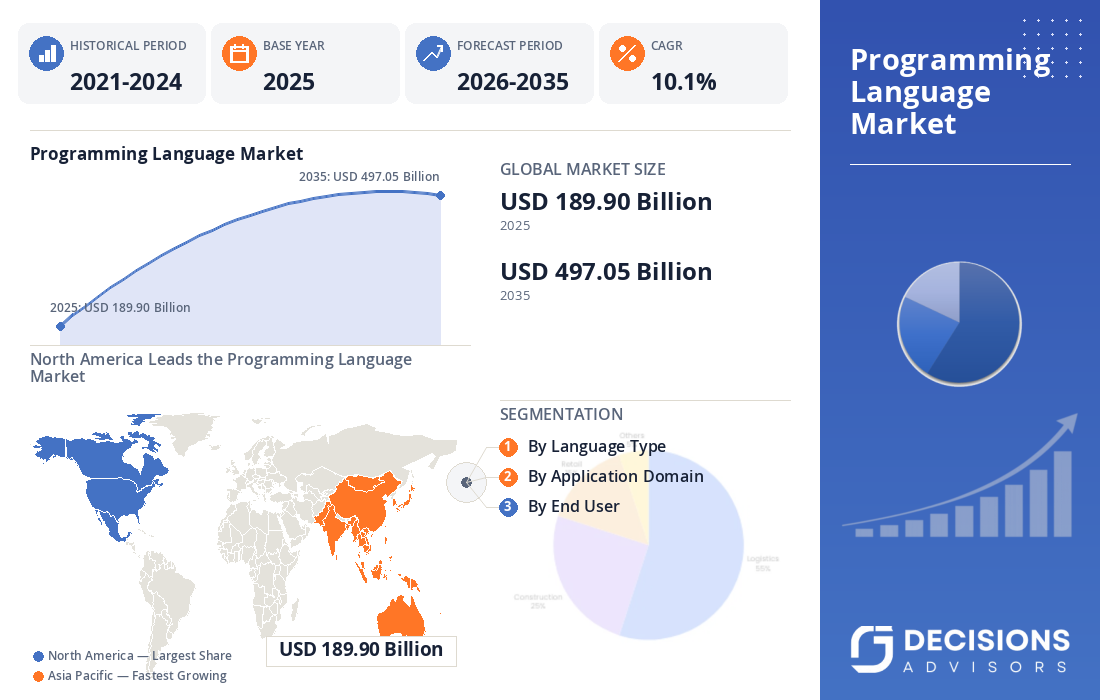
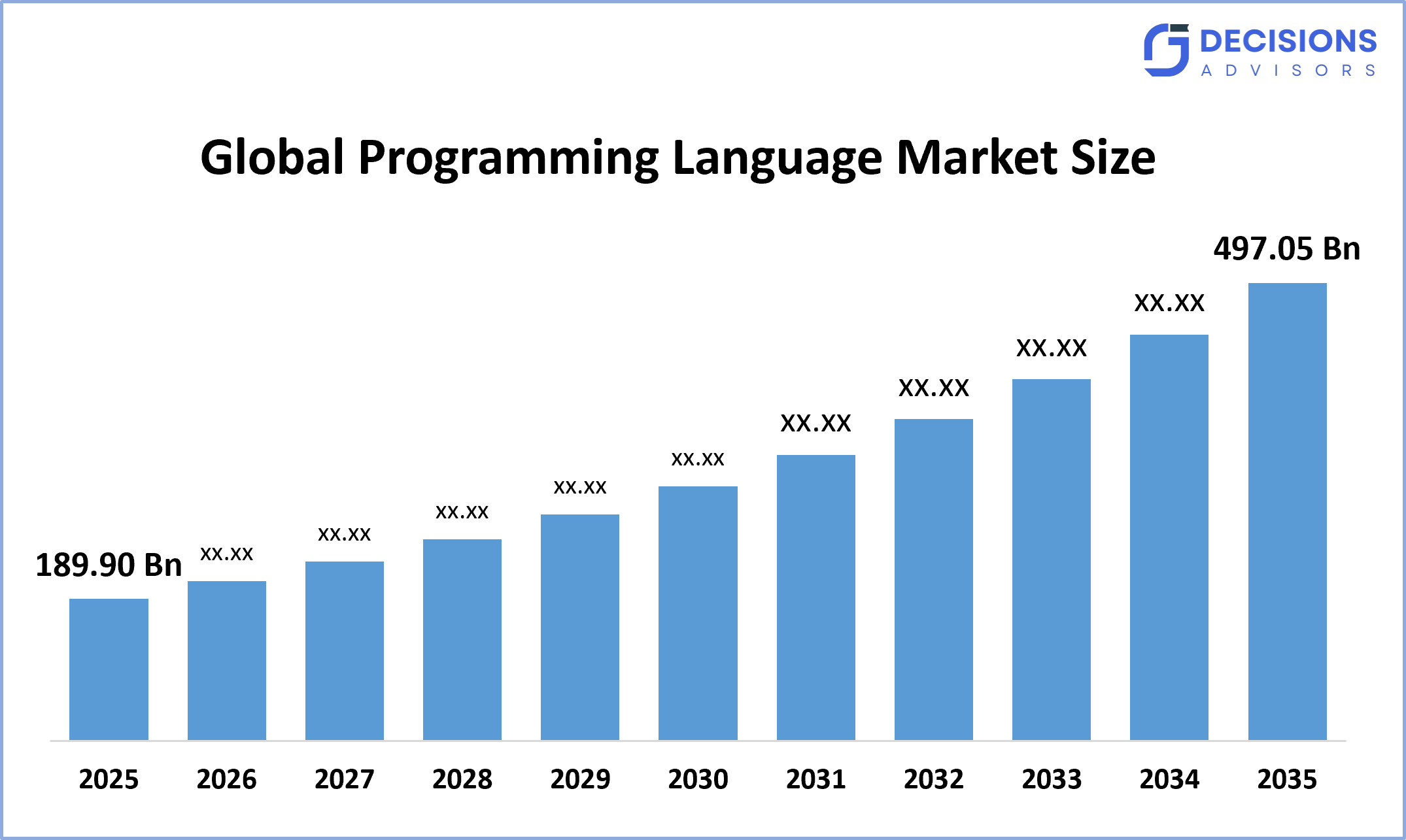
The Global Programming Language Market Size was valued at approximately USD 189.90 Billion in 2025 and is expected to reach approximately USD 497.05 Billion by 2035, expanding at a CAGR of 10.10% during the forecast period. The market is experiencing steady growth due to increasing software development activities, rising adoption of artificial intelligence and machine learning, expansion of cloud computing, growing demand for web and mobile applications, increasing enterprise digital transformation, and the expansion of developer ecosystems. Current market research also identifies North America as the largest regional market.
Market Snapshot
- Global Programming Language Market Size (2025): USD 189.90 Billion
- Projected Market Size (2035): USD 497.05 Billion
- Global Market CAGR (2026–2035): 10.10%
- Largest Regional Market: North America
- 2nd Largest Region: Europe
- Fastest Growing Region: Asia-Pacific
- Base Year: 2025
- Historical Period: 2021–2024
- Forecast Period: 2026–2035
Market Overview/ Introduction
The Global Programming Language Market encompasses the technologies, development environments, tools, and ecosystems associated with programming languages used to create software applications, websites, mobile applications, games, embedded systems, enterprise platforms, artificial intelligence solutions, and data-driven applications. Programming languages provide the syntax, semantics, and instructions required for developers to communicate with computing systems and build digital applications. Major programming languages and ecosystems include Python, JavaScript, Java, C, C++, C#, Go, Ruby, Rust, PHP, and other specialized languages. Current market research commonly segments the programming language market by language, medium, end user, application, and development environment. The market is undergoing significant transformation as organizations increasingly adopt cloud computing, artificial intelligence, machine learning, cybersecurity solutions, Internet of Things technologies, automation, and digital platforms. Programming languages that provide scalability, security, performance, interoperability, and developer productivity are gaining increasing attention.
The U.S. governments and regulatory agencies across major economies are increasingly focusing on digital transformation, cybersecurity, data protection, artificial intelligence, software development skills, and technology education.
- Several Asia-Pacific countries are witnessing increasing investment in software development, IT services, cloud infrastructure, artificial intelligence, technology education, and digital transformation, supporting the expansion of the programming language market.
Notable Insights: -
- North America maintains a leading position in the Global Programming Language Market due to its large technology industry, established software-development ecosystem, high enterprise technology spending, and strong presence of major technology companies.
- Asia-Pacific experiences strong growth due to expanding software-development capabilities, increasing digital transformation, growing IT services industries, rising technology investments, and a large pool of software developers.
- By language type, Object-Oriented programming languages account for a significant share because of their widespread use in enterprise software, web applications, mobile applications, and large-scale software development.
- By application domain, Web Development represents a major demand-generating segment due to the continuous expansion of websites, web applications, cloud platforms, e-commerce, and digital services.
- Python and other high-level programming languages are gaining importance due to their growing use in artificial intelligence, machine learning, data science, automation, and software development. Current market research identifies demand for languages supporting AI, data science, cloud-native architectures, and cybersecurity as important growth factors.
Market Drivers
The Global Programming Language Market is primarily driven by increasing software development activities and accelerating digital transformation across industries. Organizations across banking, healthcare, retail, manufacturing, telecommunications, automotive, education, and government are increasingly developing software applications and digital platforms. The rapid adoption of artificial intelligence and machine learning is another major growth driver. Programming languages such as Python are widely used for machine learning, data analytics, artificial intelligence development, and automation. The expansion of AI technologies is expected to support continued demand for programming languages and development tools. Cloud computing is also creating new opportunities for programming language ecosystems. As organizations migrate applications to cloud platforms and adopt cloud-native architectures, demand is increasing for languages capable of supporting distributed systems, microservices, containerized applications, and serverless computing.
Restrain
The Global Programming Language Market faces challenges including increasing cybersecurity threats, programming complexity, shortages of highly skilled developers, rapid technological changes, compatibility issues, and fragmentation across programming language ecosystems. The continuous introduction of new frameworks, libraries, development tools, and programming paradigms can increase the learning requirements for developers and organizations. Companies may also face migration and compatibility costs when transitioning from legacy programming environments to newer technologies. Security vulnerabilities, software-maintenance requirements, dependency management, and concerns related to code quality can further increase development costs and complexity.
Competitive Analysis:
The report offers the appropriate analysis of the key organizations/companies involved within the Global Global Programming Language Market, along with a comparative evaluation primarily based on their product offerings, business overviews, geographic presence, enterprise strategies, segment market share, and SWOT analysis. The report also provides an elaborative analysis focusing on the current news and developments of the companies, which includes product development, innovations, joint ventures, partnerships, mergers & acquisitions, strategic alliances, and others. This allows for the evaluation of the overall competition within the market.
Top Companies in the Global Programming Language Market
- Microsoft Corporation
- Google LLC
- Oracle Corporation
- Apple Inc.
- IBM Corporation
- Amazon Web Services, Inc.
- Meta Platforms, Inc.
- JetBrains
- The Python Software Foundation
- The Apache Software Foundation
Government Initiatives
|
Country |
Key Government Initiatives |
|
Us |
Government initiatives supporting digital transformation, cybersecurity, artificial intelligence, technology education, software development, and advanced computing are contributing to the growth of the programming ecosystem. |
|
Germany |
Government and EU initiatives emphasize digital transformation, artificial intelligence, cybersecurity, digital skills, software innovation, and advanced technology development. |
|
China |
Government programs supporting digital infrastructure, artificial intelligence, software development, cloud computing, and technology education are contributing to the expansion of the domestic programming and software ecosystem. |
Market Segmentation
The Global Programming Language Market share is classified into language type, application domain, end user, development environment, and region.
- The Object-Oriented Segment Dominates the Market
Based on language type, the market is divided into Statically Typed, Dynamically Typed, Object-Oriented, Functional, and Scripting. Among these, the Object-Oriented segment is expected to dominate the market due to its extensive application in enterprise software, web development, mobile applications, desktop applications, and large-scale software systems. Object-oriented programming supports reusable code structures, modular development, scalability, and efficient software maintenance.
- The Web Development Segment Accounts for a Significant Share
Based on application domain, the market is divided into Web Development, Mobile Application Development, Game Development, Embedded Systems, and Data Science. The Web Development segment represents a significant share due to the continued expansion of websites, e-commerce platforms, web applications, enterprise portals, cloud-based services, and digital platforms. Programming languages such as JavaScript, Python, Java, PHP, C#, and TypeScript are widely used across different areas of web development.
- Large Enterprises Segment Accounts for a Significant Share
Based on end user, the market is divided into Individual Developers, Small and Medium Enterprises, Large Enterprises, Educational Institutions, and Government Organizations. The Large Enterprises segment accounts for a significant share due to extensive software development requirements, enterprise application modernization, cloud migration, cybersecurity initiatives, artificial intelligence adoption, and digital transformation programs.
Regional Segment Analysis of the Global Programming Language Market
- North America (U.S., Canada, Mexico)
- Europe (Germany, U.K., France, Italy, Spain, Netherlands, Rest of Europe)
- Asia-Pacific (China, Japan, India, Australia, South Korea, Rest of Asia-Pacific)
- South America (Brazil, Argentina, Rest of South America)
- Middle East & Africa (UAE, Saudi Arabia, South Africa, Rest of MEA)
North America Maintains a Leading Share of the Global Programming Language Market in 2025
North America maintains a leading position in the Global Programming Language Market due to its well-established technology ecosystem, strong presence of software and technology companies, high adoption of cloud computing and artificial intelligence, and significant investment in software development and digital transformation. The U.S. represents a major market due to its large developer community, concentration of technology companies, expanding startup ecosystem, and increasing demand for advanced programming technologies.
Europe Holds a Significant Share of the Global Programming Language Market in 2025
Europe holds a significant share of the Global Programming Language Market, supported by increasing enterprise digitalization, growing adoption of cloud technologies, cybersecurity investments, and rising demand for software development skills. Countries such as Germany, the U.K., France, Italy, Spain, and the Netherlands have established technology industries and are investing in artificial intelligence, automation, data analytics, and digital infrastructure, supporting regional market development.
Asia-Pacific Witnesses Substantial Growth in 2025
Asia-Pacific is experiencing substantial growth due to rapid digitalization, expanding IT and software services industries, rising technology investments, and a growing developer population. Countries such as China, India, Japan, South Korea, and Australia are witnessing increasing demand for programming languages driven by cloud computing, artificial intelligence, mobile application development, e-commerce, and enterprise software. Increasing investment in technology education, software development, digital infrastructure, and emerging technologies is further supporting regional market development.
Future Market Trends in Global Programming Language Market: -
-
- Expansion of AI-Oriented Programming
Programming languages and development environments supporting artificial intelligence and machine learning are expected to gain further importance. Python and other high-level languages are increasingly used for machine learning, data science, automation, and AI application development.
-
- Growth of Cloud-Native Development
The adoption of cloud-native architectures, microservices, containers, and serverless computing is expected to increase demand for programming languages that support scalable and distributed applications.
-
- Rising Demand for Secure Programming
Cybersecurity is becoming increasingly important as software applications become more interconnected. Programming languages and development tools that support secure coding, memory safety, vulnerability detection, and reliable software development are expected to gain greater attention.
-
- Expansion of AI-Assisted Software Development
AI-assisted coding tools are expected to transform software development by supporting code generation, debugging, testing, documentation, code optimization, and developer productivity.
Market Segment
This study forecasts revenue at global, regional, and country levels from 2026 to 2035. Decision Advisors has segmented the Global Programming Language Market based on the below-mentioned segments:
Global Programming Language Market, By Language Type
- Statically Typed
- Dynamically Typed
- Object-Oriented
- Functional
- Scripting
- Others
Global Programming Language Market, By Application Domain
- Web Development
- Mobile Application Development
- Game Development
- Embedded Systems
- Data Science
- Others
Global Programming Language Market, By End User
- Individual Developers
- Small and Medium Enterprises
- Large Enterprises
- Educational Institutions
- Government Organizations
- Organic
Global Programming Language Market, By Regional Analysis
- North America
- US
- Canada
- Mexico
- Europe
- Germany
- UK
- France
- Italy
- Spain
- Russia
- Rest of Europe
- Asia Pacific
- China
- Japan
- India
- South Korea
- Australia
- Rest of Asia Pacific
- South America
- Brazil
- Argentina
- Rest of South America
- Middle East & Africa
- UAE
- Saudi Arabia
- Qatar
- South Africa
- Rest of the Middle East & Africa
Frequently Asked Questions (FAQ)
Q. What is driving the growth of the Global Programming Language Market?
A. The Global Programming Language Market is being driven by increasing software development activities, enterprise digital transformation, artificial intelligence and machine learning adoption, cloud computing, cybersecurity requirements, mobile and web application development, and the expansion of online coding education.
Q. Why are programming languages important for digital transformation?
A. Programming languages provide the foundation for developing software applications, websites, mobile applications, cloud platforms, enterprise systems, artificial intelligence solutions, and other digital technologies. Their flexibility enables organizations to build and customize solutions according to their operational requirements.
Q. What role does artificial intelligence play in the Programming Language Market?
A. Artificial intelligence is creating additional demand for programming languages and development environments used for machine learning, data processing, automation, model development, and AI application deployment. AI expansion is identified as an important growth driver for the programming language market.
Q. How are cloud technologies influencing the Programming Language Market?
A. The expansion of cloud computing, microservices, containers, and serverless architectures is increasing demand for programming languages capable of supporting scalable, distributed, and cloud-native applications.
Check Licence
Choose the plan that fits you best: Single User, Multi-User, or Enterprise solutions tailored for your needs.
We Have You Covered
- 24/7 Analyst Support
- Clients Across the Globe
- Tailored Insights
- Technology Tracking
- Competitive Intelligence
- Custom Research
- Syndicated Market Studies
- Market Overview
- Market Segmentation
- Growth Drivers
- Market Opportunities
- Regulatory Insights
- Innovation & Sustainability
Report Details
| Scope | Global |
| Pages | 230 |
| Delivery | PDF & Excel via Email |
| Language | English |
| Release | Aug 2026 |
| Access | Download from this page |