
Global Pulmonary Arterial Hypertension Market
 |
Pages:
205
|
Pages:
205
Global Pulmonary Arterial Hypertension Market Size, Share, and COVID-19 Impact Analysis, By Type (Branded and Generics), By Route of Administration (Oral, Intravenous/Subcutaneous, and Inhalational) and By Region (North America, Europe, Asia-Pacific, Latin America, Middle East, and Africa), Analysis and Forecast 2025 - 2035.
REPORT COVERAGE
Global
Global Pulmonary Arterial Hypertension Market Insights Forecasts to 2035
- The Global Pulmonary Arterial Hypertension Market Size Was valued at USD 8.03 Billion in 2024
- The Global Pulmonary Arterial Hypertension Market Size is Expected to Grow at a CAGR of around 5.41% from 2025 to 2035
- The Worldwide Pulmonary Arterial Hypertension Market Size is Expected to Reach USD 14.34 Billion by 2035
- Asia-Pacific is expected to grow the fastest during the forecast period.
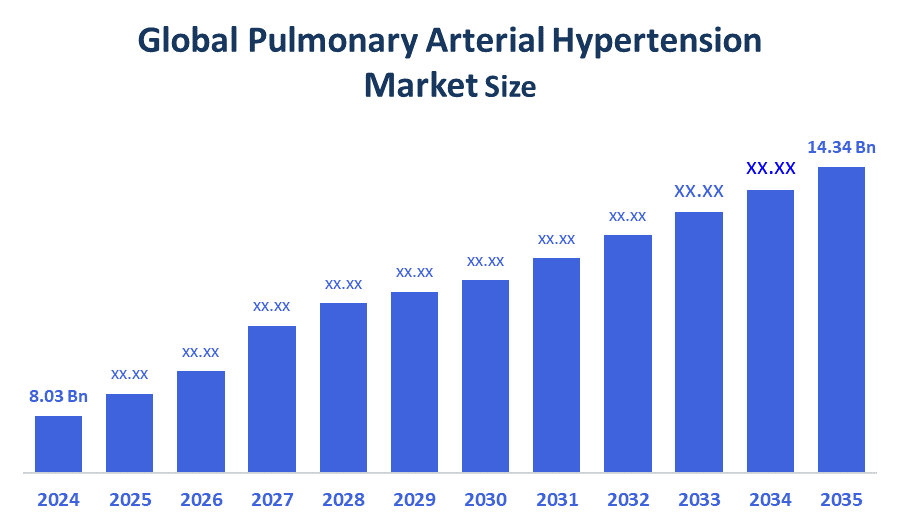
According to a research report published by Decisions Advisors and Consulting, the global pulmonary arterial hypertension market size was worth around USD 8.03 Billion in 2024 and is predicted to grow to around USD 14.34 Billion by 2035 with a compound annual growth rate (CAGR) of 5.41% from 2025 to 2035. The market expands because government and healthcare authorities provide increasing support for new drug development and because pulmonary arterial hypertension cases are rising and reimbursement policies are becoming more favorable.
Market Overview
The global pulmonary arterial hypertension market refers to the worldwide industry which provides medicines and therapies and healthcare services that treat pulmonary arterial hypertension, a rare condition which causes high blood pressure in the arteries of the lungs and results in heart strain and breathing difficulties. Additionally, the research shows that combined treatments with medications create better treatment results for patients. The increasing demand for personalized medicine together with early diagnosis methods will change how doctors treat this complex medical condition. Healthcare systems need to adopt new technologies like telemedicine and digital health solutions because these tools will help patients receive better treatment and monitoring services. The increasing incidence of obesity and sedentary lifestyles which lead to pulmonary arterial hypertension risks will result in more people developing the condition. The demand for effective treatment solutions together with complete disease management approaches will increase. Pharmaceutical companies continue their research and development activities to meet the necessary requirements of the Pulmonary Arterial Hypertension Market. The Pulmonary Arterial Hypertension Market stands ready to expand its operations because stakeholders collaborate through innovative methods to achieve better patient outcomes.
Report Coverage
This research report categorizes the pulmonary arterial hypertension market based on various segments and regions, forecasts revenue growth, and analyzes trends in each submarket. The report analyses the key growth drivers, opportunities, and challenges influencing the pulmonary arterial hypertension market. Recent market developments and competitive strategies such as expansion, type launch, development, partnership, merger, and acquisition, have been included to draw the competitive landscape in the market. The report strategically identifies and profiles the key market players and analyses their core competencies in each sub-segment of the Pulmonary Arterial Hypertension market.
Driving Factors
The pulmonary arterial hypertension market experiences major changes because of new treatment methods. The development of targeted therapies which include endothelin receptor antagonists and phosphodiesterase-5 inhibitors and soluble guanylate cyclase stimulators has created new treatment options for PAH. The advancements lead to better patient results which enhance their life quality thus creating market growth. The market for PAH therapies will reach about USD 7 billion by 2026 according to recent data which shows a compound annual growth rate of approximately 8 percent. The research and development work which focuses on finding new drugs and combination treatments will keep growing because healthcare providers search for better ways to treat PAH.
Restraining Factors
The market growth together with patient adoption in developing regions experiences obstacles because of high treatment expenses and low disease knowledge and postponed disease detection and strict medicine approval processes and drug side effects and complicated treatment methods and limited access to advanced medical treatments.
Market Segmentation
The pulmonary arterial hypertension market share is classified into type and route of administration
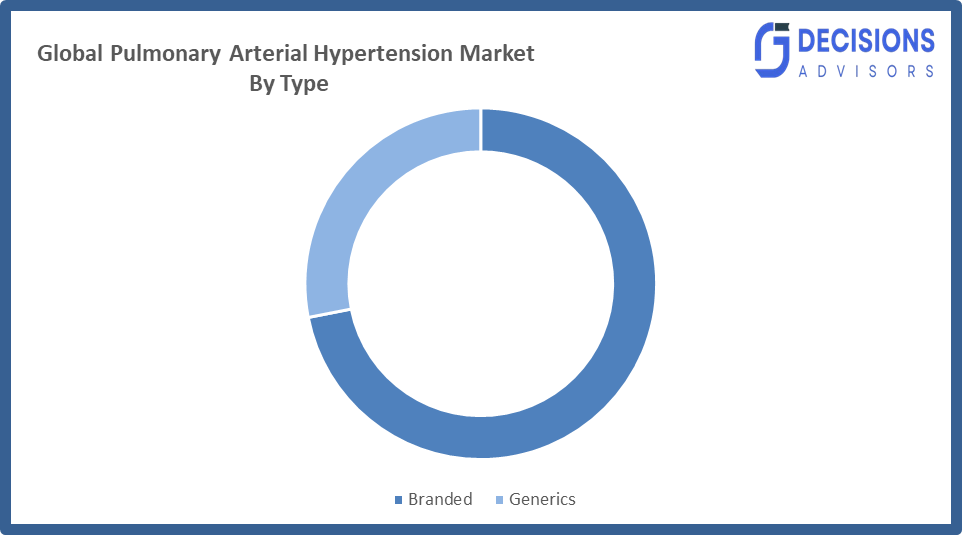
- The branded segment dominated the market in 2024, approximately 68% and is projected to grow at a substantial CAGR during the forecast period.
Based on the type, the pulmonary arterial hypertension market is divided into branded and generics. Among these, the branded segment dominated the market in 2024, approximately 68% and is projected to grow at a substantial CAGR during the forecast period. The patented therapies maintain their value because they demonstrate high clinical effectiveness and have proven safety records while doctors trust these treatments. The pharmaceutical companies provide their top products with constant research development and enhanced product designs and effective advertising campaigns. The segment maintained its dominant market position because developed regions offered favorable reimbursement policies and patients experienced better results with branded products than generic treatments.
- The oral segment accounted for the largest share in 2024, approximately 57% and is anticipated to grow at a significant CAGR during the forecast period.
Based on the grade, the pulmonary arterial hypertension market is divided into oral, intravenous/subcutaneous, and inhalational. Among these, the oral segment accounted for the largest share in 2024, approximately 57% and is anticipated to grow at a significant CAGR during the forecast period. This leads the awesome use of this route, the right for non-invasive delivery, as well as apt for long-term disease management. Patients prefer the use of oral drugs in the sole purpose of comfort and improved compliance and quality of life in comparison to injectables and inhaled drugs. Such is recommended by physicians, too, for the initial treatment. The creation of effective oral formulations, and compassionate reimbursement policy also meant a renewed impetus for the growth of the segment.
Regional Segment Analysis of the Pulmonary Arterial Hypertension Market
- North America (U.S., Canada, Mexico)
- Europe (Germany, France, U.K., Italy, Spain, Rest of Europe)
- Asia-Pacific (China, Japan, India, Rest of APAC)
- South America (Brazil and the Rest of South America)
- The Middle East and Africa (UAE, South Africa, Rest of MEA)
North America is anticipated to hold the largest share of the pulmonary arterial hypertension market over the predicted timeframe.
North America is anticipated to hold the largest share of the pulmonary arterial hypertension market over the predicted timeframe. The Orphan Drug Act of 1983 creates financial rewards which drive pharmaceutical research forward through the approval of Merck's Winrevair drug on March 2024. The American Lung Association will use its 2025 awareness campaign to increase public understanding of early detection methods. NIH-funded clinical trial networks provide substantial research support through their existing study systems while Canada improves access through its rare disease treatment framework. United Therapeutics uses its 2024 patient support programs to help patients maintain their treatment schedules. Specialized PAH centers in the region provide high-quality medical services which establish the region as the leading treatment center.
Asia-Pacific is expected to grow at a rapid CAGR in the pulmonary arterial hypertension market during the forecast period. China India and Japan have developed their healthcare systems because of their extensive population base and their technological healthcare improvements. The National Policy for Rare Diseases established by India in 2021 has made diagnostic tests more accessible which has resulted in higher PAH test results. The FDA has approved Cipla’s Ambrisentan Tablets which provide cost-effective treatment alternatives. Japan has established a sophisticated healthcare system which enables better clinical treatment through Mochida Pharmaceutical’s 2023 Treprost launch. China’s 2024 health reforms focus on rare diseases which help advance PAH clinical research studies. The Asian Pulmonary Hypertension Association’s 2025 awareness campaign improves early diagnosis. Rural areas need better awareness but specialized PAH clinics exist in urban centers which include Shanghai and Mumbai. The 2024 digital health policy which Japan implemented enables telemedicine to enhance patient monitoring functions which results in market growth.
Competitive Analysis:
The report offers the appropriate analysis of the key organizations/companies involved within the pulmonary arterial hypertension market, along with a comparative evaluation primarily based on their type of offering, business overviews, geographic presence, enterprise strategies, segment market share, and SWOT analysis. The report also provides an elaborative analysis focusing on the current news and developments of the companies, which includes type development, innovations, joint ventures, partnerships, mergers & acquisitions, strategic alliances, and others. This allows for the evaluation of the overall competition within the market.
List of Key Companies
- United Therapeutics Corporation
- Johnson & Johnson (Actelion Pharmaceuticals)
- Bayer AG
- Gilead Sciences, Inc.
- Viatris Inc.
- GlaxoSmithKline plc
- Sandoz Inc. (Novartis)
- Lupin Pharmaceuticals, Inc.
- Sun Pharmaceutical Industries, Inc.
- Teva Pharmaceuticals Industries Ltd.
- Others
Key Target Audience
- Market Players
- Investors
- End-users
- Government Authorities
- Consulting and Research Firm
- Venture capitalists
- Value-Added Resellers (VARs)
Recent Development
- In July 2024, United Therapeutics collaborated with a biotech firm to develop advanced PAH therapies, focusing on precision medicine.
Market Segment
This study forecasts revenue at global, regional, and country levels from 2020 to 2035. Decisions Advisors has segmented the pulmonary arterial hypertension market based on the below-mentioned segments:
Global Pulmonary Arterial Hypertension Market, By Type
- Branded
- Generics
Global Pulmonary Arterial Hypertension Market, By Route of Administration
- Oral
- Intravenous/Subcutaneous
- Inhalational
Global Pulmonary Arterial Hypertension Market, By Regional Analysis
- North America
- US
- Canada
- Mexico
- Europe
- Germany
- UK
- France
- Italy
- Spain
- Russia
- Rest of Europe
- Asia Pacific
- China
- Japan
- India
- South Korea
- Australia
- Rest of Asia Pacific
- South America
- Brazil
- Argentina
- Rest of South America
- Middle East & Africa
- UAE
- Saudi Arabia
- Qatar
- South Africa
- Rest of the Middle East & Africa
Frequently Asked Questions (FAQ)
1. What is the projected growth of the global pulmonary arterial hypertension market?
A: The market is projected to grow from USD 8.03 billion in 2024 to USD 14.34 billion by 2035, registering a CAGR of 5.41% due to supportive policies and rising disease prevalence.
2. Which segment dominates the market by type?
A: The branded drugs segment leads with around 68% share in 2024, supported by patented therapies, strong clinical outcomes, physician trust, continuous innovation, and favorable reimbursement policies.
3. Why is the oral route the leading administration segment?
A: Oral therapies hold about 57% share due to non-invasive delivery, convenience, better patient compliance, suitability for long-term treatment, physician preference, effective formulations, and supportive reimbursement frameworks.
4. What factors drive overall market growth?
A: Growth is driven by rising PAH cases, government support for drug development, improved reimbursement policies, targeted therapies, combination treatments, personalized medicine, early diagnosis methods, and expanding digital healthcare adoption.
5. Why does North America dominate the regional market?
A: North America leads due to strong research funding, rare disease policies, advanced healthcare infrastructure, specialized PAH centers, faster regulatory approvals, awareness campaigns, and robust patient support programs.
Check Licence
Choose the plan that fits you best: Single User, Multi-User, or Enterprise solutions tailored for your needs.
We Have You Covered
- 24/7 Analyst Support
- Clients Across the Globe
- Tailored Insights
- Technology Tracking
- Competitive Intelligence
- Custom Research
- Syndicated Market Studies
- Market Overview
- Market Segmentation
- Growth Drivers
- Market Opportunities
- Regulatory Insights
- Innovation & Sustainability
Report Details
| Scope | Global |
| Pages | 205 |
| Delivery | PDF & Excel via Email |
| Language | English |
| Release | Mar 2026 |
| Access | Download from this page |