
Global Quick Service Restaurant (QSR) Market
 |
Author:
Sayali T
|
Pages:
200
|
Author:
Sayali T
|
Pages:
200
Global Quick Service Restaurant (QSR) Market Size, Share By Service Type (Self-serviced, assisted self-serviced, fully serviced), By Category (Single Outlet, QSR Chain), By Cuisine Type (American, Italian, Asian, Others), and By Region (North America, Europe, Asia-Pacific, Latin America, Middle East & Africa), Analysis and Forecast 2026-2035
CAGR
3.72%
REVENUE 2025
USD Billion 498.43
FORECAST 2035
USD Billion 718.22
REPORT COVERAGE
Global
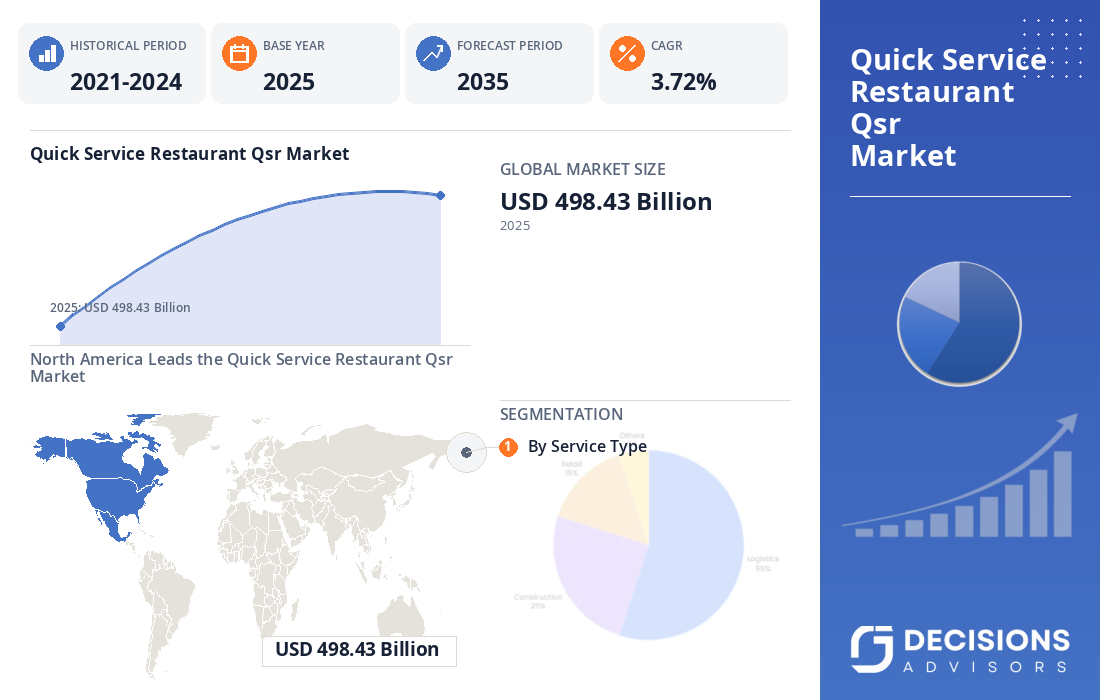
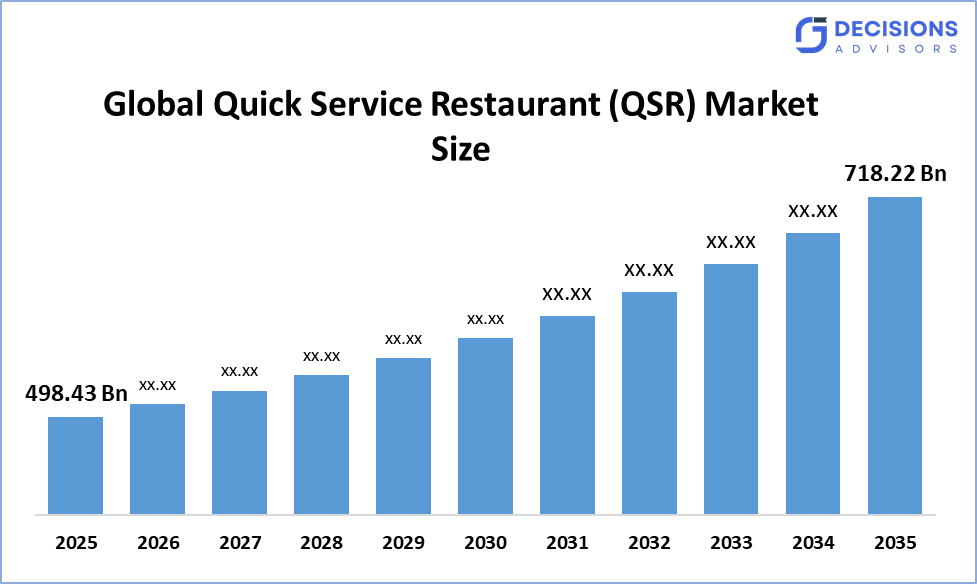
The Global Quick Service Restaurant (QSR) Market Size is predicted to grow from USD 498.43 Billion in 2025 and is likely to reach around USD 718.22 Billion by 2035 with a CAGR of 3.72%. According to Decision Advisors, the digital ordering and delivery services segment is a prevalent one within the Global Quick Service Restaurant (QSR) Market and accounts for about 48% of the total market share. The leading company within this market is the McDonald’s Corporation with revenues of about USD 27 billion and an estimated global market share of about 15-18%.
Market Snapshot
- Global Quick Service Restaurant (QSR) Market Size (2025): USD 498.43 Billion
- Projected Global Quick Service Restaurant (QSR) Market Size (2035): USD 718.22 Billion
- Global Quick Service Restaurant (QSR) Market Compound Annual Growth Rate (CAGR): 3.72%
- Largest Regional Market: North America
- 2nd Largest Region: Europe
- Fastest Growing Region: Asia Pacific
- Base Year: 2025
- Historical Period: 2021-2024
- Market Forecast Period: 2026-2035
Market Overview/ Introduction
The Global Quick Service Restaurant (QSR) Market encompasses restaurants that offer quick food and beverages through quick food and beverage preparations, standard menu choices, efficient service, and inexpensive prices through in-house, take away, drive-through, and online delivery channels. The government is helping the market through the adoption of food safety standards, digital payment methods, MSME promotion schemes, and investment in tourism and hospitality sector to expand and improve their restaurant operations. Recent innovations in the market have been the inclusion of artificial intelligence ordering system, self-ordering kiosk, robotic kitchens, and sustainable packaging options to improve operational efficiency and customer experience. Growth in the market can be attributed to urbanization, busy lifestyle, disposable income, food delivery service, and preference of customers for quick, economical, and variety of food options.
- The government requires fast food restaurants to provide clear information regarding calorie counts and any allergy-related information on their digital and printed menus. Policies urge fast-food restaurants to minimize sodium content and use of trans fats.
- International organizations ban single-use plastic products and force fast food companies to use environment-friendly, biodegradable packaging material. This is because it helps companies conform to carbon reduction targets set by the nations.
Notable Insights: -
- North America is anticipated to hold approximately 36% share of the Global Quick Service Restaurant (QSR) Market over the predicted timeframe.
- Asia-Pacificis expected to grow at a rapid CAGR in the Global Quick Service Restaurant (QSR) Market by holding approximately 31% of the share during the forecast period.
- By service type, the Self-serviced, segment dominated the market and holds approximately 47% share in 2025 and is projected to grow at a substantial CAGR during the forecast period.
- By category, the QSR Chain segment dominated the market and holds approximately 68% share in 2025 and is projected to grow at a substantial CAGR during the forecast period.
- The compound annual growth rate of the Global Quick Service Restaurant (QSR) Market is 3.72%.
- The market is likely to achieve a valuation of USD 718.22 Billion by 2035.
Market Drivers
The global Quick Service Restaurant (QSR) Market is propelled by rapid urbanization, changes in the lifestyle of consumers, and rising demand for convenient and ready-to-eat foods. An increase in disposable income levels and growing middle class population drives expenditure in the global fast-food services industry. Widespread use of online food delivery services and mobile applications and payments technology make customer experiences more convenient and accessible. Franchise expansions of popular QSR brands along with innovative menus, which offer healthy and vegetarian food choices, accelerate the growth rate of the market. Technologies, including AI-enabled ordering, self-service kiosks, and automated kitchen facilities improve operational efficiencies and customer experience. Furthermore, investment in drive-through facilities, cloud kitchens, and sustainable packaging is expected to propel the global Quick Service Restaurant (QSR) Market.
Restrain
Rising raw material costs, workforce shortages, fierce rivalry, and strict food safety requirements that impact profitability are some of the difficulties facing the global quick service restaurant (QSR) market. For QSR operators, rising raw material costs result in lower profit margins and higher operating costs.
Competitive Analysis:
The report offers the appropriate analysis of the key organizations/companies involved within the Global Quick Service Restaurant (QSR) Market along with a comparative evaluation primarily based on their product offerings, business overviews, geographic presence, enterprise strategies, segment market share, and SWOT analysis. The report also provides an elaborative analysis focusing on the current news and developments of the companies, which includes product development, innovations, joint ventures, partnerships, mergers & acquisitions, strategic alliances, and others. This allows for the evaluation of the overall competition within the market.
Top Companies in the Global Quick Service Restaurant (QSR) Market
- McDonald's
- Starbucks
- Yum! Brands
- Subway
- Restaurant Brands International
- Domino's
- Chick-fil-A
- The Wendy's Company
- Chipotle Mexican Grill
- Jollibee Foods Corporation
Government Initiatives
|
Country |
Key Government Initiatives |
|
United Kingdom |
Public health policies restrict high-fat, salt, and sugar product promotions and ban junk food advertising on television before the watershed mark, pushing QSR brands to reformulate recipes and introduce healthier alternatives. |
|
China |
The government drives public health and food standardization through the Healthy China framework, combining centralized supply chain tracking with urban-tier oversight to regulate rapid commercial fast-food expansion. |
|
Australia |
Food standards authorities regulate novel food safety and supply chain compliance, recently approving alternative proteins and cultured ingredients which incentivizes QSR chains to test eco-friendly and sustainable menu additions. |
Market Segmentation
The Global Quick Service Restaurant (QSR) Market share is classified into Service Type, Category and Cuisine Type
- The Self-serviced segment dominated the market and holds approximately 47% share in 2025 and is projected to grow at a substantial CAGR during the forecast period.
Based on the service type, the Global Quick Service Restaurant (QSR) Market has been segmented as follows: Self-serviced, Assisted Self-serviced, and Fully Serviced. Out of all of these, Self-serviced is the most prominent segment, accounting for nearly 47% share of the market in 2025. The major reason behind the growth of the Self-serviced segment is increasing usage of self-ordering kiosks, ordering apps, and digital payments, which help to save time and become more efficient.
- The QSR Chain segment accounted for the largest share of approximately 68% in 2025 and is anticipated to grow at a significant CAGR during the forecast period.
Based on the category, the Global Quick Service Restaurant (QSR) Market is categorized into Single Outlet and QSR Chain. Of these, the QSR Chain category holds the maximum share and was responsible for holding about 68% of the market share in 2025. Factors contributing to their popularity include high brand awareness, uniform menu choices, wide-ranging franchise network, and geographically diverse presence. QSR Chains are also aided by efficient digital ordering systems, loyalty schemes, and effective supply chain management which make them the main revenue generators in the global QSR market.
- The American market segment accounted for the largest share of approximately 43% in 2025 and is anticipated to grow at a significant CAGR during the forecast period.
Based on cuisine type, the Global Quick Service Restaurant (QSR) Market is segmented into American, Italian, Asian, and Others. Out of these segments, the American market segment is the most prominent one and accounts for around 43% share in 2025. This is due to the global appeal of burgers, fried chicken, sandwiches, and fries, besides the presence of several popular QSR chains in the global market. Menu innovation, low price structure, increasing franchise operations, and demand for convenience drive the prominence of the segment in the global market.
Regional Segment Analysis of the Global Quick Service Restaurant (QSR) Market
- North America (United States and Canada)?
- Asia-Pacific (China, Japan, India, South Korea, Rest of Asia-Pacific)
- Europe (United Kingdom, Germany, France, Rest of Europe)
- Latin America (Brazil, Mexico, Rest of Latin America)?
- The Middle East and Africa (United Arab Emirates, Saudi Arabia, South Africa, Rest of MEA)
North America is anticipated to hold approximately 36% share of the Global Quick Service Restaurant (QSR) Market over the predicted timeframe.
North America holds a market share of around 36% in the Global Quick Service Restaurant (QSR) Market owing to the popularity of top international QSR chains, the expenditure of consumers on fast food, and extensive use of drive-through, take-away, and food delivery services online. This is supplemented by the availability of advanced digital ordering systems, self-service kiosks, and other AI technologies in restaurants in North America. Increased demand for convenient food solutions, menu innovations, and expansion of the franchise network contribute to the growth of the market. Furthermore, increased investments in automation, loyalty programs, and sustainable packaging make North America more competitive in the Global Quick Service Restaurant (QSR) Market.
Asia-Pacific is expected to grow at a rapid CAGR in the Global Quick Service Restaurant (QSR) Market, holding approximately 31% of the share during the forecast period
The Asia Pacific region holds a market share of around 31% in the Global Quick Service Restaurant (QSR) Market owing to the rise in urbanization, disposable income, and lifestyle changes of consumers in China, India, Japan, and Southeast Asia. The Asia Pacific region experiences the growth in the number of international and domestic QSR chains, food delivery apps, and increased usage of smartphones that facilitate online ordering. Increase in the demand for convenient and cost-effective food along with the franchise growth and menu customization further drives the market growth. Moreover, the cloud kitchen, self-service technology, sustainable packaging, and presence of a young demographic further contribute to the strength of Asia Pacific in the Global Quick Service Restaurant (QSR) Market.
Asia Pacific is the fastest-growing region in the Global Quick Service Restaurant (QSR) Market during the period, holding approximately 41% share.
The Asia Pacific region is among the fastest growing regions, making up about 31% of the global QSR market owing to fast urbanization and growth in disposable income and changing lifestyle in countries like China, India, Japan, and Southeast Asian nations. Some of the key drivers contributing to the growth of the market in the region include growing chain presence of international as well as local QSR chains in the market, high smartphone penetration in the region, and growing popularity of online food delivery platforms. Other drivers contributing to the growth of the Quick Service Restaurant (QSR) Market in the region include the growing investment in digital ordering solutions, self-service kiosks, cloud kitchen, and sustainability of restaurants, along with a young population base.
Future Market Trends in Global Quick Service Restaurant (QSR) Market: -
-
- AI-Powered Ordering and Personalization
AI is revolutionizing the processes of QSRs by offering personalized menu suggestions, voice-activated orders, demand forecasts, and automated customer assistance. AI increases order accuracy minimizes wait times, boosts customer engagement, and manages inventory effectively. Increasing digitization is leading to widespread use of AI in global quick service restaurant chains.
-
- Expansion of Self-Service and Contactless Technologies
Fast food chains are increasingly utilizing ordering kiosks, smartphone apps, online payment methods, and contactless pickups. Such innovations contribute to improved convenience, reduced labor dependence, shorter service time, and increased satisfaction among customers. Growing demand from consumers for a hassle-free dining experience through technology is the reason behind this trend.
-
- Growth of Sustainable Packaging Solutions
Recyclable, biodegradable, and compostable packaging material is becoming more common among QSR businesses as a means of minimizing their impact on the environment. Businesses are replacing plastic usage with other more environmentally friendly packaging options while complying with regulations and living up to consumer demands for sustainability.
-
- Rising Adoption of Cloud Kitchens and Delivery Services
The rapid growth in cloud kitchens and food delivery services provides QSR companies with access to more customers at a reduced cost. Delivery integration, order management, and logistics provide better convenience, improve sales prospects, and aid in business growth both locally and in emerging regions around the world.
Recent Development
- In July 2024, Taco Bell improved order accuracy, speed, operational efficiency, and customer convenience by expanding its AI-powered drive-thru voice ordering technology throughout hundreds of U.S. stores.
- In August 2024, by stating its objective to achieve 500 locations, bolstering its franchise network, and improving accessibility throughout India's expanding quick-service restaurant market, Ajay's QSR expedited its expansion plans.
- In September 2024, Chipotle Mexican Grill introduced live cobotic preparation systems like Autocado to automate repetitive kitchen tasks and improve speed.
Market Segment
This study forecasts revenue at global, regional, and country levels from 2020 to 2035. Decision Advisors has segmented the Global Quick Service Restaurant (QSR) Market based on the below-mentioned segments:
Global Quick Service Restaurant (QSR) Market, By Service Type
- Self-serviced
- assisted self-serviced
- fully serviced
Global Quick Service Restaurant (QSR) Market, By Category
- Single Outlet
- QSR Chain
Global Quick Service Restaurant (QSR) Market, By Cuisine Type
- American
- Italian
- Asian
- Others
Global Quick Service Restaurant (QSR) Market, By Regional Analysis
- North America
- United States
- Canada
- Asia-Pacific
- China
- Japan
- India
- South Korea
- Rest of Asia-Pacific
- Europe
- United Kingdom
- Germany
- France
- Rest of Europe
- Latin America
- Brazil
- Mexico
- Rest of Latin America
- Middle East & Africa
- UAE
- Saudi Arabia
- South Africa
- Rest of MEA
Frequently Asked Questions (FAQ)
Q. How are digital technologies transforming the Global Quick Service Restaurant (QSR) Market?
A. Self-service kiosks, smartphone applications, contactless payments, and AI-powered ordering all increase customer convenience, shorten wait times, and boost operational effectiveness throughout QSR locations.
Q. Why are QSR chains expanding rapidly across emerging markets?
A. Growing middle-class populations, rising urbanization, rising disposable incomes, and increased demand for quick eating all contribute to the quick growth of regional and global QSR companies.
Q. What role do food delivery platforms play in the QSR market?
A. Restaurants may serve customers outside of typical dine-in locations thanks to food delivery systems, which can boost revenue and improve order accessibility.
Q. How is sustainability influencing the Global Quick Service Restaurant (QSR) Market?
A. To comply with consumer preferences and environmental laws, QSR operators are implementing recyclable packaging, cutting down on food waste, increasing energy efficiency, and sourcing sustainable ingredients.
Check Licence
Choose the plan that fits you best: Single User, Multi-User, or Enterprise solutions tailored for your needs.
We Have You Covered
- 24/7 Analyst Support
- Clients Across the Globe
- Tailored Insights
- Technology Tracking
- Competitive Intelligence
- Custom Research
- Syndicated Market Studies
- Market Overview
- Market Segmentation
- Growth Drivers
- Market Opportunities
- Regulatory Insights
- Innovation & Sustainability
Report Details
| Scope | Global |
| Pages | 200 |
| Delivery | PDF & Excel via Email |
| Language | English |
| Release | Aug 2026 |
| Access | Download from this page |