
Global Quick Service Restaurants (QSR) Market
 |
Author:
Anurag B
|
Pages:
195
|
Author:
Anurag B
|
Pages:
195
Global Quick Service Restaurants (QSR) Market Size, Share, By Cuisine Type (American, Chinese, Italian, Mexican, Japanese, Turkish & Lebanese, Others), By Service Type (Dine-In, Takeaway, Drive-Thru, Home Delivery), By Ownership Model (Company-Owned Outlets, Franchise-Based Outlets), and By Region (North America, Europe, Asia-Pacific, Latin America, Middle East, and Africa), Analysis and Forecast 2026-2035.
CAGR
9.11%
REVENUE 2025
USD Billion 1143.5
FORECAST 2035
USD Billion 2735.2
REPORT COVERAGE
Global
Market Snapshot
- Global Quick Service Restaurants (QSR) Market Size (2025): USD 1143.5 billion
- Projected Global Quick Service Restaurants (QSR) Market Size (2035): USD 2735.2 billion
- Global Quick Service Restaurants (QSR) Market Compound Annual Growth Rate (CAGR): 9.11%
- Largest Regional Market: North America
- Fastest Growing Region: Europe
- 3rd Largest Region: Asia-Pacific
- Base Year: 2025
- Historical Period: 2021–2024
- Forecast Period: 2026–2035
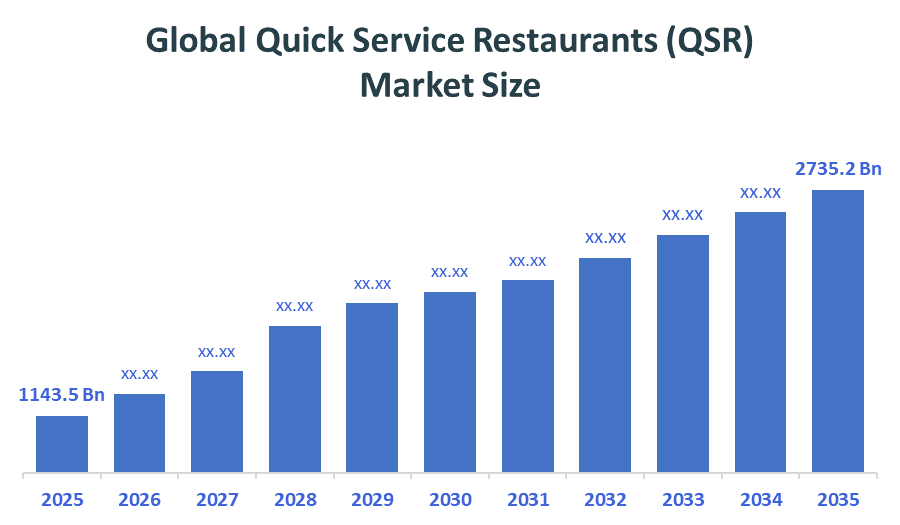
According to Decision Advisors, the Global Quick Service Restaurants (QSR) Market Size is expected to grow from USD 1143.5 billion in 2025 to USD 2735.2 billion by 2035, at a CAGR of 9.11% during the forecast period 2026-2035. The global quick service restaurants (QSR) market experiences growth because of technology drives demand through digital ordering systems and AI-powered drive-thru systems and mobile loyalty programs which increase customer retention. The combination of fast urban growth and modern people needing immediate solutions creates a demand for easy-to-use products.
Market Overview/ Introduction
The Quick Service Restaurants (QSR) industry delivers efficient restaurant operations through its standardized menu system and fast food production method which provides affordable meals to customers who prefer franchise-based restaurant expansion from chains such as McDonald's, Starbucks, and Domino's. The system operates at high-capacity offsite dining locations which include drive-thru and takeaway and delivery services while using cloud kitchens and independent local food outlets to achieve cost savings and market growth and maintain uniform customer service across different regions. The global QSR industry currently experiences technological progress through artificial intelligence drive-thru and robotic kitchen systems and predictive analytics technology which enhances operational efficiency and reduces expenses. Businesses nowadays enhance their customer relationships through digital-first platforms and contactless payment methods. The business will grow through its ability to enter new markets and develop premium health-oriented menu items and create brand identities based on sustainability practices.
- In India’s, production Linked Incentive Scheme for Food Processing Industry (PLISFPI), with an outlay of ?10,900 crores, is strengthening branded food supply chains, indirectly supporting the global Quick Service Restaurant (QSR) market through enhanced scalability and competitiveness.
- The United States based, McDonald's plans to add 10,000 outlets, targeting 50,000 restaurants globally, strengthening the global Quick Service Restaurant (QSR) market through scale expansion, enhanced supply chain efficiencies, and increased competitive intensity across regions.
- The Canada based, restaurant Brands International operates over 32,000 restaurants across 120+ countries, strengthening the global Quick Service Restaurant (QSR) market through franchise expansion, scale efficiencies, and diversified brand-driven competitive growth.
Notable Insights: -
- North America holds the largest regional market share, approximately 37.7% in the global quick service restaurants (QSR) market.
- Asia-Pacific is the fastest growing region in the global quick service restaurants (QSR) market, because of the urban consumption patterns, expanding middle-income demographics, and rapid digitalization of food delivery ecosystems.
- By cuisine type, the American segment held a dominant position with 46.1% in terms of market share in 2025.
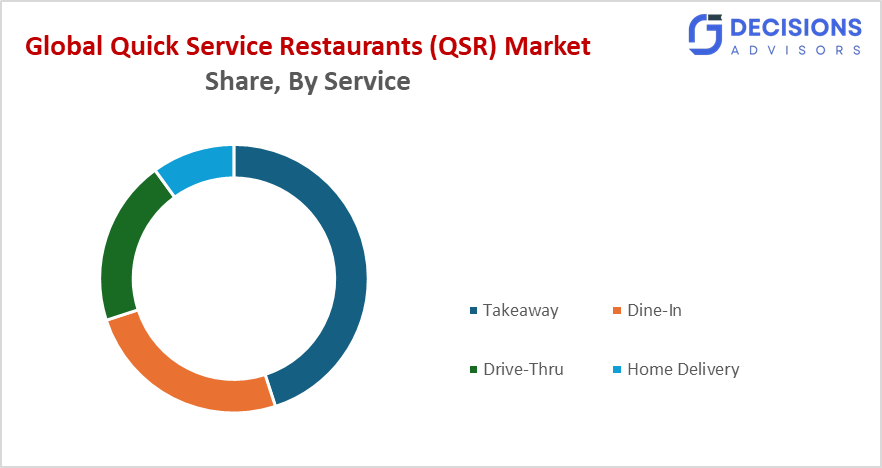
- By service type, Takeaway Segment is the dominating accounting for over 39.5% of the global market share in 2025.
- The compound annual growth rate of the global quick service restaurants (QSR) market is 9.11%.
- The market is likely to achieve a valuation of USD 2735.2 billion by 2035.
What is role of technology in grooming the market?
The global quick service restaurants (QSR) market experiences complete transformation through technology because it improves operational efficiency and enhances consumer engagement while maximizing revenue potential. The implementation of digital transformation programs enables organizations to analyze data in real time which empowers them to use predictive marketing and dynamic pricing methods, while their kitchen and inventory systems achieve cost savings through automated processes and increased production capacity. The implementation of mobile ordering systems together with AI chatbots and customized user interfaces, enables customers to access services at a faster pace, which results in higher levels of customer demand. The General Data Protection Regulation (GDPR) establishes data governance requirements, which impose penalties up to 4% of worldwide income, so QSR operators must implement secure digital systems for customer protection while maintaining their competitive advantages in the market.
How is Recent Developments Helping the Market?
The global quick service restaurant (QSR) market is experiencing better scalability and operational performance because of current technological advancements which are being implemented at high speed. The combination of AI-enabled automation and voice-assisted ordering systems results in faster service times and more precise order processing while digital ordering systems help businesses keep customers and increase their total sales. The market expansion process is moving faster because restaurant franchises are expanding their operations and businesses start to offer plant-based and regional menu options which attract more customers. The businesses can achieve better inventory management through IoT-powered systems, which simultaneously decrease waste and result in improved cost management. The Food Safety Modernization Act (FSMA) together with other regulatory requirements creates rigorous food safety standards and traceability mandates, which enable global QSR operations to develop better compliance processes, operational transparency methods, and consumer confidence mechanisms.
Market Drivers
The global quick service restaurants (QSR) market is expanding because the consumer eating habits are changing and digital technology is becoming more integrated into the industry. The demand for food delivery services has increased the more people use app-based ordering systems. The people who live in cities and lead busy lives now choose to eat at restaurants that offer quick service. The people with higher disposable incomes spend money more frequently on products which is especially true for people who live in urban areas. The business process improvements that automated kiosks and data-driven inventory systems bring help organizations achieve better performance results and faster service delivery. In China State Council guidelines promote service consumption by enhancing catering quality and supporting global food brands, strengthening the global quick service restaurants (QSR) market through expanded service supply and consumption-driven demand growth. The franchise businesses use expansion strategies to reach new markets in emerging economies while their menu development process creates local product variations that build customer loyalty and sustainable business growth.
Restrain
The global quick service restaurants (QSR) market faces multiple structural restraints factors which limit its ability to make profits and expand its operations. The industry experiences margin pressure because of rising labour costs and increasing raw material expenses while health-conscious consumers choose healthy food options instead of traditional fast-food items. The high capital expenses which digital transformation requires through IoT and advanced POS systems prevent smaller businesses from achieving effective expansion. The rising threat of data security breaches creates obstacles that organizations must overcome to achieve their digital transformation goals.
Competitive Analysis:
The report offers the appropriate analysis of the key organizations/companies involved within the quick service restaurants (QSR) market, along with a comparative evaluation primarily based on their product of offering, business overviews, geographic presence, enterprise strategies, segment market share, and SWOT analysis. The report also provides an elaborative analysis focusing on the current news and developments of the companies, which includes product development, innovations, joint ventures, partnerships, mergers & acquisitions, strategic alliances, and others. This allows for the evaluation of the overall competition within the market.
Top Companies in Global Quick Service Restaurants (QSR) Market
- McDonald's
- Yum! Brands (KFC, Pizza Hut, Taco Bell)
- Restaurant Brands International (Burger King, Popeyes, Tim Hortons)
- Subway
- Starbucks
- Domino's Pizza
- Chipotle Mexican Grill
- Wendy's
- Papa John's
- Dunkin'
Government Initiatives
|
Country |
Key Government Initiatives |
|
France |
The France’s National Strategy for Food, Nutrition and Climate (SNANC) integrate health, sustainability, and consumption patterns, influencing the global quick service restaurants (QSR) market by encouraging sustainable sourcing, healthier menus, and aligning business strategies with evolving regulatory and consumer expectations. |
|
India |
The government-led infrastructure initiatives in India are expanding catering facilities across railways and airports, strengthening organized food service ecosystems and indirectly supporting the global quick service restaurants (QSR) market through improved accessibility, scalability, and high-footfall consumer engagement. |
|
US
|
The United States-led Feed the Future Initiative, supported by USD 3.5 billion investment, strengthens global food supply chains, indirectly supporting the global quick service restaurants (QSR) market through improved sourcing efficiency and cost stability. |
Market Segmentation
The quick service restaurants (QSR) market share is classified into cuisine type, service type, ownership model
- The American segment dominated the market in 2024 and is projected to grow at a substantial CAGR of approximately 7.2% during the forecast period.
Based on the cuisine type, the quick service restaurants (QSR) market is divided into American, Chinese, Italian, Mexican, Japanese, Turkish & Lebanese, Others. Among these, the American segment dominated the market in 2024 and is projected to grow at a substantial CAGR of approximately 7.2% during the forecast period. It is because of the company achieves international success through three core elements which include its standardized product formats and its scalable franchise systems and its ability to establish global brand recognition. The combination of high consumer acceptance for burger and chicken products with effective supply chain operations and digital system integration results in continuous market demand and stable revenue streams for both established markets and developing markets.
- The Takeaway segment accounted for the largest share in 2024 and is anticipated to grow at a significant CAGR of approximately 7.1% during the forecast period.
Based on the service type, the quick service restaurants (QSR) market is divided into dine-In, takeaway, drive-thru, home delivery Among these, the Takeaway segment accounted for the largest share in 2024 and is anticipated to grow at a significant CAGR of approximately 7.1% during the forecast period. It is dominating because of the service model provides cost-effective solutions which match the purchasing habits of customers who need to make urgent purchases. The system achieves faster transaction times through its connection to digital ordering platforms which enables the business to handle more orders and maintain continuous revenue expansion in urban areas.
- The Franchise-Based Outlets segment dominated the market in 2024, and is projected to grow at a substantial CAGR during the forecast period.
Based on the ownership model, the quick service restaurants (QSR) market is divided into company-owned outlets, franchise-based outlets. Among these, the franchise-based outlets segment dominated the market in 2024, and is projected to grow at a substantial CAGR during the forecast period. The capital-light expansion model enables businesses to enter new markets while maintaining their ability to expand their operations. The business model generates continuous income through royalty payments which protect the company from operational hazards. This approach increases both business profitability and international brand consistency.
Strategies to Implement for Growth of the Market in Non-Leading Regions
The global quick service restaurant market needs businesses to concentrate on three essential elements which include affordable pricing and local restaurant options and necessary local infrastructure. The business should use two different strategies which include introducing flexible pricing systems and creating smaller restaurant locations to reach customers who need cheaper options. The development of menus based on local culinary traditions will help restaurants improve their ability to attract customers who will return. The businesses can achieve better supply chain results and delivery efficiency through the development of stronger relationships with local vendors and delivery services. The creation of mobile-first digital ordering systems will help businesses to reach their target market more effectively. The business can achieve fast growth through franchise-based expansion because it protects their financial assets. The business needs to establish brand credibility through delivering reliable product quality and implementing successful marketing strategies to reach sustained growth in developing markets.
Regional Segment Analysis of the Quick Service Restaurants (QSR) Market
- North America (U.S., Canada, Mexico)
- Europe (Germany, France, U.K., Italy, Spain, Rest of Europe)
- Asia-Pacific (China, Japan, India, Rest of APAC)
- South America (Brazil and the Rest of South America)
- The Middle East and Africa (UAE, South Africa, Rest of MEA)
North America is anticipated to hold the largest share of the Quick Service Restaurants (QSR) Market over the predicted timeframe. North America is anticipated to hold the largest share of the Quick Service Restaurants (QSR) Market, accounting for approximately 37.7% of total revenue over the forecast period. It is because the organization achieves its operations through three main factors which include high per capita food spending and advanced franchise systems and complete digital system integration. The company maintains its market dominance through three essential factors which include established consumer demand and effective supply chain operations and ongoing development of new service delivery methods.
Europe is expected to grow at a rapid CAGR in the Quick Service Restaurants (QSR) Market during the forecast period. The Europe market will experience fast growth because it accounts for approximately 6.1% of it is due to the growing automation requirements. the combination of premiumization trends with healthy menu demands and digital ordering base in restaurants. The European economies experience continuous revenue growth because consumers have developed permanent preferences and urban areas offer them easy access to products.
Asia-Pacific is the 3rd largest region to grow in the Quick Service Restaurants (QSR) Market during the region. The Asia-Pacific region stands as the third biggest area global for the Quick Service Restaurants (QSR) Market since it holds approximately 22.8% the urban consumer demand and increasing middle-income population and changing dining preferences. The market growth of formalized businesses and branded products across retail outlets leads to greater revenue generation capacity for the market.
Future Market Trends in Quick Service Restaurants (QSR) Market: -
- Digital-First Consumption Ecosystems
The QSR market currently moves toward complete digital ordering systems which use mobile ordering and payment systems and data-based interfaces to create new ways for customers to interact with their businesses. The new system improves transaction processes while boosting order volume and helping operators achieve greater customer value through customized service delivery.
- Asset-Light Expansion Models
The current expansion methods of businesses show increasing success because they depend on franchise operations and strategic partnerships to grow their geographical presence while spending less money. This business model enables companies to achieve higher investment returns by using local knowledge and decreasing their operational expenses to help them enter new markets that currently have low market penetration.
- Premiumization within Fast Service
The QSR operators are introducing higher-value offerings, including gourmet ingredients and specialty menus, to capture evolving consumer preferences. The current trend enables brands to increase their profit margins through quality-driven consumption while they maintain the quick service restaurant format's efficiency.
Recent Development
- In July 2024, McDonald's (40,000+ outlets), Starbucks (38,500+), and Subway (37,000+) are accelerating expansion in emerging markets, adopting smaller, tech-enabled formats to drive scalability in the global QSR market.
- In June 2024, McDonald's partnered with IBM to pilot AI-powered drive-thru voice ordering, enhancing operational efficiency, reducing service time, and supporting digital transformation across the global Quick Service Restaurants (QSR) market.
Market Segment
This study forecasts revenue at global, regional, and country levels from 2020 to 2035. Decision Advisors has segmented the quick service restaurants (QSR) market based on the above-mentioned segments:
Global Quick Service Restaurants (QSR) Market, By Cuisine Type
- American
- Chinese
- Italian
- Mexican
- Japanese
- Turkish & Lebanese
- Others
Global Quick Service Restaurants (QSR) Market, By Service Type
- Dine-In
- Takeaway
- Drive-Thru
- Home Delivery
Global Quick Service Restaurants (QSR) Market, By Ownership Model
- Company-Owned Outlets
- Franchise-Based Outlets
Global Quick Service Restaurants (QSR) Market, By Regional Analysis
- North America
- US
- Canada
- Mexico
- Europe
- Germany
- UK
- France
- Italy
- Spain
- Russia
- Rest of Europe
- Asia Pacific
- China
- Japan
- India
- South Korea
- Australia
- Rest of Asia Pacific
- South America
- Brazil
- Argentina
- Rest of South America
- Middle East & Africa
- UAE
- Saudi Arabia
- Qatar
- South Africa
- Rest of the Middle East & Africa
Frequently Asked Questions (FAQ)
Q. What structural factors are accelerating expansion in the global QSR market?
A. The demand for quick-service restaurants (QSR) is expanding because of three factors which include urbanization and increasing numbers of dual-income families and their need for quick dining. The business is able to grow because of three factors which include its franchise expansion and digital ordering systems and value-based menu options. Emerging economies are experiencing increased restaurant growth while established markets use menu development and high-end product strategies to maintain their expansion rates.
Q. How are supply chain disruptions influencing QSR operations globally?
A. The combination of commodity price volatility and logistics constraints and geopolitical risk factors is resulting in increased costs for businesses while they struggle to manage their inventory operations. QSR brands are diversifying their supplier networks and establishing local sourcing operations while they develop predictive analytics capabilities to build supply chain resilience which enables them to reduce operational risks and deliver services at all times.
Q. What investment trends are shaping the competitive landscape in the QSR sector?
A. The competitive environment is growing more intense because private equity funding combined with corporate mergers and technological investments. International companies are making large financial commitments to develop automation systems and cloud kitchen operations and to create environmentally friendly packaging solutions. Capital allocation, which comes from two separate investment sources, now directs funds toward markets that show potential for transformational growth because these markets offer financial returns that exceed regular expectations.
Q. What regulatory factors are impacting global QSR market dynamics?
A. Stringent food safety norms and labour laws together with sustainability mandates lead to higher compliance costs for businesses. The government requires businesses to implement calorie labelling together with environmentally sustainable packaging solutions. The regulatory requirements introduce operational difficulties to businesses yet they provide brands with opportunities to establish customer trust and build their brand value.
Check Licence
Choose the plan that fits you best: Single User, Multi-User, or Enterprise solutions tailored for your needs.
We Have You Covered
- 24/7 Analyst Support
- Clients Across the Globe
- Tailored Insights
- Technology Tracking
- Competitive Intelligence
- Custom Research
- Syndicated Market Studies
- Market Overview
- Market Segmentation
- Growth Drivers
- Market Opportunities
- Regulatory Insights
- Innovation & Sustainability
Report Details
| Scope | Global |
| Pages | 195 |
| Delivery | PDF & Excel via Email |
| Language | English |
| Release | Apr 2026 |
| Access | Download from this page |